

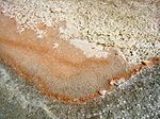
Dunaliella salina

Encyclopedia
Dunaliella salina is a type of halophile
green micro-algae
especially found in sea salt fields. Known for its anti-oxidant activity because of its ability to create large amount of carotenoids, it is used in cosmetics
and dietary supplements. Few organisms can survive in such highly saline conditions as salt evaporation ponds. To survive, these organisms have high concentrations of β-carotene to protect against the intense light, and high concentrations of glycerol
to provide protection against osmotic pressure
. This offers an opportunity for commercial biological production of these substances.
From a first pilot plant for Dunaliella cultivation for β-carotene production established in the USSR in 1966, the commercial cultivation of Dunaliella for the production of β-carotene throughout the world is now one of the success stories of halophile biotechnology. Different technologies are used, from low-tech extensive cultivation in lagoons to intensive cultivation at high cell densities under carefully controlled conditions. Although Dunaliella salina produce β-Carotene in a high salt environment, archaea
such as Halobacterium
, not Dunaliella, are responsible for the red and pink coloring of salt lakes. Occasionally, orange patches of Dunaliella colonies will crop up.
Attempts have been made to exploit the high concentrations of glycerol accumulated by Dunaliella as the basis for the commercial production of this compound. Although technically the production of glycerol from Dunaliella was shown to be possible, economic feasibility is low and no biotechnological operation presently (July 2005) exists that exploits the alga for glycerol production.
Halophile
Halophiles are extremophile organisms that thrive in environments with very high concentrations of salt. The name comes from the Greek for "salt-loving". While the term is perhaps most often applied to some halophiles classified into the Archaea domain, there are also bacterial halophiles and some...
green micro-algae
Algae
Algae are a large and diverse group of simple, typically autotrophic organisms, ranging from unicellular to multicellular forms, such as the giant kelps that grow to 65 meters in length. They are photosynthetic like plants, and "simple" because their tissues are not organized into the many...
especially found in sea salt fields. Known for its anti-oxidant activity because of its ability to create large amount of carotenoids, it is used in cosmetics
Cosmetics
Cosmetics are substances used to enhance the appearance or odor of the human body. Cosmetics include skin-care creams, lotions, powders, perfumes, lipsticks, fingernail and toe nail polish, eye and facial makeup, towelettes, permanent waves, colored contact lenses, hair colors, hair sprays and...
and dietary supplements. Few organisms can survive in such highly saline conditions as salt evaporation ponds. To survive, these organisms have high concentrations of β-carotene to protect against the intense light, and high concentrations of glycerol
Glycerol
Glycerol is a simple polyol compound. It is a colorless, odorless, viscous liquid that is widely used in pharmaceutical formulations. Glycerol has three hydroxyl groups that are responsible for its solubility in water and its hygroscopic nature. The glycerol backbone is central to all lipids...
to provide protection against osmotic pressure
Osmotic pressure
Osmotic pressure is the pressure which needs to be applied to a solution to prevent the inward flow of water across a semipermeable membrane....
. This offers an opportunity for commercial biological production of these substances.
From a first pilot plant for Dunaliella cultivation for β-carotene production established in the USSR in 1966, the commercial cultivation of Dunaliella for the production of β-carotene throughout the world is now one of the success stories of halophile biotechnology. Different technologies are used, from low-tech extensive cultivation in lagoons to intensive cultivation at high cell densities under carefully controlled conditions. Although Dunaliella salina produce β-Carotene in a high salt environment, archaea
Archaea
The Archaea are a group of single-celled microorganisms. A single individual or species from this domain is called an archaeon...
such as Halobacterium
Halobacterium
In taxonomy, Halobacterium is a genus of the Halobacteriaceae.The genus Halobacterium consists of several species of archaea with an aerobic metabolism which require an environment with a high concentration of salt; many of their proteins will not function in low-salt environments. They grow on...
, not Dunaliella, are responsible for the red and pink coloring of salt lakes. Occasionally, orange patches of Dunaliella colonies will crop up.
Attempts have been made to exploit the high concentrations of glycerol accumulated by Dunaliella as the basis for the commercial production of this compound. Although technically the production of glycerol from Dunaliella was shown to be possible, economic feasibility is low and no biotechnological operation presently (July 2005) exists that exploits the alga for glycerol production.
See also
- SeaweedSeaweedSeaweed is a loose, colloquial term encompassing macroscopic, multicellular, benthic marine algae. The term includes some members of the red, brown and green algae...
- http://www.interclinical.com.au/products.php?parent=hp Algotene