
All Topics  
Drosophila

 
Drosophila

   Email Print
   Bookmark   Link


Drosophila


Drosophila is a genus
Genus

A genus is a low-level taxonomic rank used in the classification of living and fossil organisms. The taxonomic ranks are domain , kingdom , phylum, class , order , family , genus, and species....
 of small flies
Fly

True flies are insects of the Order Diptera , possessing a single pair of insect wing on the mesothorax and a pair of halteres, derived from the hind wings, on the metathorax....
, belonging to the family
Family (biology)

In biological classification, family is a taxonomic rank. Exact details of formal nomenclature depend on the Nomenclature Codes which applies....
 Drosophilidae
Drosophilidae

Drosophilidae is a diverse, cosmopolitan distribution family of fly, including the genus Drosophila, which includes fruit flies. The best known species is Drosophila melanogaster that is used extensively for studies concerning genetics, development, physiology, ecology, behaviour, etc....
, whose members are often called "fruit flies" or more appropriately (though less frequently) pomace
Pomace

Pomace is the solid remains of grapes, olives, or other fruit after wine press for juice or oil. It contains the skins, pulp, seeds, and stems of the fruit....
 flies, vinegar
Vinegar

Vinegar is an acidic liquid processed from the fermentation of ethanol in a process that yields its key ingredient, acetic acid . It also may come in a diluted form....
 flies, or wine
Wine

Wine is an alcoholic beverage often made of fermentation grape juice. The natural chemical balance of grapes is such that they can ferment without the addition of sugars, acids, enzymes or other nutrients....
 flies, a reference to the characteristic of many species to linger around overripe or rotting fruit. They should not be confused with the Tephritidae
Tephritidae

Tephritidae is one of two Diptera family referred to as "fruit flies". Tephritidae does not include the model organism of the genus Drosophila, which is often called the "common fruit fly"....
, a related family, which are also called fruit flies (sometimes referred to as "true fruit flies"); these feed primarily on unripe or ripe fruit
Fruit

The term fruit has different meanings dependent on context, and the term is not synonymous in food preparation and biology. In botany, which is the scientific study of plants, fruits are the ripened Ovary of flowering plants....
, with many species being regarded as destructive agricultural pests, especially the Mediterranean fruit fly.


Discussion
Ask a question about 'Drosophila'
Start a new discussion about 'Drosophila'
Answer questions from other users
Full Discussion Forum


Encyclopedia


Drosophila is a genus
Genus

A genus is a low-level taxonomic rank used in the classification of living and fossil organisms. The taxonomic ranks are domain , kingdom , phylum, class , order , family , genus, and species....
 of small flies
Fly

True flies are insects of the Order Diptera , possessing a single pair of insect wing on the mesothorax and a pair of halteres, derived from the hind wings, on the metathorax....
, belonging to the family
Family (biology)

In biological classification, family is a taxonomic rank. Exact details of formal nomenclature depend on the Nomenclature Codes which applies....
 Drosophilidae
Drosophilidae

Drosophilidae is a diverse, cosmopolitan distribution family of fly, including the genus Drosophila, which includes fruit flies. The best known species is Drosophila melanogaster that is used extensively for studies concerning genetics, development, physiology, ecology, behaviour, etc....
, whose members are often called "fruit flies" or more appropriately (though less frequently) pomace
Pomace

Pomace is the solid remains of grapes, olives, or other fruit after wine press for juice or oil. It contains the skins, pulp, seeds, and stems of the fruit....
 flies, vinegar
Vinegar

Vinegar is an acidic liquid processed from the fermentation of ethanol in a process that yields its key ingredient, acetic acid . It also may come in a diluted form....
 flies, or wine
Wine

Wine is an alcoholic beverage often made of fermentation grape juice. The natural chemical balance of grapes is such that they can ferment without the addition of sugars, acids, enzymes or other nutrients....
 flies, a reference to the characteristic of many species to linger around overripe or rotting fruit. They should not be confused with the Tephritidae
Tephritidae

Tephritidae is one of two Diptera family referred to as "fruit flies". Tephritidae does not include the model organism of the genus Drosophila, which is often called the "common fruit fly"....
, a related family, which are also called fruit flies (sometimes referred to as "true fruit flies"); these feed primarily on unripe or ripe fruit
Fruit

The term fruit has different meanings dependent on context, and the term is not synonymous in food preparation and biology. In botany, which is the scientific study of plants, fruits are the ripened Ovary of flowering plants....
, with many species being regarded as destructive agricultural pests, especially the Mediterranean fruit fly. One species of Drosophila in particular, D. melanogaster
Drosophila melanogaster

Drosophila melanogaster is a two-winged insect that belongs to the Diptera, the Order of the Fly. The species is commonly known as the Drosophilidae or vinegar fly, and is one of the most commonly used model organisms in biology, including studies in genetics, physiology and Life history theory....
, has been heavily used in research in genetics
Genetics

Genetics , a discipline of biology, is the science of heredity and Genetic variation in living organisms. The fact that living things inherit traits from their parents has been used since prehistoric times to improve crop plants and animals through selective breeding....
 and is a common model organism
Model organism

A model organism is a species that is extensively studied to understand particular biology phenomena, with the expectation that discoveries made in the organism model will provide insight into the workings of other organisms....
 in developmental biology
Developmental biology

Developmental biology is the study of the process by which organisms grow and develop. Modern developmental biology studies the genetic control of cell growth, cellular differentiation and "morphogenesis," which is the process that gives rise to biological tissues, organ s and anatomy....
. Indeed, the terms "fruit fly" and "Drosophila" are often used synonymously with D. melanogaster in modern biological literature. The entire genus, however, contains about 1,500 species and is very diverse in appearance, behavior, and breeding habitat.

Name

The term "Drosophila", meaning "dew-loving", is a modern scientific Latin
Latin

Latin is an Italic language, historically spoken in Latium and Ancient Rome. Through the Military history of the Roman Empire, Latin spread throughout the Mediterranean and a large part of Europe....
 adaptation from Greek
Greek language

Greek is an Indo-European languages native to the southern Balkan peninsula, the language of the Greek people. It forms an independent branch within Indo-European....
 words d??s??, drósos, "dew
Dew

Dew is water in the form of droplets that appears on thin, exposed objects in the morning or evening. As the exposed surface cools by thermal radiation its heat, atmospheric moisture condensation at a rate greater than that at which it can evaporation, resulting in the formation of water droplets....
", and f????, phílos, "loving" with the Latin feminine suffix -a. On occasion, the name is misspelled as "drosophilia".

Morphology

Drosophila Residua Head
Drosophila Setosimentum
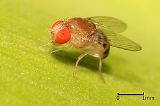
Drosophila are small flies, typically pale yellow to reddish brown to black, with red eyes. Many species, including the noted Hawaiian picture-wings, have distinct black patterns on the wings. The plumose (feathery) arista
Antenna (biology)

Antennae are paired appendages connected to the front-most morphogenesis of arthropods. In crustaceans, they are biramous and present on the first two segments of the head, with the smaller pair known as antennules....
, bristling of the head and thorax, and wing venation are characters used to diagnose the family. Most are small, about 2–4 millimetres long, but some, especially many of the Hawaiian species, are larger than a house fly.

Life cycle and ecology


Habitat

Drosophila are found all around the world, with more species in the tropical regions. They can be found in deserts, tropical rainforest
Tropical rainforest

Tropical rainforests are usually found around the equator. They are common in Asia, Australia, Africa, South America, Central America, Southern Mexico and on many of the Pacific Islands....
, cities, swamp
Swamp

A swamp is a wetland featuring temporary or permanent inundation of large areas of land, by shallow bodies of water. A swamp generally has a substantial number of hammock , or dry-land protrusions, covered by aquatic vegetation, or vegetation that tolerates periodical inundation....
s, and alpine zones
Alpine climate

Alpine climate is the average weather for a region above the tree line. The climate becomes colder at high elevations—this characteristic is described by the adiabatic lapse rate of air: air tends to get colder as it rises, since it expands....
. Some northern species hibernate
Hibernation

Hibernation is a state of inactivity and Metabolism depression in animals, characterized by lower body temperature, slower breathing, and lower metabolic rate....
. Most species breed in various kinds of decaying plant and fungal
Fungus

A fungus is a Eukaryote organism that is a member of the Kingdom Fungi . The fungi are a monophyletic group, also called the Eumycota , that is phylogeny distinct from the morphologically similar slime molds and water molds ....
 material, including fruit
Fruit

The term fruit has different meanings dependent on context, and the term is not synonymous in food preparation and biology. In botany, which is the scientific study of plants, fruits are the ripened Ovary of flowering plants....
, bark
BARK

BARK was an early Electromechanics. BARK was built using standard phone relays, implementing a 32-bit binary machine and could perform addition in 150 ms and multiplication in 250 ms....
, slime flux
Slime flux

Slime flux is a bacterial disease of certain trees, primarily elm, cottonwood, poplar, boxelder, Ash tree, aspen, fruitless mulberry, and oak. A wound to the bark, caused by pruning, insects, poor branch angles or natural cracks and splits, causes sap to ooze from the wound....
es, flower
Flower

A flower, sometimes known as a bloom or blossom, is the reproduction structure found in flowering plants . The biological function of a flower is to mediate the union of male sperm with female ovum in order to produce seeds....
s, and mushroom
Mushroom

A mushroom is the fleshy, spore-bearing fruiting body of a fungus, typically produced above ground on soil or on its food source. The standard for the name "mushroom" is the cultivated white button mushroom, Agaricus bisporus, hence the word mushroom is most often applied to those fungi that have a stem , a cap , and gills on the unde...
s. A few species have switched to being parasites or predators. Many species can be attracted to baits of fermented banana
Banana

File:Banana and cross section.jpgBanana is the common name for a fruit and also the herbaceous plants of the genus Musa which produce this commonly eaten fruit....
s or mushrooms, but others are not attracted to any kind of baits. Males may congregate at patches of suitable breeding substrate to compete for the females, or form leks
Lek (animal behaviour)

A lek is a gathering of males, of certain animal species, for the purposes of competitive mating display. Leks assemble before and during the breeding season, on a daily basis....
, conducting courtship in an area separate from breeding sites.

Several Drosophila species, including D. melanogaster, D. immigrans, and D. simulans
Drosophila simulans

Drosophila simulans is a species of fly closely related to Drosophila melanogaster and which belongs to the same Drosophila melanogaster species subgroup....
, are closely associated with humans, and are often referred to as domestic
Domestication

Domestication or taming refers to the process whereby a population of living things becomes accustomed to a controlled environment by other plants or animals through a process of Selective breeding....
 species. These and other species (D. subobscura, Zaprionus indianus) have been accidentally introduced around the world by human activities such as fruit transports.

Reproduction

Drosophila Egg
Fruit Fly Larva 01
Males of this genus are known to have the longest sperm
Spermatozoon

A sperm, from the ancient Greek word sp???a and and more commonly known as a sperm cell, is the ploidy cell that is the male gamete. It Fertilization an ovum to form a zygote....
 cells of any organism on Earth, including one species, Drosophila bifurca
Drosophila bifurca

Drosophila bifurca is a species of fruit fly. Males of this species are known to have the longest spermatozoon cells of any organism on Earth, an astonishing 5.8 cm long when uncoiled....
, that have sperm that are 5.8 centimetres long. The cells are mostly tail, and are delivered to the females in tangled coils. The other members of the genus Drosophila also make relatively few giant sperm cells, with D. bifurca's being the longest. D. melanogaster sperm cells are a more modest 1.8 millimetres long, although this is still about 300 times as long as a human sperm.

Drosophila vary widely in their reproductive capacity. Those such as D. melanogaster that breed in large, relatively rare resources have ovaries that mature 10–20 eggs at a time, so that they can be laid together on one site. Others that breed in more-abundant but less nutritious substrates, such as leaves, may only lay one egg per day. The eggs have one or more respiratory filaments near the anterior end; the tips of these extend above the surface and allow oxygen to reach the embryo. Larvae feed not on the vegetable matter itself but on the yeast
Yeast

Yeasts are eukaryote microorganisms classified in the Kingdom fungus, with about 1,500 species currently described; they dominate fungal diversity in the oceans....
s and microorganism
Microorganism

A microorganism or microbe is an organism that is microscopic . The study of microorganisms is called microbiology, a subject that began with Anton van Leeuwenhoek's discovery of microorganisms in 1675, using a microscope of his own design....
s present on the decaying breeding substrate. Development time varies widely between species (between 7 and more than 60 days) and depends on the environmental factors such as temperature
Temperature

In physics, temperature is a physical property of a Physical system that underlies the common notions of hot and cold; something that feels hotter generally has the greater temperature....
, breeding substrate, and crowding.

Laboratory–cultured animals

Drosophila melanogaster is a popular experimental animal because it is easily cultured in mass out of the wild, has a short generation time, and mutant animals are readily obtainable. In 1906 Thomas Hunt Morgan
Thomas Hunt Morgan

Thomas Hunt Morgan was an American genetics and Embryology. Morgan received his PhD from Johns Hopkins University in 1890 and researched embryology during his tenure at Bryn Mawr College....
 began his work on D. melanogaster and reported his first finding of a white (eyed) mutant in 1910 to the academic community. He was in search of a model organism to study genetic heredity and required a species that could randomly acquire genetic mutation that would visibly manifest as morphological changes in the adult animal. His work on Drosophila earned him the 1933 Nobel Prize
Nobel Prize

The Nobel Prize , established in the 1895 will of Swedish chemist Alfred Nobel; it was first awarded in Nobel Prize in Physics, Nobel Prize in Chemistry, Nobel Prize in Physiology or Medicine, Nobel Prize in Literature, and Nobel Peace Prize in 1901....
 in Medicine for identifying chromosomes as the vector of inheritance for genes.

However, some species of Drosophila are difficult to culture in the laboratory, often because they breed on a single specific host in the wild. For some it can be done with particular recipes for rearing media, or by introducing chemicals such as sterols that are found in the natural host; for others it is (so far) impossible. In some cases, the larvae can develop on normal Drosophila lab medium but the female will not lay eggs; for these it is often simply a matter of putting in a small piece of the natural host to receive the eggs. The in San Diego maintains cultures of hundreds of species for researchers.

Predators

Drosophila are prey for many generalist predators such as robber flies
Asilidae

Insects in the fly family Asilidae are commonly called robber flies. The family Asilidae contains about 7,100 described species worldwide....
. In Hawaii
Hawaii

File:Pahoehoe and Aa flows at Hawaii.jpgThe State of Hawaii is a U.S. state in the United States, located on an archipelago in the central Pacific Ocean southwest of the continental United States, southeast of Japan, and northeast of Australia....
, the introduction of yellowjackets
Vespula

Vespula is a small genus of eusocial wasps, widely distributed in the Northern Hemisphere. Along with members of their sister taxon Dolichovespula, they are collectively known by the common name yellowjackets in North America....
 from the mainland United States
United States

The United States of America is a Federal government constitutional republic comprising U.S. state and a federal district. The country is situated mostly in central North America, where its Contiguous United States and Washington, D.C., the Capital districts and territories, lie between the Pacific Ocean and Atlantic Oceans, Borders of the U...
 has led to the decline of many of the large species. The larvae are preyed on by other fly larvae, staphylinid beetles, and ants.

Systematics


The genus
Genus

A genus is a low-level taxonomic rank used in the classification of living and fossil organisms. The taxonomic ranks are domain , kingdom , phylum, class , order , family , genus, and species....
 Drosophila as currently defined is paraphyletic (see below) and contains 1450 described species, while the estimated total number of species is estimated at thousands. The majority of the species
Species

In biology, a species is one of the basic units of biological classification and a taxonomic rank. A species is often defined as a group of organisms capable of interbreeding and producing fertile offspring....
 are members of two subgenera: Drosophila (~1,100 species) and Sophophora
Sophophora

The subgenus Sophophora of the genus Drosophila was first described by Alfred Sturtevant in 1939. It contains the best known drosophilid species, Drosophila melanogaster....
 (including D. (S.) melanogaster
Drosophila melanogaster

Drosophila melanogaster is a two-winged insect that belongs to the Diptera, the Order of the Fly. The species is commonly known as the Drosophilidae or vinegar fly, and is one of the most commonly used model organisms in biology, including studies in genetics, physiology and Life history theory....
; ~330 species). The Hawaiian species of Drosophila (estimated to be more than 500, with ~380 species described) are sometimes recognized as a separate genus or subgenus, Idiomyia, but this is not widely accepted. About 250 species are part of the genus Scaptomyza, which arose from the Hawaiian Drosophila and later re-colonized continental areas.

Evidence from phylogenetic studies suggests that the following genera arose from within the genus Drosophila:
  • Liodrosophila Duda, 1922
  • Mycodrosophila Oldenburg, 1914
  • Samoaia Malloch, 1934
  • Scaptomyza Hardy, 1849
  • Zaprionus Coquillett, 1901
  • Zygothrica Wiedemann, 1830
  • Hirtodrosophila Duda, 1923 (position uncertain)


Several of the subgeneric and generic names are based on anagrams of Drosophila. These include:
  • Dorsilopha
  • Lordiphosa
  • Siphlodora
  • Phloridosa
  • Psilodorha


Drosophila species genome project

Drosophila are extensively used as a model organism in genetics (including population genetics), cell-biology, biochemistry, and especially developmental biology. Therefore, extensive efforts are made to sequence drosphilid genomes. The genomes of the following species have been fully or partially sequenced so far:
  • Drosophila (Sophophora) melanogaster
    Drosophila melanogaster

    Drosophila melanogaster is a two-winged insect that belongs to the Diptera, the Order of the Fly. The species is commonly known as the Drosophilidae or vinegar fly, and is one of the most commonly used model organisms in biology, including studies in genetics, physiology and Life history theory....
  • Drosophila (Sophophora) simulans
    Drosophila simulans

    Drosophila simulans is a species of fly closely related to Drosophila melanogaster and which belongs to the same Drosophila melanogaster species subgroup....
  • Drosophila (Sophophora) sechellia
    Drosophila melanogaster species subgroup

    The Drosophila melanogaster species subgroup contains 9 species, including the best known species Drosophila melanogaster and Drosophila simulans....
  • Drosophila (Sophophora) yakuba
    Drosophila melanogaster species subgroup

    The Drosophila melanogaster species subgroup contains 9 species, including the best known species Drosophila melanogaster and Drosophila simulans....
  • Drosophila (Sophophora) erecta
    Drosophila melanogaster species subgroup

    The Drosophila melanogaster species subgroup contains 9 species, including the best known species Drosophila melanogaster and Drosophila simulans....
  • Drosophila (Sophophora) ananassae
    Drosophila melanogaster species group

    The Drosophila melanogaster species group belongs to the subgenus Sophophora and contains 12 subgroups. The phylogeny in this species group is poorly known despite many studies covering many of the species subgroups....
  • Drosophila (Sophophora) pseudoobscura
    Drosophila pseudoobscura

    Drosophila pseudoobscura is a species of Drosophilidae, used extensively in lab studies of speciation.In 2005, D. pseudoobscura was the second Drosophila species to have its genome sequenced, after the model organism Drosophila melanogaster....
  • Drosophila (Sophophora) persimilis
  • Drosophila (Sophophora) willistoni
  • Drosophila (Drosophila) mojavensis
  • Drosophila (Drosophila) virilis
  • Drosophila (Drosophila) grimshawi


The data will be used for many purposes, including evolutionary genome comparisons. D. simulans and D. sechellia are sister species, and provide viable offspring when crossed, while D. melanogaster and D. simulans produce infertile hybrid offspring. The Drosophila genome is often compared with the genomes of more distantly related species such as the honeybee Apis mellifera or the mosquito
Mosquito

Mosquitoes are common flying insects in the family Culicidae that are found around the world. There are about 3,500 species. They have a pair of scaled wings, a pair of halteres, a slender body, and six long legs....
 Anopheles gambiae
Anopheles gambiae

Anopheles gambiae, refers to a cryptic species complex of morphologically indistinguishable mosquitoes in the genus Anopheles, which contains the most important vectors of malaria in Sub-Saharan Africa , and the most efficient malaria vectors in the world....
.

Curated data are available at FlyBase
FlyBase

FlyBase is an online bioinformatics database of the biology and genome of the model organism Drosophila melanogaster and related Drosophilid dipterans....
.

See also

  • Drosophila embryogenesis
    Drosophila embryogenesis

    Drosophila has long been a favorite model organism for geneticsists and Developmental biologyal biologists studying embryogenesis. The small size, short generation time, and large brood size makes it ideal for genetic studies....
  • Insect Habitat
    Insect Habitat

    The Insect Habitat was a science payload intended for the International Space Station as part of the Space Station Biological Research Program ....


External links

  • FlyBase is a comprehensive database for information on the genetics and molecular biology of Drosophila. It includes data from the Drosophila Genome Projects and data curated from the literature.
  • : Assembly, Alignment and Annotation of 12 Drosophila species
  • breeds hundreds of species and supplies them to researchers
  • is an integrated database of genomic, expression and protein data for Drosophila
  • is library of Drosophila on web