
All Topics  
Drosophilidae

 
Drosophilidae

   Email Print
   Bookmark   Link


Drosophilidae


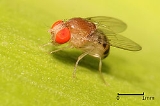
Drosophilidae is a diverse, cosmopolitan
Cosmopolitan distribution

In biogeography, a biological category of living things is said to have cosmopolitan distribution if this category can be found almost anywhere around the world....
 family
Family (biology)

In biological classification, family is a taxonomic rank. Exact details of formal nomenclature depend on the Nomenclature Codes which applies....
 of flies
Fly

True flies are insects of the Order Diptera , possessing a single pair of insect wing on the mesothorax and a pair of halteres, derived from the hind wings, on the metathorax....
, including the genus
Genus

A genus is a low-level taxonomic rank used in the classification of living and fossil organisms. The taxonomic ranks are domain , kingdom , phylum, class , order , family , genus, and species....
 Drosophila
Drosophila

Drosophila is a genus of small fly, belonging to the family Drosophilidae, whose members are often called "fruit flies" or more appropriately pomace flies, vinegar flies, or wine flies, a reference to the characteristic of many species to linger around overripe or rotting fruit....
, which includes fruit flies. The best known species is Drosophila melanogaster
Drosophila melanogaster

Drosophila melanogaster is a two-winged insect that belongs to the Diptera, the Order of the Fly. The species is commonly known as the Drosophilidae or vinegar fly, and is one of the most commonly used model organisms in biology, including studies in genetics, physiology and Life history theory....
 that is used extensively for studies concerning genetics
Genetics

Genetics , a discipline of biology, is the science of heredity and Genetic variation in living organisms. The fact that living things inherit traits from their parents has been used since prehistoric times to improve crop plants and animals through selective breeding....
, development, physiology
Physiology

Physiology is the study of the mechanical, physical, and biochemical functions of living organisms. Physiology has traditionally been divided between plant physiology and animal and all living things physiology but the principles of physiology are universal, no matter what particular organism is being studied....
, ecology
Ecology

Ecology is the science study of the distribution and Abundance of life and the interactions between organisms and their nature environment ....
, behaviour, etc. The fruit fly is mostly composed of post-mitotic cells, has a very short lifespan, and shows gradual aging. Like in other species, temperature influences the life history of the animal.


Discussion
Ask a question about 'Drosophilidae'
Start a new discussion about 'Drosophilidae'
Answer questions from other users
Full Discussion Forum


Recent Posts


Encyclopedia


Drosophilidae is a diverse, cosmopolitan
Cosmopolitan distribution

In biogeography, a biological category of living things is said to have cosmopolitan distribution if this category can be found almost anywhere around the world....
 family
Family (biology)

In biological classification, family is a taxonomic rank. Exact details of formal nomenclature depend on the Nomenclature Codes which applies....
 of flies
Fly

True flies are insects of the Order Diptera , possessing a single pair of insect wing on the mesothorax and a pair of halteres, derived from the hind wings, on the metathorax....
, including the genus
Genus

A genus is a low-level taxonomic rank used in the classification of living and fossil organisms. The taxonomic ranks are domain , kingdom , phylum, class , order , family , genus, and species....
 Drosophila
Drosophila

Drosophila is a genus of small fly, belonging to the family Drosophilidae, whose members are often called "fruit flies" or more appropriately pomace flies, vinegar flies, or wine flies, a reference to the characteristic of many species to linger around overripe or rotting fruit....
, which includes fruit flies. The best known species is Drosophila melanogaster
Drosophila melanogaster

Drosophila melanogaster is a two-winged insect that belongs to the Diptera, the Order of the Fly. The species is commonly known as the Drosophilidae or vinegar fly, and is one of the most commonly used model organisms in biology, including studies in genetics, physiology and Life history theory....
 that is used extensively for studies concerning genetics
Genetics

Genetics , a discipline of biology, is the science of heredity and Genetic variation in living organisms. The fact that living things inherit traits from their parents has been used since prehistoric times to improve crop plants and animals through selective breeding....
, development, physiology
Physiology

Physiology is the study of the mechanical, physical, and biochemical functions of living organisms. Physiology has traditionally been divided between plant physiology and animal and all living things physiology but the principles of physiology are universal, no matter what particular organism is being studied....
, ecology
Ecology

Ecology is the science study of the distribution and Abundance of life and the interactions between organisms and their nature environment ....
, behaviour, etc. The fruit fly is mostly composed of post-mitotic cells, has a very short lifespan, and shows gradual aging. Like in other species, temperature influences the life history of the animal. Several genes have been identified whose manipulation extends the lifespan of these animals.

Economic significance


Generally, drosophilids are considered nuisance flies. Zaprionus indianus Gupta is unusual among Drosophilidae species in being a serious, primary pest of at least one commercial fruit, fig
FIG

FIG may refer to:* F?d?ration Internationale de Gymnastique* International Federation of Surveyors...
s in Brazil. Drosophila repleta larvae inhabit drains and spread bacteria.

Diagnosis


Recent versions of the diagnostic characteristics can be found in "Drosophila: A Guide to Species Identification and Use" by Therese A. Markow and Patrick O'Grady, (Academic Press, 2005) ISBN: 0124730523 or "Drosophila: A Laboratory Handbook" by M. Ashburner
Michael Ashburner

Michael Ashburner is professor of biology in the Department of Genetics at University of Cambridge and is the former joint-head of the European Bioinformatics Institute of the European Molecular Biology Laboratory....
, K. Golic, S. Hawley, (Cold Spring Harbor Laboratory Press, 2005).

Phylogeny


The knowledge of the phylogeny of this family is incomplete. The family is subdivided in two subfamilies, the Drosophilinae
Drosophilinae

The Drosophilinae are the largest subfamily in the Drosophilidae. The other subfamily is the Steganinae....
 and the Steganinae
Steganinae

The Steganinae Hendel, 1917, is the smaller of two subfamilies in the fruit fly family Drosophilidae. The other subfamily is the Drosophilinae....
. The two subfamilies do not contain a single morphological character that distinguishes them. However, the combination of characterists is sufficient to assign species correctly to the subfamilies.

Most molecular phylogeny
Molecular phylogeny

Molecular phylogenetics, also known as molecular systematics, is the use of the structure of molecules to gain information on an organism's evolutionary relationships....
 studies focus on the genus
Genus

A genus is a low-level taxonomic rank used in the classification of living and fossil organisms. The taxonomic ranks are domain , kingdom , phylum, class , order , family , genus, and species....
 Drosophila
Drosophila

Drosophila is a genus of small fly, belonging to the family Drosophilidae, whose members are often called "fruit flies" or more appropriately pomace flies, vinegar flies, or wine flies, a reference to the characteristic of many species to linger around overripe or rotting fruit....
 and related genera. Currently, there is no overview of the more than 100 articles using molecular techniques to reconstruct the phylogeny.

Gallery


External links