

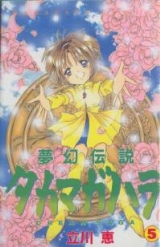
Dream Saga

Encyclopedia
is a shōjo
manga
by Megumi Tachikawa
, serialised in Nakayoshi
from February 1997 to June 1999, and reprinted in 5 tankōbon
.
It is a fantasy adventure tale about a young girl called Yuuki Wakasa, who one day acquires a magical red stone. The stone allows her to travel to Takamagahara
(高天原 "High Plane of Heaven"), the dream world, when she sleeps, and can only return to Nakatsukuni
(中ツ国 "middle country"), the real world, when she goes to sleep in the dream.
Yuuki discovers that she must save the sun, Amaterasu, from being trapped and destroyed in Takamagahara, or the light will be lost from both worlds forever.
The plot draws elements from the samurai epic Nansō Satomi Hakkenden
by Kyokutei Bakin
, and from Chinese
and Japanese mythology
, particularly the Amano-Iwato
legend.
The manga has been translated and republished in German
by Egmont Manga & Anime
from November 2002 to May 2003, and English
by Tokyopop
from August 2004 to August 2005. The series has since gone out of print.
, the chapters of Dream Saga were serialized
in the Japanese magazine Nakayoshi
from February 1997 to June 1999. The chapters were collected into five tankōbon
volumes by Kodansha
and published from October 1997 to September 1999.
Tokyopop
licensed Dream Saga for an English-language release in North America and published the five volumes from August 10, 2004 to August 9, 2005.
Shojo
The term refers to manga marketed to a female audience roughly between the ages of 10-18. The name romanizes the Japanese 少女 , literally: "little female". Shōjo manga covers many subjects in a variety of narrative and graphic styles, from historical drama to science fiction — often with a strong...
manga
Manga
Manga is the Japanese word for "comics" and consists of comics and print cartoons . In the West, the term "manga" has been appropriated to refer specifically to comics created in Japan, or by Japanese authors, in the Japanese language and conforming to the style developed in Japan in the late 19th...
by Megumi Tachikawa
Megumi Tachikawa
is a Japanese shōjo manga artist, best known for the manga Saint Tail, which was also adapted into an anime series. She made her manga debut in 1992 with 16-sai no Tiara, which was nominated for the 'New Face' manga award.-Works:...
, serialised in Nakayoshi
Nakayoshi
is a shōjo manga magazine published by Kodansha in Japan. First published in December 1954, it is a long-running magazine with over 50 years worth of manga publication history. The target demographic for Nakayoshi is aimed at young girls between...
from February 1997 to June 1999, and reprinted in 5 tankōbon
Tankobon
, with a literal meaning close to "independently appearing book", is the Japanese term for a book that is complete in itself and is not part of a series , though the manga industry uses it for volumes which may be in a series...
.
It is a fantasy adventure tale about a young girl called Yuuki Wakasa, who one day acquires a magical red stone. The stone allows her to travel to Takamagahara
Takamagahara
Takama-ga-hara , literally "High Heaven's Plain" but often translated as the "High Plain of Heaven," is a place in Japanese mythology. In Shinto, Takama-ga-hara is the dwelling place of the Kami. It is believed to be connected to the Earth by the bridge Ama-no uki-hashi...
(高天原 "High Plane of Heaven"), the dream world, when she sleeps, and can only return to Nakatsukuni
Ashihara no Nakatsukuni
is, in Japanese mythology, the world between Takamagahara and Yomi . In time, the term became another word for the country or the location of Japan. The term can be used interchangeably with Toyoashihara no Nakatsukuni...
(中ツ国 "middle country"), the real world, when she goes to sleep in the dream.
Yuuki discovers that she must save the sun, Amaterasu, from being trapped and destroyed in Takamagahara, or the light will be lost from both worlds forever.
The plot draws elements from the samurai epic Nansō Satomi Hakkenden
Nanso Satomi Hakkenden
is a Japanese 106 volume epic novel by Kyokutei Bakin. Written over a period of nearly thirty years and published from 1814 to 1842, Bakin had gone blind before finishing the tale, and the final parts were dictated to his daughter-in-law Michi to be transcribed...
by Kyokutei Bakin
Kyokutei Bakin
was a late Japanese Edo period gesaku author best known for works such as Nansō Satomi Hakkenden and Chinsetsu Yumiharizuki.-Life:He was born as , he wrote under the pen name which is a pun as the kanji may also be read as Kuruwa de Makoto meaning a man who is truly devoted to the courtesans of...
, and from Chinese
Chinese mythology
Chinese mythology is a collection of cultural history, folktales, and religions that have been passed down in oral or written tradition. These include creation myths and legends and myths concerning the founding of Chinese culture and the Chinese state...
and Japanese mythology
Japanese mythology
Japanese mythology is a system of beliefs that embraces Shinto and Buddhist traditions as well as agriculturally based folk religion. The Shinto pantheon comprises innumerable kami...
, particularly the Amano-Iwato
Amano-Iwato
literally means "The cave of the sun god" or "heavenly rock cave". In Japanese mythology, Susanoo, the Japanese god of the seas, was the one who drove Amaterasu into Ame-no-Iwato. This caused the sun to hide for a long period of time....
legend.
The manga has been translated and republished in German
German language
German is a West Germanic language, related to and classified alongside English and Dutch. With an estimated 90 – 98 million native speakers, German is one of the world's major languages and is the most widely-spoken first language in the European Union....
by Egmont Manga & Anime
Egmont Manga & Anime
Egmont Manga & Anime is one of the largest publishers of manga in Germany. It was founded in the year 2000 as a daughter company of Egmont Ehapa, after the manga boom in Germany became apparent around the turn of the millennium. Since 2003, EMA has been part of Egmont vgs in Cologne.- History :In...
from November 2002 to May 2003, and English
English language
English is a West Germanic language that arose in the Anglo-Saxon kingdoms of England and spread into what was to become south-east Scotland under the influence of the Anglian medieval kingdom of Northumbria...
by Tokyopop
Tokyopop
Tokyopop, styled TOKYOPOP, and formerly known as Mixx, is a distributor, licensor, and publisher of anime, manga, manhwa, and Western manga-style works. The existing German publishing division produces German translations of licensed Japanese properties and original English-language manga, as well...
from August 2004 to August 2005. The series has since gone out of print.
Characters
- Yuuki Wakasa is the heroine of the story. Because of her mother's personality she has to look after her three brothers, Kousuke, the oldest brother, and the twins Youichi and Youji. She uses Seiza for punishment. She is loud, outgoing and clumsy 5th grader that can make everyone shut up. She was once a normal fifth grader until a strange stone fell from the sky in her hands. After that she was sent to find the four other stone bearers and save Amaterasu. Unlike the others, Yuuki travels between Nakatsukuni and Takamagahara in the same body. She is easily moved to tears by the plights of nature caused by noncaring humans. Yuuki is also called "Horizon Girl". She is also the next Lady Amaterasu. She also has a crush on Takaomi which later on confess her feelings towards him.
- Takaomi Kai is a boy in Yuuki's class and her crush. He has an older brother, but he never appears in the manga. In Nakatsukuni, he has a mellow attitude and cares about Yuuki which is about the only thing he has in common with the Takaomi in Takamagahara. The one in Takamagahara is 15 years old and a leader of a band of thieves. His hobbies are eating, sleeping, and hitting on every girl he meets. He says that he does it to be polite. He is very aggressive and violent. He also has a mysterious mark on his forehead.
- Takaomi also is the recipient of a magic stone. He too has a part in the legend as he finds out after rescuing Princess Kana from the crystal snake. King Tsukuyomi reveals that Takaomi's role in the legend is to transform into the god of destruction and eat Amaterasu. This will destroy both worlds.
- Karyubinga, or Binga to Yuuki, is a female bird. When Yuuki uses her powers, she can make Binga bigger anytime she likes. Only those with a magic stone can talk with Binga. Binga has a fiery temper.
- Souta Inaba is in Yuuki's class. He enjoys studying and is very smart (which he often likes to point out, especially to Nachi). He tends to argue quite often with Nachi. In Takamagahara, Souta is a long-haired priest who predicts the future by dropping his stone into water. They use his fortune-telling skills to make money in Takamagahara, seeing as all of the others tend to get fired from their jobs because of their constant arguing. He has been researching "the end of the legend," and tells Yuuki that he never thought that he'd be part of that legend. Souta has a fear of ghostsFear of ghostsThe fear of ghosts in many human cultures is based on beliefs that some ghosts may be malignant towards people and dangerous ....
. The symbol on his stone is "sariyasu" (cloth).
- He goes to the same school as Yuuki, but is not in the same class. He's sort of a bully, and is said to have beaten a junior high student. He has an older sister (which was never shown), and he doesn't spend much time studying. He first meets Yuuki and the others in Takamagahara when he attacks Takaomi for the bounty on his head. He then finds a magic stone in the net that the poacher used, and that's when he gets his memories from Nakatsukuni. He then meets Yuuki in Nakatasukini when he discovers that she checked out a book from the library that he was going to borrow, telling her afterwards that there is another student in his class with a magic stone. He has a crush on Miss Nakime.
- In Nakatsukuni, Keima is Taizou's classmate. He loves to recycle things and invent things from the trash the gathers. He's good in school. In Takamagahara, he is an innovator. He still loves to sift through trash. He is 15 years old.
- In Nakatsukuni, Nachi is Yuuki's classmate. He is good at sports, but he puts no effort into his studying. He will grow up to inherit his parents' company. He has a crush on Takaomi. In Takamagahara, he is the only one with a different gender. He is a 16 year old girl. Nachi still has a crush on Takaomi.
- Miss Nakime is Lady Amaterasu's assistant. She is smart, calm, but very lonely. She can't communicate with the magic stone holders very well. Taizou has a crush on her. She is losing energy as she supports Lady Amaterasu. She was the one who initiated the Amanoiwato Project.
Release
Written and illustrated by Megumi TachikawaMegumi Tachikawa
is a Japanese shōjo manga artist, best known for the manga Saint Tail, which was also adapted into an anime series. She made her manga debut in 1992 with 16-sai no Tiara, which was nominated for the 'New Face' manga award.-Works:...
, the chapters of Dream Saga were serialized
Serial (literature)
In literature, a serial is a publishing format by which a single large work, most often a work of narrative fiction, is presented in contiguous installments—also known as numbers, parts, or fascicles—either issued as separate publications or appearing in sequential issues of a single periodical...
in the Japanese magazine Nakayoshi
Nakayoshi
is a shōjo manga magazine published by Kodansha in Japan. First published in December 1954, it is a long-running magazine with over 50 years worth of manga publication history. The target demographic for Nakayoshi is aimed at young girls between...
from February 1997 to June 1999. The chapters were collected into five tankōbon
Tankobon
, with a literal meaning close to "independently appearing book", is the Japanese term for a book that is complete in itself and is not part of a series , though the manga industry uses it for volumes which may be in a series...
volumes by Kodansha
Kodansha
, the largest Japanese publisher, produces the manga magazines Nakayoshi, Afternoon, Evening, and Weekly Shonen Magazine, as well as more literary magazines such as Gunzō, Shūkan Gendai, and the Japanese dictionary Nihongo Daijiten. The company has its headquarters in Bunkyō, Tokyo...
and published from October 1997 to September 1999.
Tokyopop
Tokyopop
Tokyopop, styled TOKYOPOP, and formerly known as Mixx, is a distributor, licensor, and publisher of anime, manga, manhwa, and Western manga-style works. The existing German publishing division produces German translations of licensed Japanese properties and original English-language manga, as well...
licensed Dream Saga for an English-language release in North America and published the five volumes from August 10, 2004 to August 9, 2005.
Volume list
Trivia
- All three of the Imperial Regalia of JapanImperial Regalia of JapanThe , also known as the Three Sacred Treasures of Japan, consist of the sword Kusanagi , the mirror Yata no Kagami , and the jewel Yasakani no Magatama...
appear in Dream Saga. The mirror Shinjukyou (Yata no kagami) and an additional mirror, the Shinkakyou, open the stairs to Tenjukyu. A sword, most likely the Kusanagi, is retrieved from one of the crystal Orochi's scales. And the magic stones resemble the Yasakani no magatama.