


Dolcoath mine

Encyclopedia

Copper
Copper is a chemical element with the symbol Cu and atomic number 29. It is a ductile metal with very high thermal and electrical conductivity. Pure copper is soft and malleable; an exposed surface has a reddish-orange tarnish...
and tin
Tin
Tin is a chemical element with the symbol Sn and atomic number 50. It is a main group metal in group 14 of the periodic table. Tin shows chemical similarity to both neighboring group 14 elements, germanium and lead and has two possible oxidation states, +2 and the slightly more stable +4...
mine in Camborne
Camborne
Camborne is a town and civil parish in west Cornwall, England, United Kingdom. It is at the western edge of a conurbation comprising Camborne, Pool and Redruth....
, Cornwall
Cornwall
Cornwall is a unitary authority and ceremonial county of England, within the United Kingdom. It is bordered to the north and west by the Celtic Sea, to the south by the English Channel, and to the east by the county of Devon, over the River Tamar. Cornwall has a population of , and covers an area of...
, in the United Kingdom
United Kingdom
The United Kingdom of Great Britain and Northern IrelandIn the United Kingdom and Dependencies, other languages have been officially recognised as legitimate autochthonous languages under the European Charter for Regional or Minority Languages...
. Its name derives from the Cornish
Cornish language
Cornish is a Brythonic Celtic language and a recognised minority language of the United Kingdom. Along with Welsh and Breton, it is directly descended from the ancient British language spoken throughout much of Britain before the English language came to dominate...
for 'Old Ground', and it was also affectionately known as The Queen of Cornish Mines. The site is north-west of Carn Brea
Carn Brea
Carn Brea is a civil parish and hilltop site in Cornwall, United Kingdom. The hilltop site is situated approximately one mile southwest of Redruth.-Neolithic settlement:...
. Dolcoath Road runs between the A3047 road and Chapel Hill. The site is south of this road.
History
The mineral rights were owned by the Basset family of Tehidy who are recorded on a deed in 1588 as leasing the ground to a family called Crane. By 1720 the mine was being worked for copper, and it was almost 300 feet (91.4 m) deep in 1746, when William BorlaseWilliam Borlase
William Borlase , Cornish antiquary, geologist and naturalist, was born at Pendeen in Cornwall, of an ancient family . From 1722 he was Rector of Ludgvan and died there in 1772.-Life and works:...
called it a "very considerable mine". In 1778 it was nearly 600 feet (182.9 m) deep, according to William Price. The mine closed in 1787 because the large amount of copper ore that was being cheaply mined from Parys Mountain
Parys Mountain
Parys Mountain – in the Welsh language Mynydd Parys – is located south of the town of Amlwch in north east Anglesey, Wales. It is the site of a large copper mine that was extensively exploited in the late 18th century.-History:...
on Anglesey had depressed the price. However the price of copper slowly recovered and the mine reopened in 1799.
Of around 470 copper-producing mines in Cornwall and Devon, Dolcoath became the fifth largest. But as depth increased the copper died out, and by 1832 the mine was in danger of closing. However the mine captain, Charles Thomas
Charles Thomas (Mine Agent)
Charles Thomas was a mining agent and share dealer in Camborne, Cornwall, in the United Kingdom. He was an advocate of deep mining....
, was convinced that tin ore would be found deeper down and after disagreements with the shareholders his faith was repaid and the first tin dividend was paid in 1853.
By 1882 the mine had reached a depth of 2160 feet (658.4 m) and had 12 miles (19.3 km) of tunnels passable by men and a further 40 miles (64.4 km) of old workings which had become unused and impassable. In 1893 there was a major accident at the 412-fathom level (see below). In 1895 it took men employed in the lower levels between 2–3 hours to go down and return to the surface, so they could not work more than 4–5 hours a day.
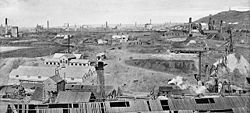
In 1895 it was decided to reconstruct the company as a limited company
Limited company
A limited company is a company in which the liability of the members or subscribers of the company is limited to what they have invested or guaranteed to the company. Limited companies may be limited by shares or by guarantee. And the former of these, a limited company limited by shares, may be...
, replacing the old cost book system under which most Cornish mines had traditionally been run. A new shaft, named the Williams Shaft after the first chairman of the new company, was started in October 1895, intended to be the first 3000 feet (914.4 m) vertical shaft in Cornwall. It was completed in 1910 and came into use the next year.
In 1920 when the mine had become virtually worked out and following the tin price collapse (new deposits were also being found elsewhere in the world) Dolcoath finally closed. The company was reconstructed in 1923 when fresh capital was raised and a new 2000 feet (609.6 m) circular shaft was sited north of the old mine at Roskear
Roskear
Roskear is a cricket ground in Camborne, Cornwall. It was established in 1906, when Cornwall played Devon in the 1906 Minor Counties Championship...
. The New Dolcoath Mine was actually an amalgamation of several smaller mines including Stray Park and Roskear. In 1936 Dolcoath's sett
Mining sett
Mining setts were a legal arrangement used historically in the counties of Devon and Cornwall in South West England to manage the exploitation of land for the extraction of tin....
was purchased by South Crofty
South Crofty
South Crofty is a metalliferous Tin and Copper mine located in the village of Pool, Cornwall, England UK. An ancient mine, it has seen production for over 400 years, and extends almost two and a half miles across and down and has mined over 40 lodes. Evidence of mining activity in South Crofty has...
.
Major accident
On 20 September 1893 a party of miners were strengthening a large stull at the 412 level (nearly half a mile underground). The stull consisted of about 22 pieces of 18 inches (457.2 mm) by 33 feet (10.1 m) timbers of Pitch PinePitch Pine
The Pitch Pine, Pinus rigida, is a small-to-medium sized pine, native to eastern North America. This species occasionally hybridizes with other pine species such as Loblolly Pine , Shortleaf Pine , and Pond Pine The Pitch Pine, Pinus rigida, is a small-to-medium sized (6-30 meters or 20-100 feet)...
set about 2 ft (0.6096 m) apart. It was holding up some 600 feet (182.9 m) in height of waste rock. The day before, the mine captain, Josiah Thomas, and Captain James Johns, the chief underground agent, had visited the level and expressed concern at the safety of the stull because one of the pieces was bending. Men were immediately instructed to strengthen it. Repair work proceeded through the morning until at 1 pm after a small fall of rock, the whole stull suddenly gave way, killing seven of the men working underneath. One man, Richard Davies, was rescued unhurt after 37 hours. In around 1898 the then mine captain, Arthur Thomas, reported that "he went to America some time after, and is now working in South Africa."
At the subsequent inquest, Captain Josiah Thomas said that the working party must have removed some of the old props before putting in the new ones, but this was contradicted by one of the survivors who reported that the men were doing nothing at the time to cause the fall.
Output
Before its first closure in 1788, Dolcoath was estimated to have produced tin and copper valued at least £1,250,000. Of this, £450,000 was due to copper production between 1740 and 1777. From 1799 to its final closure in 1920 its total production of minerals was valued at over £9 million - this included arsenicArsenic
Arsenic is a chemical element with the symbol As, atomic number 33 and relative atomic mass 74.92. Arsenic occurs in many minerals, usually in conjunction with sulfur and metals, and also as a pure elemental crystal. It was first documented by Albertus Magnus in 1250.Arsenic is a metalloid...
, silver and other minerals.
From 1853, when the first dividend on tin was paid, the mine produced over 100,000 tons of black tin
Black tin
Black tin is the raw ore of tin, usually cassiterite, as sold by a tin mine to a smelting company. After mining, the ore has to be concentrated by a number of processes to reduce the amount of gangue it contains before it can be sold...
. This was far in excess of the production of any other mine in Cornwall. In 1896 the mine was yielding 80 lbs of black tin per ton of rock lifted, but this gradually declined to 30 lbs by 1915 which level was maintained until the mine closed.
Because of its success, the mine paid frequent dividends to its shareholders, and its shares, which were nicknamed 'Dollies', were among the most sought-after of the industry.
Mine captains
- Richard Trevithick, (father of Richard TrevithickRichard TrevithickRichard Trevithick was a British inventor and mining engineer from Cornwall. His most significant success was the high pressure steam engine and he also built the first full-scale working railway steam locomotive...
). Constructed the deep aditAditAn adit is an entrance to an underground mine which is horizontal or nearly horizontal, by which the mine can be entered, drained of water, and ventilated.-Construction:...
in 1765 and installed a Newcomen pumping engineNewcomen steam engineThe atmospheric engine invented by Thomas Newcomen in 1712, today referred to as a Newcomen steam engine , was the first practical device to harness the power of steam to produce mechanical work. Newcomen engines were used throughout Britain and Europe, principally to pump water out of mines,...
in around 1775. - Andrew VivianAndrew VivianAndrew Vivian was a British mechanical engineer, inventor, and mine captain of the Dolcoath mine in Cornwall, England.In partnership with his cousin Richard Trevithick, the inventor of "high pressure" steam engines, and the entrepreneur Davis Giddy, Vivian financed the production of the first...
, cousin & collaborator of the younger Richard TrevithickRichard TrevithickRichard Trevithick was a British inventor and mining engineer from Cornwall. His most significant success was the high pressure steam engine and he also built the first full-scale working railway steam locomotive...
(resigned 1806). - J. Rule (from 1806).
- William Petherick (died January 1844).
- Charles ThomasCharles Thomas (Mine Agent)Charles Thomas was a mining agent and share dealer in Camborne, Cornwall, in the United Kingdom. He was an advocate of deep mining....
(from 1844 to 1867). Instigated the deep mining that discovered large quantities of tin ore. - Josiah Thomas (from 1867 to 1895). Son of the above, continued his father's development of the mine. In 1876 he introduced boring machines operated by compressed air, and in 1892 the first set of Californian stamps. He was appointed managing director of the mine in 1895, and died in October 1901.
- Arthur Thomas (from 1895 to ?). Son of the above.
See also
- South CroftySouth CroftySouth Crofty is a metalliferous Tin and Copper mine located in the village of Pool, Cornwall, England UK. An ancient mine, it has seen production for over 400 years, and extends almost two and a half miles across and down and has mined over 40 lodes. Evidence of mining activity in South Crofty has...
- Mining in CornwallMining in CornwallMining in Cornwall and Devon began in the early Bronze Age approximately 2,150 BC and ended with the South Crofty tin mine in Cornwall closing in 1998...
- Camborne School of MinesCamborne School of MinesThe Camborne School of Mines , commonly abbreviated to CSM, was founded in 1888. It is now a specialist department of the University of Exeter. Its research and teaching is related to the understanding and management of the Earth's natural processes, resources and the environment...
- John Harris (poet)John Harris (poet)John Harris was a Cornish poet.Harris was born and raised in a two-bedroom cottage on the slopes of Bolenowe Carn, a small village near Camborne, Cornwall, in the United Kingdom...
Cornish poet