

Director of the Defense Intelligence Agency

Encyclopedia
The Director of the U.S. Defense Intelligence Agency
is a three-star military officer and is the highest ranking intelligence officer in the Department of Defense
. He is the primary military intelligence advisor to the Secretary of Defense and the Chairman of the Joint Chiefs of Staff
and also answers to the Director of National Intelligence. The Director of DIA also commands the Joint Functional Component Command for Intelligence, Surveillance and Reconnaissance
which is subordinate to US Strategic Command. The Under Secretary of Defense for Intelligence
is the top Office of the Secretary of Defense
intelligence civilian and is the primary military intelligence advisor to the DNI in his capacity as Director of Defense Intelligence.
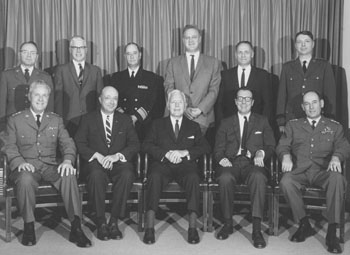
As the first director of DIA, General Carroll faced the profound challenge of creating a new centralized intelligence organization in the face of the military services' opposition and at a time of increased Cold War tensions. General Carroll not only initiated DIA operations, he established precedents and procedures that would allow it to carry out its mission: to produce and manage foreign military intelligence for the Department of Defense. Such support was essential at a time when the United States was still solidifying its superpower status and facing ideological challenges as well as threats to national security.
The year 1969 began with the inauguration of a new President, Richard M. Nixon. That change in the nation's chief executive was echoed by a change in DIA's directorship later that year. With General Bennett's assumption of command, there was a change in the style but not substance of the organization's leadership: in other words, DIA had another strong, dedicated director to lead it through some very challenging times.
Admiral de Poix continued the reorganization of the Agency begun by his predecessor, General Bennett. Streamlining the organization had become critical since severe manpower cutbacks had taken a major toll on the Agency. DIA manpower had been cut by one third after Vietnam. By 1973, nearly all elements had been consolidated and realigned.
In October 1974, General Graham began a comprehensive overhaul of DIA production functions, organization, and management. The end of the Vietnam War produced many refugees and heightened concern for American POW/MIAs. Intense Congressional review during 1975-76 created turbulence in the national Intelligence Community. Amid these issues, massive resource decrements were faced by DIA and the entire Defense intelligence community.
General Wilson, who began his tenure as the Director, DIA in May 1976, completely reorganized the Defense Intelligence Agency. He assured the J-2's of the U&S Commands and the Services, however, of his "commitment to the pursuit of excellence within DIA, particularly in support of the operating forces." He pledged that one of his major goals as Director would be to stress "the importance of military operational intelligence requirements."
In 1978, the Deputy Secretary of Defense observed that, "The DIA has made laudable progress in improving the quality of its intelligence products and in focusing more sharply on the needs and concerns of its consumers. I am prepared now to support several additional steps which I believe will enhance the Agency's analysis and intelligence community standing." This resulted in a major reorganization of DIA, completed under the stewardship of General Tighe in August 1979, which established a basic infrastructure that lasted nearly a decade.
General Williams focused the Agency on enhancing support to tactical and theater commanders, improving capabilities to meet major wartime intelligence requirements, and strengthening indications and warning assets. In December 1981, President Reagan signed Executive Order 12333
giving the Intelligence Community a mandate for the years ahead.
Soon after General Perroots arrived at the Agency, Secretary of Defense Caspar Weinberger
presented DIA with its first Joint Meritorious Unit Award for intelligence support during the TWA and ACHILLE LAURO hijackings, the Philippine crisis, and the counterterrorist operations against Libya. This award echoed the changing national security environment featuring the new threats of terrorism, global volatility, and low-intensity conflict.
Soon after his arrival at DIA, General Soyster directed the Defense intelligence effort in support of the successful US operation in Panama in 1989. This clearly demonstrated the benefits of increased cooperation and planning that had been achieved between DIA and operational force planners when compared to the 1983 Grenada incursion.
The Secretary of Defense appointed Mr. Nagy as Acting Director for the interim period from September through November 1991, the only civilian to be so named. In this capacity he provided continuity during a critical time when decrements against Agency resources caused reconsideration of many managerial issues and review of traditional threat priorities throughout the Defense Intelligence Community. He served until Lieutenant General James R. Clapper, Jr., USAF, assumed the directorship.
General Clapper came to DIA following the collapse of the Soviet Union as the predominant focus of US intelligence and in the aftermath of Operation DESERT STORM. DIA improved crisis management and support to the decision maker and warfighter based on the experience gained during the Gulf War. The end of the Cold War led to the most fundamental reexamination of US national security policy since the 1940s.
General Minihan came to DIA in the midst of critical events in the Balkans. In the summer of 1995, the Croatian Army launched several successful offensives in the Krajina region, NATO launched air strikes against targets in Bosnian Serb territory, and Bosnian Serb forces overran Srebrenica, a UN declared "safe area." In the fall on 1995, the major players in the Yugoslav crisis agreed in Geneva on the basic principles for peace in Bosnia.
General Hughes faced critical challenges in the area of terrorism in his first year as Director. In the wake of a terrorist bombing of US barracks at Khobar Towers on June 25, 1996 that left 24 dead and 500 wounded, DIA re-examined its counter-terrorism capability. Former DIA Director, Lieutenant General James Clapper, USAF (Ret), was selected as participant on the Khobar Towers Bomb Blast Assessment Team.
As Vice Admiral Wilson came on board in the summer of 1999. During Wilson's tenure DIA supported a Joint Task Forces deploying over 100 DIA augmentees and providing more than 600 personnel to intelligence task forces, to an Allied military intelligence battalion in Bosnia
, and to National Intelligence Support Teams in Riyadh, Tuzla and Sarajevo.
Vice Admiral Lowell E. Jacoby was appointed as Acting Director on July 2002 and became the official Director on October 2002.
Major General Michael D. Maples, U.S. Army, was appointed the 16th DIA Director on November 4, 2005. He pinned on his third star on November 29. LTG Maples also commands the Joint Functional Component Command for Intelligence, Surveillance and Reconnaissance for the United States Strategic Command. LTG Maples served as the Vice Director and Director of Management of the Joint Staff prior to assuming his responsibilities as DIA Director and Commander, JFCC-ISR.
In a ceremony held at the Defense Intelligence Analysis Center on March 18, 2009, U.S. Army Lt. Gen. Ronald L. Burgess Jr. became the 17th director of the Defense Intelligence Agency and assumed command of the Joint Functional Component Command for Intelligence, Surveillance and Reconnaissance (JFCC-ISR) for U.S. Strategic Command (USSTRATCOM). Prior to assuming his new position, he served as the director of intelligence staff and as the acting principal deputy director of national intelligence, Office of the Director of National Intelligence.
Defense Intelligence Agency
The Defense Intelligence Agency is a member of the Intelligence Community of the United States, and is the central producer and manager of military intelligence for the United States Department of Defense, employing over 16,500 U.S. military and civilian employees worldwide...
is a three-star military officer and is the highest ranking intelligence officer in the Department of Defense
United States Department of Defense
The United States Department of Defense is the U.S...
. He is the primary military intelligence advisor to the Secretary of Defense and the Chairman of the Joint Chiefs of Staff
Chairman of the Joint Chiefs of Staff
The Chairman of the Joint Chiefs of Staff is by law the highest ranking military officer in the United States Armed Forces, and is the principal military adviser to the President of the United States, the National Security Council, the Homeland Security Council and the Secretary of Defense...
and also answers to the Director of National Intelligence. The Director of DIA also commands the Joint Functional Component Command for Intelligence, Surveillance and Reconnaissance
Joint Functional Component Command for Intelligence, Surveillance and Reconnaissance
The Joint Functional Component Command for Intelligence, Surveillance and Reconnaissance is a subordinate command of the United States Strategic Command, one of the ten Unified Combatant Commands under the United States Department of Defense and co-located with the Defense Intelligence Agency...
which is subordinate to US Strategic Command. The Under Secretary of Defense for Intelligence
Under Secretary of Defense for Intelligence
The Under Secretary for Intelligence or USD is a high-ranking civilian position in the Office of the Secretary of Defense within the U.S. Department of Defense that acts as the principal advisor and deputy to the Secretary and Deputy Secretary of Defense on matters relating to intelligence...
is the top Office of the Secretary of Defense
Office of the Secretary of Defense
The Office of the Secretary of Defense is a headquarters-level staff of the Department of Defense of the United States of America. It is the principal civilian staff element of the Secretary of Defense, and it assists the Secretary in carrying out authority, direction and control of the Department...
intelligence civilian and is the primary military intelligence advisor to the DNI in his capacity as Director of Defense Intelligence.
Directors of DIA
- 1st - Joseph CarrollJoseph CarrollLieutenant General Joseph Francis Carroll was the founding director of the Defense Intelligence Agency , and founding director of the Air Force Office of Special Investigations .-Youth & Education:...
, Lt. Gen., USAF (October 1961 - September 1969)
As the first director of DIA, General Carroll faced the profound challenge of creating a new centralized intelligence organization in the face of the military services' opposition and at a time of increased Cold War tensions. General Carroll not only initiated DIA operations, he established precedents and procedures that would allow it to carry out its mission: to produce and manage foreign military intelligence for the Department of Defense. Such support was essential at a time when the United States was still solidifying its superpower status and facing ideological challenges as well as threats to national security.
- 2nd - Donald V. BennettDonald V. BennettDonald Vivian Bennett retired as a four star general from the United States Army in 1974. He attended Michigan State University and graduated from the United States Military Academy in 1940 then served overseas in World War II. Bennett won the Distinguished Service Cross as well as two Purple...
, LTG, USA (September 1969 - August 1972)
The year 1969 began with the inauguration of a new President, Richard M. Nixon. That change in the nation's chief executive was echoed by a change in DIA's directorship later that year. With General Bennett's assumption of command, there was a change in the style but not substance of the organization's leadership: in other words, DIA had another strong, dedicated director to lead it through some very challenging times.
- 3rd - Vincent P. De PoixVincent P. De PoixVice Admiral Vincent P. de Poix USN, a graduate of the United States Naval Academy, became a naval aviator and fought in World War II. He was the first commander of the USS Enterprise , participated in the Vietnam War, and commanded the United States Second Fleet...
, VADM, USN (August 1972 - September 1974)
Admiral de Poix continued the reorganization of the Agency begun by his predecessor, General Bennett. Streamlining the organization had become critical since severe manpower cutbacks had taken a major toll on the Agency. DIA manpower had been cut by one third after Vietnam. By 1973, nearly all elements had been consolidated and realigned.
- 4th - Daniel O. GrahamDaniel O. GrahamDaniel O. Graham was a U.S. Army officer. Graham was born in Portland, Oregon and grew up in Medford. He attended college at the United States Military Academy at West Point, the Army's Command and General Staff College, and graduated in 1946. He also attended the U.S...
, LTG, USA (September 1974 - December 1975)
In October 1974, General Graham began a comprehensive overhaul of DIA production functions, organization, and management. The end of the Vietnam War produced many refugees and heightened concern for American POW/MIAs. Intense Congressional review during 1975-76 created turbulence in the national Intelligence Community. Amid these issues, massive resource decrements were faced by DIA and the entire Defense intelligence community.
- 5th - Samuel V. WilsonSamuel V. WilsonLieutenant General Samuel Vaughan Wilson , aka "General Sam", completed his active military career in the fall of 1977, having divided his service almost equally between special operations and intelligence assignments...
, LTG, USA (May 1976 - August 1977)
General Wilson, who began his tenure as the Director, DIA in May 1976, completely reorganized the Defense Intelligence Agency. He assured the J-2's of the U&S Commands and the Services, however, of his "commitment to the pursuit of excellence within DIA, particularly in support of the operating forces." He pledged that one of his major goals as Director would be to stress "the importance of military operational intelligence requirements."
- 6th - Eugene F. TigheEugene F. TigheLieutenant General Eugene Francis Tighe, Jr. was director of the Defense Intelligence Agency, Washington, D.C..Tighe was born in 1921, in New Raymer, Colorado, and graduated from Manual Arts High School, Los Angeles, in 1939...
, Lt Gen, USAF (September 1977 - August 1981)
In 1978, the Deputy Secretary of Defense observed that, "The DIA has made laudable progress in improving the quality of its intelligence products and in focusing more sharply on the needs and concerns of its consumers. I am prepared now to support several additional steps which I believe will enhance the Agency's analysis and intelligence community standing." This resulted in a major reorganization of DIA, completed under the stewardship of General Tighe in August 1979, which established a basic infrastructure that lasted nearly a decade.
- 7th - James A. WilliamsJames A. WilliamsJames A. Williams was a United States Army lieutenant general. Williams served as Director of the Defense Intelligence Agency in the 1980s. He is a 1987 inductee of the Military Intelligence Hall of Fame and is the chairman of the board of directors for the National Military Intelligence...
, LTG, USA (September 1981 - September 1985)
General Williams focused the Agency on enhancing support to tactical and theater commanders, improving capabilities to meet major wartime intelligence requirements, and strengthening indications and warning assets. In December 1981, President Reagan signed Executive Order 12333
Executive Order 12333
On December 4, 1981 President Ronald Reagan signedExecutive Order 12333,an Executive Order intended toextend powers and responsibilities of US intelligence agencies and direct the leaders of U.S...
giving the Intelligence Community a mandate for the years ahead.
- 8th - Lt. Gen. Leonard H. Perroots, Lt. Gen, USAF (October 1985 - December 1988)
Soon after General Perroots arrived at the Agency, Secretary of Defense Caspar Weinberger
Caspar Weinberger
Caspar Willard "Cap" Weinberger , was an American politician, vice president and general counsel of Bechtel Corporation, and Secretary of Defense under President Ronald Reagan from January 21, 1981, until November 23, 1987, making him the third longest-serving defense secretary to date, after...
presented DIA with its first Joint Meritorious Unit Award for intelligence support during the TWA and ACHILLE LAURO hijackings, the Philippine crisis, and the counterterrorist operations against Libya. This award echoed the changing national security environment featuring the new threats of terrorism, global volatility, and low-intensity conflict.
- 9th - Harry E. SoysterHarry E. SoysterHarry Edward Soyster is a retired United States Army Lieutenant General.-Overview:He served as the Commanding General of the United States Army Intelligence and Security Command . Upon promotion to the rank of Lieutenant General, Soyster served as the Director of the Defense Intelligence Agency at...
, LTG, USA (December 1988 - September 1991)
Soon after his arrival at DIA, General Soyster directed the Defense intelligence effort in support of the successful US operation in Panama in 1989. This clearly demonstrated the benefits of increased cooperation and planning that had been achieved between DIA and operational force planners when compared to the 1983 Grenada incursion.
- 10th - Mr. Dennis M. NagyDennis M. NagyDennis Mark Nagy was acting Director of the Defense Intelligence Agency from September 1991 to November 1991. Nagy, who is of Hungarian ancestry, attended the U.S. Air Force Academy and graduated in 1965 with a bachelor of science degree in international relations and a commission in the U.S. Air...
, civilian (September 1991 - November 1991)
The Secretary of Defense appointed Mr. Nagy as Acting Director for the interim period from September through November 1991, the only civilian to be so named. In this capacity he provided continuity during a critical time when decrements against Agency resources caused reconsideration of many managerial issues and review of traditional threat priorities throughout the Defense Intelligence Community. He served until Lieutenant General James R. Clapper, Jr., USAF, assumed the directorship.
- 11th - James R. ClapperJames R. ClapperJames R. Clapper, Jr. is a retired lieutenant general in the United States Air Force and is currently the Director of National Intelligence. He was previously dual-hatted as the first Director of Defense Intelligence within the Office of the Director of National Intelligence alongside the position...
, Lt Gen, USAF (November 1991 - August 1995)
General Clapper came to DIA following the collapse of the Soviet Union as the predominant focus of US intelligence and in the aftermath of Operation DESERT STORM. DIA improved crisis management and support to the decision maker and warfighter based on the experience gained during the Gulf War. The end of the Cold War led to the most fundamental reexamination of US national security policy since the 1940s.
- 12th - Kenneth MinihanKenneth MinihanLieutenant General Kenneth A. Minihan is a former director of the National Security Agency and the Defense Intelligence Agency ....
, Lt Gen, USAF (August 1995 - February 1996)
General Minihan came to DIA in the midst of critical events in the Balkans. In the summer of 1995, the Croatian Army launched several successful offensives in the Krajina region, NATO launched air strikes against targets in Bosnian Serb territory, and Bosnian Serb forces overran Srebrenica, a UN declared "safe area." In the fall on 1995, the major players in the Yugoslav crisis agreed in Geneva on the basic principles for peace in Bosnia.
- 13th - Patrick M. HughesPatrick M. Hughes-Overview:Lieutenant General Patrick M. Hughes, United States Army was the 12th Director of the Defense Intelligence Agency. Previously he was Director of Intelligence and DIA, Joint Staff in the Office of the Chairman of the Joint Chiefs of Staff, from 1994 to 1996, and the Director of...
, LTG, USA ( February 1996 - July 1999)
General Hughes faced critical challenges in the area of terrorism in his first year as Director. In the wake of a terrorist bombing of US barracks at Khobar Towers on June 25, 1996 that left 24 dead and 500 wounded, DIA re-examined its counter-terrorism capability. Former DIA Director, Lieutenant General James Clapper, USAF (Ret), was selected as participant on the Khobar Towers Bomb Blast Assessment Team.
- 14th - Thomas R. WilsonThomas R. WilsonVice Admiral Thomas Ray Wilson 0USN was Director of the Defense Intelligence Agency from July 1999 to July 2002.-Overview:Vice Admiral Thomas R. Wilson, USN was the 13th Director of the Defense Intelligence Agency...
, VADM, USN (July 1999 - July 2002)
As Vice Admiral Wilson came on board in the summer of 1999. During Wilson's tenure DIA supported a Joint Task Forces deploying over 100 DIA augmentees and providing more than 600 personnel to intelligence task forces, to an Allied military intelligence battalion in Bosnia
Bosnia and Herzegovina
Bosnia and Herzegovina , sometimes called Bosnia-Herzegovina or simply Bosnia, is a country in Southern Europe, on the Balkan Peninsula. Bordered by Croatia to the north, west and south, Serbia to the east, and Montenegro to the southeast, Bosnia and Herzegovina is almost landlocked, except for the...
, and to National Intelligence Support Teams in Riyadh, Tuzla and Sarajevo.
- 15th - Lowell E. JacobyLowell E. JacobyVice Admiral Lowell Edwin Jacoby, USN was the 14th Director of the Defense Intelligence Agency. Previously he was in the from 1999 to 2002, and the Director of Naval Intelligence and Commander, Office of Naval Intelligence from 1997 to 1999. He was the from 1994 to 1997 and Commander, from...
, VADM, USN (July 2002 - November 2005)
Vice Admiral Lowell E. Jacoby was appointed as Acting Director on July 2002 and became the official Director on October 2002.
- 16th - Michael D. MaplesMichael D. MaplesLieutenant General Michael David Maples, USA served as the 16th Director of the Defense Intelligence Agency , appointed on November 4, 2005. He received his third star on November 29. Maples also commanded the Joint Functional Component Command for Intelligence, Surveillance and Reconnaissance ...
, LTG, USA (November 2005 - March 2009)
Major General Michael D. Maples, U.S. Army, was appointed the 16th DIA Director on November 4, 2005. He pinned on his third star on November 29. LTG Maples also commands the Joint Functional Component Command for Intelligence, Surveillance and Reconnaissance for the United States Strategic Command. LTG Maples served as the Vice Director and Director of Management of the Joint Staff prior to assuming his responsibilities as DIA Director and Commander, JFCC-ISR.
- 17th - Ronald Burgess, LTG, USA (March 2009 - Present)
In a ceremony held at the Defense Intelligence Analysis Center on March 18, 2009, U.S. Army Lt. Gen. Ronald L. Burgess Jr. became the 17th director of the Defense Intelligence Agency and assumed command of the Joint Functional Component Command for Intelligence, Surveillance and Reconnaissance (JFCC-ISR) for U.S. Strategic Command (USSTRATCOM). Prior to assuming his new position, he served as the director of intelligence staff and as the acting principal deputy director of national intelligence, Office of the Director of National Intelligence.