


Diodotus Tryphon

Encyclopedia
Diodotus Tryphon was king of the Hellenistic Seleucid kingdom
. As a general of the army, he promoted the claims of Antiochus VI Dionysus
, the infant son of Alexander Balas
, in Antioch after Alexander's death, but then in 142 deposed the child and himself seized power in Coele-Syria
where Demetrius II Nicator
was unpopular for his oppressive treatment of the Jews.
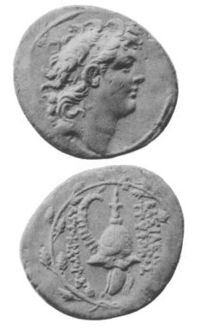 The internal situation in the Seleucid domains was so convoluted, and Diodotus was so eager to gain allies, that in 143 BC Hasmonean
rule was reinstated in Judea in exchange for aid. True to their word, several Jewish armies marched against Diodotus' rival Demetrius and opposing cities. However, the Jewish forces under the High Priest Jonathan
behaved too boldly, leading to his capture and murder by ruse when Diodotus marched into Judea. Despite his preparations and intentions to cow the Jews, Diodotus was entirely unsuccessful, and left the region under the rule of Jonathan's brother Simon, with little gain beyond a minor tribute of 100 talents. Finally, in 138 Diodotus was attacked and defeated in Antioch by Antiochus VII
of Side. Diodotus committed suicide after his defeat.
In 138 BC, Diodotus claimed that his charge had contracted an illness and supposedly required surgery, during which he died - presumably disguising his murder at his supposed benefactor's bequest.
Seleucid Empire
The Seleucid Empire was a Greek-Macedonian state that was created out of the eastern conquests of Alexander the Great. At the height of its power, it included central Anatolia, the Levant, Mesopotamia, Persia, today's Turkmenistan, Pamir and parts of Pakistan.The Seleucid Empire was a major centre...
. As a general of the army, he promoted the claims of Antiochus VI Dionysus
Antiochus VI Dionysus
Antiochus VI Dionysus , king of the Hellenistic Seleucid kingdom, was the son of Alexander Balas and Cleopatra Thea, daughter of Ptolemy VI of Egypt....
, the infant son of Alexander Balas
Alexander Balas
Alexander Balas , ruler of the Greek Seleucid kingdom 150-146 BC, was a native of Smyrna of humble origin, but gave himself out to be the son of Antiochus IV Epiphanes and Laodice IV and heir to the Seleucid throne...
, in Antioch after Alexander's death, but then in 142 deposed the child and himself seized power in Coele-Syria
Coele-Syria
Coele-Syria , or Cœle-Syria or Celesyria, traditionally given the meaning 'hollow' Syria, was the region of southern Syria disputed between the Seleucid dynasty and the Ptolemaic dynasty. Rather than limiting the Greek term to the Beqaa Valley of Lebanon, it is often used to cover the entire area...
where Demetrius II Nicator
Demetrius II Nicator
For the similarly named Macedonian ruler, see Demetrius II of Macedon. For the Macedonian prince, see Demetrius the Fair.Demetrius II , called Nicator , was one of the sons of Demetrius I Soter, brother of Antiochus VII Sidetes and his mother could have been Laodice V...
was unpopular for his oppressive treatment of the Jews.
Hasmonean
The Hasmonean dynasty , was the ruling dynasty of Judea and surrounding regions during classical antiquity. Between c. 140 and c. 116 BCE, the dynasty ruled semi-autonomously from the Seleucids in the region of Judea...
rule was reinstated in Judea in exchange for aid. True to their word, several Jewish armies marched against Diodotus' rival Demetrius and opposing cities. However, the Jewish forces under the High Priest Jonathan
Jonathan Maccabaeus
Jonathan Apphus was leader of the Hasmonean Dynasty of Judea from 161 to 143 BCE. The name Apphus could mean = "the dissembler", "the Wary", or "the diplomat", in allusion to a trait prominent in him -Leader of the Jews:...
behaved too boldly, leading to his capture and murder by ruse when Diodotus marched into Judea. Despite his preparations and intentions to cow the Jews, Diodotus was entirely unsuccessful, and left the region under the rule of Jonathan's brother Simon, with little gain beyond a minor tribute of 100 talents. Finally, in 138 Diodotus was attacked and defeated in Antioch by Antiochus VII
Antiochus VII Sidetes
Antiochus VII Euergetes, nicknamed Sidetes , ruler of the Hellenistic Seleucid Empire, reigned from 138 to 129 BC. He was the last Seleucid king of any stature....
of Side. Diodotus committed suicide after his defeat.
In 138 BC, Diodotus claimed that his charge had contracted an illness and supposedly required surgery, during which he died - presumably disguising his murder at his supposed benefactor's bequest.