

Coele-Syria

Encyclopedia
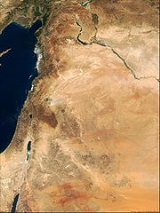
Coele-Syria or Cœle-Syria or Celesyria, traditionally given the meaning 'hollow' Syria, was the region of southern Syria
disputed between the Seleucid dynasty
and the Ptolemaic dynasty
. Rather than limiting the Greek term to the Beqaa Valley
of Lebanon
, it is often used to cover the entire area south of the river Eleutherus including Judea
. In fact, Diodorus Siculus
indicates Coele-Syria to also include the Judean coasts as far south as Joppa
. The Hellenistic term Koile Syria that appears first in Arrian
's Anabasis (2.13.7) and has been much discussed, now seems simply to have been a transcription of Aramaic kul, "all, the entire", identifying all of Syria, very much as the range of applications have suggested.
 Alexander the Great's general Ptolemy
first occupied Coele-Syria in 318 BC
. When Ptolemy joined the coalition against Antigonus I Monophthalmus
in 313 BC
he, however, quickly withdrew from Coele-Syria. In 312 BC
Seleucus I Nicator
, defeated Demetrius
, the son of Antigonus, in the Battle of Gaza
which again allowed Ptolemy to occupy Coele-Syria. Though he was again to pull out after only a few months, after Demetrius had won a battle over his general and Antigonus entered Syria in force up to Antigonuses, this brief success had enabled Seleucus to make a dash for Babylonia
which Seleucus secured. In 302 BC
, Ptolemy joined a new coalition against Antigonus and reoccupied Coele-Syria, but quickly withdrew on hearing a false report that Antigonus had won a victory. He was only to return when Antigonus had been defeated at Ipsus
in 301 BC
. Coele-Syria was assigned to Seleucus
, by the victors of Ipsus, as Ptolemy had added nothing to the victory. Though, given Ptolemy's track record, he was unlikely to organize a serious defense of Coele-Syria, Seleucus acquiesced in Ptolemy's occupation, probably because Seleucus remembered how it had been with Ptolemy's help he had reestablished himself in Babylonia. The later Seleucids were not to be so understanding, resulting in the century of Syrian Wars
between the Ptolemies and Seleucids.
began diminishing with the eruption of the Maccabean Revolt in 165 BC. With Seleucid troops being involved in warfare on the Parthian
front, Judea succeeded in securing its independence by 140 BC. Despite attemtps of Seleucid rulers to regain territories, the conquests of Pompey
in 64 BC were a decisive blow to them, and Syria
became part of the Roman Republic
.
Syria
Syria , officially the Syrian Arab Republic , is a country in Western Asia, bordering Lebanon and the Mediterranean Sea to the West, Turkey to the north, Iraq to the east, Jordan to the south, and Israel to the southwest....
disputed between the Seleucid dynasty
Seleucid dynasty
The Seleucid dynasty or the Seleucidae was a Greek Macedonian royal family, founded by Seleucus I Nicator , which ruled the Seleucid Kingdom centered in the Near East and regions of the Asian part of the earlier Achaemenid Persian Empire during the Hellenistic period.-History:Seleucus was an...
and the Ptolemaic dynasty
Ptolemaic dynasty
The Ptolemaic dynasty, was a Macedonian Greek royal family which ruled the Ptolemaic Empire in Egypt during the Hellenistic period. Their rule lasted for 275 years, from 305 BC to 30 BC...
. Rather than limiting the Greek term to the Beqaa Valley
Beqaa Valley
The Beqaa Valley is a fertile valley in east Lebanon. For the Romans, the Beqaa Valley was a major agricultural source, and today it remains Lebanon’s most important farming region...
of Lebanon
Lebanon
Lebanon , officially the Republic of LebanonRepublic of Lebanon is the most common term used by Lebanese government agencies. The term Lebanese Republic, a literal translation of the official Arabic and French names that is not used in today's world. Arabic is the most common language spoken among...
, it is often used to cover the entire area south of the river Eleutherus including Judea
Judea
Judea or Judæa was the name of the mountainous southern part of the historic Land of Israel from the 8th century BCE to the 2nd century CE, when Roman Judea was renamed Syria Palaestina following the Jewish Bar Kokhba revolt.-Etymology:The...
. In fact, Diodorus Siculus
Diodorus Siculus
Diodorus Siculus was a Greek historian who flourished between 60 and 30 BC. According to Diodorus' own work, he was born at Agyrium in Sicily . With one exception, antiquity affords no further information about Diodorus' life and doings beyond what is to be found in his own work, Bibliotheca...
indicates Coele-Syria to also include the Judean coasts as far south as Joppa
Joppa
Joppa appears in the Bible as the name of the now Israeli city of Yafo, otherwise known as Jaffa.Joppa can also refer to:-Locations:United Kingdom...
. The Hellenistic term Koile Syria that appears first in Arrian
Arrian
Lucius Flavius Arrianus 'Xenophon , known in English as Arrian , and Arrian of Nicomedia, was a Roman historian, public servant, a military commander and a philosopher of the 2nd-century Roman period...
's Anabasis (2.13.7) and has been much discussed, now seems simply to have been a transcription of Aramaic kul, "all, the entire", identifying all of Syria, very much as the range of applications have suggested.
History
Ptolemy I Soter
Ptolemy I Soter I , also known as Ptolemy Lagides, c. 367 BC – c. 283 BC, was a Macedonian general under Alexander the Great, who became ruler of Egypt and founder of both the Ptolemaic Kingdom and the Ptolemaic Dynasty...
first occupied Coele-Syria in 318 BC
318 BC
Year 318 BC was a year of the pre-Julian Roman calendar. At the time, it was known as the Year of the Consulship of Flaccinator and Venno...
. When Ptolemy joined the coalition against Antigonus I Monophthalmus
Antigonus I Monophthalmus
Antigonus I Monophthalmus , son of Philip from Elimeia, was a Macedonian nobleman, general, and satrap under Alexander the Great. During his early life he served under Philip II, and he was a major figure in the Wars of the Diadochi after Alexander's death, declaring himself king in 306 BC and...
in 313 BC
313 BC
Year 313 BC was a year of the pre-Julian Roman calendar. At the time, it was known as the Year of the Consulship of Cursor and Brutus...
he, however, quickly withdrew from Coele-Syria. In 312 BC
312 BC
Year 312 BC was a year of the pre-Julian Roman calendar. At the time, it was known as the Year of the Consulship of Corvus and Mus...
Seleucus I Nicator
Seleucus I Nicator
Seleucus I was a Macedonian officer of Alexander the Great and one of the Diadochi. In the Wars of the Diadochi that took place after Alexander's death, Seleucus established the Seleucid dynasty and the Seleucid Empire...
, defeated Demetrius
Demetrius I of Macedon
Demetrius I , called Poliorcetes , son of Antigonus I Monophthalmus and Stratonice, was a king of Macedon...
, the son of Antigonus, in the Battle of Gaza
Battle of Gaza (312 BC)
The Battle of Gaza was a battle of the Third war of the Diadochi between Ptolemy and Demetrius .Ptolemy launched an invasion of Syria...
which again allowed Ptolemy to occupy Coele-Syria. Though he was again to pull out after only a few months, after Demetrius had won a battle over his general and Antigonus entered Syria in force up to Antigonuses, this brief success had enabled Seleucus to make a dash for Babylonia
Babylonia
Babylonia was an ancient cultural region in central-southern Mesopotamia , with Babylon as its capital. Babylonia emerged as a major power when Hammurabi Babylonia was an ancient cultural region in central-southern Mesopotamia (present-day Iraq), with Babylon as its capital. Babylonia emerged as...
which Seleucus secured. In 302 BC
302 BC
Year 302 BC was a year of the pre-Julian Roman calendar. At the time, it was known as the Year of the Consulship of Denter and Paullus...
, Ptolemy joined a new coalition against Antigonus and reoccupied Coele-Syria, but quickly withdrew on hearing a false report that Antigonus had won a victory. He was only to return when Antigonus had been defeated at Ipsus
Battle of Ipsus
The Battle of Ipsus was fought between some of the Diadochi in 301 BC near the village of that name in Phrygia...
in 301 BC
301 BC
Year 301 BC was a year of the pre-Julian Roman calendar. At the time, it was known as the Year of the Dictatorship of Corvus...
. Coele-Syria was assigned to Seleucus
Seleucus I Nicator
Seleucus I was a Macedonian officer of Alexander the Great and one of the Diadochi. In the Wars of the Diadochi that took place after Alexander's death, Seleucus established the Seleucid dynasty and the Seleucid Empire...
, by the victors of Ipsus, as Ptolemy had added nothing to the victory. Though, given Ptolemy's track record, he was unlikely to organize a serious defense of Coele-Syria, Seleucus acquiesced in Ptolemy's occupation, probably because Seleucus remembered how it had been with Ptolemy's help he had reestablished himself in Babylonia. The later Seleucids were not to be so understanding, resulting in the century of Syrian Wars
Syrian Wars
The Syrian Wars were a series of six wars between the Successor states of the Seleucid Empire and the Ptolemaic Kingdom of Egypt during the 3rd and 2nd centuries BC over the region then called Coele-Syria, one of the few avenues into Egypt...
between the Ptolemies and Seleucids.
Dissolution
Seleucid control over the area of JudeaJudea
Judea or Judæa was the name of the mountainous southern part of the historic Land of Israel from the 8th century BCE to the 2nd century CE, when Roman Judea was renamed Syria Palaestina following the Jewish Bar Kokhba revolt.-Etymology:The...
began diminishing with the eruption of the Maccabean Revolt in 165 BC. With Seleucid troops being involved in warfare on the Parthian
Parthia
Parthia is a region of north-eastern Iran, best known for having been the political and cultural base of the Arsacid dynasty, rulers of the Parthian Empire....
front, Judea succeeded in securing its independence by 140 BC. Despite attemtps of Seleucid rulers to regain territories, the conquests of Pompey
Pompey
Gnaeus Pompeius Magnus, also known as Pompey or Pompey the Great , was a military and political leader of the late Roman Republic...
in 64 BC were a decisive blow to them, and Syria
Syria (Roman province)
Syria was a Roman province, annexed in 64 BC by Pompey, as a consequence of his military presence after pursuing victory in the Third Mithridatic War. It remained under Roman, and subsequently Byzantine, rule for seven centuries, until 637 when it fell to the Islamic conquests.- Principate :The...
became part of the Roman Republic
Roman Republic
The Roman Republic was the period of the ancient Roman civilization where the government operated as a republic. It began with the overthrow of the Roman monarchy, traditionally dated around 508 BC, and its replacement by a government headed by two consuls, elected annually by the citizens and...
.
See also
- Herodian kingdomHerodian kingdomThe Herodian kingdom or Herodian Judea was a client kingdom of the Roman Empire from 37 BCE, when Herod the Great was appointed "King of the Jews" by the Roman Senate,...
- Tetrarchy (Judea)Tetrarchy (Judea)The Tetrarchy of Judea was formed following the death of Herod the Great in 4 BCE, when his kingdom was divided between his sons as an inheritance...
- Judaea (Roman province)Judaea (Roman province)Judaea or Iudaea are terms used by historians to refer to the Roman province that extended over parts of the former regions of the Hasmonean and Herodian kingdoms of Israel...
- Syria PalaestinaSyria PalaestinaSyria Palæstina was a Roman province between 135CE and 390CE. It had been established by the merge of Roman Syria and Roman Judaea, following the defeat of the Bar Kokhba Revolt in 135 CE. In 193 Syria-Coele was split to form a separate provincial locality...