


Dental drill

Encyclopedia
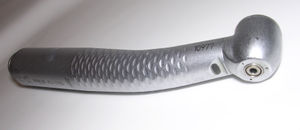
Drill
A drill or drill motor is a tool fitted with a cutting tool attachment or driving tool attachment, usually a drill bit or driver bit, used for drilling holes in various materials or fastening various materials together with the use of fasteners. The attachment is gripped by a chuck at one end of...
used during dental procedures, usually to remove decay and shape tooth structure prior to the insertion of a filling or crown
Dental restoration
A dental restoration or dental filling is a dental restorative material used to restore the function, integrity and morphology of missing tooth structure. The structural loss typically results from caries or external trauma. It is also lost intentionally during tooth preparation to improve the...
. A dental drill may also be used in the cleaning and shaping of root canals
Root canal
A root canal is the space within the root of a tooth. It is part of a naturally occurring space within a tooth that consists of the pulp chamber , the main canal, and more intricate anatomical branches that may connect the root canals to each other or to the surface of the root.-Root canal anatomy:...
during endodontic treatment, or to remove old or temporary fillings or crowns prior to the insertion of new or permanent restorations. The term "dental drill" is considered the more colloquial form of the term "dental handpiece," although it can also be construed as to include the power source for one or more handpieces, a "dental engine
Dental engine
A dental engine is a large chair-side appliance found in a dentist's office. At minimum, a dental engine serves as a source of mechanical or pneumatic power for one or more handpieces; typically, it will also include a small faucet and a spit-sink, which the patient can use for rinsing, as well as...
." "Handpiece" and "engine" are more generic and euphemistic terms for generic dental tools.
Modern dental drills can rotate at up to 400,000 rpm
Revolutions per minute
Revolutions per minute is a measure of the frequency of a rotation. It annotates the number of full rotations completed in one minute around a fixed axis...
, and generally use hard metal alloy
Alloy
An alloy is a mixture or metallic solid solution composed of two or more elements. Complete solid solution alloys give single solid phase microstructure, while partial solutions give two or more phases that may or may not be homogeneous in distribution, depending on thermal history...
bits known as burrs
Burr (cutter)
Burrs are small cutters used in die grinders, rotary tools or dentist's drills. The name may be considered appropriate when their small sized head is compared to that of a seed of the burr fruit or the teeth compared to a metal burr.To maintain the correct surface speed and cutting conditions...
. Dental burs come in a great variety of shapes designed for specific applications. They are often made of steel
Steel
Steel is an alloy that consists mostly of iron and has a carbon content between 0.2% and 2.1% by weight, depending on the grade. Carbon is the most common alloying material for iron, but various other alloying elements are used, such as manganese, chromium, vanadium, and tungsten...
with a tungsten carbide
Tungsten carbide
Tungsten carbide is an inorganic chemical compound containing equal parts of tungsten and carbon atoms. Colloquially, tungsten carbide is often simply called carbide. In its most basic form, it is a fine gray powder, but it can be pressed and formed into shapes for use in industrial machinery,...
coating, or of tungsten carbide entirely. The bur may also have a diamond
Diamond
In mineralogy, diamond is an allotrope of carbon, where the carbon atoms are arranged in a variation of the face-centered cubic crystal structure called a diamond lattice. Diamond is less stable than graphite, but the conversion rate from diamond to graphite is negligible at ambient conditions...
coating.
Dental drills, which have a distinctive, shrill sound, are often a prominent factor in many people's fear of dentistry
Dental fear
Dental fear refers to the fear of dentistry and of receiving dental care. A severe form of this fear is variously called dental phobia, odontophobia, dentophobia, dentist phobia, or dental anxiety...
.
History
Indus Valley Civilization
The Indus Valley Civilization was a Bronze Age civilization that was located in the northwestern region of the Indian subcontinent, consisting of what is now mainly modern-day Pakistan and northwest India...
has yielded evidence of dentistry being practiced as far back as 7000 BC. This earliest form of dentistry involved curing tooth related disorders with bow drill
Bow drill
The bow drill is an ancient tool. While it was usually used to make fire, it was also used for primitive woodworking and dentistry. It consists of a bearing block or handhold, a spindle or drill, a hearth or fireboard, and a simple bow...
s operated, perhaps, by skilled bead craftsmen. The reconstruction of this ancient form of dentistry showed that the methods used were reliable and effective. Cavities of 3.5 mm depth with concentric groovings indicate use of a drill tool. The age of the teeth has been estimated at 9000 years. In later times, mechanical hand drills were used. Like most hand drills, they were quite slow, with speeds of up to 15 rpm
Revolutions per minute
Revolutions per minute is a measure of the frequency of a rotation. It annotates the number of full rotations completed in one minute around a fixed axis...
. In 1864, British
United Kingdom
The United Kingdom of Great Britain and Northern IrelandIn the United Kingdom and Dependencies, other languages have been officially recognised as legitimate autochthonous languages under the European Charter for Regional or Minority Languages...
dentist George Fellows Harrington invented a clockwork
Clockwork
A clockwork is the inner workings of either a mechanical clock or a device that operates in a similar fashion. Specifically, the term refers to a mechanical device utilizing a complex series of gears....
dental drill named Erado. The device was much faster than earlier drills, but also very noisy. In 1868, American
United States
The United States of America is a federal constitutional republic comprising fifty states and a federal district...
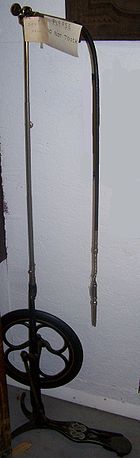
dentist George F. Green came up with a pneumatic dental drill powered with pedal
Lever
In physics, a lever is a rigid object that is used with an appropriate fulcrum or pivot point to either multiply the mechanical force that can be applied to another object or resistance force , or multiply the distance and speed at which the opposite end of the rigid object travels.This leverage...
-operated bellows
Bellows
A bellows is a device for delivering pressurized air in a controlled quantity to a controlled location.Basically, a bellows is a deformable container which has an outlet nozzle. When the volume of the bellows is decreased, the air escapes through the outlet...
. James B. Morrison devised a pedal-powered burr drill in 1871.
The first electric dental drill was patented in 1875 by Green, a development that revolutionized dentistry. By 1914, electric dental drills could reach speeds of up to 3000 rpm
Revolutions per minute
Revolutions per minute is a measure of the frequency of a rotation. It annotates the number of full rotations completed in one minute around a fixed axis...
. A second wave of rapid development occurred in the 1950s and 60s, including the development of the air turbine
Pneumatic motor
A pneumatic motor or compressed air engine is a type of motor which does mechanical work by expanding compressed air. Pneumatic motors generally convert the compressed air to mechanical work through either linear or rotary motion...
drill.
The modern incarnation of the dental drill is the air turbine handpiece, developed by John Patrick Walsh (later knighted) and members of the staff of the Dominion Physical Laboratory (DPL) Wellington , New Zealand. The first official application for a provisional patent for the handpiece was granted in October 1949. This handpiece was driven by compressed air. The final model is held by the Commonwealth Inventions development Board in Canada. The New Zealand patent number is No/104611. The patent was granted in November to John Patrick Walsh who conceived the idea of the contra angle air-turbine handpiece after he had used a small commercial-type air grinder as a straight handpiece. Dr. John Borden developed it in America and it was first commercially manufactured and distributed by the DENTSPLY Company as the Borden Airotor in 1957.
Current iterations can operate at up to 800,000 rpm, however, most common is a 400,000 rpm "high speed" handpiece for precision work complemented with a "low speed" handpiece operating at a speed that is dictated by a micromotor which creates the momentum (max up to 40,000 rpm) for applications requiring higher torque than a high-speed handpiece can deliver.
Dental bur
A dental bur is a type of burr (cutter)Burr (cutter)
Burrs are small cutters used in die grinders, rotary tools or dentist's drills. The name may be considered appropriate when their small sized head is compared to that of a seed of the burr fruit or the teeth compared to a metal burr.To maintain the correct surface speed and cutting conditions...
used in a handpiece. The burs are usually made of tungsten carbide
Tungsten carbide
Tungsten carbide is an inorganic chemical compound containing equal parts of tungsten and carbon atoms. Colloquially, tungsten carbide is often simply called carbide. In its most basic form, it is a fine gray powder, but it can be pressed and formed into shapes for use in industrial machinery,...
or diamond
Diamond
In mineralogy, diamond is an allotrope of carbon, where the carbon atoms are arranged in a variation of the face-centered cubic crystal structure called a diamond lattice. Diamond is less stable than graphite, but the conversion rate from diamond to graphite is negligible at ambient conditions...
. The three parts to a bur are the head, the neck, and the shank.
The head of the bur contains the blade
Blade
A blade is that portion of a tool, weapon, or machine with a cutting edge and/or a pointed tip that is designed to cut and/or puncture, stab, slash, chop, slice, thrust, or scrape animate or inanimate surfaces or materials...
s which remove material. These blades may be positioned at different angle
Angle
In geometry, an angle is the figure formed by two rays sharing a common endpoint, called the vertex of the angle.Angles are usually presumed to be in a Euclidean plane with the circle taken for standard with regard to direction. In fact, an angle is frequently viewed as a measure of an circular arc...
s in order to change the property of the bur. More obtuse angles will produce a negative rake angle
Rake angle
Rake angle is a parameter used in various cutting and machining processes, describing the angle of the cutting face relative to the work. There are three types of rake angles: positive, negative, and zero...
which increases the strength
Physical strength
Physical strength is the ability of a person or animal to exert force on physical objects using muscles. Increasing physical strength is the goal of strength training.-Overview:...
and longevity
Tool wear
Tool wear describes the gradual failure of cutting tools due to regular operation. It is a term often associated with tipped tools, tool bits, or drill bits that are used with machine tools.Types of wear include:...
of the bur. More acute angles will produce a positive rake angle which has a sharper blade, but which dulls more quickly.
There are various shapes of burs that include round, inverted cone, straight fissure, tapered fissure, and pear-shaped burs. Additional cuts across the blades of burs were added to increase cutting efficiency, but their benefit has been minimized with the advent of high-speed handpieces. These extra cuts are called crosscuts.
Due to the wide array of different burs, numbering systems to categorize burs are used and include a US numbering system and a numbering system used by the International Organisation for Standardisation
International Organization for Standardization
The International Organization for Standardization , widely known as ISO, is an international standard-setting body composed of representatives from various national standards organizations. Founded on February 23, 1947, the organization promulgates worldwide proprietary, industrial and commercial...
(ISO).
Alternatives
Starting in the 1990s, a number of alternatives to conventional rotary dental drills have been developed. These include laser ablationLaser ablation
Laser ablation is the process of removing material from a solid surface by irradiating it with a laser beam. At low laser flux, the material is heated by the absorbed laser energy and evaporates or sublimates. At high laser flux, the material is typically converted to a plasma...
systems and air abrasion
Abrasion (mechanical)
Abrasion is the process of scuffing, scratching, wearing down, marring, or rubbing away. It can be intentionally imposed in a controlled process using an abrasive...
devices (essentially miniature sand blasters).
Other uses
Dental drills and burrs are commonly used by jewellers and hobbyists for high-precision drilling work.External links
- "Dental More Gentle with Painless 'Drillings' and Matching Fillings", Food and Drug AdministrationFood and Drug AdministrationThe Food and Drug Administration is an agency of the United States Department of Health and Human Services, one of the United States federal executive departments...
(FDA) Consumer magazine, May-June 1999 - "'Robotic' dental drill to be tested on humans", New ScientistNew ScientistNew Scientist is a weekly non-peer-reviewed English-language international science magazine, which since 1996 has also run a website, covering recent developments in science and technology for a general audience. Founded in 1956, it is published by Reed Business Information Ltd, a subsidiary of...
, 20 April 2005 - "Dental Technology and Research", Canadian Dental Association Web Site - (PDF file)
- "History of Dentistry", American Dental Association Web Site