Damascening

Encyclopedia
Inlay
Inlay is a decorative technique of inserting pieces of contrasting, often coloured materials into depressions in a base object to form patterns or pictures that normally are flush with the matrix. In a wood matrix, inlays commonly use wood veneers, but other materials like shells, mother-of-pearl,...
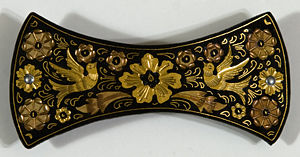
ing different metals into one another—typically, gold
Gold
Gold is a chemical element with the symbol Au and an atomic number of 79. Gold is a dense, soft, shiny, malleable and ductile metal. Pure gold has a bright yellow color and luster traditionally considered attractive, which it maintains without oxidizing in air or water. Chemically, gold is a...
or silver
Silver
Silver is a metallic chemical element with the chemical symbol Ag and atomic number 47. A soft, white, lustrous transition metal, it has the highest electrical conductivity of any element and the highest thermal conductivity of any metal...
into a darkly oxidized steel
Steel
Steel is an alloy that consists mostly of iron and has a carbon content between 0.2% and 2.1% by weight, depending on the grade. Carbon is the most common alloying material for iron, but various other alloying elements are used, such as manganese, chromium, vanadium, and tungsten...
background—to produce intricate patterns similar to niello
Niello
Niello is a black mixture of copper, silver, and lead sulphides, used as an inlay on engraved or etched metal. It can be used for filling in designs cut from metal...
. The English term comes from a perceived resemblance to the rich tapestry
Tapestry
Tapestry is a form of textile art, traditionally woven on a vertical loom, however it can also be woven on a floor loom as well. It is composed of two sets of interlaced threads, those running parallel to the length and those parallel to the width ; the warp threads are set up under tension on a...
patterns of damask
Damask
Damask is a reversible figured fabric of silk, wool, linen, cotton, or synthetic fibers, with a pattern formed by weaving. Damasks are woven with one warp yarn and one weft yarn, usually with the pattern in warp-faced satin weave and the ground in weft-faced or sateen weave...
silk
Silk
Silk is a natural protein fiber, some forms of which can be woven into textiles. The best-known type of silk is obtained from the cocoons of the larvae of the mulberry silkworm Bombyx mori reared in captivity...
.
The technique has a long history in Japan
Japan
Japan is an island nation in East Asia. Located in the Pacific Ocean, it lies to the east of the Sea of Japan, China, North Korea, South Korea and Russia, stretching from the Sea of Okhotsk in the north to the East China Sea and Taiwan in the south...
, where it was used to decorate katana
Katana
A Japanese sword, or , is one of the traditional bladed weapons of Japan. There are several types of Japanese swords, according to size, field of application and method of manufacture.-Description:...
fittings, particularly tsuba. Known as zougan in Japanese, it has developed its own subset of terms to describe the particular patterns, although "shippou-zougan" is an enamelling technique which most Westerners would consider closer to champlevé
Champlevé
Champlevé is an enamelling technique in the decorative arts, or an object made by that process, in which troughs or cells are carved or cast into the surface of a metal object, and filled with vitreous enamel. The piece is then fired until the enamel melts, and when cooled the surface of the object...
.
Damascened-inlay jewelry, especially of Japanese origin, is sometimes referred to as shakudo
Shakudo
Shakudō is a billon of gold and copper , mostly designed for its dark blue-purple patina. It was historically used in Japan to decorate katana fittings such as tsuba and kozuka...
from the use of that alloy
Alloy
An alloy is a mixture or metallic solid solution composed of two or more elements. Complete solid solution alloys give single solid phase microstructure, while partial solutions give two or more phases that may or may not be homogeneous in distribution, depending on thermal history...
as the dark background.
The technique of niello is also famously attested in prehistoric Greece. The earliest occurrence of damascening in the Aegean, from the Shaft Graves of Mycenae, dates to the latest Middle Bronze Age/Middle Helladic IIIB period (dagger Nu-304). Ultimately of Near Eastern provenance, the technique of inlaying silver/gold was adapted to suit Aegean taste and style.
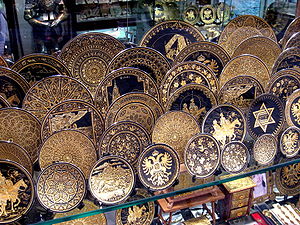
Cities that are known for a rich history in Damascening where the technique is still practiced are Toledo, Spain
Toledo, Spain
Toledo's Alcázar became renowned in the 19th and 20th centuries as a military academy. At the outbreak of the Spanish Civil War in 1936 its garrison was famously besieged by Republican forces.-Economy:...
, and Kyoto, Japan.
External links