
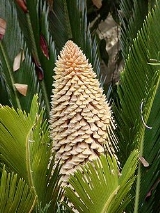
Cycas is the
type genusIn biology, the phrase type genus is used differently depending on the nomenclatural Code that applies:* In zoological nomenclature, a type genus is "The nominal genus that is the name-bearing type of a nominal family-group taxon."...
and the only genus currently recognised in the
cycadCycads are a group of seed plants characterized by a large crown of compound leaves and a stout trunk. They are evergreen, gymnospermous, dioecious plants having large pinnately compound leaves...
family
Cycadaceae. About 95 species are currently accepted. The best-known species is
Cycas revolutaCycas revoluta , is an attractive plant native to southern Japan. Though often known by the common name of king sago palm, or just sago palm, it is not a palm at all, but a cycad....
, widely cultivated under the name "Sago Palm" or "King Sago Palm" due to its palm-like appearance although it is not a true
palmArecaceae or Palmae , the palm family, is a family of flowering plants, the only family in the monocot order Arecales...
. The generic name comes from
GreekGreek , an independent branch of the Indo-European family of languages, is the language of the Greeks. Native to the southern Balkans, it has the longest documented history of any Indo-European language, spanning 34 centuries of written records. In its ancient form, it is the language of classical...
Koikas, and means "a kind of palm".
The genus is native to the
Old WorldThe Old World consists of those parts of Earth known to Europeans, Asians, and Africans in the 15th century.-Regions:The Old World includes Europe, Asia, and Africa , plus surrounding islands...
, with the species concentrated around the
equatorThe equator is the intersection of the Earth's surface with the plane perpendicular to the Earth's axis of rotation and containing the Earth's center of mass. In simpler language, it is an imaginary line on the Earth's surface equidistant from the North Pole and South Pole that divides the Earth...
ial regions.
Cycas is the
type genusIn biology, the phrase type genus is used differently depending on the nomenclatural Code that applies:* In zoological nomenclature, a type genus is "The nominal genus that is the name-bearing type of a nominal family-group taxon."...
and the only genus currently recognised in the
cycadCycads are a group of seed plants characterized by a large crown of compound leaves and a stout trunk. They are evergreen, gymnospermous, dioecious plants having large pinnately compound leaves...
family
Cycadaceae. About 95 species are currently accepted. The best-known species is
Cycas revolutaCycas revoluta , is an attractive plant native to southern Japan. Though often known by the common name of king sago palm, or just sago palm, it is not a palm at all, but a cycad....
, widely cultivated under the name "Sago Palm" or "King Sago Palm" due to its palm-like appearance although it is not a true
palmArecaceae or Palmae , the palm family, is a family of flowering plants, the only family in the monocot order Arecales...
. The generic name comes from
GreekGreek , an independent branch of the Indo-European family of languages, is the language of the Greeks. Native to the southern Balkans, it has the longest documented history of any Indo-European language, spanning 34 centuries of written records. In its ancient form, it is the language of classical...
Koikas, and means "a kind of palm".
The genus is native to the
Old WorldThe Old World consists of those parts of Earth known to Europeans, Asians, and Africans in the 15th century.-Regions:The Old World includes Europe, Asia, and Africa , plus surrounding islands...
, with the species concentrated around the
equatorThe equator is the intersection of the Earth's surface with the plane perpendicular to the Earth's axis of rotation and containing the Earth's center of mass. In simpler language, it is an imaginary line on the Earth's surface equidistant from the North Pole and South Pole that divides the Earth...
ial regions. It is native to eastern and southeastern
AsiaAsia is the world's largest and most populous continent, located in the eastern and northern hemispheres. It covers 8.6% of the earth's total surface area and with approximately 4 billion people, it hosts 60% of the world's current human population.Asia is traditionally defined as part of the...
including the
PhilippinesThe Philippines officially known as the Republic of the Philippines, is a country in Southeast Asia with Manila as its capital city. It comprises 7,107 islands in the western Pacific Ocean....
with 10 species (9 of which are endemic), eastern
AfricaAfrica is the world's second-largest and second most-populous continent, after Asia. At about 30.2 million km² including adjacent islands, it covers 6% of the Earth's total surface area and 20.4% of the total land area. With a billion people in 61 territories, it accounts for about 14.8% of the...
(including
MadagascarMadagascar, or Republic of Madagascar , is an island nation in the Indian Ocean off the southeastern coast of Africa. The main island, also called Madagascar, is the fourth-largest island in the world, and is home to 5% of the world's plant and animal species, of which more than 80% are endemic to...
), northern
AustraliaAustralia , officially the Commonwealth of Australia, is a country in the Southern Hemisphere comprising the continental mainland , the island of Tasmania, and numerous smaller islands in the Indian and Pacific Oceans...
,
PolynesiaPolynesia is a subregion of Oceania, comprising a large grouping of over 1,000 islands scattered over the central and southern Pacific Ocean.-Definition:...
, and
MicronesiaMicronesia is a subregion of Oceania, comprising hundreds of small islands in the western Pacific Ocean. It is distinct from Melanesia to the south, and Polynesia to the east. The Philippines and Indonesia lie to the west....
. Australia has 26 species, while the Indo-Chinese area has about 30. The northernmost species (
C. revoluta) is found at 31°N in southern
Japanis an island country in East Asia. Located in the Pacific Ocean, it lies to the east of the Sea of Japan, People's Republic of China, North Korea, South Korea and Russia, stretching from the Sea of Okhotsk in the north to the East China Sea and Taiwan in the south...
. The southernmost (
C. megacarpa) is found at 26°S in southeast
QueenslandQueensland is a state of Australia that occupies the north-eastern section of the mainland continent. It is bordered by the Northern Territory to the west, South Australia to the south-west and New South Wales to the south. To the east, Queensland is bordered by the Coral Sea and Pacific Ocean...
,
AustraliaAustralia , officially the Commonwealth of Australia, is a country in the Southern Hemisphere comprising the continental mainland , the island of Tasmania, and numerous smaller islands in the Indian and Pacific Oceans...
.
The plants are
dioeciousDioecious species are whose members can produce only one type of gamete; each individual organism belonging to a dioecious species is distinctly male or female . The majority of animal species are dioecious...
, and the family Cycadaceae is unique among the cycads in not forming seed
coneA cone is an organ on plants in the division Pinophyta that contains the reproductive structures. The familiar woody cone is the female cone, which produces seeds. The male cones, which produce pollen, are usually herbaceous and much less conspicuous even at full maturity...
s on female plants, but rather a group of leaf-like structures each with seeds on the lower margins, and pollen cones on male individuals.
The
caudexA caudex is a form of stem morphology appearing as a thickened, short, perennial stem that is either underground or near ground level . It may be swollen for the purpose of water storage, especially in xerophytes...
is cylindrical, surrounded by the persistent
petioleIn botany, the petiole is the small stalk attaching the leaf blade to the stem. The petiole usually has the same internal structure as the stem. Outgrowths appearing on each side of the petiole are called stipules. Leaves lacking a petiole are called sessile, or clasping when they partly...
base. Most species form distinct branched or unbranched trunks but in some species the main trunk can be subterranean with the leaf crown appearing to arise directly from the ground. The leaves are
pinnatePinnate is a term used to describe feather-like or multi-divided features arising from both sides of a common axis in plant or animal structures, and comes from the Latin word pinna meaning "feather", "wing", or "fin". A similar term is pectinate, which refers to a comb-like arrangement of parts...
(or more rarely bipinnate) and arranged spirally, with thick and hard keratinose. The leaflets are articulated, have midrib but lack secondary veins. Megasporophylls are not gathered in cones.
Often considered a
living fossilLiving fossil is an informal term for any living species of organism which appears to be the same as a species otherwise only known from fossils and which has no close living relatives. These species have all survived major extinction events, and generally retain low taxonomic diversities...
, the earliest
fossilFossils are the preserved remains or traces of animals, plants, and other organisms from the remote past. The totality of fossils, both discovered and undiscovered, and their placement in fossiliferous rock formations and sedimentary layers is known as the fossil record...
s of the genus
Cycas appear in the
CenozoicThe Cenozoic Era The Cenozoic (also Cænozoic or Cainozoic) Era The Cenozoic (also Cænozoic or Cainozoic) Era (meaning "new life" (Greek (kainos), "new", and (zoe), "life"), is the most recent of the three classic geological eras and covers the period from 65.5 million years ago to the...
although
Cycas-like fossils that may belong to Cycadaceae extend well into the
MesozoicThe Mesozoic Era is one of three geologic eras of the Phanerozoic eon. The division of time into eras dates back to Giovanni Arduino, in the 18th century, although his original name for the era now called the "Mesozoic" was "Secondary" The Mesozoic Era is one of three geologic eras of the...
.
Cycas is not closely related to other genera of cycads, and phylogenetic studies have shown that Cycadaceae is the sister-group to all other extant cycads.
The plant takes several years to grow, sexual reproduction takes place after 10 years of exclusive vegetative growth.
Species
- Cycas aculeata
Cycas aculeata is a species of cycad in the genus Cycas, native to Vietnam, where it is endemic to a single site on the south slopes of the Hai Van Pass.It has a short subterranean stem 15-18 cm diameter, which bears 6-23 leaves...
- Cycas angulata
Cycas angulata is a species of cycad in the genus Cycas, native to Australia in northeast Northern Territory and northwest Queensland ....
- Cycas annaikalensis
- Cycas apoa
Cycas apoa is a species of cycad in the genus Cycas, native to northern New Guinea. It occurs in the Sepik River basin, in wet lowland forest in modestly seasonally flooded areas....
- Cycas arenicola
Cycas arenicola is a species of cycad in the genus Cycas, native to Australia, in the far north of Northern Territory in the basin of the upper East Alligator River in Arnhem Land. It grows in Eucalyptus woodlands on highly siliceous soils . They thrive in open situations.The stems reach 1.5 m ...
- Cycas armstrongii
Cycas armstrongii is a species of cycad in the genus Cycas, native to Australia, in the northwest of Northern Territory from the Finniss River in the west to the Arnhem Highway to the east....
- Cycas arnhemica
Cycas arnhemica is a species of cycad in the genus Cycas, native to Australia, in the northwest of Northern Territory in Arnhem Land, after which it is named.The stems are erect, growing to 1.5-2.5 m tall...
- Cycas badensis
Cycas badensis is a species of cycad in the genus Cycas, native to Australia, in the extreme north of Queensland, where it is endemic on Badu Island in the Torres Strait Islands....
- Cycas balansae
Cycas balansae is a species of cycad in the genus Cycas, native to southwestern China and adjacent northern Vietnam , where it occurs in dense mountain rainforests....
- Cycas basaltica
Cycas basaltica is a species of cycad in the genus Cycas, native to Australia, in the far north of Western Australia in the Kimberley region....
- Cycas beddomei
Cycas beddomei is a species of cycad in the genus Cycas, native to India, where it is confined to a small area of Andhra Pradesh state in the Cuddapah Hills in scrubland and brush covered hills....
- Cycas bifida
Cycas bifida is a species of cycad plant in the genus Cycas, native to southern China , and northern Vietnam ....
- Cycas bougainvilleana
Cycas bougainvilleana is a species of cycad in the genus Cycas, native to the islands northeast of Papua New Guinea, on New Britain, the Bismarck Archipelago and the Solomon Islands, where it occurs on or near the coast in calcareous coral sand dunes and in adjacent forests.The stems are erect, up...
- Cycas brachycantha
Cycas brachycantha is a species of cycad in the genus Cycas, native to northern Vietnam where it is endemic to Bắc Kạn Province. It grows in often soil-free cracks and crevices of limestone crests and ridges under the canopy of evergreen forests....
- Cycas brunnea
Cycas brunnea is a species of cycad in the genus Cycas, native to northern Australia in northwest Queensland and northeast Northern Territory in a small area straddling the border of the two regions...
- Cycas cairnsiana
Cycas cairnsiana is a species of cycad in the genus Cycas, native to northern Australia in northern Queensland on the Newcastle Range.The stems grow to 2-5 m tall and 12-16 cm diameter, with swollen base...
- Cycas calcicola
Cycas calcicola is a species of cycad in the genus Cycas, native to northern Australia in the northwest of Northern Territory.The stems are erect, 2-5 m tall and 16-22 cm diameter. The leaves are variably deep green and glabrous to white tomentose above, and persistently white tomentose below,...
- Cycas campestris
Cycas campestris is a species of cycad in the genus Cycas, native to southeastern Papua New Guinea in the lowland region near Port Moresby. It grows in open, grassy locations, often in areas with frequent grass fires....
- Cycas candida
- Cycas canalis
Cycas canalis is a species of cycad in the genus Cycas, native to northern Australia in the northwest of Northern Territory, where it occurs in two areas, on the coast at Channel Point, and inland in the Daly River area near Dorisvale....
- Cycas chamaoensis
Cycas chamaoensis is named after the only known habitat of this species, on and near Khao Chamao. Stems are arborescent, either erect or decumbent. Leaves numerous, exceeding 60 per crown, 1.2-2.5 meters in length, ending in terminal spine. Petiole 30–60 cm, glabrous and partially spiny...
- Cycas changjiangensis
- Cycas chevalieri
- Cycas circinalis
Cycas circinalis, also known as the Queen Sago, is a type of cycad that was thought to be linked with the degenerative disease Lytico-Bodig disease on the island of Guam; however, the species native to Guam has since been recognised as a separate species, Cycas micronesica, by K.D...
- Cycas clivicola
- Cycas collina
- Cycas condaoensis
- Cycas conferta
- Cycas couttsiana
- Cycas curranii
- Cycas debaoensis
- Cycas desolata
- Cycas diannanensis
|
Cycas dolichophylla
Cycas edentata
Cycas elephantipes
Cycas elongata
Cycas falcata
Cycas fairylakea
Cycas ferruginea
Cycas fugax
Cycas furfuracea
Cycas guizhouensis
Cycas hainanensis
Cycas hoabinhensis
Cycas hongheensis
Cycas inermis
Cycas javana
Cycas lanepoolei
Cycas lindstromii
Cycas litoralis
Cycas maconochiei
Cycas macrocarpa
Cycas media Cycas media is a palm-like tall shrub native to woodlands of Queensland, Australia. The leathery, thick leaves are divided and grow from the center in a palm-like arrangement. All plant parts are considered highly toxic. However, the seeds are eaten by Aborigines after careful and extensive...
Cycas megacarpa
Cycas micholitzii
Cycas micronesicaCycas micronesica is a type of cycad found in Micronesia , the Marianas Group and the western Caroline Islands. The species, previously lumped with Cycas rumphii or Cycas circinalis, was described in 1994 by Ken Hill...
Cycas multipinnata
Cycas nathorstii
Cycas nongnoochiae
Cycas ophiolitica
Cycas orientis
Cycas pachypoda
Cycas panzhihuaensis
Cycas papuana |
Cycas pectinata
Cycas petraea
Cycas platyphylla
Cycas pranburiensis
Cycas pruinosa Cycas pruinosa is a small to medium species of cycad. It is a widespread but sporadic species in the eastern and southern Kimberley region of Western Australia, occurring also in the Spirit Hills on Bullo River station in the Northern Territory....
Cycas revolutaCycas revoluta , is an attractive plant native to southern Japan. Though often known by the common name of king sago palm, or just sago palm, it is not a palm at all, but a cycad....
Cycas riuminiana
Cycas rumphii
Cycas schumanniana
Cycas scratchleyana
Cycas seemannii A.Braun
Cycas segmentifida
Cycas semota
Cycas sexseminifera
Cycas siamensis
Cycas silvestris
Cycas simplicipinna
Cycas spherica
Cycas szechuanensis
Cycas taitungensisCycas taitungensis is a species of genus Cycas, native to Taitung, Taiwan. C. taitungensis is one of the evergreen trees and can grow up to about 2 meters. It was listed by the IUCN Red List of Threatened Plants in category VU...
Cycas taiwanianaCycas taiwaniana is a species of genus Cycas. The species is native to Guangdong, Guangxi and Fujian of China. Although the specific name of C. taiwaniana is derived from "Taiwan", where the original type specimens was found, it is not naturally distributes in Taiwan. Instead of C. taiwaniana, the...
Cycas tanqingii
Cycas tansachana
Cycas thouarsii
Cycas tropophylla
Cycas tuckeri
Cycas wadei
Cycas xipholepis
Cycas yorkiana
Cycas yunnanensis
Cycas zambalensis
Cycas zeylanica |