
All Topics  
Cycas revoluta

 
Cycas Revoluta

   Email Print
   Bookmark   Link


Cycas revoluta


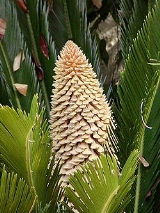
Cycas revoluta (sago cycad), is an attractive plant native to southern Japan
Japan

Japan is an island country in East Asia. Located in the Pacific Ocean, it lies to the east of the Sea of Japan, People's Republic of China, North Korea, South Korea and Russia, stretching from the Sea of Okhotsk in the north to the East China Sea and Taiwan in the south....
. Though often known by the common name of king sago palm, or just sago palm, it is not a palm
Arecaceae

Palm or Palmae or Panamea , the palm family, is a family of flowering plants belonging to the Monocotyledon order, Arecales. There are roughly 202 currently known Genus with around 2600 species, most of which are restricted to tropics, subtropics, and warm temperate climates....
 at all, but a cycad
Cycad

File:Cycad cone.jpgCycads are a group of seed plants characterized by a large crown of compound Leaf and a stout trunk . They are evergreen, gymnospermous, dioecious plants having large pinnately compound leaves....
.

This very symmetrical plant supports a crown of shiny, dark green leaves on a thick shaggy trunk that is typically about 20 cm (8 in.) in diameter, sometimes wider. The trunk is very low to subterranean in young plants, but lengthens above ground with age.


Discussion
Ask a question about 'Cycas revoluta'
Start a new discussion about 'Cycas revoluta'
Answer questions from other users
Full Discussion Forum


Encyclopedia


Cycas revoluta (sago cycad), is an attractive plant native to southern Japan
Japan

Japan is an island country in East Asia. Located in the Pacific Ocean, it lies to the east of the Sea of Japan, People's Republic of China, North Korea, South Korea and Russia, stretching from the Sea of Okhotsk in the north to the East China Sea and Taiwan in the south....
. Though often known by the common name of king sago palm, or just sago palm, it is not a palm
Arecaceae

Palm or Palmae or Panamea , the palm family, is a family of flowering plants belonging to the Monocotyledon order, Arecales. There are roughly 202 currently known Genus with around 2600 species, most of which are restricted to tropics, subtropics, and warm temperate climates....
 at all, but a cycad
Cycad

File:Cycad cone.jpgCycads are a group of seed plants characterized by a large crown of compound Leaf and a stout trunk . They are evergreen, gymnospermous, dioecious plants having large pinnately compound leaves....
.

This very symmetrical plant supports a crown of shiny, dark green leaves on a thick shaggy trunk that is typically about 20 cm (8 in.) in diameter, sometimes wider. The trunk is very low to subterranean in young plants, but lengthens above ground with age. It can grow into very old specimens with 6–7 m (over 20 feet) of trunk; however, the plant is very slow-growing and requires about 50–100 years to achieve this height. Trunks can branch multiple times, thus producing multiple heads of leaves.

Cycadkingsago
The leaves are a deep semiglossy green and about 50–150 cm (18-45 in.) long when the plants are of a reproductive age. They grow out into a feather-like rosette to 1 m (3 feet) in diameter. The crowded, stiff, narrow leaflets are 8–18 cm (~7 in.) long and have strongly recurved or revolute edges. The basal leaflets become more like spines. The petiole or stems of the Sago Cycad are 6–10 cm (2.5-4 in.) long and have small protective barbs that must be avoided.

Propagation of Cycas revoluta is either by seed
Seed

A seed is a small Plant embryogenesis plant enclosed in a covering called the seed coat, usually with some Food storage. It is the product of the ripened ovule of gymnosperm and angiosperm plants which occurs after fertilization and some growth within the mother plant....
 or by removal of basal offsets. As with other cycads, it is dioecious
Plant sexuality

Plant sexuality covers the wide variety of sexual reproduction systems found across the plant kingdom. This article describes Morphology aspects of sexual reproduction of plants....
, with the males bearing cone
Conifer cone

A cone is an organ on plants in the division Pinophyta that contains the plant sexuality structures. The familiar woody cone is the female cone, which produces seeds....
s and the females bearing groups of megasporophylls. Pollination can be done naturally by insect
Insect

Insects are the biggest class of arthropods and the only ones with wings. They are the most diverse group of animals on the planet. They are most diverse at the equator and their diversity declines toward the poles....
s or artificially.

Cultivation and Uses

Cycas revoluta is one of the most widely cultivated cycads, grown outdoors in warm temperate and subtropical regions, or under glass in colder areas. It grows best in sandy, well-drained soil, preferably with some organic matter. It needs good drainage or it will rot. It is fairly drought-tolerant and grows well in full sun or outdoor shade, but needs bright light when grown indoors. The leaves can bleach somewhat if moved from indoors to full sun outdoors.

Of all the cycads, the Sago Palm is the most popular in horticulture
Horticulture

'Horticulture' is the industry and science of plant cultivation. Horticulturists work and conduct research in the disciplines of plant propagation and cultivation, Crop , plant breeding and genetic engineering, plant biochemistry, and plant physiology....
. It is seen in almost all botanical gardens, in both temperate and tropical locations. In many areas of the world, it is heavily promoted commercially as a landscape plant. It is also quite popular as a bonsai
Bonsai

Bonsai 'Bonsai' is a Japanese pronunciation of the earlier Chinese term penzai . The word bonsai is used in the West as an umbrella term for all miniature trees in containers or pots....
 plant. First described in the late 1700s, it is native to various areas of southern Japan and is thus tolerant of mild to somewhat cold temperatures, provided the ground is dry. Frond damage can occur at temperatures below −5 °C. It does however require hot summers with mean temperatures of 30 to 35 °C (86 to 95 F) for successful growth, making outdoor growing impossible in colder places such as northern Europe
Europe

Europe is, conventionally, one of the world's seven continents. Comprising the westernmost peninsula of Eurasia, Europe is generally divided from Asia to its east by the water divide of the Ural Mountains, the Ural , the Caspian Sea, and by the Caucasus Mountains to the southeast....
, even where winter temperatures are not too cold. One disadvantage of its domestic use is that it is poisonous to animals and humans.

Toxicity

Cycad Sago Palm is extremely poisonous to both humans and animals if ingested. Pets are at particular risk since they seem to find the plant very palatable. The ASPCA Animal Poison Control Center estimates a fatality rate of 50 to 75 percent when ingestion of the Sago Palm is involved. The incidence of Sago Palm ingestion by pets has risen by over 200% in the last five years. If any quantity of the plant is ingested, a poison control center or doctor should be contacted immediately. Effects of ingestion can include permanent internal damage and death.

All parts of the plant are toxic; however, the seeds contain the highest level of the toxin cycasin. Cycasin causes gastrointestinal irritation, and in high enough doses, leads to liver failure. Other toxins include Beta-methylamino L-alanine
Beta-methylamino L-alanine

?-Methylamino-L-alanine, or BMAA, is a neurotoxin found in the seeds of the cycad. This non-proteinogenic amino acid is produced by cyanobacteria of the genus Nostoc that live on the plant's roots....
, a neurotoxic amino acid
Amino acid

In chemistry, an amino acid is a molecule containing both amine and carboxyl functional groups. These molecules are particularly important in biochemistry, where this term refers to alpha-amino acids with the general formula H2NCHRCOOH, where R is an organic substituent....
, and an unidentified toxin which has been observed to cause hindlimb paralysis in cattle.

External links

  • - Flavon's Wild herb and Alpine plants