

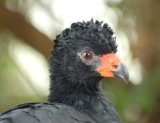
Curassow

Encyclopedia
Curassows are one of the three major groups of cracid
birds. Three of the four genera
are restricted to tropical South America
; a single species
of Crax ranges north to Mexico
. They form a distinct clade
which is usually classified as the subfamily Cracinae.
Genus Mitu
Genus Pauxi
– Helmeted curassows
Horned Curassow or Southern Helmeted Curassow, Pauxi unicornis
Genus Crax
s, true guan
s, and the Horned Guan
), mt and nDNA sequence
data indicates that the curassows diverged from their closest living relatives (probably the guans) at some time during the Oligocene
, or c.35–20 mya (Pereira et al. 2002). This data must be considered preliminary until corroborated by material (e.g. fossil
) evidence however.
What appears certain from analysis of the molecular data, calibrated against geological events that would have induced speciation
is that there are 2 major lineages of curassows: one containing only Crax, and another made up of Mitu and Pauxi. The position of the peculiar Nocturnal Curassow is not well resolved; it might be closer to the latter, but in any case, it diverged around the same time as the split between the two major lineages. All curassow genera appear to have diverged, in fact, during the Tortonian
(early Late Miocene
): the initial split took place some 10–9 mya, and Pauxi diverged from Mitu some 8–7.4 mya (but see genus article).(Pereira & Baker 2004)
Unlike the other cracids, biogeography
and phylogeny indicate that the extant lineages of curassows probably originated in the lowlands of the western/northwestern Amazonas
basin
, most likely in the general area where today, the borders of Brazil
, Peru
, Colombia
and Venezuela
meet. In the two larger genera, vicariant speciation seems to have played a major role.(Pereira et al. 2002, Pereira & Baker 2004)
Cracidae
The chachalacas, guans and curassows are birds in the family Cracidae.These are species of tropical and subtropical Central and South America. One species, the Plain Chachalaca, just reaches southernmost Texas in the USA...
birds. Three of the four genera
Genus
In biology, a genus is a low-level taxonomic rank used in the biological classification of living and fossil organisms, which is an example of definition by genus and differentia...
are restricted to tropical South America
South America
South America is a continent situated in the Western Hemisphere, mostly in the Southern Hemisphere, with a relatively small portion in the Northern Hemisphere. The continent is also considered a subcontinent of the Americas. It is bordered on the west by the Pacific Ocean and on the north and east...
; a single species
Species
In biology, a species is one of the basic units of biological classification and a taxonomic rank. A species is often defined as a group of organisms capable of interbreeding and producing fertile offspring. While in many cases this definition is adequate, more precise or differing measures are...
of Crax ranges north to Mexico
Mexico
The United Mexican States , commonly known as Mexico , is a federal constitutional republic in North America. It is bordered on the north by the United States; on the south and west by the Pacific Ocean; on the southeast by Guatemala, Belize, and the Caribbean Sea; and on the east by the Gulf of...
. They form a distinct clade
Clade
A clade is a group consisting of a species and all its descendants. In the terms of biological systematics, a clade is a single "branch" on the "tree of life". The idea that such a "natural group" of organisms should be grouped together and given a taxonomic name is central to biological...
which is usually classified as the subfamily Cracinae.
- Genus Nothocrax
- Nocturnal CurassowNocturnal CurassowThe Nocturnal Curassow is a species of bird in the Cracidae family.It is found in Brazil, Colombia, Ecuador, Peru, and Venezuela....
,
- Nocturnal Curassow
Mitu (bird)
Mitu is a genus of curassows, large birds in the family Cracidae. They are found in humid tropical forests in South America. Their plumage is iridescent black with a white or rufous crissum and tail-tip, and their legs and bills are red...
- Crestless CurassowCrestless CurassowThe Crestless Curassow is a species of bird in the Cracidae family.It is found in Brazil, Colombia, Guyana, and Venezuela.Its natural habitat is subtropical or tropical moist lowland forests.-References:...
, Mitu tomentosum - Alagoas CurassowAlagoas CurassowThe Alagoas Curassow, Mitu mitu, is a large, mainly glossy black pheasant-like bird. It was formerly found in forests in north-eastern Brazil, but it is now extinct in the wild. A captive population exists...
, Mitu mitu - extinct in the wildExtinct in the WildExtinct in the Wild is a conservation status assigned to species or lower taxa, the only known living members of which are being kept in captivity or as a naturalized population outside its historic range.-Examples:...
(mid-late 1980s) - Salvin's CurassowSalvin's CurassowThe Salvin's Curassow is a species of bird in the Cracidae family.It is found in Colombia, Ecuador, and Peru.Its natural habitat is subtropical or tropical moist lowland forests....
, Mitu salvini - Razor-billed CurassowRazor-billed CurassowThe Razor-billed Curassow is a species of bird in the Cracidae family. It is found throughout a large part of the Amazon Rainforest, though largely restricted to regions south of the Amazon River. Unlike other members of the genus Mitu, its crissum is deep chestnut and the tail-tip is white...
, Mitu tuberosum
Pauxi
The genus Pauxi consist of the two species of helmeted curassows, terrestrial black fowl with ornamental casque on their heads. Both are found in South America.This genus contains only 2 species, namely...
– Helmeted curassows
- Helmeted CurassowHelmeted CurassowThe Helmeted Curassow or Northern Helmeted Curassow, is a large terrestrial black curassow with a small head, large bluish grey casque on forehead, red bill, white-tipped tail feathers, greenish glossed mantle and breast feathers, and white below. Both sexes are similar...
, or Northern Helmeted Curassow
Crax
Crax is a genus of curassows from tropical South America. Only the Great Curassow ranges north through Central America as far as Mexico.The variety of male bill ornament shapes and colors is typical for this genus, as is a curly crest and a contrasting white or rufous crissum...
- Great CurassowGreat CurassowThe Great Curassow is a large, pheasant-like bird from the Neotropics. At in length and in weight, this is a very large cracid. No other cracid match its maximum weight, but its length is matched by a few other cracids....
, Crax rubra - Blue-billed CurassowBlue-billed CurassowThe Blue-knobbed Curassow or Blue-billed Curassow is a species of bird in the Cracidae family, which includes the chachalacas, guans, and curassows....
, Crax alberti - Yellow-knobbed CurassowYellow-knobbed CurassowThe Yellow-knobbed Curassow is a large species of bird found in forest and woodland in Colombia and Venezuela. It feeds mainly on the ground, but flies up into trees if threatened. Its most striking features are its crest, made of feathers that curl forward, and the fleshy yellow knob at the base...
, Crax daubentoni - Wattled CurassowWattled CurassowThe Wattled Curassow is a threatened member of the family Cracidae, the curassows, guans, and chachalacas. It is found in remote rainforests in the western Amazon Basin in South America.-Description:...
, Crax globulosa - Red-billed CurassowRed-billed CurassowThe Red-knobbed Curassow or Red-billed Curassow, Crax blumenbachii, is an endangered species of Cracid that is endemic to lowland Atlantic Forest in the states of Espírito Santo, Bahia and Minas Gerais in southeastern Brazil. Its population is decreasing due to hunting and deforestation, and it has...
Crax blumenbachii - Bare-faced CurassowBare-faced CurassowThe Bare-faced Curassow is a species of bird in the Cracidae family, the chachalacas, guans, curassows, etc.It is found in eastern-central and southern Brazil, Paraguay, and eastern Bolivia, and extreme northeast Argentina, in the cerrado, pantanal, and the southeastern region of the Amazon...
, Crax fasciolata - Black CurassowBlack CurassowThe Black Curassow , also known as the Smooth-billed Curassow, and the Crested Curassow, is a species of bird in the Cracidae family, the chachalacas, guans, and curassows. It is found in humid forests in northern South America in Colombia, Venezuela, the Guianas and far northern Brazil...
, Crax alector
Evolution
In line with the other 3 main lineages of cracids (chachalacaChachalaca
Chachalacas are mainly brown birds from the genus Ortalis. These cracids are found in wooded habitats in far southern United States , Mexico, and Central and South America. They are social, can be very noisy and often remain fairly common even near humans, as their relatively small size makes them...
s, true guan
Guan (bird)
The guans are a number of bird genera which make up the largest group in the family Cracidae. They are found mainly in northern South America, southern Central America, and a few adjacent Caribbean islands...
s, and the Horned Guan
Horned Guan
The Horned Guan, Oreophasis derbianus is a large, approximately 85 cm long, turkey-like bird with glossed black upperparts plumage, red legs, white iris, yellow bill and a red horn on top of head. The breast and upper belly are white, and its long tail feathers are black with white band near...
), mt and nDNA sequence
DNA sequence
The sequence or primary structure of a nucleic acid is the composition of atoms that make up the nucleic acid and the chemical bonds that bond those atoms. Because nucleic acids, such as DNA and RNA, are unbranched polymers, this specification is equivalent to specifying the sequence of...
data indicates that the curassows diverged from their closest living relatives (probably the guans) at some time during the Oligocene
Oligocene
The Oligocene is a geologic epoch of the Paleogene Period and extends from about 34 million to 23 million years before the present . As with other older geologic periods, the rock beds that define the period are well identified but the exact dates of the start and end of the period are slightly...
, or c.35–20 mya (Pereira et al. 2002). This data must be considered preliminary until corroborated by material (e.g. fossil
Fossil
Fossils are the preserved remains or traces of animals , plants, and other organisms from the remote past...
) evidence however.
What appears certain from analysis of the molecular data, calibrated against geological events that would have induced speciation
Speciation
Speciation is the evolutionary process by which new biological species arise. The biologist Orator F. Cook seems to have been the first to coin the term 'speciation' for the splitting of lineages or 'cladogenesis,' as opposed to 'anagenesis' or 'phyletic evolution' occurring within lineages...
is that there are 2 major lineages of curassows: one containing only Crax, and another made up of Mitu and Pauxi. The position of the peculiar Nocturnal Curassow is not well resolved; it might be closer to the latter, but in any case, it diverged around the same time as the split between the two major lineages. All curassow genera appear to have diverged, in fact, during the Tortonian
Tortonian
The Tortonian is in the geologic timescale an age or stage of the late Miocene that spans the time between 11.608 ± 0.005 Ma and 7.246 ± 0.005 Ma . It follows the Serravallian and is followed by the Messinian....
(early Late Miocene
Miocene
The Miocene is a geological epoch of the Neogene Period and extends from about . The Miocene was named by Sir Charles Lyell. Its name comes from the Greek words and and means "less recent" because it has 18% fewer modern sea invertebrates than the Pliocene. The Miocene follows the Oligocene...
): the initial split took place some 10–9 mya, and Pauxi diverged from Mitu some 8–7.4 mya (but see genus article).(Pereira & Baker 2004)
Unlike the other cracids, biogeography
Biogeography
Biogeography is the study of the distribution of species , organisms, and ecosystems in space and through geological time. Organisms and biological communities vary in a highly regular fashion along geographic gradients of latitude, elevation, isolation and habitat area...
and phylogeny indicate that the extant lineages of curassows probably originated in the lowlands of the western/northwestern Amazonas
Amazon Basin
The Amazon Basin is the part of South America drained by the Amazon River and its tributaries that drains an area of about , or roughly 40 percent of South America. The basin is located in the countries of Bolivia, Brazil, Colombia, Ecuador, Guyana, Peru, and Venezuela...
basin
Depression (geology)
A depression in geology is a landform sunken or depressed below the surrounding area. Depressions may be formed by various mechanisms.Structural or tectonic related:...
, most likely in the general area where today, the borders of Brazil
Brazil
Brazil , officially the Federative Republic of Brazil , is the largest country in South America. It is the world's fifth largest country, both by geographical area and by population with over 192 million people...
, Peru
Peru
Peru , officially the Republic of Peru , is a country in western South America. It is bordered on the north by Ecuador and Colombia, on the east by Brazil, on the southeast by Bolivia, on the south by Chile, and on the west by the Pacific Ocean....
, Colombia
Colombia
Colombia, officially the Republic of Colombia , is a unitary constitutional republic comprising thirty-two departments. The country is located in northwestern South America, bordered to the east by Venezuela and Brazil; to the south by Ecuador and Peru; to the north by the Caribbean Sea; to the...
and Venezuela
Venezuela
Venezuela , officially called the Bolivarian Republic of Venezuela , is a tropical country on the northern coast of South America. It borders Colombia to the west, Guyana to the east, and Brazil to the south...
meet. In the two larger genera, vicariant speciation seems to have played a major role.(Pereira et al. 2002, Pereira & Baker 2004)