

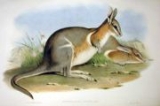
Crescent Nail-tail Wallaby

Encyclopedia
The Crescent Nail-tail Wallaby (Onychogalea lunata) was a nail-tail wallaby
that lived in the woodlands and scrubs of the west and centre of Australia
. It had silky fur and, like other nail-tail wallabies, had a horny spur at the tip of its tail. It was the size of a hare and was the smallest nail-tail wallaby at about 15 inches tall. When it was chased, it tended to seek refuge in a hollow tree. It entered at the bottom, clambered up and appeared at an opening high above. While running, the species held its forelimbs awkwardly and moved them in a rotary motion.
The wallaby
remained common, even in agricultural districts in the south-west of Western Australia
, until about 1900. It had begun a steep decline by 1908, when the last wallaby was caught in the area. The last specimen of this wallaby to be collected alive was caught in a dingo
trap on the Nullarbor Plain
in 1927 or 1928. W.A. Mills sent it to Taronga Zoo
in Sydney
and the animal ended up in the Australian Museum
. The species survived in the more arid parts of its distribution until the 1950s, and it is thought that it became extinct at about 1956, probably because of the spread of the Red Fox
.
Nail-tail wallaby
The nail-tail wallabies are three species of macropod found in Australia. They are distinguished by a horny spur at the end of their tail, and are now generally very rare. Only one species has survived European settlement unscathed: the Crescent Nail-tail is extinct, and the Bridled Nail-tail is...
that lived in the woodlands and scrubs of the west and centre of Australia
Australia
Australia , officially the Commonwealth of Australia, is a country in the Southern Hemisphere comprising the mainland of the Australian continent, the island of Tasmania, and numerous smaller islands in the Indian and Pacific Oceans. It is the world's sixth-largest country by total area...
. It had silky fur and, like other nail-tail wallabies, had a horny spur at the tip of its tail. It was the size of a hare and was the smallest nail-tail wallaby at about 15 inches tall. When it was chased, it tended to seek refuge in a hollow tree. It entered at the bottom, clambered up and appeared at an opening high above. While running, the species held its forelimbs awkwardly and moved them in a rotary motion.
The wallaby
Wallaby
A wallaby is any of about thirty species of macropod . It is an informal designation generally used for any macropod that is smaller than a kangaroo or wallaroo that has not been given some other name.-Overview:...
remained common, even in agricultural districts in the south-west of Western Australia
Western Australia
Western Australia is a state of Australia, occupying the entire western third of the Australian continent. It is bounded by the Indian Ocean to the north and west, the Great Australian Bight and Indian Ocean to the south, the Northern Territory to the north-east and South Australia to the south-east...
, until about 1900. It had begun a steep decline by 1908, when the last wallaby was caught in the area. The last specimen of this wallaby to be collected alive was caught in a dingo
Dingo
The Australian Dingo or Warrigal is a free-roaming wild dog unique to the continent of Australia, mainly found in the outback. Its original ancestors are thought to have arrived with humans from southeast Asia thousands of years ago, when dogs were still relatively undomesticated and closer to...
trap on the Nullarbor Plain
Nullarbor Plain
The Nullarbor Plain is part of the area of flat, almost treeless, arid or semi-arid country of southern Australia, located on the Great Australian Bight coast with the Great Victoria Desert to its north. It is the world's largest single piece of limestone, and occupies an area of about...
in 1927 or 1928. W.A. Mills sent it to Taronga Zoo
Taronga Zoo
Taronga Zoo is the city zoo of Sydney, New South Wales, Australia. Officially opened on 7 October 1916, it is located on the shores of Sydney Harbour in the suburb of Mosman...
in Sydney
Sydney
Sydney is the most populous city in Australia and the state capital of New South Wales. Sydney is located on Australia's south-east coast of the Tasman Sea. As of June 2010, the greater metropolitan area had an approximate population of 4.6 million people...
and the animal ended up in the Australian Museum
Australian Museum
The Australian Museum is the oldest museum in Australia, with an international reputation in the fields of natural history and anthropology. It features collections of vertebrate and invertebrate zoology, as well as mineralogy, palaeontology, and anthropology...
. The species survived in the more arid parts of its distribution until the 1950s, and it is thought that it became extinct at about 1956, probably because of the spread of the Red Fox
Red Fox
The red fox is the largest of the true foxes, as well as being the most geographically spread member of the Carnivora, being distributed across the entire northern hemisphere from the Arctic Circle to North Africa, Central America, and the steppes of Asia...
.