

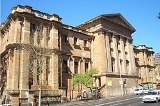
Australian Museum

Encyclopedia
The Australian Museum is the oldest museum
in Australia
, with an international reputation in the fields of natural history
and anthropology
. It features collections of vertebrate
and invertebrate
zoology
, as well as mineralogy
, palaeontology, and anthropology
. Apart from exhibitions, the museum is also involved in indigenous studies research and community programs.
It is located in College Street
, Sydney
and was originally known as the Colonial Museum or Sydney Museum. The museum was renamed in June 1836 by a Sub-Committee meeting, when it was resolved during an argument that it should be renamed the Australian Museum.
 The museum was founded on 30 March 1845, by Earl Bathurst
, then the Secretary of State for the Colonies
, who wrote to the Governor of New South Wales
of his intent to found a public museum, and provisions to provide £200 yearly towards its upkeep.
The establishment of a museum had been planned in 1821 by the Philosophical Society of Australasia, and although specimens were collected, the Society folded in 1822. The year 1826 saw the arrival of entomologist and Fellow of the Linnean Society of London
Alexander Macleay
, who, after being appointed New South Wales Colonial Secretary
, began lobbying for a museum.
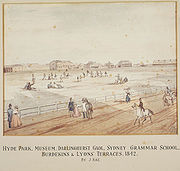
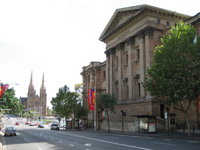
The first location of the museum was likely a room in the offices of the Colonial Secretary, although for the next 30 years it moved to several other locations in Sydney, until moving into its current location in 1849. This handsome sandstone
building on the corner of College and Park Streets, opposite Hyde Park
, was first opened to the public in May 1857. It was designed by the New South Wales Colonial Architect
James Barnet
. The first chairman of the museum was William Holmes, who was appointed on 16 June 1829. He was accidentally shot while at Moreton Bay
on assignment, in August 1831.
 The Museum was administered directly by the colonial government until June 1836, until the establishment of a Committee of Superintendence of the Australian Museum and Botanical Garden. Sub-committees were established for each institution. Members of these committees were generally the ruling members of the political and scientific elite of Sydney; and scions of the Macleay served until 1853, at which point the Committee was abolished. In that year, the government drafted the Australian Museum Act, thereby incorporating
it and establishing a Board of Trustees consisting of 24 members. William Sharp Macleay, the former Committee chairman, continued to serve as the Chairman of this committee.
The first curator of the Australian Museum was well-known naturalist
George Bennett, appointed in 1835, who was the first to catalogue the Museum's collections. After his 1841 resignation, he was succeeded by Rev. W.B. Clarke until 1843, and then by William Sheridan Wall, a longtime collector with the Museum.In these early years, collecting was the main priority of the Museum. Specimens were commonly traded with English and European institutions.
The scientific stature of the Museum was established under the curatorship of Gerard Krefft
, who served until 1874, himself a well-published scientist. His successor, Edward Pierson Ramsay
, who served until 1894, greatly increased the recruitment of scientific staff within the institution. The museum catalogues, first documented by Bennett, were the first scientific publications by the Museum, but with the addition of science staff, and thereby, research output, in 1890 Ramsay started the Records of the Australian Museum a publication which continues to this day.
In 1918, the position of Curator was renamed Director and Curator, and from 1921, Director. In 1948, the Scientific Assistants (the scientific staff) were redesignated Curators and Assistant Curators. In 1983, during a period of reorganisation, the position of Curator was changed, becoming Collection Manager.
During the 19th century, galleries mainly included large display cases overly filled with specimens and artifacts. Displays grew to include diorama
s showing habitat groups beginning in the 1920s, but otherwise, the Museum was largely unchanged during the timespan beginning with the curatorship of Robert Etheridge Jr (1895–1919), until 1954, with the appointment of John Evans. Under his direction, additional buildings were built, several galleries were entirely overhauled, and a new Exhibitions department was created. The size of the education staff was also radically increased. By the end of the 1950s, all of the galleries had been completely overhauled.
The Museum's growth in the field of scientific research continued with Frank Talbot, who succeeded Evans in 1966, and a new department of Environmental Studies
was created in 1968. The museum support society TAMS (The Australian Museum Society) was formed in 1972, and in 1973 the Lizard Island Research Station (LIMS), was established near Cairns
.
Officially launched on 8 March 1978 was the Australian Museum Exhibition Train. The train was described as 'a wonderful new concept of the travelling circus! The only difference is that the travelling Museum Train will bring school children and the people of NSW into contact with the wonders of nature, evolution and Wildlife.' The 2-carriage Museum Train was renovated and refurbished at Eveleigh Carriage Works, and fitted out with exhibits by the Australian Museum at a cost of about $100,000. One carriage displayed the evolution of the earth, animals and man. The second carriage was a lecture and visual display area. It was expected to take 2 years to visit all NSW centres connected by rail.
Director Des Griffin, the successor to Talbot, oversaw extensions to the original Museum building, which were completed in 1988. His direction saw increased cooperation with Aborigines, leading to new exhibitions and policies, as well as repatriations of artefacts.
In 1991, the museum established Australian Museum Business Services (AMBS), a commercial consulting and project management consulting group. AMBS initially undertook ecological, Australian Aboriginal archaeological and exhibitions management consulting projects for a range of clients, and since 2007 has included historic heritage and archaeology in its range of expertise.
In 1995, the museum established new research centres in Conservation
, Biodiversity
, Evolutionary Research
, Geodiversity
, and People and Places. In 1998, the djamu gallery opened at Customs House
, Circular Quay, the first major new venue for the Museum beyond College Street site. A series of exhibitions on Indigenous culture were displayed until the gallery closed at the end of 2000.
The current director is Frank Howarth
.
Museum
A museum is an institution that cares for a collection of artifacts and other objects of scientific, artistic, cultural, or historical importance and makes them available for public viewing through exhibits that may be permanent or temporary. Most large museums are located in major cities...
in Australia
Australia
Australia , officially the Commonwealth of Australia, is a country in the Southern Hemisphere comprising the mainland of the Australian continent, the island of Tasmania, and numerous smaller islands in the Indian and Pacific Oceans. It is the world's sixth-largest country by total area...
, with an international reputation in the fields of natural history
Natural history
Natural history is the scientific research of plants or animals, leaning more towards observational rather than experimental methods of study, and encompasses more research published in magazines than in academic journals. Grouped among the natural sciences, natural history is the systematic study...
and anthropology
Anthropology
Anthropology is the study of humanity. It has origins in the humanities, the natural sciences, and the social sciences. The term "anthropology" is from the Greek anthrōpos , "man", understood to mean mankind or humanity, and -logia , "discourse" or "study", and was first used in 1501 by German...
. It features collections of vertebrate
Vertebrate
Vertebrates are animals that are members of the subphylum Vertebrata . Vertebrates are the largest group of chordates, with currently about 58,000 species described. Vertebrates include the jawless fishes, bony fishes, sharks and rays, amphibians, reptiles, mammals, and birds...
and invertebrate
Invertebrate
An invertebrate is an animal without a backbone. The group includes 97% of all animal species – all animals except those in the chordate subphylum Vertebrata .Invertebrates form a paraphyletic group...
zoology
Zoology
Zoology |zoölogy]]), is the branch of biology that relates to the animal kingdom, including the structure, embryology, evolution, classification, habits, and distribution of all animals, both living and extinct...
, as well as mineralogy
Mineralogy
Mineralogy is the study of chemistry, crystal structure, and physical properties of minerals. Specific studies within mineralogy include the processes of mineral origin and formation, classification of minerals, their geographical distribution, as well as their utilization.-History:Early writing...
, palaeontology, and anthropology
Anthropology
Anthropology is the study of humanity. It has origins in the humanities, the natural sciences, and the social sciences. The term "anthropology" is from the Greek anthrōpos , "man", understood to mean mankind or humanity, and -logia , "discourse" or "study", and was first used in 1501 by German...
. Apart from exhibitions, the museum is also involved in indigenous studies research and community programs.
It is located in College Street
College Street, Sydney
College Street in Sydney, New South Wales, Australia is a major street in the centre of the Central Business District. It runs from Queens Square near St James station to Whitlam Square at Liverpool St...
, Sydney
Sydney
Sydney is the most populous city in Australia and the state capital of New South Wales. Sydney is located on Australia's south-east coast of the Tasman Sea. As of June 2010, the greater metropolitan area had an approximate population of 4.6 million people...
and was originally known as the Colonial Museum or Sydney Museum. The museum was renamed in June 1836 by a Sub-Committee meeting, when it was resolved during an argument that it should be renamed the Australian Museum.
History
Earl Bathurst
Earl Bathurst, of Bathurst in the County of Sussex, is a title in the Peerage of Great Britain. It was created in 1772 for Allen Bathurst, 1st Baron Bathurst. He was a politician and an opponent of Sir Robert Walpole...
, then the Secretary of State for the Colonies
Secretary of State for the Colonies
The Secretary of State for the Colonies or Colonial Secretary was the British Cabinet minister in charge of managing the United Kingdom's various colonial dependencies....
, who wrote to the Governor of New South Wales
New South Wales
New South Wales is a state of :Australia, located in the east of the country. It is bordered by Queensland, Victoria and South Australia to the north, south and west respectively. To the east, the state is bordered by the Tasman Sea, which forms part of the Pacific Ocean. New South Wales...
of his intent to found a public museum, and provisions to provide £200 yearly towards its upkeep.
The establishment of a museum had been planned in 1821 by the Philosophical Society of Australasia, and although specimens were collected, the Society folded in 1822. The year 1826 saw the arrival of entomologist and Fellow of the Linnean Society of London
Linnean Society of London
The Linnean Society of London is the world's premier society for the study and dissemination of taxonomy and natural history. It publishes a zoological journal, as well as botanical and biological journals...
Alexander Macleay
Alexander Macleay
Hon. Alexander Macleay MLC FLS FRS was a leading member of the Linnean Society and a fellow of the Royal Society.Macleay was born on Ross-shire, Scotland, eldest son of William Macleay, provost of Wick...
, who, after being appointed New South Wales Colonial Secretary
Chief Secretary
The Chief Secretary is the title of a senior civil servant in members of the Commonwealth of Nations, and, historically, in the British Empire. Prior to the dissolution of the colonies, the Chief Secretary was the second most important official in a colony of the British Empire after the...
, began lobbying for a museum.
The first location of the museum was likely a room in the offices of the Colonial Secretary, although for the next 30 years it moved to several other locations in Sydney, until moving into its current location in 1849. This handsome sandstone
Sandstone
Sandstone is a sedimentary rock composed mainly of sand-sized minerals or rock grains.Most sandstone is composed of quartz and/or feldspar because these are the most common minerals in the Earth's crust. Like sand, sandstone may be any colour, but the most common colours are tan, brown, yellow,...
building on the corner of College and Park Streets, opposite Hyde Park
Hyde Park, Sydney
Hyde Park is a large park in Sydney, New South Wales, Australia. Hyde Park is on the eastern side of the Sydney central business district. It is the southernmost of a chain of parkland that extends north to the shore of Port Jackson . It is approximately rectangular in shape, being squared at the...
, was first opened to the public in May 1857. It was designed by the New South Wales Colonial Architect
New South Wales Government Architect
The New South Wales Government Architect is an officer of the New South Wales government. Historically, the government architect was in charge of the state government's public building projects....
James Barnet
James Barnet
James Johnstone Barnet was the Colonial Architect for New South Wales from 1862 - 1890.-Life and career:Barnet was born at Almericlose, Arbroath, Scotland. The son of a builder, he was educated at the local high school...
. The first chairman of the museum was William Holmes, who was appointed on 16 June 1829. He was accidentally shot while at Moreton Bay
Moreton Bay
Moreton Bay is a bay on the eastern coast of Australia 45 km from Brisbane, Queensland. It is one of Queensland's most important coastal resources...
on assignment, in August 1831.
Incorporation (business)
Incorporation is the forming of a new corporation . The corporation may be a business, a non-profit organisation, sports club, or a government of a new city or town...
it and establishing a Board of Trustees consisting of 24 members. William Sharp Macleay, the former Committee chairman, continued to serve as the Chairman of this committee.
The first curator of the Australian Museum was well-known naturalist
Natural history
Natural history is the scientific research of plants or animals, leaning more towards observational rather than experimental methods of study, and encompasses more research published in magazines than in academic journals. Grouped among the natural sciences, natural history is the systematic study...
George Bennett, appointed in 1835, who was the first to catalogue the Museum's collections. After his 1841 resignation, he was succeeded by Rev. W.B. Clarke until 1843, and then by William Sheridan Wall, a longtime collector with the Museum.In these early years, collecting was the main priority of the Museum. Specimens were commonly traded with English and European institutions.
The scientific stature of the Museum was established under the curatorship of Gerard Krefft
Gerard Krefft
Johann Ludwig Gerard Krefft , one of Australia's first and greatest zoologists and palaeontologists. In addition to many scientific papers, his books include The Snakes of Australia, A Catalogue of the Minerals and Rocks in the Australian Museum and A Short Guide to the Australian Fossil Remains...
, who served until 1874, himself a well-published scientist. His successor, Edward Pierson Ramsay
Edward Pierson Ramsay
Edward Pierson Ramsay was an Australian zoologist who specialised in ornithology.-Early life:Pierson was born in Dobroyd Estate, Long Cove, Sydney and educated at St Mark's Collegiate School, The King's School, Parramatta...
, who served until 1894, greatly increased the recruitment of scientific staff within the institution. The museum catalogues, first documented by Bennett, were the first scientific publications by the Museum, but with the addition of science staff, and thereby, research output, in 1890 Ramsay started the Records of the Australian Museum a publication which continues to this day.
In 1918, the position of Curator was renamed Director and Curator, and from 1921, Director. In 1948, the Scientific Assistants (the scientific staff) were redesignated Curators and Assistant Curators. In 1983, during a period of reorganisation, the position of Curator was changed, becoming Collection Manager.
During the 19th century, galleries mainly included large display cases overly filled with specimens and artifacts. Displays grew to include diorama
Diorama
The word diorama can either refer to a nineteenth century mobile theatre device, or, in modern usage, a three-dimensional full-size or miniature model, sometimes enclosed in a glass showcase for a museum...
s showing habitat groups beginning in the 1920s, but otherwise, the Museum was largely unchanged during the timespan beginning with the curatorship of Robert Etheridge Jr (1895–1919), until 1954, with the appointment of John Evans. Under his direction, additional buildings were built, several galleries were entirely overhauled, and a new Exhibitions department was created. The size of the education staff was also radically increased. By the end of the 1950s, all of the galleries had been completely overhauled.
The Museum's growth in the field of scientific research continued with Frank Talbot, who succeeded Evans in 1966, and a new department of Environmental Studies
Environmental science
Environmental science is an interdisciplinary academic field that integrates physical and biological sciences, to the study of the environment, and the solution of environmental problems...
was created in 1968. The museum support society TAMS (The Australian Museum Society) was formed in 1972, and in 1973 the Lizard Island Research Station (LIMS), was established near Cairns
Cairns, Queensland
Cairns is a regional city in Far North Queensland, Australia, founded 1876. The city was named after William Wellington Cairns, then-current Governor of Queensland. It was formed to serve miners heading for the Hodgkinson River goldfield, but experienced a decline when an easier route was...
.
Officially launched on 8 March 1978 was the Australian Museum Exhibition Train. The train was described as 'a wonderful new concept of the travelling circus! The only difference is that the travelling Museum Train will bring school children and the people of NSW into contact with the wonders of nature, evolution and Wildlife.' The 2-carriage Museum Train was renovated and refurbished at Eveleigh Carriage Works, and fitted out with exhibits by the Australian Museum at a cost of about $100,000. One carriage displayed the evolution of the earth, animals and man. The second carriage was a lecture and visual display area. It was expected to take 2 years to visit all NSW centres connected by rail.
Director Des Griffin, the successor to Talbot, oversaw extensions to the original Museum building, which were completed in 1988. His direction saw increased cooperation with Aborigines, leading to new exhibitions and policies, as well as repatriations of artefacts.
In 1991, the museum established Australian Museum Business Services (AMBS), a commercial consulting and project management consulting group. AMBS initially undertook ecological, Australian Aboriginal archaeological and exhibitions management consulting projects for a range of clients, and since 2007 has included historic heritage and archaeology in its range of expertise.
In 1995, the museum established new research centres in Conservation
Conservation biology
Conservation biology is the scientific study of the nature and status of Earth's biodiversity with the aim of protecting species, their habitats, and ecosystems from excessive rates of extinction...
, Biodiversity
Biodiversity
Biodiversity is the degree of variation of life forms within a given ecosystem, biome, or an entire planet. Biodiversity is a measure of the health of ecosystems. Biodiversity is in part a function of climate. In terrestrial habitats, tropical regions are typically rich whereas polar regions...
, Evolutionary Research
Evolution
Evolution is any change across successive generations in the heritable characteristics of biological populations. Evolutionary processes give rise to diversity at every level of biological organisation, including species, individual organisms and molecules such as DNA and proteins.Life on Earth...
, Geodiversity
Geodiversity
Geodiversity is the variety of earth materials, forms and processes that constitute and shape the Earth, either the whole or a specific part of it. Relevant materials include minerals, rocks, sediments, fossils, soils and water. Forms may comprise folds, faults, landforms and other expressions of...
, and People and Places. In 1998, the djamu gallery opened at Customs House
Customs House, Sydney
The Customs House is an historic Sydney landmark located in the city's Circular Quay area. Constructed initially in 1844-1845, the building served as the headquarters of the Customs Service until 1990. Ownership was then transferred from the Commonwealth Government of Australia to the City of...
, Circular Quay, the first major new venue for the Museum beyond College Street site. A series of exhibitions on Indigenous culture were displayed until the gallery closed at the end of 2000.
The current director is Frank Howarth
Frank Howarth
Frank Richard Howarth is an Australian public servant, and has been the Director of the Australian Museum since February 2004....
.