
All Topics  
Courts of England and Wales


   Email Print
   Bookmark   Link


Courts of England and Wales


Her Majesty's Courts of Justice of England and Wales are the civil
Civil law (common law)

Civil law, as opposed to criminal law, refers to that branch of law dealing with disputes between individuals and/or organizations, in which damages may be awarded to the victim....
 and criminal
Criminal law

The term criminal law, sometimes called penal law, refers to any of various bodies of rules in different jurisdictions whose common characteristic is the potential for unique and often severe impositions as punishment for failure to comply....
 court
Court

A court is a body, often a government institution, with the authority to adjudication legal disputes and dispense private law, criminal justice, or administrative law justice in accordance with rules of law....
s responsible for the administration of justice
Justice

Justice is the concept of morality rightness based on ethics, rationality, law, natural law, fairness and equity."...
 in England and Wales
England and Wales

England and Wales is a legal unit within the United Kingdom. It consists of England and Wales, two of the four countries of the United Kingdom....
; they apply the law of England and Wales and are established under Acts of the Parliament of the United Kingdom
Parliament of the United Kingdom

The Parliament of the United Kingdom of Great Britain and Northern Ireland is the supreme legislature in the United Kingdom and British overseas territories....
.

The United Kingdom
United Kingdom

The United Kingdom of Great Britain and Northern Ireland, commonly known as the United Kingdom , the UK or Britain,is a sovereign state located off the northwestern coast of continental Europe....
 does not have a single unified judicial system—England and Wales
England and Wales

England and Wales is a legal unit within the United Kingdom. It consists of England and Wales, two of the four countries of the United Kingdom....
 have one system, Scotland
Courts of Scotland

The civil law , criminal law and heraldry court of law of Scotland are responsible for the administration of justice. They are constituted and governed by Scots law....
 another, and Northern Ireland
Courts of Northern Ireland

The courts of Northern Ireland are the Civil law and Criminal law court responsible for the administration of justice in Northern Ireland: they are constituted and governed by Northern Ireland law....
 a third. There are exceptions to this rule; for example in immigration law
Immigration law

Immigration law refers to national government policies which control the phenomenon of immigration to their country.Immigration law, regarding foreign citizens, is related to nationality law, which governs the legal status of people, in matters such as citizenship....
, the Asylum and Immigration Tribunal
Asylum and Immigration Tribunal

The Asylum and Immigration Tribunal is a tribunal constituted in the United Kingdom with jurisdiction to hear appeals from many immigration and Right of asylum decisions....
's jurisdiction covers the whole of the United Kingdom, while in employment law there is a single system of Employment Tribunal
Employment tribunal

Employment Tribunals are tribunal non-departmental public bodies in England and Wales and Scotland which have statute jurisdiction to hear many kinds of disputes between employers and employees....
s for England, Wales, and Scotland (but not Northern Ireland).

The Court of Appeal, the High Court, the Crown Court, the Magistrates' Courts, and the County Courts are administered by Her Majesty's Courts Service
Her Majesty's Courts Service

Her Majesty's Courts Service is an executive agency of the Ministry of Justice and is responsible for the administration of the civil, family and criminal courts in England and Wales....
, an executive agency of the Ministry of Justice
Ministry of Justice (United Kingdom)

The Ministry of Justice has been a department of the Her Majesty's Government since 2007. It was created on 9 May 2007 by merging the Department for Constitutional Affairs with parts of the Home Office responsible for criminal justice policy, sentencing policy, probation, prisons and prevention of re-offending in England and Wales....
.

House of Lords
House of Lords

The House of Lords is the second house of the Parliament of the United Kingdom and is also commonly referred to as "the Lords". The Parliament comprises the British monarchy, the British House of Commons , and the Lords....
 is the highest appeal court in almost all cases in England and Wales.


Discussion
Ask a question about 'Courts of England and Wales'
Start a new discussion about 'Courts of England and Wales'
Answer questions from other users
Full Discussion Forum


Recent Posts


Encyclopedia


Her Majesty's Courts of Justice of England and Wales are the civil
Civil law (common law)

Civil law, as opposed to criminal law, refers to that branch of law dealing with disputes between individuals and/or organizations, in which damages may be awarded to the victim....
 and criminal
Criminal law

The term criminal law, sometimes called penal law, refers to any of various bodies of rules in different jurisdictions whose common characteristic is the potential for unique and often severe impositions as punishment for failure to comply....
 court
Court

A court is a body, often a government institution, with the authority to adjudication legal disputes and dispense private law, criminal justice, or administrative law justice in accordance with rules of law....
s responsible for the administration of justice
Justice

Justice is the concept of morality rightness based on ethics, rationality, law, natural law, fairness and equity."...
 in England and Wales
England and Wales

England and Wales is a legal unit within the United Kingdom. It consists of England and Wales, two of the four countries of the United Kingdom....
; they apply the law of England and Wales and are established under Acts of the Parliament of the United Kingdom
Parliament of the United Kingdom

The Parliament of the United Kingdom of Great Britain and Northern Ireland is the supreme legislature in the United Kingdom and British overseas territories....
.

The United Kingdom
United Kingdom

The United Kingdom of Great Britain and Northern Ireland, commonly known as the United Kingdom , the UK or Britain,is a sovereign state located off the northwestern coast of continental Europe....
 does not have a single unified judicial system—England and Wales
England and Wales

England and Wales is a legal unit within the United Kingdom. It consists of England and Wales, two of the four countries of the United Kingdom....
 have one system, Scotland
Courts of Scotland

The civil law , criminal law and heraldry court of law of Scotland are responsible for the administration of justice. They are constituted and governed by Scots law....
 another, and Northern Ireland
Courts of Northern Ireland

The courts of Northern Ireland are the Civil law and Criminal law court responsible for the administration of justice in Northern Ireland: they are constituted and governed by Northern Ireland law....
 a third. There are exceptions to this rule; for example in immigration law
Immigration law

Immigration law refers to national government policies which control the phenomenon of immigration to their country.Immigration law, regarding foreign citizens, is related to nationality law, which governs the legal status of people, in matters such as citizenship....
, the Asylum and Immigration Tribunal
Asylum and Immigration Tribunal

The Asylum and Immigration Tribunal is a tribunal constituted in the United Kingdom with jurisdiction to hear appeals from many immigration and Right of asylum decisions....
's jurisdiction covers the whole of the United Kingdom, while in employment law there is a single system of Employment Tribunal
Employment tribunal

Employment Tribunals are tribunal non-departmental public bodies in England and Wales and Scotland which have statute jurisdiction to hear many kinds of disputes between employers and employees....
s for England, Wales, and Scotland (but not Northern Ireland).

The Court of Appeal, the High Court, the Crown Court, the Magistrates' Courts, and the County Courts are administered by Her Majesty's Courts Service
Her Majesty's Courts Service

Her Majesty's Courts Service is an executive agency of the Ministry of Justice and is responsible for the administration of the civil, family and criminal courts in England and Wales....
, an executive agency of the Ministry of Justice
Ministry of Justice (United Kingdom)

The Ministry of Justice has been a department of the Her Majesty's Government since 2007. It was created on 9 May 2007 by merging the Department for Constitutional Affairs with parts of the Home Office responsible for criminal justice policy, sentencing policy, probation, prisons and prevention of re-offending in England and Wales....
.

Appellate Committee of the House of Lords

The House of Lords
House of Lords

The House of Lords is the second house of the Parliament of the United Kingdom and is also commonly referred to as "the Lords". The Parliament comprises the British monarchy, the British House of Commons , and the Lords....
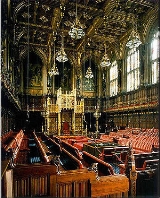
 is the highest appeal court in almost all cases in England and Wales. The judicial functions of the House of Lords are entirely separate from its legislative role with only the Law Lords hearing the appeals from the Court of Appeal and the High Court. Its decisions are binding on all lower courts.

Its judicial functions were abolished by the Supreme Court of Judicature Act 1873
Supreme Court of Judicature Act 1873

The Judicature Act 1873 was an Act of Parliament by the Parliament of the United Kingdom in 1873. It reorganized the English court system to establish the High Court of England and Wales and the Court of Appeal of England and Wales, and also originally provided for the abolition of the judicial functions of the House of Lords with respect to...
, but an election was held before the act came into force, and the new Parliament
Parliament of the United Kingdom

The Parliament of the United Kingdom of Great Britain and Northern Ireland is the supreme legislature in the United Kingdom and British overseas territories....
 passed the Supreme Court of Judicature Act 1875 which amended the first Act to preserve the House of Lords' judicial function. The Constitutional Reform Act 2005
Constitutional Reform Act 2005

The Constitutional Reform Act 2005 is an Act of Parliament of the Parliament of the United Kingdom. It provides for a Supreme Court of the United Kingdom to take over the existing role of the Law Lords and some powers of the Judicial Committee of the Privy Council, and remove the functions of Speaker of the House of Lords and Head of the Jud...
 will transfer these functions to the Supreme Court of the United Kingdom
Supreme Court of the United Kingdom

The Supreme Court of the United Kingdom was established in law by Part III of the Constitutional Reform Act 2005. The Lord Chancellor has announced that it will start work in October 2009 once its new premises are ready....
. The House is also the court of trial in impeachment
Impeachment

Impeachment is the first of two stages in a specific process for a legislative body to consider whether or not to forcibly remove a government official from office....
 cases, although impeachment in England is now obsolete.

Judicial Committee of the Privy Council

The Privy Council is the highest court of appeal for the UK in a handful of areas of law, notably devolution
Devolution

Devolution is the Statute granting of powers from the central government of a state to government at a subnational level, such as a regional, local, or state level....
 matters. In addition, it is the highest court of appeal for a dwindling number of Commonwealth
Commonwealth of Nations

The Commonwealth of Nations, also known as the Commonwealth or the British Commonwealth, is an intergovernmental organization of fifty-three independent member states....
 countries and the Channel Islands and the Isle of Man. The judges who sit on the Privy Council are for the most part also members of the Appellate Committee of the House of Lords.

The Supreme Court of England and Wales

Middlesex
The Supreme Court was created by the Judicature Acts as "Supreme Court of Judicature". It was renamed the Supreme Court of England and Wales in 1981. It is the most important superior court of England and Wales. It consists of the following courts:

  • Court of Appeal
    Court of Appeal of England and Wales

    The Court of Appeal of England and Wales is the second most senior court in the Courts of England and Wales, with only the Judicial functions of the House of Lords above it....
  • High Court of Justice
    High Court of Justice

    The High Court of Justice is, together with the Crown Court and the Court of Appeal of England and Wales, part of the Courts of England and Wales ....
  • Crown Court
    Crown Court

    The Crown Court of England and Wales is, together with the High Court of Justice of England and Wales and the Court of Appeal of England and Wales, one of the constituent parts of the Supreme Court of Judicature in England and Wales....


When all the provisions of the Constitutional Reform Act 2005
Constitutional Reform Act 2005

The Constitutional Reform Act 2005 is an Act of Parliament of the Parliament of the United Kingdom. It provides for a Supreme Court of the United Kingdom to take over the existing role of the Law Lords and some powers of the Judicial Committee of the Privy Council, and remove the functions of Speaker of the House of Lords and Head of the Jud...
 come into force the courts comprised in the present Supreme Court of England and Wales will become known as the Senior Courts of England and Wales. This change is being made consequent to the establishment of the Supreme Court of the United Kingdom
Supreme Court of the United Kingdom

The Supreme Court of the United Kingdom was established in law by Part III of the Constitutional Reform Act 2005. The Lord Chancellor has announced that it will start work in October 2009 once its new premises are ready....
 by that Act.

Court of Appeal

English Court System
The Court of Appeal deals only with appeals from other courts. The Court of Appeal consists of two divisions: the Civil Division hears appeals from the High Court and County Court and certain superior tribunals, while the Criminal Division may only hear appeals from the Crown Court connected with a trial on indictment (i.e. trial by judge and jury (the jury is only present if the defendant pleads "not guilty")). Its decisions are binding on all courts apart from the House of Lords
House of Lords

The House of Lords is the second house of the Parliament of the United Kingdom and is also commonly referred to as "the Lords". The Parliament comprises the British monarchy, the British House of Commons , and the Lords....
.

High Court

The High Court of Justice functions both as a civil court of first instance
Trial court

A trial court or court of first instance is a court in which trials take place.A trial court of general jurisdiction is authorized to hear any type of Civil law or Criminal law Legal case that is not committed exclusively to another court....
 and a criminal appellate court
Appellate court

An appellate court is any court of law that is empowered to hear an appeal of a trial court or other lower tribunal. In most jurisdictions, the court system is divided into at least three levels: the trial court, which initially hears cases and reviews evidence and testimony to determine the facts of the case; at least one intermediate appell...
 for cases from the subordinate courts. It consists of three divisions: the Queen's Bench, the Chancery and the Family divisions. The divisions of the High Court are not separate courts. Although particular kinds of cases will be assigned to each division depending on their subject matter, each division may exercise the jurisdiction of the High Court. However, beginning proceedings in the wrong division may result in a costs penalty.

Crown Court

Courtsoxford20060325 Kaihsutai
The Crown Court is a criminal court of both original and appellate jurisdiction which in addition handles a limited amount of civil business both at first instance and on appeal. It was established by the Courts Act
Courts Act 1971

The Courts Act 1971 is an Act of Parliament of the Parliament of the United Kingdom the purpose of which was to reform and modernise the courts system of England and Wales....
 of 1971. It replaced the Assizes
Assize Court

The Court of Assize, or Assizes, refers to an obsolete circuit criminal court in most common-law contexts, but is still in use elsewhere, e.g., Assizes of Jerusalem....
 whereby High Court judges would periodically travel around the country hearing cases, and Quarter Sessions
Quarter Sessions

The Courts of Quarter Sessions or Quarter Sessions were periodic courts held in each county and county borough in England and Wales until 1972, when together with the Assize courts they were abolished by the Courts Act 1971 and replaced by a single permanent Crown Court of England and Wales for England and Wales....
 which were periodic county courts. The Old Bailey is the unofficial name of London's most famous Criminal Court, which is now part of the Crown Court. Its official name is the "Central Criminal Court". The Crown Court also hears appeals from Magistrates' Court
Magistrates' Court

A magistrates' court or court of petty sessions, formerly known as a police court, is the lowest level of Courts of England and Wales in England and Wales and many other common law jurisdictions....
s.

The Crown Court is the only court in England and Wales that has the jurisdiction to try cases on indictment and when exercising such a role it is a superior court in that its judgments cannot be reviewed by the Administrative Court of the Queen’s Bench Division of the High Court.

The Crown Court is an inferior court in respect of the other work it undertakes, viz. inter alia, appeals from the Magistrates’ court and other tribunals.

Subordinate courts


The most common subordinate courts in England and Wales are the

  • Magistrates' Court
    Magistrates' Court

    A magistrates' court or court of petty sessions, formerly known as a police court, is the lowest level of Courts of England and Wales in England and Wales and many other common law jurisdictions....
    s
  • Family Proceedings Court
    Family Proceedings Court

    The Family Proceedings Court is the name given to the Magistrates? Court when members of the family panel sit to hear a family case. It is a court of first instance in England and Wales that deals with family matters....
    s
  • Youth courts
  • County Court
    County Court

    A county court is a court based in or with a jurisdiction covering one or more county, which are administrative divisions within a country....
    s


Magistrates', Family Proceedings and Youth Courts

Magistrates' Courts are presided over by a bench of lay magistrates (or justices of the peace), or a legally-trained district judge (formerly known as a stipendiary magistrate), sitting in each local justice area. There are no juries
Jury

A jury is a sworn body of people convened to render a rationalism, impartiality verdict officially submitted to them by a court, or to set a sentence or judgment....
. They hear minor criminal cases, as well as certain licensing applications. Youth courts are run on similar lines to Adult magistrates' courts but deal with offenders aged between the ages of 10 and 17 inclusive. Youth courts are presided over by a specially trained subset of experienced Adult Magistrates or a District Judge. Youth Magistrates have a wider catalogue of disposals available to them for dealing with young offenders and often hear more serious cases against youths (which for adults would normally be dealt with by the Crown Court). In addition some Magistrates' Courts are also a Family Proceedings Court
Family Proceedings Court

The Family Proceedings Court is the name given to the Magistrates? Court when members of the family panel sit to hear a family case. It is a court of first instance in England and Wales that deals with family matters....
 and hear Family law cases including care cases and they have the power to make adoption orders. Family Proceedings Courts are not open to the public. The Family Proceedings Court Rules 1991 apply to cases in the Family Proceedings Court
Family Proceedings Court

The Family Proceedings Court is the name given to the Magistrates? Court when members of the family panel sit to hear a family case. It is a court of first instance in England and Wales that deals with family matters....
. Youth courts are not open to the public for observation, only the parties involved in a case being admitted.

County Courts

County Courts are statutory courts with a purely civil jurisdiction. They are presided over by either a District or Circuit Judge and, except in a small minority of cases such as civil actions against the Police, the judge sits alone as trier of fact and law without assistance from a jury. County courts have divorce jurisdiction and undertake private family cases, care proceedings and adoptions.

County Courts are local courts in the sense that each one has an area over which certain kinds of jurisdiction -- such as actions concerning land or cases concerning children who reside in the area -- are exercised. For example, proceedings for possession of land must be started in the county court in whose district the property lies. However, in general any county court in England and Wales may hear any action and claims are frequently transferred from court to court.

Tribunals


The Court Service administers the tribunals that fall under the direct responsibility of the Lord Chancellor. Tribunals can be considered the lowest rung of the court hierarchy in England and Wales.

Special courts and tribunals


In addition, there are many other specialist courts. These are often described as "Tribunals" rather than courts, but the difference in name is not of any great consequence. For example an Employment Tribunal
Employment tribunal

Employment Tribunals are tribunal non-departmental public bodies in England and Wales and Scotland which have statute jurisdiction to hear many kinds of disputes between employers and employees....
 is an inferior court of record for the purposes of the law of contempt of court
Contempt of court

Contempt of court is a court order which, in the context of a court Trial or Hearing , deems an individual as having been disrespectful of the court, its process, and its invested powers....
. In many cases there is a statutory right of appeal from a tribunal to a particular court or specially constituted appellate tribunal. In the absence of a specific appeals court, the only remedy from a decision of a Tribunal may be a judicial review to the High Court, which will often be more limited in scope than an appeal.

Examples of specialist courts are:

  • Employment Tribunal
    Employment tribunal

    Employment Tribunals are tribunal non-departmental public bodies in England and Wales and Scotland which have statute jurisdiction to hear many kinds of disputes between employers and employees....
    s (formerly Industrial Tribunals) with appeal to the Employment Appeal Tribunal
    Employment Appeal Tribunal

    The Employment Appeal Tribunal is a tribunal non-departmental public body in England and Wales and Scotland, and is a superior court of record. Its primary role is to hear appeals from Employment Tribunals in England, Scotland and Wales....
  • the Employment Appeal Tribunal, which is a superior court of record, and therefore not subject to judicial review, appeals go to the Court of Appeal
    Court of Appeal of England and Wales

    The Court of Appeal of England and Wales is the second most senior court in the Courts of England and Wales, with only the Judicial functions of the House of Lords above it....
  • Leasehold Valuation Tribunals, with appeal to the Lands Tribunal
  • the Lands Tribunal
  • VAT and Duties Tribunals (who deal with indirect tax
    Indirect tax

    The term indirect tax has more than one meaning.In the colloquial sense, an indirect tax is a tax collected by an intermediary from the person who bears the ultimate economic burden of the tax ....
     cases)
  • the General Commissioners and Special Commissioners (who deal with direct tax
    Direct tax

    The term direct tax has more than one meaning: a colloquial meaning and, in the United States, a constitutional law meaning. Certain taxes may be direct taxes in the colloquial sense but indirect taxes in the constitutional sense....
     cases)
  • Rent assessment committee
    Rent assessment committee

    A rent assessment committee is a tribunal in England and Wales set up under the rent acts whose main task is to assess fair and market rents of properties referred to it....
    s


Coroners' courts


The post of coroner
Coroner

A coroner or forensics examiner is an official responsible for investigating deaths, particularly some of those happening under unusual circumstances, and determining the cause of death....
 is ancient, dating from the 11th Century, and coroners still sit today to determine the cause of death in situations where people have died in potentially suspicious circumstances, abroad, or in the care of central authority.

Ecclesiastical courts


The Church of England
Church of England

The Church of England is the State religion Christianity Ecclesia in England, the Mother Church of the worldwide Anglican Communion and the oldest among the communion's thirty-eight independent national and regional churches....
 is an established church (i.e.. it is the official state church) and formerly had exclusive or non-exclusive subject matter jurisdiction over marriage and divorce cases, testamentary matters, defamation, and several other areas. Since the nineteenth century, the jurisdiction of the ecclesiastical court
Ecclesiastical court

Church CourtsAn ecclesiastical court is any of certain courts having jurisdiction mainly in spiritual or religious matters. In the Middle Ages in many areas of Europe these courts had much wider powers than before the development of nation states....
s has narrowed principally to matters of church property and errant clergy. Each Diocese has a 'Chancellor' (either a barrister
Barrister

A barrister is a lawyer found in many common law jurisdictions that employ a split profession in relation to legal representation. In split professions, the other type of lawyer is the solicitor....
 or solicitor
Solicitor

In the United Kingdom and Republic of Ireland, the legal profession is split between solicitors and barristers, and a law practitioner will usually only hold one title....
) who acts as a judge in the consistory court
Consistory court

The consistory court is a type of ecclesiastical court, especially within the Church of England. They were established by a charter of King William I of England, and still exist today, although since about the middle of the 19th century consistory courts have lost much of their subject-matter jurisdiction....
 of the diocese. The Bishop
Bishop

A bishop is an ordination or consecration member of the Clergy#Christian clergy who is generally entrusted with a position of authority and oversight....
 no longer has the right to preside personally, as he formerly did. Appeals lie to the Arches Court
Arches Court

The Arches Court, presided over by the Dean of Arches, is an ecclesiastical court of the Church of England covering the Province of Canterbury....
 (in Canterbury) and the Chancery Court
Chancery Court

The Chancery Court of York is an ecclesiastical court for the Province of York of the Church of England.The presiding officer, the Official Principal and Auditor, has been the same person as the Dean of the Arches since the nineteenth century ....
 (in York), and from them to the Court of Ecclesiastical Causes Reserved
Court of Ecclesiastical Causes Reserved

The Court of Ecclesiastical Causes Reserved, an ecclesiastical court, is an appellate court of the Church of England. In cases involving church doctrine, ceremony or ritual the Court of Ecclesiastical Causes Reserved hears the case....
 (CECR). From the CECR appeals lie to the Judicial Committee of the Privy Council
Judicial Committee of the Privy Council

The Judicial Committee of the Privy Council is one of the highest courts in the United Kingdom, established by the Judicial Committee Act 1833....
.

Other courts

  • Court-martial
    Court-martial

    A court-martial is a military court. These military courts can determine punishments for members of the military subject to military law who are found guilty or may dismiss the charges based on the evidence and the case presented....
     (military)
  • Admiralty court
    Admiralty court

    Admiralty courts, also known as maritime courts, are courts exercising jurisdiction over all maritime contracts, torts, injuries and offences....
     (maritime)
  • Court of Chivalry
    Court of Chivalry

    Her Majesty's High Court of Chivalry of England and Wales is a civil court in England. It has had jurisdiction in cases of the misuse of heraldry arms since the fourteenth century....
     (heraldry)
  • Barmote Court
    Barmote Court

    The Barmote Court is a court held in the history of lead mining in Derbyshire districts of Derbyshire, England, for the purpose of determining the customs peculiar to the industry and also for the settlements of any disputes which may arise in connection therewith....
     (Derbyshire lead-mining court)
  • Patents County Court
    Patents County Court

    In the legal system of Courts of England and Wales, the Patents County Court in London is an alternative venue to the Patents Court of the High Court of England and Wales for bringing legal cases involving certain matters concerning patents, industrial design rights and, more recently, trade marks, including Community Community trade mark an...
     (Intellectual property cases)
  • Restrictive Practices Court
    Restrictive Practices Court

    The Restrictive Practices Court is a senior court of record in the United Kingdom. It was created in 1956 to foster competition through enforcement of the Restrictive Trade Practices Act 1956....


Criminal cases


There are two kinds of criminal trial: 'summary' and 'on indictment'. For an adult, summary trials take place in a magistrates' court, while trials on indictment take place in the Crown Court. Despite the possibility of two venues for trial, almost all criminal cases, however serious, commence in the Magistrates' Court
Magistrates' Court

A magistrates' court or court of petty sessions, formerly known as a police court, is the lowest level of Courts of England and Wales in England and Wales and many other common law jurisdictions....
s. It is possible to start a trial for an indictable offence
Indictable offence

In many common law jurisdictions , an indictable offence is an offence which can only be tried on an indictment after a preliminary hearing to determine whether there is a prima facie case to answer or by a grand jury....
 by a voluntary bill of indictment, and go directly to the Crown Court, but that would be unusual.

A criminal case that starts in the Magistrates' Court, may begin, either by the defendant being charged and then being brought forcibly before Magistrates, or by summons to the defendant to appear on a certain day before the Magistrates. A summons is usually confined to very minor offences. The hearing (of the charge or summons) before the Magistrates is known as a "first appearance".

Offences are of three categories: indictable only, summary and either way. Indictable only offences such as murder and rape must be tried on indictment in the Crown Court. On first appearance, the Magistrates must immediately refer the defendant to the Crown Court for trial, their only role being to decide whether to remand the defendant on bail or in custody.

Summary offences, such as most motoring offences, are much less serious and most must be tried in the Magistrates' Court, although a few may be sent for trial to the Crown Court along with other offences that may be tried there (for example assault). The vast majority of offences are also concluded in the Magistrates' Court (over 90% of cases).

Either way offences are intermediate offences such as theft and, with the exception of low value criminal damage, may be tried either summarily (by magistrates) or by Judge and Jury in the Crown Court. If the magistrates consider that an either way offence is too serious for them to deal with, they may "decline jurisdiction" which means that the defendant will have to appear in the Crown Court. Conversely even if the magistrates accept jurisdiction, an adult defendant has a right to compel a jury trial. Defendants under 18 years of age do not have this right and will be tried in the Youth Court
Youth justice in England and Wales

The youth justice system in England and Wales comprises the organs and processes which are used to prosecute, convict and punish persons under 18 years of age who commit criminal offences....
 (similar to a Magistrates' Court) unless the case is homicide or else is particularly serious.

A Magistrates' Court is made up in two ways. Either a group (known as a 'bench') of 'lay magistrates', who do not have to be, and are not normally, lawyers, will hear the case. A lay bench must consist of at least three magistrates. Alternatively a case may be heard by a district judge (formerly known as a stipendiary magistrate), who will be a qualified lawyer and will sit singly, but has the same powers as a lay bench. District judges usually sit in the more busy courts in cities or hear complex cases (eg extradition). Magistrates have limited sentencing powers.

In the Crown Court
Crown Court

The Crown Court of England and Wales is, together with the High Court of Justice of England and Wales and the Court of Appeal of England and Wales, one of the constituent parts of the Supreme Court of Judicature in England and Wales....
, the case is tried by a Recorder (part time judge), Circuit Judge
Circuit Judge

Circuit Judges are senior judges in England and Wales who sit in the Crown Court, County Courts and certain specialized sub-divisions of the High Court of Justice, such as the Technology and Construction Court....
 or a High Court judge, with a jury. The status of the judge depends on the seriousness and complexity of the case. The jury is involved only if the defendant pleads "not guilty".

Appeals


From the Magistrates' Court, an appeal can be taken to the Crown Court on matters of fact and law or, on matters of law alone, to the Divisional Court
Divisional Court

A Divisional Court, in relation to the High Court of Justice of England and Wales, means a court sitting with at least two judges. Matters heard by a Divisional Court include all criminal cases in the High Court as well as certain judicial review cases....
 of Queen's Bench Division of the High Court, which is called an appeal "by way of case stated
Case Stated

Case Stated is legal function available in England and Wales to review a magistrates' court decision on a point of law.?Case stated? is a statement of facts prepared by one court for the opinion of another on a point of law....
". The Magistrates' Court is also an inferior court and is therefore subject to judicial review
Judicial review

Judicial review is the power of the courts to annul the acts of the executive and/or the legislative power where it finds them incompatible with a higher norm....
.

The Crown Court is more complicated. When it is hearing a trial on indictment (a jury trial) it is treated as a superior court, which means that its decisions may not be judicially reviewed and appeal only lies to the Criminal Division of the Court of Appeal
Court of Appeal of England and Wales

The Court of Appeal of England and Wales is the second most senior court in the Courts of England and Wales, with only the Judicial functions of the House of Lords above it....
.

In other circumstances (for example when acting as an appeal court from a Magistrates' Court) the Crown Court is an inferior court, which means that it is subject to judicial review. When acting as an inferior court, appeals by way of case stated on matters of law may be made to the Divisional Court of Queen's Bench Division of the High Court.

Appeals from the High Court, in criminal matters, may only go to the House of Lords. Appeals from the Court of Appeal (Criminal Division) may also only be taken to the House of Lords.

Appeals to the House of Lords are unusual in that the court from which appeal is being made (either the High Court or the Court of Appeal) must certify that there is a question of general public importance. This additional control mechanism is not present with civil appeals and means that far fewer criminal appeals are heard by the House of Lords.

Civil cases


Under the Civil Procedure Rules 1998
Civil Procedure Rules 1998

The Civil Procedure Rules 1998 are the rules of civil procedure used by the Court of Appeal, High Court of Justice, and County Courts in Civil law in England and Wales....
, civil
Civil law (common law)

Civil law, as opposed to criminal law, refers to that branch of law dealing with disputes between individuals and/or organizations, in which damages may be awarded to the victim....
 claims under £5,000 are dealt with in the County Court
County Court

A county court is a court based in or with a jurisdiction covering one or more county, which are administrative divisions within a country....
 under the 'Small Claims Track'. This is generally known to the lay public as the 'Small Claims Court' but does not exist as a separate court. Claims between £5,000 and £15,000 that are capable of being tried within one day are allocated to the 'Fast Track' and claims over £15,000 to the 'Multi Track'. These 'tracks' are labels for the use of the court system - the actual cases will be heard in the County Court or the High Court depending on their value.

For Personal Injury, Defamation cases and some Landlord and Tenant disputes the thresholds for each track have different values.

International Relationships


Relationship with the European Court of Justice

Contrary to popular belief, there is no right to appeal at any stage in UK court proceedings to the European Court of Justice
European Court of Justice

The Court of Justice of the European Communities, usually called the European Court of Justice , is the Supreme court of the European Union ....
 (ECJ). Any court in the UK may refer a particular point of law relating to European Union law to the ECJ for determination. However, once the ECJ has given its interpretation, the case is referred back to the court that referred it. This is symptomatic of the fact that although the European Union
European Union

The European Union is an economic and political union of 27 European Union member state, located primarily in Europe. It was established by the Treaty of Maastricht on 1 November 1993 upon the foundations of the pre-existing European Economic Community....
 is increasingly federal, there is no federal court system, just laws that must be interpreted in the same way across all member states.

The decision to refer a question to the ECJ can be made by the court of its own initiative, or at the request of any of the parties before it. Where a question of European law is in doubt and there is no appeal from the decision of a court, it is required (except under the doctrine of acte clair) to refer the question to the ECJ; otherwise any referral is entirely at the discretion of the court.

Some first-instance cases, such as applications for annulment of an EU law or a claim for damages against an EU institution, can be brought before the EU-wide Court of First Instance
Court of First Instance

The European Court of First Instance, created in 1989, is a court of the European Union....
 and other EU tribunals, the decisions of which can be directly appealed to the ECJ on points of law only.

Relationship with the European Court of Human Rights

European Court of Human Rights
It is not possible to appeal the decision of any court in England and Wales to the European Court of Human Rights
European Court of Human Rights

The European Court of Human Rights in Strasbourg was established under the European Convention on Human Rights of 1950 to monitor compliance by Contracting Parties....
 (ECtHR). Although it is frequent to hear media references to an "appeal" being taken "to Europe", what actually takes place is rather different.

The ECtHR is an international court that hears complaints concerning breaches of the European Convention on Human Rights and Fundamental Freedoms. An unsatisfied litigant in England and Wales might complain to the ECtHR that English law has violated his rights. A decision in the ECtHR will not change English law, and it is up to the Government of the United Kingdom to decide what action (if any) to take after an adverse finding.

Courts in England and Wales are not bound to follow a decision of the ECtHR, although they should "take into account" ECtHR jurisprudence when applying the Convention. The Convention has always had an influence on decisions of courts in England and Wales, but now the Convention has two further effects:
  1. a court, being a public body, must act in accordance with the Convention Rights found in the Human Rights Act 1998
    Human Rights Act 1998

    The Human Rights Act 1998 is an Act of Parliament of the United Kingdom which received Royal Assent on 9 November 1998, and mostly came into force on 2 October 2000....
    , which includes a requirement to construe statutes in accordance with the Convention; and
  2. direct claims may be made under the Human Rights Act 1998 against a public body for breach of Convention rights.


Relationship with the International Criminal Court


It is not yet clear what this relationship will be.

History

For nearly 300 years, from the time of the Norman Conquest until 1362, French
French language

French is a Romance language spoken around the world by around 80 million people as first language, by 190 million as second language, and by about another 200 million people as an acquired tongue, with significant speakers in 54 countries....
 was the language of the courts, rather than English
English language

English is a West Germanic language that originated in Anglo-Saxon England and has lingua franca status in many parts of the world as a result of the military, economic, scientific, political and cultural influence of the British Empire in the 18th, 19th and early 20th centuries and that of the United States from the mid 20th century onwa...
. The Supreme Court of judicature was formed in 1873 from the merging of various courts then existing, such as the

  • Court of Queen's Bench
  • High Court of Chancery
    Court of Chancery

    The Court of Chancery was one of the court of equity in Courts of the United Kingdom....
  • Court of Exchequer
    Exchequer of pleas

    The Exchequer of Pleas or Exchequer was one of the three common-law courts of Medieval England and Early Modern England and Wales. The term Exchequer is used where there is no possibility of confusion with the government department of the Exchequer of which the Exchequer of Pleas formed a part....
  • High Court of Admiralty
    Admiralty court

    Admiralty courts, also known as maritime courts, are courts exercising jurisdiction over all maritime contracts, torts, injuries and offences....
  • Court of Common Pleas
    Court of Common Pleas (England)

    The Court of Common Pleas, also known as the Common Bench or Common Place, was a common law court in the English legal system. Created to relieve pressure on what later became the Court of King's Bench , the Court of Common Pleas stood as the third highest common law court for over 600 years until its abolition in 1875....
  • Court of Probate
    Probate

    Probate is the legal process of administering the estate of a deceased person by resolving all claims and distributing the deceased person's property under the valid will....
     and Matrimonial Causes
    Divorce

    Divorce or dissolution of marriage is a legal process in which a judge or other authority dissolves the bonds of matrimony existing between two persons, thus restoring them to the marital status of being single....


Other historical courts include:
  • Star Chamber
    Star Chamber

    The Star Chamber was an England court of law that sat at the royal Palace of Westminster until 1641. It was made up of Privy Counsellors, as well as common-law judges, and supplemented the activities of the common-law and equity courts in both civil and criminal matters....
  • Court of Piepowders
    Court of Piepowders

    In England, a Court of Piepowders was a special tribunal organised by a borough on the occasion of a fair or market. These courts had unlimited jurisdiction over personal actions for events taking place in the market, including disputes between merchants, theft, and acts of violence....
     (marketplace courts)
  • Stannary Court (Cornish mining court)
  • Assize Court
    Assize Court

    The Court of Assize, or Assizes, refers to an obsolete circuit criminal court in most common-law contexts, but is still in use elsewhere, e.g., Assizes of Jerusalem....


See also

  • Judiciary of England and Wales
    Judiciary of England and Wales

    There are various levels of judiciary in England and Wales ? different types of courts have different styles of judges. They also form a strict hierarchy of importance, in line with the order of the courts in which they sit, so that judges of the Court of Appeal of England and Wales are generally given more weight than district judges sitting...
  • Her Majesty's Courts Service
    Her Majesty's Courts Service

    Her Majesty's Courts Service is an executive agency of the Ministry of Justice and is responsible for the administration of the civil, family and criminal courts in England and Wales....
  • List of Courts in England and Wales
    List of Courts in England and Wales

    This is a list of Courts in England and Wales. For information about the different types of Courts see Courts of England and Wales....
  • Legal year
    Legal year

    In English law, the legal year is the calendar during which the judges sit in court. The year is divided into four terms: Michaelmas term from October to December, Hilary term from January to April, Easter term from April to May and Trinity term from June to July....
  • English law
    English law

    English law is the Legal systems of the world of England and Wales, and is the basis of common law legal systems used in most Commonwealth of Nations countriesand the United States ....
  • Contemporary Welsh Law
    Contemporary Welsh Law

    Contemporary Welsh Law is a term of art applied to the body of primary legislation and secondary legislation legislation generated by the National Assembly of Wales, according to newly devolution granted in the Parliament of the United Kingdom Government of Wales Act 2006....
  • Scots Law
    Scots law

    Scots law is a unique Legal systems of the world with an ancient basis in Roman law. Grounded in Codification Civil law dating back to the Corpus Juris Civilis, it also features elements of common law with Legal institutions of Scotland in the High Middle Ages sources....
  • European Union Law
    European Union law

    The Law of the European Union is the unique legal system which operates alongside the laws of Member States of the European Union . EU law has direct effect within the legal systems of its Member States, and overrides national law in many areas, especially in areas covered by the Four Freedoms ....
  • Canon Law
    Canon law

    Canon law is internal ecclesiastical law governing the Roman Catholic Church, the Eastern Orthodox Church churches, and the Anglicanism of churches....
  • Courts of the Republic of Ireland
    Courts of the Republic of Ireland

    The Courts of the Republic of Ireland consist of the Supreme Court of Ireland, the Court of Criminal Appeal , the High Court , the Circuit Court and the District Court , the lowest court of the land....
  • List of Supreme Court of Judicature cases
    List of Supreme Court of Judicature cases

    This is a chronological list of notable cases decided by the Supreme Court England and Wales. That is, cases from the High Court of Justice of England and Wales, Court of Appeal of England and Wales, and Crown Court....


External links

  • (pdf)