


Courseulles-sur-Mer

Encyclopedia
Courseulles-sur-Mer is a commune
in the Calvados
department in the Basse-Normandie
region
in northwestern France
.
It is a popular tourist destination not only with locals but also with international visitors who come to tour the Normandy landing beaches. The population of the town can reach 15,000 people in the summer months owing to a large number of summer homes owned for the most part by Parisians.
The town is split in two by the river Seulles. Today the port of Courseulles bustles with fishing boats and pleasure craft, coming from as far away as the Netherlands, yet in the summer of 1944, the Canadian military used it to unload upwards of 1,000 tons of material a day for the first two weeks following D-Day
on 6 June 1944.
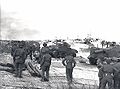 More than 14,000 Canadians
stormed the 8 kilometres (5 mi) stretch of beach between Graye-sur-Mer and St. Aubin-sur-Mer on 6 June 1944. They were followed by 150,000 additional Canadian troops over the next few months. Canadian soldiers of the 3rd Canadian Infantry Division and 2nd Canadian Armoured Brigade, which formed the Canadian assault force on Juno Beach suffered 1074 casualties, including 369 killed on the beach and in the countryside on the first day of the invasion. The Canadians reached almost 10 km (6.2 mi) inland on the first day of fighting, the farthest advance of any of the Allied landing forces. The Canadian military cemetery of Bény-Reviers
is the resting place of 2,043 Canadians and 1 Frenchman. The land for this cemetery was donated by France to the Government of Canada after the Second World War and lies 4 km (2.5 mi) inland from Courseulles-sur-Mer just off Route 79.
The Juno Beach Centre
is a museum located at Courseulles-sur-Mer, at the head of the Juno invasion beach
on which 14,000 Canadian troops landed on D-Day
6 June 1944. The museum opened on the 6 June 2003, the 59th anniversary of the D-Day landings.
Communes of France
The commune is the lowest level of administrative division in the French Republic. French communes are roughly equivalent to incorporated municipalities or villages in the United States or Gemeinden in Germany...
in the Calvados
Calvados
The French department of Calvados is part of the region of Basse-Normandie in Normandy. It takes its name from a cluster of rocks off the English Channel coast...
department in the Basse-Normandie
Basse-Normandie
Lower Normandy is an administrative region of France. It was created in 1956, when the Normandy region was divided into Lower Normandy and Upper Normandy...
region
Régions of France
France is divided into 27 administrative regions , 22 of which are in Metropolitan France, and five of which are overseas. Corsica is a territorial collectivity , but is considered a region in mainstream usage, and is even shown as such on the INSEE website...
in northwestern France
France
The French Republic , The French Republic , The French Republic , (commonly known as France , is a unitary semi-presidential republic in Western Europe with several overseas territories and islands located on other continents and in the Indian, Pacific, and Atlantic oceans. Metropolitan France...
.
It is a popular tourist destination not only with locals but also with international visitors who come to tour the Normandy landing beaches. The population of the town can reach 15,000 people in the summer months owing to a large number of summer homes owned for the most part by Parisians.
The town is split in two by the river Seulles. Today the port of Courseulles bustles with fishing boats and pleasure craft, coming from as far away as the Netherlands, yet in the summer of 1944, the Canadian military used it to unload upwards of 1,000 tons of material a day for the first two weeks following D-Day
D-Day
D-Day is a term often used in military parlance to denote the day on which a combat attack or operation is to be initiated. "D-Day" often represents a variable, designating the day upon which some significant event will occur or has occurred; see Military designation of days and hours for similar...
on 6 June 1944.
History
Canada
Canada is a North American country consisting of ten provinces and three territories. Located in the northern part of the continent, it extends from the Atlantic Ocean in the east to the Pacific Ocean in the west, and northward into the Arctic Ocean...
stormed the 8 kilometres (5 mi) stretch of beach between Graye-sur-Mer and St. Aubin-sur-Mer on 6 June 1944. They were followed by 150,000 additional Canadian troops over the next few months. Canadian soldiers of the 3rd Canadian Infantry Division and 2nd Canadian Armoured Brigade, which formed the Canadian assault force on Juno Beach suffered 1074 casualties, including 369 killed on the beach and in the countryside on the first day of the invasion. The Canadians reached almost 10 km (6.2 mi) inland on the first day of fighting, the farthest advance of any of the Allied landing forces. The Canadian military cemetery of Bény-Reviers
Bény-sur-Mer Canadian War Cemetery
The Bény-sur-Mer Canadian War Cemetery is a cemetery containing predominantly Canadian soldiers killed during the early stages of the Battle of Normandy in the Second World War. The Cemetery is located in and named after Bény-sur-Mer in the Calvados department, near Caen in lower Normandy...
is the resting place of 2,043 Canadians and 1 Frenchman. The land for this cemetery was donated by France to the Government of Canada after the Second World War and lies 4 km (2.5 mi) inland from Courseulles-sur-Mer just off Route 79.
The Juno Beach Centre
Juno Beach Centre
The Juno Beach Centre or, in French, Centre Juno Beach, is a museum located in Courseulles-sur-Mer in the Calvados region of Normandy, France...
is a museum located at Courseulles-sur-Mer, at the head of the Juno invasion beach
Juno Beach
Juno or Juno Beach was one of five sectors of the Allied invasion of German-occupied France in the Normandy landings on 6 June 1944, during the Second World War. The sector spanned from Saint-Aubin, a village just east of the British Gold sector, to Courseulles, just west of the British Sword sector...
on which 14,000 Canadian troops landed on D-Day
D-Day
D-Day is a term often used in military parlance to denote the day on which a combat attack or operation is to be initiated. "D-Day" often represents a variable, designating the day upon which some significant event will occur or has occurred; see Military designation of days and hours for similar...
6 June 1944. The museum opened on the 6 June 2003, the 59th anniversary of the D-Day landings.
Population
Twin towns
- Dartmouth, DevonDartmouth, DevonDartmouth is a town and civil parish in the English county of Devon. It is a tourist destination set on the banks of the estuary of the River Dart, which is a long narrow tidal ria that runs inland as far as Totnes...
, UK since 1977 - Rigaud, QuébecRigaud, QuebecRigaud is a municipality in southwestern Quebec, Canada in the county of Vaudreuil-Soulanges at the junction of the Ottawa River and the Rigaud River. The population as of the Canada 2006 Census was 6,780...
, Canada since 1991 - Goldbach, BavariaGoldbach, BavariaGoldbach is a market community in the Aschaffenburg district in the Regierungsbezirk of Lower Franconia in Bavaria, Germany.-Location:...
, Lower FranconiaLower FranconiaLower Franconia is one of the three administrative regions of Franconia in Bavaria , Germany ....
(Unterfranken) in BavariaBavariaBavaria, formally the Free State of Bavaria is a state of Germany, located in the southeast of Germany. With an area of , it is the largest state by area, forming almost 20% of the total land area of Germany...
, Germany since 1995
See also
- Communes of the Calvados department