

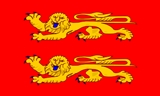
Basse-Normandie

Overview
Régions of France
France is divided into 27 administrative regions , 22 of which are in Metropolitan France, and five of which are overseas. Corsica is a territorial collectivity , but is considered a region in mainstream usage, and is even shown as such on the INSEE website...
of France
France
The French Republic , The French Republic , The French Republic , (commonly known as France , is a unitary semi-presidential republic in Western Europe with several overseas territories and islands located on other continents and in the Indian, Pacific, and Atlantic oceans. Metropolitan France...
. It was created in 1956, when the Normandy
Normandy
Normandy is a geographical region corresponding to the former Duchy of Normandy. It is in France.The continental territory covers 30,627 km² and forms the preponderant part of Normandy and roughly 5% of the territory of France. It is divided for administrative purposes into two régions:...
region was divided into Lower Normandy and Upper Normandy. The region includes three departments, Calvados
Calvados
The French department of Calvados is part of the region of Basse-Normandie in Normandy. It takes its name from a cluster of rocks off the English Channel coast...
, Manche
Manche
Manche is a French department in Normandy named after La Manche , which is the French name for the English Channel.- History :Manche is one of the original 83 departments created during the French Revolution on March 4, 1790...
and Orne
Orne
Orne is a department in the northwest of France, named after the river Orne.- History :Orne is one of the original 83 departments created during the French Revolution, on March 4, 1790. It was created from parts of the former provinces of Normandy and Perche.- Geography :Orne is in the region of...
, that cover the part of Normandy traditionally termed "Lower Normandy" lying west of the Dives River
Dives River
The Dives is a 105 km long river in the Pays d'Auge, Normandie, France. It flows into the English Channel in Cabourg.The source of the Dives is near Exmes, in the Orne department...
, the Pays d'Auge
Pays d'Auge
The Pays d'Auge is an area in Normandy, straddling the départements of Calvados and Orne . The chief town is Lisieux.-Geography:Generally it consists of the basin of the Touques River....
(except a small part remaining in Upper Normandy), a small part of the Pays d'Ouche
Pays d'Ouche
The Pays d'Ouche is an historical and geographical region in Normandy. It extends from the southwest of Évreux up to Bernay and Beaumont-le-Roger as a northern limit, and down to L'Aigle and to Gacé in the south....
(the main part remaining in Upper Normandy), the Norman Perche
Perche
Perche is a former province of northern France extending over the départements of Orne, Eure, Eure-et-Loir and Sarthe, which were created from Perche during the French Revolution.-Geography:...
and part of the "French" Perche
Perche
Perche is a former province of northern France extending over the départements of Orne, Eure, Eure-et-Loir and Sarthe, which were created from Perche during the French Revolution.-Geography:...
.
