

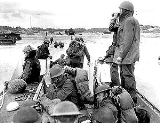
Juno Beach

Encyclopedia
Juno or Juno Beach was one of five sectors of the Allied invasion of German-occupied France in the Normandy landings on 6 June 1944, during the Second World War. The sector spanned from Saint-Aubin
, a village just east of the British Gold
sector, to Courseulles, just west of the British Sword
sector. The Juno landings were judged necessary to provide flanking support to the British drive on Caen
from Sword, as well as to capture the German airfield at Carpiquet
west of Caen. Taking Juno was the responsibility of the 3rd Canadian Infantry Division
and commandos
of the Royal Marines
, with support from Naval Force J, the Juno contingent of the invasion fleet, including the Royal Canadian Navy
(RCN). The beach was defended by two battalion
s of the German 716th Infantry Division, with elements of the 21st Panzer Division held in reserve near Caen.
The invasion plan called for two brigade
s of the 3rd Canadian Division to land in two subsectors—Mike and Nan—focusing on Courseulles, Bernières
and Saint-Aubin. It was hoped that preliminary naval and air bombardment would soften up the beach defences and destroy coastal strongpoints. Close support on the beaches was to be provided by amphibious tanks of the 2nd Canadian Armoured Brigade
. Once the landing zones were secured, the plan called for the 9th Canadian Infantry Brigade to land reserve battalions and deploy inland, the Royal Marine commandos to establish contact with the British 3rd Infantry Division on Sword
, and the 7th Canadian Infantry Brigade to link up with the British 50th (Northumbrian) Infantry Division on Gold
. The 3rd Canadian Division's D-Day objectives were to capture Carpiquet Airfield and reach the Caen–Bayeux
railway line by nightfall.
The landings initially encountered heavy resistance from the German 716th Division; the preliminary bombardment proved less effective than had been hoped, and rough weather forced the first wave to be delayed until 07:35. Several assault companies
—notably those of the Royal Winnipeg Rifles and The Queen's Own Rifles of Canada
—took heavy casualties in the opening minutes of the first wave. Strength of numbers, as well as coordinated fire support from artillery and armoured squadrons, cleared most of the coastal defences within two hours of landing. The reserves of the 7th and 8th brigades began deploying at 08:30 (along with the Royal Marines), while the 9th Brigade began its deployment at 11:40.
The subsequent push inland towards Carpiquet and the Caen–Bayeux railway line achieved mixed results. The sheer numbers of men and vehicles on the beaches created lengthy delays between the landing of the 9th Brigade and the beginning of substantive attacks to the south. The 7th Brigade encountered heavy initial opposition before pushing south and making contact with the 50th Infantry Division at Creully. The 8th Brigade encountered heavy resistance from a battalion of the 716th at Tailleville, while the 9th Brigade deployed towards Carpiquet early in the evening. Resistance in Saint-Aubin prevented the Royal Marines from establishing contact with the British 3rd Division on Sword. When all operations on the Anglo-Canadian front were ordered to halt at 21:00, only one unit had reached its D-Day objective, but the 3rd Canadian Infantry Division had succeeded in pushing farther inland than any other landing force on D-Day.
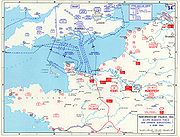 In 1942 the Western Allies agreed to open a second front
in Western Europe to take pressure off the beleaguered Red Army
in the Soviet Union
. While Britain and the United States did not yet possess the resources to mount a full invasion, invasion plans that came to be known as Operation Sledgehammer
were drawn up, in case the German position in Western Europe
weakened or the USSR's situation became dire. In August 1942 Anglo-Canadian forces attempted an abortive landing—Operation Jubilee—at the French
port of Dieppe
; the landing was designed to test the feasibility of a cross-channel invasion. The attack was poorly planned and ended in disaster; 4,963 soldiers were killed, wounded or captured. Following the Anglo-American victory against Field Marshal Erwin Rommel
in North Africa
in May 1943, British, American and Canadian troops invaded Sicily in July 1943, followed by Italy in September
. By December the Allies' progress had slowed facing tenacious German resistance and the difficult geography of the Italian Peninsula
.
After gaining valuable experience in amphibious assaults and inland fighting, Allied planners returned to the plans to invade Northern France, now postponed to 1944. Under the direction of General Dwight D. Eisenhower
(Supreme Commander Allied Expeditionary Force) and Frederick Morgan
, plans for the invasion of France coalesced as Operation Overlord
. With an initial target date of 1 May 1944, the infantry attack was conceived as a joint assault by five divisions transported by landing craft, constituting the largest amphibious operation in military history. The attack was later scheduled for Monday, 5 June 1944, and Normandy
was selected for the landing sites, with a zone of operations extending from the Cotentin Peninsula
to Caen
. There were originally seventeen sectors along the Normandy coastline with codenames taken from one of the spelling alphabets of the time, from Able, west of Omaha Beach
, to Rodger on the east flank of the invasion area. Eight further sectors were added when the planned invasion was extended to include Utah
on the Cotentin Peninsula. Sectors were further subdivided into beaches identified by the colours Green, Red and White. Operation Overlord called for the British Second Army to assault between the River Orne and Port en Bessin, capture Caen, and form a front line from Caumont-l'Éventé
to the south-east of Caen, to acquire airfields and protect the left flank of the United States First Army while it captured Cherbourg. Possession of Caen and its surroundings would give Second Army a suitable staging area for a push south to capture the city of Falaise
, which could then be used as a pivot for a swing left to advance on Argentan
, the Touques River
and then towards the River Seine.
After delays due to both logistical difficulties and poor weather, the D-Day of Overlord, the largest amphibious operation ever, was postponed 24 hours to 6 June 1944. Eisenhower and Montgomery, commander of 21st Army Group, aimed to capture Caen within the first day, and liberate Paris
within 90 days.
, the landing phase of Overlord, called for a five-division front spread across 50 miles (80.5 km) of coastline; three airborne divisions (two American, one British) would also land in the pre-dawn hours of D-Day. Eisenhower and General Bernard Montgomery hoped to have eight infantry divisions and fourteen tank regiments in the Normandy beachhead by nightfall on D-Day. The landing zone was divided into five landing areas, with the Americans attacking Utah (the westernmost) and Omaha, and the British attacking Gold and Sword. Juno, a 6 miles (9.7 km) stretch of shoreline between La Riviere to the west and Saint-Aubin to the east, was assigned to the 3rd Canadian Infantry Division
(3rd CID), commanded by Major-General Rodney Keller
. Juno included the villages of Courseulles and Bernières.
, North Africa
and Italy
, it remained a powerful fighting force. Despite this, most of the German divisions along the French coast in late 1943 were composed of either new recruits or veteran units resting and rebuilding from the Eastern Front
; altogether some 856,000 soldiers were stationed in France
, predominantly on the coast. An additional 60,000 Hilfswillige ("voluntary helpers"), Russia
n and Polish
conscripts to the German army, served on the French coast. Under the command of Field Marshals Erwin Rommel
and Gerd von Rundstedt
, the defences of the Atlantic Wall
—a line of coastal gun emplacements, machine-gun nests, minefields and beach obstacles along the French coast—were heavily upgraded; in the first six months of 1944 the Germans laid 1.2 million tons of steel and 17.3 million cubic yards of concrete. Rommel also surrounded the coast with four million antitank and antipersonnel mines and 500,000 beach obstacles.
On Juno the defences of the Atlantic Wall were heavier than at many other landing sectors. The Germans assumed that the Allies would land during high tide to minimize the distance during which they were exposed on the beaches, and created "a 'devil's garden' of beach obstacles ... deployed in rows between 12 and 17 feet above the low-tide mark". Strongpoints of machine-gun positions, antitank and antipersonnel artillery and bunkers were located every 1000 yards (914.4 m), manned by several platoon
s with mortars. Minefields were deployed surrounding these strongpoints, and additional defences were present in the Courseulles harbour.
The Calvados
beaches of Normandy were defended by the 716th Static and 352nd Infantry Divisions, with the Canadian landing zone defended by elements of the 716th. It was formed mostly from soldiers under 18 or over 35, comprising 7,771 combat troops in six battalions (as opposed to 9 or 12 battalions of Allied divisions). While the 352nd was considered a first-rate division, the 716th was "accounted a better-than-average static division"; these divisions generally had very little mechanized or armoured capability, and had to rely primarily on infantry and field regiments. On Juno the division's 736th Grenadier Regiment deployed four infantry companies: 7 Kompanie held what was to become "Mike Sector", the 6th was stationed in Courseulles, the 5th was at Bernières, and the 9th held Nan sector and Saint-Aubin. A second line of four infantry companies and one panzer company was stationed 1 miles (1.6 km) inland. The 21st Panzer Division was deployed south-east of Caen, and two battalions of Polish and Russian conscripts were stationed on the flanks of Juno adjacent to Sword and Gold.
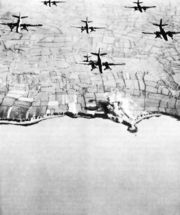 Canadian training for D-Day had begun as early as July 1943, when Lieutenant-General Andrew McNaughton
of the First Canadian Army informed Harry Crerar
, commander of II Canadian Corps
, that the 3rd Canadian Infantry Division might play a role in the invasion of France. Initial training was demanding, and complicated by the lack of any landing craft to practice with, either LCAs
or LCTs. Field exercises in Scotland
commenced in August and September 1943, and succeeded in establishing unique techniques and equipment for use by armoured and artillery regiments in storming the beach; the most significant were the amphibious duplex drive tanks (DD tanks). Mechanisms were also developed to allow artillery to bombard the beach while still attached to their landing craft. Through the winter of 1943 units jointly developed more advanced assault tactics among the Juno regiments.
The landings would be supported by the largest invasion fleet in history—7,016 vessels in total. The Royal Canadian Navy
contributed 121 vessels to the armada, including destroyers, frigates, corvettes, landing ships, minesweepers and torpedo boats. Four Canadian Tribal-class destroyers
were in the Royal Navy's 10th Destroyer Flotilla, which joined other RN units in keeping the English Channel
near Normandy clear of German naval units. Naval Force J had begun intense training for the invasion with the 3rd Canadian Infantry Division in February 1944, with a full-scale simulation of the invasion carried out on 4 May in Exercise Fabius. On D-Day itself Force J, commanded from HMS Hilary
, was to bombard German defensive positions along the landing zone with everything from heavy-calibre cruiser guns to self-propelled artillery attached to landing craft. According to Canadian Army Historian C. P. Stacey, light bombardment of the landing zone would commence "30 minutes before H Hour and continue for 15 minutes; heavy bombing would then begin on the flanks of the divisional attack, lasting until H Hour". Additional cover would be provided by Royal and Royal Canadian Air Force squadrons both before and on D-Day. A successful surprise invasion required total air superiority over the English Channel and Normandy. In the months preceding D-Day the RAF Second Tactical Air Force attacked airfields, coastal garrisons, radar, railway lines and transport routes in order to soften the beach defences, as well as prevent the German Luftwaffe from mounting a serious challenge to air superiority over Normandy. By dawn, on 6 June, the RAF tactical air forces had 2,434 fighter and fighter-bomber aircraft with approximately 700 light
and medium bomber
s to support them.
The operational plan for Juno was divided into two main sectors: Mike (west) and Nan (east). Mike Sector would be attacked by the 7th Canadian Infantry Brigade
, with the Royal Winnipeg Rifles, The Canadian Scottish Regiment and the 1st Hussars
in support. The 7th Brigade was to take Courseulles and drive inland. Nan Sector would be assaulted by the Regina Rifle Regiment of 7th Brigade, as well as the North Shore Regiment
and the Queen's Own Rifles of Canada
of the 8th Canadian Infantry Brigade
, while tanks of the Fort Garry Horse provided armoured support; a squadron of specialized AVRE
engineering tanks from the British 79th Armoured Division
would land on each beach sector as well. The 8th Brigade was to capture Bernières and the western edge of Saint-Aubin, then push south into Normandy. The operational plan also called for the 9th Canadian Infantry Brigade and the Sherbrooke Fusiliers to be deployed to Juno as reinforcements within 4 to 6 hours of the initial assault. By nightfall of D-Day the 3rd Canadian Infantry Division was slated to have captured the high ground west of Caen, the Bayeux–Caen railway line, and the seaside towns of Courseulles, Bernières, Saint-Aubin and Beny-sur-Mer.
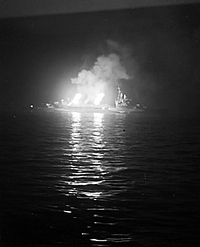 Air attacks on Normandy's coastal defences began in earnest on 5 June at 23:30, with RAF Bomber Command
units targeting the primary coastal defences. The attack continued until 05:15, with 5,268 tons of bombs dropped by 1,136 sorties; this marked the largest attack by Bomber Command in terms of tonnage up to that point in the war. Initial attacks on the Atlantic Wall proved ineffective, with poor weather and visibility making it difficult to accurately hit the bunkers and turrets. The bombing left the defences on Omaha
, Gold and Juno virtually intact, yet did not damage Allied landing craft in the Channel (as many planners feared it would). 230 Royal Canadian Air Force
bombers specifically bombed targets on Juno during this raid, yet direct damage was limited.
As the Americans began their own bombing runs against Omaha and Utah
to the west, the Anglo-Canadian naval forces began their counter-battery fire
, seeking to knock out German shore batteries and bunkers. The British had attached the cruisers HMS Belfast
and Diadem
to Force J to serve as heavy support. Belfast commenced bombardment of the Atlantic Wall
at 05:30 and Diadem at 05:52 on 6 June. The naval gunfire proved more effective than the aerial bombardment; the battery at Longues
was the only one to return fire, and was quickly destroyed by the light cruiser HMS Ajax
. Indeed, most of the gun batteries at Juno were incomplete on D-Day, and did not possess sufficient protection or communication measures to accurately return fire on Force J. The Beny-sur-Mer battery was neutralized by Diadem shortly after she opened fire.
At 06:10 the 11 destroyers of Force J moved shoreward to begin bombardment, hoping to damage light gun emplacements and prevent the German 716th from mobilizing and moving across the beach. They were supplemented by additional raids by medium bombers and fighter-bombers of the RAF and USAAF, which dropped an additional 2,796 tons of ordnance on the five landing zones. While the medium bombers proved inaccurate, the Hawker Typhoon
fighter-bombers proved more effective at attacking coastal defences. As the bombing runs continued to hit Juno with ordnance, the destroyers and landing craft moved towards the beach and began close-range saturation bombardment. In addition to the destroyers of Force J—two Canadian, eight British, one French—bombardment was also provided by converted LCTs fitted with 4.7 inches (119.4 mm) guns. Smaller, light-gunned landing craft were able to get closer to the beach and use their 6-pounder guns against German defensive positions. Additional firepower was provided by 8 landing craft fitted with over 1000 high-explosive rockets and 24 LCTs, each carrying four M7 Priest
self-propelled guns. These field regiments, while still seaborne, were to fire heavy concentrations of high explosive and smoke shells against the four main "resistance nests" in "Mike" and "Nan" sectors, beginning half an hour before H Hour. Forward observation and fire control officers in the leading assault waves were to make the necessary adjustments to this neutralizing fire during the assault.
The bombardment was scheduled to cease immediately before the assault companies deployed on Juno, but due to heavy seas, the landing was delayed by ten minutes, to 07:45 in Mike sector and 07:55 in Nan Sector. This was at a slightly higher tide, closer to the beach obstacles and mines. The LCTs carrying the field artillery were forced to adjust course to avoid landing too early; the LCTs carrying DD tank
s were forced to break off their advance. The seas proved too rough to launch the DD tanks, so they were ordered to deploy from the LCTs several hundred yards out from the beach.
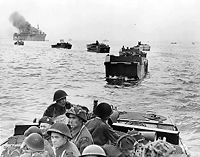 Though the 7th Canadian Infantry Brigade was scheduled to land at Mike Sector at 07:35, rough seas and poor craft coordination pushed this time back by ten minutes. Two assault companies of the Royal Winnipeg Rifles, one assault company of the Canadian Scottish Regiment, and one squadron of the 1st Hussars were to land in "Mike Red" and also in "Mike Green", while the Regina Rifle Regiment, supported by a second squadron of the 1st Hussars, landed in "Nan Green" sector. The first Winnipegs touched down at 07:49, with the remaining assault companies deploying within seven minutes. The LCAs carrying "B" Company craft were engaged while about 700 yards from shore. Disembarkation had to be done under direct fire and in consequence heavy casualties were sustained by this company while landing. The strongpoint in this area consisted of three casemates and twelve machine-gun emplacements. This left the infantry the grim prospect of clearing it by direct assault. "B" company was unable to advance further without armoured support. The Hussars' "A" Squadron launched 1500 yards (1,371.6 m) from the beach, but would not be fully deployed until a full six minutes after the Winnipegs were ashore. To their west "D" Company faced less defensive fire, as it was clear of the strongpoint. The company easily cleared the beach, and went through the barbed wire with light casualties. "A" platoon of the 6th Field Company Royal Canadian Engineers were redirected to clear the minefields facing "D" Company, given that the flail tanks had yet to land. On the far right, "C" Company of the Canadian Scottish Regiment landed with little opposition, and discovered that their objective—a 75 mm gun emplacement—had been destroyed by naval gunfire.
To the east of Mike Sector, the Regina Rifles came ashore at Nan Green with the objective of subduing German forces in Courseulles. "A" Company reported touchdown at 08:09, and met heavy resistance almost immediately; "B" Company reported touchdown at 08:15. The Hussars' tanks first reported deploying twenty minutes before the infantry, with "B" Squadron HQ reporting their landing at 07:58. They faced the task of destroying a heavy gun emplacement equipped with 88 mm and 75 mm guns, and 4 feet (1.2 m) thick concrete walls. The pre-landing bombardment had failed to destroy the emplacement, and heavy machine guns subsequently inflicted high casualty rates on the company; one LCA reported six men killed within seconds of lowering the ramps. One platoon was able to breach the barbed wire lining the beach and take cover in Courseulles, and then eliminated the machine-gun positions engaging "A" Company of the Regina Rifles. The DD tanks arrived in the Regina Rifles sector with both greater numbers and punctuality than in the Winnipegs' sector. The 75 mm gun emplacement in the Courseulles strongpoint was destroyed by fire from "B" Squadron of the 1st Hussars; the 88 mm was similarly silenced. To their east, "B" Company encountered limited resistance, and succeeded in pushing into Courseulles, and soon "had cleared a succession of the assigned blocks in the village", according to Stacey.
With the initial assault companies ashore and fighting for their objectives, the reserve companies and battalion (Canadian Scottish Regiment) began their deployment on Juno. "A" and "C" companies of the Winnipeg Rifles landed at 08:05, and began to push towards the villages of Banville and Sainte-Croix-sur-Mer
. "A" Company encountered heavy machine-gun resistance, and had to request support from the 1st Hussars to clear the position. On Nan Green, "C" and "D" companies of the Regina Rifles prepared to storm Courseulles. "C" Company touched down at 08:35, and moved into the village without difficulty. "D" Company was further delayed, meaning that several LCAs struck antitank mines attached to beach obstacles; only 49 "D" Company soldiers reached the beach. The Canadian Scottish Regiment arrived on the beach at 08:30, with the leading companies coming under heavy mortar fire; it took the regiment a full hour to get off the beaches and push further inland.
(QOR) landed at 08:12 at Nan White and faced the most tenacious defences of any unit in Nan Sector: an 88 mm gun emplacement with multiple machine-gun nests outside of Bernières. The first LCA to touch down saw 10 of its first 11 soldiers either killed or wounded. "B" Company came ashore directly in front of the main resistance nests, 200 yards east of their intended landing zone, subjecting them to heavy mortar and machine-gun fire. The QOR had been scheduled to advance with DD fire support, but the heavy seas meant that "instead of swimming in, they [DD tanks] left their craft close inshore and landed behind the infantry assault companies". Several soldiers from "B" Company succeeded in outflanking the main pillbox and killing its gunners with grenades and small arms. One LCA's rudder from "B" Company had jammed, and that platoon landed far to the left of the rest of "B" Company, enabling them to outflank and destroy the gun emplacements. With the defences silenced, the QOR was able to advance into Bernières, having taken 65 casualties on the beaches. To their west, "A" Company encountered less resistance, but was limited by poorly coordinated run-ins by the LCAs to the beach. "A" Company was able to quickly reach the seawall and breach the barbed wire, but encountered heavy mortar and sniper resistance in Bernières. This was the only sector of Juno where armoured supported proved ineffective, as "B" Squadron of the Fort Garry Horse was too far out from the beach to provide heavy support.
The first units of the North Shore Regiment's "A" and "B" companies touched down on Nan Red at 08:10 in chest-deep water. They were tasked with securing Saint-Aubin and clearing defences in the village. "B" Company landed to find that the Saint-Aubin strongpoint "appeared not to have been touched" by preliminary naval bombardment. The two assault companies faced a 100 yards (91.4 m) sprint across open beach in the face of fire from Saint-Aubin. "A" Company suffered the heaviest casualties, incurring many fatalities from beach mines. "B" Company faced stronger opposition at the strongpoint, yet managed to breach the seawall and barbed wire. The strongpoint's 50 mm antitank gun was still active, and the thick concrete casemate
s protected it from infantry fire. By 08:10 Sherman tanks of the Fort Garry Horse and Armoured Vehicle Royal Engineers
(AVRE) tanks of the 80th Assault Squadron, Royal Engineers, had landed at Nan Red, and began to assist "B" Company in clearing the gun emplacement. The 50 mm gun knocked out four of the squadron's tanks, while the North Shore's machine-gun platoon flanked the position. The right section of the strongpoint was eliminated by antitank guns and combat engineers, while the central antitank gun was silenced by petard shells from the British AVREs. When the North Shore captured the strongpoint, approximately half the defenders were killed; 48 German soldiers surrendered.
The 8th Brigade's reserve battalion, Le Régiment de la Chaudière
, began deploying to the beaches at 08:30 along with the reserve companies of the North Shore and QOR. More than half of the LCAs were crippled by mines buried along the beach; QOR "C" Company was forced to touch down further offshore when their LCAs were damaged by mines. "C" Company linked up with "B" Squadron of the Fort Garry Horse, and moved to assist the pinned-down and exhausted "A" Company. The North Shore's C and D companies landed outside of Saint-Aubin, with "C" Company taking over for "A" Company in the advance further into Saint-Aubin, while "D" Company established a firm presence inside the village. All but one of the LCAs carrying Chaudière "A" Company foundered before they could touch down on the beach, and they lost most of their equipment while swimming to shore. The Chaudières quickly formed up outside Bernières and Saint-Aubin, linking up with both the QOR and the North Shores. The reserve also included the No. 48 (Royal Marine) Commando
, which was scheduled to land 45 minutes after the first arrivals. The Commandos were to pass Saint-Aubin's eastern edge and occupy Langrune-sur-Mer on the eastern end of Juno. The strongpoint facing them had not been cleared, and 40 per cent of the 400-man unit became casualties within seconds of landing.
Having subdued German defences on the beach, the other priority of the landed forces was to clear Juno of obstacles, debris and undetonated mines, as well as establish the 3rd Canadian Infantry Division's headquarters in Bernières. Movement Control Units came ashore just before noon, with military policemen beginning to marshal vehicles through to Bernières and Courseulles. Sappers of 619 Independent Field Company also moved in to begin clearing the minefields surrounding the beach, so as to free up the advance south towards Carpiquet. Keller himself established divisional headquarters in Bernières shortly after noon.
In Nan Sector the 8th Brigade's advance started slower than that of the 7th Brigade, owing to the fact that the Chaudieres had lost most of their equipment on the advance over the beaches. The Queen's Own Rifles' "C" Company was pinned down at the edge of Bernières by sniper-fire, and could not cross the open fields behind the town; their armoured support was also stopped by heavy antitank fire coming from Beny-sur-Mer. The Chaudieres "A" and "B" companies were caught in the crossfire; "B" Company lost almost an entire platoon when a German 88 mm scored a direct hit on a Priest self-propelled gun. Chaudiere and QOR progress was slow; all told, it took nearly two hours for artillery and heavy guns to clear the defences at Beny-sur-Mer, allowing the QOR to advance towards the town. Beny-sur-Mer was reported cleared at 14:00, at which point the Chaudieres began to mass in the town for a further advance south towards Carpiquet. The QOR broke off to the left to engage heavy artillery batteries to the west of Beny, and "B" Company was assisted by the guns of HMCS Algonquin, which destroyed a bunker of 105 mm guns. To their east, "C" and "D" Company of the North Shores advanced towards Tailleville—the headquarters of II Battalion of the 736th Grenadiers. Mortar fire north of the headquarters was both concentrated and accurate, slowing the advance of "C" Company. They were supported in their drive south by tanks of the Fort Garry Horse, which caught close to 100 German defenders in open fields. The North Shores and their armour support entered Tailleville at 14:00, at which point the six tanks of "C" Squadron moved through the village, destroying German gun emplacements. However, the defenders of the II Battalion had created a complex underground bunker system in the village, which enabled them to continuously outflank Canadian infantry; it would take another seven hours to clear Tailleville of defenders, which ensured that the North Shores would be unable to capture German radar sites to the south on D-Day.
Meanwhile, "B" Company of the North Shore Regiment and No. 48 Commando of the Royal Marines were engaged in a protracted fight to secure Saint-Aubin and Lagrune-sur-Mer. "B" Company had generally neutralized the strongpoint at WN27 within two hours of landing, which allowed Troops A and B of the Royal Marines to push west. These units had the important objective of bridging the 5 miles (8 km) gap between the landing zones at Juno and Sword, which would allow for a continuous Anglo-Canadian front by the end of the first day. The Royal Marines began to advance on Lagrune and strongpoint WN26, while to their east No. 41 Commando Royal Marines advanced from Sword. The strongpoint was defended by "a reinforced platoon from the 736th Grenadiers", and was centred on a group of fortified houses and 50 mm antitank guns. B Troop's first attempt to capture it failed, and the assault was renewed with support from Centaur tanks only to again falter in the face of heavy resistance. No. 48 Commando was forced to call the assault off at nightfall, as reports of massing counterattacks by the 21st Panzer Division against the divide between Sword and Juno began to filter in. The strongpoints at Lagrune and Luc-sur-Mer were finally captured on 8 June.
 The division's advance south of Tailleville had halted, preventing an attack on German radar stations. The Queen's Own Rifles and "C" Company of the Chaudieres opted to continue their advance towards Anguerny and Columby-sur-Thaon and Objective Line "Elm". The beachhead was now filled to capacity with troops, to the point that "B" Company of the Chaudieres could not be deployed alongside "C" Company without severely hindering the advance of the QOR to their east. "C" Company's advance on Basly was even further hindered by the proximity of the combat; the fighting occurred at such close range that the 14th Field Artillery would not provide fire support for fear of friendly-fire casualties. When "C" Company reached Basly, the North Nova Scotia Highlanders formed up outside Beny-sur-Mer, with the intention of overtaking the Chaudieres and making for Carpiquet and the Caen–Bayeux highway. At 16:45 the North Novas assembled in Beny, and were the target of concentrated German mortar fire as the Sherbrooke Fusiliers de-waterproofed their tanks. Three companies of the North Novas and a squadron of the Sherbrookes advanced on the mortar positions, taking heavy casualties among the infantry but clearing the positions. The QOR entered Anguerny—on the Elm Objective Line—at 17:30, and sent "D" Company to probe German defences on the hills overlooking the village. The Chaudieres reported that Basly was cleared of defenders at 18:15, allowing the 9th Brigade to advance towards Carpiquet Airfield. By 19:00 the North Nova Scotia Highlanders were advancing towards Carpiquet, encountering their first resistance an hour later. With reports of the 21st Panzer Division attacking the flanks of the British 3rd Infantry Division on Sword, Lieutenant-General Miles Dempsey
—commander of the British Second Army—ordered forces on Sword, Juno and Gold to establish defensive positions at their intermediate objectives.
On the western edge of the Canadian sector, the advance of the 7th Brigade had stalled in the face of stiffening resistance in St. Croix and Banville, throwing the right flank of the assault off-schedule. The German defenders gave ground slowly, and did not begin withdrawing from the towns until the Bren Gun platoons began to arrive at 14:00. Once St. Croix and Banville were cleared, the Canadian Scots pushed south to Colombiers, reinforced the platoons that had captured the bridge across the Seulles earlier in the day, and moved towards the Creully–Caen road. The Canadian Scots reported reaching the road at 16:30, and continued to push south past Objective Line Elm. To their west the Royal Winnipegs stopped at Elm Line, and began to erect defensive positions with Bren Gun carriers and artillery. The Regina Rifles, meanwhile, had been slow to advance from Courseulles on account of the heavy casualties taken securing the village; the 1st Hussars' "B" Squadron was in a similar position, with only half its fighting strength having made it off the beach. By 18:00 the Reginas were advancing, while the Hussars scouted ahead of the infantry companies. As the Reginas linked up with the Canadian Scots, the order to hold positions and dig in arrived from Keller's headquarters; the two battalions halted at 21:00.
Three tanks of the 1st Hussars' "C" Squadron (No. 2 Troop) had continued to advance southwards, pushing through side-roads towards Carpiquet Airfield. Aside from a German staff-car and a machine-gun nest, the three Sherman tanks encountered virtually no resistance, advancing all the way to the Caen–Bayeux railway line and becoming the only unit on the whole of D-Day to reach its final objective. Though the commander of the unit—Lieutenant William F. McCormick—attempted to contact his superiors to bring up reinforcements to attack Carpiquet Airfield, the three tanks eventually withdrew back to the Canadian lines.
Wilhelm Richter recorded that less than one full battalion could be mustered for further defence. The German 21st Panzer Division had driven a wedge between the British and Canadian 3rd Divisions, yet had been unable to dislodge either from the beaches. To the south, Hitler
had released the elite Panzer Lehr Division and the 12th SS Panzer Division Hitlerjugend
(Hitler Youth), both of which now prepared to head north with the I SS Panzer Corps
.
American Airborne Divisions had suffered heavy casualties—their landings were scattered all over the dropzones—but had captured Sainte-Mère-Église
to the west of Utah. On the Cotentin Peninsula
, the American 4th Division had suffered lighter casualties in securing Utah, and had established a strong bridgehead by the end of D-Day. Omaha had met with less success, as intact defences and high-calibre troops of the 352nd Division caused heavier casualties than at any of the other beaches; at one point the attack was going so badly that Lieutenant General
Omar Bradley
considered withdrawing the US V Corps from the beaches. A second wave of attacks breached the coastal defences, but could only push 2000 yards (1,828.8 m) inland by nightfall. To the west of Juno, the British 50th (Northumbrian) Infantry Division encountered only light resistance, and succeeded in advancing inland and creating a continuous front with Juno (though not with Omaha) with only 413 casualties. To their east, the British 3rd Infantry Division succeeded in establishing a foothold on Sword. However, counterattacks by the 21st Panzer Division in the afternoon prevented the 3rd Infantry from advancing on Caen and from making contact with the Canadian 3rd on Juno. The counterattack did not succeed in driving the British off the beaches, as units of the British 6th Airborne Division—which had landed the previous night near the River Orne—were able to outflank the 21st and force it to withdraw.
In spite of the heavy casualties inflicted on the 352nd and 716th Infantry Divisions, the German Seventh Army quickly established plans for counterattacks. Early logistical responses to the invasion were confused, as the divisions necessary for counterattacks fell under a different jurisdiction than those defending the coast. Furthermore, the heavy Panzer divisions, such as the Panzer Lehr, 12th SS Panzer, and 2nd SS Panzer, could not be mobilized to the coast without the explicit authorization of Hitler himself. The order to mobilize Panzer Lehr and the 12th SS was finally given in the mid-afternoon of 6 June. When the 9th Canadian Infantry Brigade and the Sherbrooke Fusiliers began to advance on 7 June, they were met by entrenched forces of the 716th Infantry and 21st Panzer Divisions. At 17:00, the advancing force was counterattacked by the 12th SS, under the command of Kurt Meyer. After heavy fighting the 9th Brigade was forced to withdraw to their D-Day positions, having suffered heavier casualties than any single unit on Juno itself the previous day. However, the 7th Brigade succeeded in reaching its final D-Day objectives along Line Oak, while the 8th Brigade attempted to destroy German radar stations to their east, a task which would only be completed on 11 June.
The 3rd Canadian Infantry Division made contact with the British on Sword on 7 June, before forming one continuous front with the American sector by 13 June. The subsequent advance on Caen and Cherbourg was slow, as a greater number of German Panzer units were concentrated near Caen and Carentan. The Canadians captured Carpiquet Airfield during Operation Windsor
on 5 July, while Anglo-Canadian forces captured Caen as part of Operation Charnwood
(8–9 July) and Operation Atlantic
(18–20 July).
of 292 officers and men.
notes that "the prevailing low, thick cloud frustrated its [Bomber Command's] efforts". Colonel Stacey—the official historian of the Canadian Army in the Second World War—considers the effects of the bombing runs to have been "spotty", noting that while several coastal batteries were not hit, those that were (such as the battery at Houlgate) were hit accurately. Chester Wilmot
offers a different view, suggesting that "[the coastal guns] had been accurately bombed, but had survived because they were heavily protected by the concrete casemates Rommel had insisted upon". Historians' assessment of the naval bombardment is even more mixed; while they generally agree that it failed to fully neutralize German defences on Juno, they are in disagreement as to why. Stacey suggests that while the "beach-drenching fire" was concentrated and substantial, it was both inaccurate and of insufficient firepower to destroy the coastal bunkers. He further suggests that the effect of the drenching fire was moral rather than material, in that it forced defenders to keep below-ground and sapped their morale. Terry Copp echoes this analysis, noting that "reasonable accuracy could not be obtained from the pitching decks of LCTs [by mounted artillery on the ships]"; the 13th Field Regiment's drenching fire fell on average 200 yards (182.9 m) past their targets. British historian Max Hastings
notes that because of the delay in landing times by ten minutes, a substantial gap existed between the cessation of bombardment and the actual landing of the first waves of infantry, meaning that platoons of the 716th had ample time to return to their positions. The bombardment of specific strongpoints in the towns along the coast was inconsistent; the North Shore Regiment reported that the strongpoint near Saint-Aubin "appeared not to have been touched" by bombardment, while the strongpoints facing the Canadian Scottish Regiment had been eliminated by naval bombardment before their landing.
Despite the verdict of a successful D-Day for the 3rd CID, the failure of Canadian units to reach their final objectives has proven more disputed than the reasons for their success. Terry Copp places the blame on Keller, who committed the entirety of the 9th Brigade reserve to land on the narrower beaches of the 8th Brigade—which was still itself fighting to clear the seaside towns—after receiving reports of poor progress by the 7th Brigade. Dutch historian Dan Van der Vat notes that "the planned breakout of the 9th Brigade was held up by a huge jam of vehicles". Wilmot also places the blame with logistical difficulties of the landing, saying that "on the whole it was not so much the opposition in front as the congestion behind—on the beaches and in Bernières—that prevented the Canadians from reaching their final D-Day objective". Stacey offers a different view, suggesting that it was not impossible for the 3rd CID to reach its D-Day objectives, and that the failure to do so rests in the fact that "British and Canadian forces were usually better at deceiving the enemy and achieving initial success in an assault than they were at exploiting surprise and success once achieved. Perhaps they were rather too easily satisfied". Copp disagrees with Stacey's assessment, suggesting that such caution was not the result of poor planning but of the fact that "the British and Canadians fought the way they had been trained, moving forward to designated objectives in controlled bounds and digging in at the first sign of a counterattack". He also disputes whether the capture of the final objectives would have been strategically intelligent, observing that "if 9th Brigade had reached Carpiquet and dug in, with artillery in position to offer support, the commander of the 26th Panzer Grenadiers might have followed orders and waited until a coordinated counterattack with other divisions had been organized. Such an attack might well have done far more damage to the Allied beachhead than the hastily improvised operation actually carried out [on 7 June]".
Stacey offers a second line of analysis on the Canadians' failure to advance to Line Oak, suggesting that difficulties encountered by the British 3rd Infantry Division on Sword caused Dempsey to halt the advance of the entire British Second Army. The British encountered heavy counterattacks by the 21st Panzer Division, which prevented the British 9th Brigade from establishing contact with the Canadians at Juno. Copp offers agreement on this assessment, writing: "Before this withdrawal [of the 21st Panzer Division] became evident, Dempsey had concluded that more armoured counterattacks could be expected. So he ordered all three assault divisions to dig in at their second line of objectives. This decision was relayed to subordinate commanders somewhere after 19:00", just as the 9th Canadian Brigade was preparing to advance south towards Carpiquet. Wilmot also agrees with this analysis, arguing that the British 3rd Infantry Division's brigade commanders were overly cautious in advancing towards Caen. This, in turn, slowed the momentum of the entire Anglo-Canadian advance, especially given the reports of counterattacks Dempsey received from Sword.
Saint-Aubin-sur-Mer, Calvados
Saint-Aubin-sur-Mer is a commune in the Calvados department in the Basse-Normandie region in northwestern France.-History:Saint-Aubin-sur-Mer is located at the eastern end of Nan Sector of Juno Beach, one of the landing sites on D-Day, at the beginning of the Battle of Normandy, during World War II...
, a village just east of the British Gold
Gold Beach
Gold Beach was the code name of one of the D-Day landing beaches that Allied forces used to invade German-occupied France on 6 June 1944, during World War II....
sector, to Courseulles, just west of the British Sword
Sword Beach
Sword, commonly known as Sword Beach, was the code name given to one of the five main landing areas along the Normandy coast during the initial assault phase, Operation Neptune, of Operation Overlord; the Allied invasion of German-occupied France that commenced on 6 June 1944...
sector. The Juno landings were judged necessary to provide flanking support to the British drive on Caen
Caen
Caen is a commune in northwestern France. It is the prefecture of the Calvados department and the capital of the Basse-Normandie region. It is located inland from the English Channel....
from Sword, as well as to capture the German airfield at Carpiquet
Carpiquet
Carpiquet is a commune in the Calvados department in the Basse-Normandie region in northwestern France. Caen – Carpiquet Airport is located in Carpiquet.-Geography:Carpiquet is on the western side of the Caen metropolitan area...
west of Caen. Taking Juno was the responsibility of the 3rd Canadian Infantry Division
3rd Canadian Infantry Division
The Canadian 3rd Infantry Division was an infantry division of the Canadian Army from 1940 to c.1945.- History :The formation of the division was authorized on 17 May 1940...
and commandos
British Commandos
The British Commandos were formed during the Second World War in June 1940, following a request from the British Prime Minister, Winston Churchill, for a force that could carry out raids against German-occupied Europe...
of the Royal Marines
Royal Marines
The Corps of Her Majesty's Royal Marines, commonly just referred to as the Royal Marines , are the marine corps and amphibious infantry of the United Kingdom and, along with the Royal Navy and Royal Fleet Auxiliary, form the Naval Service...
, with support from Naval Force J, the Juno contingent of the invasion fleet, including the Royal Canadian Navy
Royal Canadian Navy
The history of the Royal Canadian Navy goes back to 1910, when the naval force was created as the Naval Service of Canada and renamed a year later by King George V. The Royal Canadian Navy is one of the three environmental commands of the Canadian Forces...
(RCN). The beach was defended by two battalion
Battalion
A battalion is a military unit of around 300–1,200 soldiers usually consisting of between two and seven companies and typically commanded by either a Lieutenant Colonel or a Colonel...
s of the German 716th Infantry Division, with elements of the 21st Panzer Division held in reserve near Caen.
The invasion plan called for two brigade
Brigade
A brigade is a major tactical military formation that is typically composed of two to five battalions, plus supporting elements depending on the era and nationality of a given army and could be perceived as an enlarged/reinforced regiment...
s of the 3rd Canadian Division to land in two subsectors—Mike and Nan—focusing on Courseulles, Bernières
Bernières-sur-Mer
Bernières-sur-Mer is a commune in the Calvados department in the Basse-Normandie region in northwestern France.In 1944, Le Régiment de la Chaudière, a French Canadian infantry unit, came ashore at Bernières-sur-Mer as a part of Operation Overlord, the D-Day landings which began the liberation of...
and Saint-Aubin. It was hoped that preliminary naval and air bombardment would soften up the beach defences and destroy coastal strongpoints. Close support on the beaches was to be provided by amphibious tanks of the 2nd Canadian Armoured Brigade
2nd Canadian Armoured Brigade
-History:Soon after 3rd Canadian Tank Brigade assumed the designation in summer 1943 of the original 2nd Canadian Tank Brigade, the new 2nd Tank was redesignated and reorganized as 2nd Canadian Armoured Brigade. Although reorganized as an armoured brigade, no motor battalion served under its command...
. Once the landing zones were secured, the plan called for the 9th Canadian Infantry Brigade to land reserve battalions and deploy inland, the Royal Marine commandos to establish contact with the British 3rd Infantry Division on Sword
Sword Beach
Sword, commonly known as Sword Beach, was the code name given to one of the five main landing areas along the Normandy coast during the initial assault phase, Operation Neptune, of Operation Overlord; the Allied invasion of German-occupied France that commenced on 6 June 1944...
, and the 7th Canadian Infantry Brigade to link up with the British 50th (Northumbrian) Infantry Division on Gold
Gold Beach
Gold Beach was the code name of one of the D-Day landing beaches that Allied forces used to invade German-occupied France on 6 June 1944, during World War II....
. The 3rd Canadian Division's D-Day objectives were to capture Carpiquet Airfield and reach the Caen–Bayeux
Bayeux
Bayeux is a commune in the Calvados department in Normandy in northwestern France.Bayeux is the home of the Bayeux Tapestry, which depicts the events leading up to the Norman conquest of England.-Administration:Bayeux is a sub-prefecture of Calvados...
railway line by nightfall.
The landings initially encountered heavy resistance from the German 716th Division; the preliminary bombardment proved less effective than had been hoped, and rough weather forced the first wave to be delayed until 07:35. Several assault companies
Company (military unit)
A company is a military unit, typically consisting of 80–225 soldiers and usually commanded by a Captain, Major or Commandant. Most companies are formed of three to five platoons although the exact number may vary by country, unit type, and structure...
—notably those of the Royal Winnipeg Rifles and The Queen's Own Rifles of Canada
The Queen's Own Rifles of Canada
The Queen's Own Rifles of Canada is a militia regiment within the Canadian Forces, based in Toronto, Ontario. The regiment is part of Land Force Central Area's 32 Canadian Brigade Group. It is the only Primary Reserve regiment in Canada to have a parachute role. The regiment consists of the reserve...
—took heavy casualties in the opening minutes of the first wave. Strength of numbers, as well as coordinated fire support from artillery and armoured squadrons, cleared most of the coastal defences within two hours of landing. The reserves of the 7th and 8th brigades began deploying at 08:30 (along with the Royal Marines), while the 9th Brigade began its deployment at 11:40.
The subsequent push inland towards Carpiquet and the Caen–Bayeux railway line achieved mixed results. The sheer numbers of men and vehicles on the beaches created lengthy delays between the landing of the 9th Brigade and the beginning of substantive attacks to the south. The 7th Brigade encountered heavy initial opposition before pushing south and making contact with the 50th Infantry Division at Creully. The 8th Brigade encountered heavy resistance from a battalion of the 716th at Tailleville, while the 9th Brigade deployed towards Carpiquet early in the evening. Resistance in Saint-Aubin prevented the Royal Marines from establishing contact with the British 3rd Division on Sword. When all operations on the Anglo-Canadian front were ordered to halt at 21:00, only one unit had reached its D-Day objective, but the 3rd Canadian Infantry Division had succeeded in pushing farther inland than any other landing force on D-Day.
Invasion of Normandy
Western Front (World War II)
The Western Front of the European Theatre of World War II encompassed, Denmark, Norway, Luxembourg, Belgium, the Netherlands, France, and West Germany. The Western Front was marked by two phases of large-scale ground combat operations...
in Western Europe to take pressure off the beleaguered Red Army
Red Army
The Workers' and Peasants' Red Army started out as the Soviet Union's revolutionary communist combat groups during the Russian Civil War of 1918-1922. It grew into the national army of the Soviet Union. By the 1930s the Red Army was among the largest armies in history.The "Red Army" name refers to...
in the Soviet Union
Soviet Union
The Soviet Union , officially the Union of Soviet Socialist Republics , was a constitutionally socialist state that existed in Eurasia between 1922 and 1991....
. While Britain and the United States did not yet possess the resources to mount a full invasion, invasion plans that came to be known as Operation Sledgehammer
Operation Sledgehammer
Operation Sledgehammer was a World War II Allied plan for a cross-Channel invasion of Europe, as the first step in helping to reduce pressure on the Soviet Red Army by establishing a Second Front...
were drawn up, in case the German position in Western Europe
Western Europe
Western Europe is a loose term for the collection of countries in the western most region of the European continents, though this definition is context-dependent and carries cultural and political connotations. One definition describes Western Europe as a geographic entity—the region lying in the...
weakened or the USSR's situation became dire. In August 1942 Anglo-Canadian forces attempted an abortive landing—Operation Jubilee—at the French
France
The French Republic , The French Republic , The French Republic , (commonly known as France , is a unitary semi-presidential republic in Western Europe with several overseas territories and islands located on other continents and in the Indian, Pacific, and Atlantic oceans. Metropolitan France...
port of Dieppe
Dieppe, Seine-Maritime
Dieppe is a commune in the Seine-Maritime department in France. In 1999, the population of the whole Dieppe urban area was 81,419.A port on the English Channel, famous for its scallops, and with a regular ferry service from the Gare Maritime to Newhaven in England, Dieppe also has a popular pebbled...
; the landing was designed to test the feasibility of a cross-channel invasion. The attack was poorly planned and ended in disaster; 4,963 soldiers were killed, wounded or captured. Following the Anglo-American victory against Field Marshal Erwin Rommel
Erwin Rommel
Erwin Johannes Eugen Rommel , popularly known as the Desert Fox , was a German Field Marshal of World War II. He won the respect of both his own troops and the enemies he fought....
in North Africa
North Africa
North Africa or Northern Africa is the northernmost region of the African continent, linked by the Sahara to Sub-Saharan Africa. Geopolitically, the United Nations definition of Northern Africa includes eight countries or territories; Algeria, Egypt, Libya, Morocco, South Sudan, Sudan, Tunisia, and...
in May 1943, British, American and Canadian troops invaded Sicily in July 1943, followed by Italy in September
Italian Campaign (World War II)
The Italian Campaign of World War II was the name of Allied operations in and around Italy, from 1943 to the end of the war in Europe. Joint Allied Forces Headquarters AFHQ was operationally responsible for all Allied land forces in the Mediterranean theatre, and it planned and commanded the...
. By December the Allies' progress had slowed facing tenacious German resistance and the difficult geography of the Italian Peninsula
Italian Peninsula
The Italian Peninsula or Apennine Peninsula is one of the three large peninsulas of Southern Europe , spanning from the Po Valley in the north to the central Mediterranean Sea in the south. The peninsula's shape gives it the nickname Lo Stivale...
.
After gaining valuable experience in amphibious assaults and inland fighting, Allied planners returned to the plans to invade Northern France, now postponed to 1944. Under the direction of General Dwight D. Eisenhower
Dwight D. Eisenhower
Dwight David "Ike" Eisenhower was the 34th President of the United States, from 1953 until 1961. He was a five-star general in the United States Army...
(Supreme Commander Allied Expeditionary Force) and Frederick Morgan
Frederick E. Morgan
Lieutenant General Sir Frederick Edgeworth Morgan KCB was a British Army officer who fought in the First World War and the Second World War...
, plans for the invasion of France coalesced as Operation Overlord
Operation Overlord
Operation Overlord was the code name for the Battle of Normandy, the operation that launched the invasion of German-occupied western Europe during World War II by Allied forces. The operation commenced on 6 June 1944 with the Normandy landings...
. With an initial target date of 1 May 1944, the infantry attack was conceived as a joint assault by five divisions transported by landing craft, constituting the largest amphibious operation in military history. The attack was later scheduled for Monday, 5 June 1944, and Normandy
Normandy
Normandy is a geographical region corresponding to the former Duchy of Normandy. It is in France.The continental territory covers 30,627 km² and forms the preponderant part of Normandy and roughly 5% of the territory of France. It is divided for administrative purposes into two régions:...
was selected for the landing sites, with a zone of operations extending from the Cotentin Peninsula
Cotentin Peninsula
The Cotentin Peninsula, also known as the Cherbourg Peninsula, is a peninsula in Normandy, forming part of the north-western coast of France. It juts out north-westwards into the English Channel, towards Great Britain...
to Caen
Caen
Caen is a commune in northwestern France. It is the prefecture of the Calvados department and the capital of the Basse-Normandie region. It is located inland from the English Channel....
. There were originally seventeen sectors along the Normandy coastline with codenames taken from one of the spelling alphabets of the time, from Able, west of Omaha Beach
Omaha Beach
Omaha Beach is the code name for one of the five sectors of the Allied invasion of German-occupied France in the Normandy landings on 6 June 1944, during World War II...
, to Rodger on the east flank of the invasion area. Eight further sectors were added when the planned invasion was extended to include Utah
Utah Beach
Utah Beach was the code name for the right flank, or westernmost, of the Allied landing beaches during the D-Day invasion of Normandy, as part of Operation Overlord on 6 June 1944...
on the Cotentin Peninsula. Sectors were further subdivided into beaches identified by the colours Green, Red and White. Operation Overlord called for the British Second Army to assault between the River Orne and Port en Bessin, capture Caen, and form a front line from Caumont-l'Éventé
Caumont-l'Éventé
Caumont-l'Éventé is a commune in the Calvados department in northwestern France.-Population:-Administration:Caumont-l'Éventé is the seat of the canton of Caumont-l'Éventé, which includes 14 communes with 6373 inhabitants .-References:*...
to the south-east of Caen, to acquire airfields and protect the left flank of the United States First Army while it captured Cherbourg. Possession of Caen and its surroundings would give Second Army a suitable staging area for a push south to capture the city of Falaise
Falaise, Calvados
Falaise is a commune in the Calvados department in the Basse-Normandie region in northwestern France.-History:The town was the birthplace of William I the Conqueror, first of the Norman Kings of England. The Château de Falaise , which overlooks the town from a high crag, was formerly the seat of...
, which could then be used as a pivot for a swing left to advance on Argentan
Argentan
Argentan is a commune, and the seat of two cantons and of an arrondissement in the Orne department in north-western France.Argentan is located NE of Rennes, ENE of the Mont Saint-Michel, SE of Cherbourg, SSE of Caen, SW of Rouen and N of Le Mans....
, the Touques River
Touques River
The Touques is a small 104 km long coastal river in Pays d'Auge in Normandy, France. The Touques is officially navigable up to the Pont des Belges, 800 m from its estuary. Its source is in the Perche hills, south of Gacé. The river runs northwards, and flows into the English Channel between the...
and then towards the River Seine.
After delays due to both logistical difficulties and poor weather, the D-Day of Overlord, the largest amphibious operation ever, was postponed 24 hours to 6 June 1944. Eisenhower and Montgomery, commander of 21st Army Group, aimed to capture Caen within the first day, and liberate Paris
Liberation of Paris
The Liberation of Paris took place during World War II from 19 August 1944 until the surrender of the occupying German garrison on August 25th. It could be regarded by some as the last battle in the Battle for Normandy, though that really ended with the crushing of the Wehrmacht forces between the...
within 90 days.
Juno
Operation NeptuneOperation Neptune
The Normandy landings, codenamed Operation Neptune, were the landing operations of the Allied invasion of Normandy, in Operation Overlord, during World War II. The landings commenced on Tuesday, 6 June 1944 , beginning at 6:30 AM British Double Summer Time...
, the landing phase of Overlord, called for a five-division front spread across 50 miles (80.5 km) of coastline; three airborne divisions (two American, one British) would also land in the pre-dawn hours of D-Day. Eisenhower and General Bernard Montgomery hoped to have eight infantry divisions and fourteen tank regiments in the Normandy beachhead by nightfall on D-Day. The landing zone was divided into five landing areas, with the Americans attacking Utah (the westernmost) and Omaha, and the British attacking Gold and Sword. Juno, a 6 miles (9.7 km) stretch of shoreline between La Riviere to the west and Saint-Aubin to the east, was assigned to the 3rd Canadian Infantry Division
3rd Canadian Infantry Division
The Canadian 3rd Infantry Division was an infantry division of the Canadian Army from 1940 to c.1945.- History :The formation of the division was authorized on 17 May 1940...
(3rd CID), commanded by Major-General Rodney Keller
Rod Keller
Major General Rodney Frederick Leopold Keller CBE was a notable Canadian Army officer who rose to divisional-level command in the Second World War...
. Juno included the villages of Courseulles and Bernières.
German defences
While the German army had seen its strength and morale heavily depleted by campaigns in RussiaRussia
Russia or , officially known as both Russia and the Russian Federation , is a country in northern Eurasia. It is a federal semi-presidential republic, comprising 83 federal subjects...
, North Africa
North Africa
North Africa or Northern Africa is the northernmost region of the African continent, linked by the Sahara to Sub-Saharan Africa. Geopolitically, the United Nations definition of Northern Africa includes eight countries or territories; Algeria, Egypt, Libya, Morocco, South Sudan, Sudan, Tunisia, and...
and Italy
Italy
Italy , officially the Italian Republic languages]] under the European Charter for Regional or Minority Languages. In each of these, Italy's official name is as follows:;;;;;;;;), is a unitary parliamentary republic in South-Central Europe. To the north it borders France, Switzerland, Austria and...
, it remained a powerful fighting force. Despite this, most of the German divisions along the French coast in late 1943 were composed of either new recruits or veteran units resting and rebuilding from the Eastern Front
Eastern Front (World War II)
The Eastern Front of World War II was a theatre of World War II between the European Axis powers and co-belligerent Finland against the Soviet Union, Poland, and some other Allies which encompassed Northern, Southern and Eastern Europe from 22 June 1941 to 9 May 1945...
; altogether some 856,000 soldiers were stationed in France
France
The French Republic , The French Republic , The French Republic , (commonly known as France , is a unitary semi-presidential republic in Western Europe with several overseas territories and islands located on other continents and in the Indian, Pacific, and Atlantic oceans. Metropolitan France...
, predominantly on the coast. An additional 60,000 Hilfswillige ("voluntary helpers"), Russia
Russia
Russia or , officially known as both Russia and the Russian Federation , is a country in northern Eurasia. It is a federal semi-presidential republic, comprising 83 federal subjects...
n and Polish
Poland
Poland , officially the Republic of Poland , is a country in Central Europe bordered by Germany to the west; the Czech Republic and Slovakia to the south; Ukraine, Belarus and Lithuania to the east; and the Baltic Sea and Kaliningrad Oblast, a Russian exclave, to the north...
conscripts to the German army, served on the French coast. Under the command of Field Marshals Erwin Rommel
Erwin Rommel
Erwin Johannes Eugen Rommel , popularly known as the Desert Fox , was a German Field Marshal of World War II. He won the respect of both his own troops and the enemies he fought....
and Gerd von Rundstedt
Gerd von Rundstedt
Karl Rudolf Gerd von Rundstedt was a Generalfeldmarschall of the German Army during World War II. He held some of the highest field commands in all phases of the war....
, the defences of the Atlantic Wall
Atlantic Wall
The Atlantic Wall was an extensive system of coastal fortifications built by Nazi Germany between 1942 and 1944 along the western coast of Europe as a defense against an anticipated Allied invasion of the mainland continent from Great Britain.-History:On March 23, 1942 Führer Directive Number 40...
—a line of coastal gun emplacements, machine-gun nests, minefields and beach obstacles along the French coast—were heavily upgraded; in the first six months of 1944 the Germans laid 1.2 million tons of steel and 17.3 million cubic yards of concrete. Rommel also surrounded the coast with four million antitank and antipersonnel mines and 500,000 beach obstacles.
On Juno the defences of the Atlantic Wall were heavier than at many other landing sectors. The Germans assumed that the Allies would land during high tide to minimize the distance during which they were exposed on the beaches, and created "a 'devil's garden' of beach obstacles ... deployed in rows between 12 and 17 feet above the low-tide mark". Strongpoints of machine-gun positions, antitank and antipersonnel artillery and bunkers were located every 1000 yards (914.4 m), manned by several platoon
Platoon
A platoon is a military unit typically composed of two to four sections or squads and containing 16 to 50 soldiers. Platoons are organized into a company, which typically consists of three, four or five platoons. A platoon is typically the smallest military unit led by a commissioned officer—the...
s with mortars. Minefields were deployed surrounding these strongpoints, and additional defences were present in the Courseulles harbour.
The Calvados
Calvados
The French department of Calvados is part of the region of Basse-Normandie in Normandy. It takes its name from a cluster of rocks off the English Channel coast...
beaches of Normandy were defended by the 716th Static and 352nd Infantry Divisions, with the Canadian landing zone defended by elements of the 716th. It was formed mostly from soldiers under 18 or over 35, comprising 7,771 combat troops in six battalions (as opposed to 9 or 12 battalions of Allied divisions). While the 352nd was considered a first-rate division, the 716th was "accounted a better-than-average static division"; these divisions generally had very little mechanized or armoured capability, and had to rely primarily on infantry and field regiments. On Juno the division's 736th Grenadier Regiment deployed four infantry companies: 7 Kompanie held what was to become "Mike Sector", the 6th was stationed in Courseulles, the 5th was at Bernières, and the 9th held Nan sector and Saint-Aubin. A second line of four infantry companies and one panzer company was stationed 1 miles (1.6 km) inland. The 21st Panzer Division was deployed south-east of Caen, and two battalions of Polish and Russian conscripts were stationed on the flanks of Juno adjacent to Sword and Gold.
Canadian preparations
Andrew McNaughton
General Andrew George Latta McNaughton, CH, CB, CMG, DSO, CD, PC was a Canadian army officer, politician and diplomat.- Early life :...
of the First Canadian Army informed Harry Crerar
Harry Crerar
Henry Duncan Graham "Harry" Crerar CH, CB, DSO, KStJ, CD, PC was a Canadian general and the country's "leading field commander" in World War II.-Early years:...
, commander of II Canadian Corps
II Canadian Corps
II Canadian Corps was a corps-level formation that, along with I Corps and I Canadian Corps , comprised the First Canadian Army in Northwest Europe during World War II.Authorization for the formation of the Corps headquarters became effective in England on...
, that the 3rd Canadian Infantry Division might play a role in the invasion of France. Initial training was demanding, and complicated by the lack of any landing craft to practice with, either LCAs
Landing Craft Assault
The Landing Craft Assault was a British landing craft used extensively in World War II. Its primary purpose was to ferry troops from transport ships to attack enemy-held shores. The craft derived from a prototype designed by John I. Thornycroft Ltd. During the war it was manufactured throughout...
or LCTs. Field exercises in Scotland
Scotland
Scotland is a country that is part of the United Kingdom. Occupying the northern third of the island of Great Britain, it shares a border with England to the south and is bounded by the North Sea to the east, the Atlantic Ocean to the north and west, and the North Channel and Irish Sea to the...
commenced in August and September 1943, and succeeded in establishing unique techniques and equipment for use by armoured and artillery regiments in storming the beach; the most significant were the amphibious duplex drive tanks (DD tanks). Mechanisms were also developed to allow artillery to bombard the beach while still attached to their landing craft. Through the winter of 1943 units jointly developed more advanced assault tactics among the Juno regiments.
The landings would be supported by the largest invasion fleet in history—7,016 vessels in total. The Royal Canadian Navy
Royal Canadian Navy
The history of the Royal Canadian Navy goes back to 1910, when the naval force was created as the Naval Service of Canada and renamed a year later by King George V. The Royal Canadian Navy is one of the three environmental commands of the Canadian Forces...
contributed 121 vessels to the armada, including destroyers, frigates, corvettes, landing ships, minesweepers and torpedo boats. Four Canadian Tribal-class destroyers
Tribal class destroyer (1936)
The Tribal class, or Afridi class, were a class of destroyers built for the Royal Navy, Royal Canadian Navy and Royal Australian Navy that saw service in World War II...
were in the Royal Navy's 10th Destroyer Flotilla, which joined other RN units in keeping the English Channel
English Channel
The English Channel , often referred to simply as the Channel, is an arm of the Atlantic Ocean that separates southern England from northern France, and joins the North Sea to the Atlantic. It is about long and varies in width from at its widest to in the Strait of Dover...
near Normandy clear of German naval units. Naval Force J had begun intense training for the invasion with the 3rd Canadian Infantry Division in February 1944, with a full-scale simulation of the invasion carried out on 4 May in Exercise Fabius. On D-Day itself Force J, commanded from HMS Hilary
HMS Hilary (1931)
HMS Hilary, was a former passenger liner launched in 1931, as SS Hilary, which was requisitioned by the Royal Navy during the Second World War and used as an ocean boarding vessel in the North Atlantic. It was later converted back to a merchantman but subsequently recommissioned back into the Royal...
, was to bombard German defensive positions along the landing zone with everything from heavy-calibre cruiser guns to self-propelled artillery attached to landing craft. According to Canadian Army Historian C. P. Stacey, light bombardment of the landing zone would commence "30 minutes before H Hour and continue for 15 minutes; heavy bombing would then begin on the flanks of the divisional attack, lasting until H Hour". Additional cover would be provided by Royal and Royal Canadian Air Force squadrons both before and on D-Day. A successful surprise invasion required total air superiority over the English Channel and Normandy. In the months preceding D-Day the RAF Second Tactical Air Force attacked airfields, coastal garrisons, radar, railway lines and transport routes in order to soften the beach defences, as well as prevent the German Luftwaffe from mounting a serious challenge to air superiority over Normandy. By dawn, on 6 June, the RAF tactical air forces had 2,434 fighter and fighter-bomber aircraft with approximately 700 light
Light bomber
A light bomber is a relatively small and fast class of military bomber aircraft which were primarily employed before the 1950s. Such aircraft would typically not carry more than one ton of ordnance....
and medium bomber
Medium bomber
A medium bomber is a bomber aircraft designed to operate with medium bombloads over medium distances; the name serves to distinguish them from the larger heavy bombers and smaller light bombers...
s to support them.
The operational plan for Juno was divided into two main sectors: Mike (west) and Nan (east). Mike Sector would be attacked by the 7th Canadian Infantry Brigade
7th Canadian Infantry Brigade
The 7th Canadian Infantry Brigade , along with the 8th Canadian Infantry Brigade and the 9th Canadian Infantry Brigade , formed the 3rd Canadian Infantry Division, which was a Canadian Army formation during World War II...
, with the Royal Winnipeg Rifles, The Canadian Scottish Regiment and the 1st Hussars
1st Hussars
The 1st Hussars is an armoured Primary Reserve regiment of the Canadian Forces, currently based in London, Ontario and Sarnia, Ontario.-Foundation and organisation:...
in support. The 7th Brigade was to take Courseulles and drive inland. Nan Sector would be assaulted by the Regina Rifle Regiment of 7th Brigade, as well as the North Shore Regiment
North Shore Regiment
The North Shore Regiment was a Canadian army unit that was raised in New Brunswick.This unit consisted primarily of soldiers from the northern part of th province of New Brunswick....
and the Queen's Own Rifles of Canada
The Queen's Own Rifles of Canada
The Queen's Own Rifles of Canada is a militia regiment within the Canadian Forces, based in Toronto, Ontario. The regiment is part of Land Force Central Area's 32 Canadian Brigade Group. It is the only Primary Reserve regiment in Canada to have a parachute role. The regiment consists of the reserve...
of the 8th Canadian Infantry Brigade
8th Canadian Infantry Brigade
The 8th Canadian Infantry Brigade was an infantry formation of the 3rd Canadian Infantry Division during World War II-World War II:After training in Britain, the 8th Brigade formed part of the assault forces on D-Day, at Juno Beach...
, while tanks of the Fort Garry Horse provided armoured support; a squadron of specialized AVRE
Armoured Vehicle Royal Engineers
Armoured Vehicle Royal Engineers is the title given to a series of armoured vehicles operated by the Royal Engineers for the purpose of battlefield engineer support. These vehicles have been either purpose-built or post-production modifications of existing tank-based armoured vehicles...
engineering tanks from the British 79th Armoured Division
79th Armoured Division
The 79th Armoured Division was a specialist British Army armoured formation created as part of the preparations for the Normandy invasion of 6 June 1944...
would land on each beach sector as well. The 8th Brigade was to capture Bernières and the western edge of Saint-Aubin, then push south into Normandy. The operational plan also called for the 9th Canadian Infantry Brigade and the Sherbrooke Fusiliers to be deployed to Juno as reinforcements within 4 to 6 hours of the initial assault. By nightfall of D-Day the 3rd Canadian Infantry Division was slated to have captured the high ground west of Caen, the Bayeux–Caen railway line, and the seaside towns of Courseulles, Bernières, Saint-Aubin and Beny-sur-Mer.
Early bombardment
RAF Bomber Command
RAF Bomber Command controlled the RAF's bomber forces from 1936 to 1968. During World War II the command destroyed a significant proportion of Nazi Germany's industries and many German cities, and in the 1960s stood at the peak of its postwar military power with the V bombers and a supplemental...
units targeting the primary coastal defences. The attack continued until 05:15, with 5,268 tons of bombs dropped by 1,136 sorties; this marked the largest attack by Bomber Command in terms of tonnage up to that point in the war. Initial attacks on the Atlantic Wall proved ineffective, with poor weather and visibility making it difficult to accurately hit the bunkers and turrets. The bombing left the defences on Omaha
Omaha Beach
Omaha Beach is the code name for one of the five sectors of the Allied invasion of German-occupied France in the Normandy landings on 6 June 1944, during World War II...
, Gold and Juno virtually intact, yet did not damage Allied landing craft in the Channel (as many planners feared it would). 230 Royal Canadian Air Force
Royal Canadian Air Force
The history of the Royal Canadian Air Force begins in 1920, when the air force was created as the Canadian Air Force . In 1924 the CAF was renamed the Royal Canadian Air Force and granted royal sanction by King George V. The RCAF existed as an independent service until 1968...
bombers specifically bombed targets on Juno during this raid, yet direct damage was limited.
As the Americans began their own bombing runs against Omaha and Utah
Utah Beach
Utah Beach was the code name for the right flank, or westernmost, of the Allied landing beaches during the D-Day invasion of Normandy, as part of Operation Overlord on 6 June 1944...
to the west, the Anglo-Canadian naval forces began their counter-battery fire
Counter-battery fire
Counter-battery fire is a type of mission assigned to military artillery forces, which are given the task of locating and firing upon enemy artillery.-Background:...
, seeking to knock out German shore batteries and bunkers. The British had attached the cruisers HMS Belfast
HMS Belfast (C35)
HMS Belfast is a museum ship, originally a Royal Navy light cruiser, permanently moored in London on the River Thames and operated by the Imperial War Museum....
and Diadem
HMS Diadem (84)
HMS Diadem was a Dido-class light cruiser of the Bellona subgroup of the Royal Navy. She was a modified Dido design with only four turrets but improved AA armament - aka Dido Group 2. She was built by R. and W. Hawthorn, Leslie and Company, Limited , UK), with the keel being laid down on 15...
to Force J to serve as heavy support. Belfast commenced bombardment of the Atlantic Wall
Atlantic Wall
The Atlantic Wall was an extensive system of coastal fortifications built by Nazi Germany between 1942 and 1944 along the western coast of Europe as a defense against an anticipated Allied invasion of the mainland continent from Great Britain.-History:On March 23, 1942 Führer Directive Number 40...
at 05:30 and Diadem at 05:52 on 6 June. The naval gunfire proved more effective than the aerial bombardment; the battery at Longues
Longues-sur-Mer battery
The Longues-sur-Mer battery was a World War II artillery battery constructed by the Wehrmacht near the French village of Longues-sur-Mer in Normandy. It formed a part of Germany's Atlantic Wall coastal fortifications....
was the only one to return fire, and was quickly destroyed by the light cruiser HMS Ajax
HMS Ajax (22)
HMS Ajax was a Leander class light cruiser which served with the British Royal Navy during World War II. She became famous for her part in the Battle of the River Plate, the Battle of Crete, the Battle of Malta and as a supply escort in the Siege of Tobruk. This ship was the eighth in the Royal...
. Indeed, most of the gun batteries at Juno were incomplete on D-Day, and did not possess sufficient protection or communication measures to accurately return fire on Force J. The Beny-sur-Mer battery was neutralized by Diadem shortly after she opened fire.
At 06:10 the 11 destroyers of Force J moved shoreward to begin bombardment, hoping to damage light gun emplacements and prevent the German 716th from mobilizing and moving across the beach. They were supplemented by additional raids by medium bombers and fighter-bombers of the RAF and USAAF, which dropped an additional 2,796 tons of ordnance on the five landing zones. While the medium bombers proved inaccurate, the Hawker Typhoon
Hawker Typhoon
The Hawker Typhoon was a British single-seat fighter-bomber, produced by Hawker Aircraft. While the Typhoon was designed to be a medium-high altitude interceptor, and a direct replacement for the Hawker Hurricane, several design problems were encountered, and the Typhoon never completely satisfied...
fighter-bombers proved more effective at attacking coastal defences. As the bombing runs continued to hit Juno with ordnance, the destroyers and landing craft moved towards the beach and began close-range saturation bombardment. In addition to the destroyers of Force J—two Canadian, eight British, one French—bombardment was also provided by converted LCTs fitted with 4.7 inches (119.4 mm) guns. Smaller, light-gunned landing craft were able to get closer to the beach and use their 6-pounder guns against German defensive positions. Additional firepower was provided by 8 landing craft fitted with over 1000 high-explosive rockets and 24 LCTs, each carrying four M7 Priest
M7 Priest
The 105 mm Howitzer Motor Carriage M7 was an American self-propelled artillery vehicle produced during World War II. It was given the official service name 105 mm Self Propelled Gun, Priest by the British Army, due to the pulpit-like machine gun ring, and following on from the Bishop and...
self-propelled guns. These field regiments, while still seaborne, were to fire heavy concentrations of high explosive and smoke shells against the four main "resistance nests" in "Mike" and "Nan" sectors, beginning half an hour before H Hour. Forward observation and fire control officers in the leading assault waves were to make the necessary adjustments to this neutralizing fire during the assault.
The bombardment was scheduled to cease immediately before the assault companies deployed on Juno, but due to heavy seas, the landing was delayed by ten minutes, to 07:45 in Mike sector and 07:55 in Nan Sector. This was at a slightly higher tide, closer to the beach obstacles and mines. The LCTs carrying the field artillery were forced to adjust course to avoid landing too early; the LCTs carrying DD tank
DD tank
DD tanks , were a type of amphibious swimming tank developed by the British during the Second World War...
s were forced to break off their advance. The seas proved too rough to launch the DD tanks, so they were ordered to deploy from the LCTs several hundred yards out from the beach.
Landing: 7th Brigade (Mike, Nan Green)
To the east of Mike Sector, the Regina Rifles came ashore at Nan Green with the objective of subduing German forces in Courseulles. "A" Company reported touchdown at 08:09, and met heavy resistance almost immediately; "B" Company reported touchdown at 08:15. The Hussars' tanks first reported deploying twenty minutes before the infantry, with "B" Squadron HQ reporting their landing at 07:58. They faced the task of destroying a heavy gun emplacement equipped with 88 mm and 75 mm guns, and 4 feet (1.2 m) thick concrete walls. The pre-landing bombardment had failed to destroy the emplacement, and heavy machine guns subsequently inflicted high casualty rates on the company; one LCA reported six men killed within seconds of lowering the ramps. One platoon was able to breach the barbed wire lining the beach and take cover in Courseulles, and then eliminated the machine-gun positions engaging "A" Company of the Regina Rifles. The DD tanks arrived in the Regina Rifles sector with both greater numbers and punctuality than in the Winnipegs' sector. The 75 mm gun emplacement in the Courseulles strongpoint was destroyed by fire from "B" Squadron of the 1st Hussars; the 88 mm was similarly silenced. To their east, "B" Company encountered limited resistance, and succeeded in pushing into Courseulles, and soon "had cleared a succession of the assigned blocks in the village", according to Stacey.
With the initial assault companies ashore and fighting for their objectives, the reserve companies and battalion (Canadian Scottish Regiment) began their deployment on Juno. "A" and "C" companies of the Winnipeg Rifles landed at 08:05, and began to push towards the villages of Banville and Sainte-Croix-sur-Mer
Sainte-Croix-sur-Mer
Sainte-Croix-sur-Mer is a commune in the Calvados department in the Basse-Normandie region in northwestern France.-Population:-References:*...
. "A" Company encountered heavy machine-gun resistance, and had to request support from the 1st Hussars to clear the position. On Nan Green, "C" and "D" companies of the Regina Rifles prepared to storm Courseulles. "C" Company touched down at 08:35, and moved into the village without difficulty. "D" Company was further delayed, meaning that several LCAs struck antitank mines attached to beach obstacles; only 49 "D" Company soldiers reached the beach. The Canadian Scottish Regiment arrived on the beach at 08:30, with the leading companies coming under heavy mortar fire; it took the regiment a full hour to get off the beaches and push further inland.
Landing: 8th Brigade (Nan White, Red)
Originally scheduled to land at 07:45 to the east of the 7th, the 8th Canadian Infantry Brigade's two assault battalions were postponed by 10 minutes as a result of heavy seas. The Queen's Own Rifles of CanadaThe Queen's Own Rifles of Canada
The Queen's Own Rifles of Canada is a militia regiment within the Canadian Forces, based in Toronto, Ontario. The regiment is part of Land Force Central Area's 32 Canadian Brigade Group. It is the only Primary Reserve regiment in Canada to have a parachute role. The regiment consists of the reserve...
(QOR) landed at 08:12 at Nan White and faced the most tenacious defences of any unit in Nan Sector: an 88 mm gun emplacement with multiple machine-gun nests outside of Bernières. The first LCA to touch down saw 10 of its first 11 soldiers either killed or wounded. "B" Company came ashore directly in front of the main resistance nests, 200 yards east of their intended landing zone, subjecting them to heavy mortar and machine-gun fire. The QOR had been scheduled to advance with DD fire support, but the heavy seas meant that "instead of swimming in, they [DD tanks] left their craft close inshore and landed behind the infantry assault companies". Several soldiers from "B" Company succeeded in outflanking the main pillbox and killing its gunners with grenades and small arms. One LCA's rudder from "B" Company had jammed, and that platoon landed far to the left of the rest of "B" Company, enabling them to outflank and destroy the gun emplacements. With the defences silenced, the QOR was able to advance into Bernières, having taken 65 casualties on the beaches. To their west, "A" Company encountered less resistance, but was limited by poorly coordinated run-ins by the LCAs to the beach. "A" Company was able to quickly reach the seawall and breach the barbed wire, but encountered heavy mortar and sniper resistance in Bernières. This was the only sector of Juno where armoured supported proved ineffective, as "B" Squadron of the Fort Garry Horse was too far out from the beach to provide heavy support.
The first units of the North Shore Regiment's "A" and "B" companies touched down on Nan Red at 08:10 in chest-deep water. They were tasked with securing Saint-Aubin and clearing defences in the village. "B" Company landed to find that the Saint-Aubin strongpoint "appeared not to have been touched" by preliminary naval bombardment. The two assault companies faced a 100 yards (91.4 m) sprint across open beach in the face of fire from Saint-Aubin. "A" Company suffered the heaviest casualties, incurring many fatalities from beach mines. "B" Company faced stronger opposition at the strongpoint, yet managed to breach the seawall and barbed wire. The strongpoint's 50 mm antitank gun was still active, and the thick concrete casemate
Casemate
A casemate, sometimes rendered casement, is a fortified gun emplacement or armored structure from which guns are fired. originally a vaulted chamber in a fortress.-Origin of the term:...
s protected it from infantry fire. By 08:10 Sherman tanks of the Fort Garry Horse and Armoured Vehicle Royal Engineers
Armoured Vehicle Royal Engineers
Armoured Vehicle Royal Engineers is the title given to a series of armoured vehicles operated by the Royal Engineers for the purpose of battlefield engineer support. These vehicles have been either purpose-built or post-production modifications of existing tank-based armoured vehicles...
(AVRE) tanks of the 80th Assault Squadron, Royal Engineers, had landed at Nan Red, and began to assist "B" Company in clearing the gun emplacement. The 50 mm gun knocked out four of the squadron's tanks, while the North Shore's machine-gun platoon flanked the position. The right section of the strongpoint was eliminated by antitank guns and combat engineers, while the central antitank gun was silenced by petard shells from the British AVREs. When the North Shore captured the strongpoint, approximately half the defenders were killed; 48 German soldiers surrendered.
The 8th Brigade's reserve battalion, Le Régiment de la Chaudière
Le Régiment de la Chaudière
The Régiment de la Chaudière is a Primary Reserve infantry regiment of the Canadian Forces.-Insignia:The regimental insignia consists of two crossed machine guns, surmounted by a beaver supporting a fleur-de-lys...
, began deploying to the beaches at 08:30 along with the reserve companies of the North Shore and QOR. More than half of the LCAs were crippled by mines buried along the beach; QOR "C" Company was forced to touch down further offshore when their LCAs were damaged by mines. "C" Company linked up with "B" Squadron of the Fort Garry Horse, and moved to assist the pinned-down and exhausted "A" Company. The North Shore's C and D companies landed outside of Saint-Aubin, with "C" Company taking over for "A" Company in the advance further into Saint-Aubin, while "D" Company established a firm presence inside the village. All but one of the LCAs carrying Chaudière "A" Company foundered before they could touch down on the beach, and they lost most of their equipment while swimming to shore. The Chaudières quickly formed up outside Bernières and Saint-Aubin, linking up with both the QOR and the North Shores. The reserve also included the No. 48 (Royal Marine) Commando
4th Special Service Brigade
The 4th Special Service Brigade was created in March 1944 from units of the Royal Marines. Due to the success of the Army Commandos’ operations in Norway, the Channel Islands, St...
, which was scheduled to land 45 minutes after the first arrivals. The Commandos were to pass Saint-Aubin's eastern edge and occupy Langrune-sur-Mer on the eastern end of Juno. The strongpoint facing them had not been cleared, and 40 per cent of the 400-man unit became casualties within seconds of landing.
Deploying reinforcements
With Juno itself largely secured, Keller prepared to deploy the reserves of the 9th Canadian Infantry Brigade and tanks of the Sherbrooke Fusiliers. The reports coming in from the battalions already on Juno were mixed; Canadian military historian Terry Copp says that the North Shore was "proceeding according to plan", while the Chaudieres were "making progress slowly". The two self-propelled artillery regiments—the 14th Field and 19th Army Field Regiments, Royal Canadian Artillery—had deployed at 09:25 and 09:10, and had several dozen guns in action before 11:00. Opposition and continued problems with mine obstacles on Nan Red meant that the entire 9th Brigade would have to land in Bernières and Nan White sector. When the 9th Brigade's LCIs touched down at 11:40, the congestion on the beach in Nan White was so heavy that most infantry companies could not disembark from their landing craft. The 9th Brigade's reserves consisted of the Cameron Highlanders of Ottawa, the North Nova Scotia Highlanders, the Stormont, Dundas and Glengarry Highlanders, and the Highland Light Infantry of Canada. The Glengarry Highlanders reported coming under mortar fire from German positions further inland, as "with little room to manoeuvre on dry land, the entire 9th Brigade became easy targets for German artillery". The 9th Brigade quickly made it across the beach, and joined the Chaudieres, Queen's Own Rifles and Fort Garry Horse in Bernières to await further advance inland.Having subdued German defences on the beach, the other priority of the landed forces was to clear Juno of obstacles, debris and undetonated mines, as well as establish the 3rd Canadian Infantry Division's headquarters in Bernières. Movement Control Units came ashore just before noon, with military policemen beginning to marshal vehicles through to Bernières and Courseulles. Sappers of 619 Independent Field Company also moved in to begin clearing the minefields surrounding the beach, so as to free up the advance south towards Carpiquet. Keller himself established divisional headquarters in Bernières shortly after noon.
Initial attacks
At 14:35, Keller met with the commanders of the 8th and 9th Infantry Brigades, as well as the newly reconstituted 2nd Armoured Brigade (Fort Garry Horse, Sherbrooke Fusiliers, 1st Hussars). With the first line of objectives (codenamed Yew) secured on the beachhead, Keller ordered the 7th and 8th Brigades to advance with armoured support towards the second line of objectives (Elm), whereupon 9th Brigade would then leapfrog over the 7th and 8th to reach the third objective line (Oak). Facing them were the remains of three battalions of the 736th Grenadier Regiment, and three battalions of the 726th Regiment. "B" Company of the Winnipegs was still facing heavy resistance from snipers and machine guns in Courseulles, while the eastern companies of the North Shore Regiment were fighting for Saint-Aubin. "A" and "C" companies of the Royal Winnipegs moved off the beach, cut through the walls of barbed wire behind the German bunkers, pushed through Vaux and Graye-sur-Mer, and began to advance towards St. Croix and Banville. "C" Company advanced on Banville—the headquarters of II Battalion of the 726th—but was stopped by three machine-gun emplacements just short of the town. Winnipeg "A" Company joined "C" Company of the Canadian Scottish Regiment and a troop of "C" Squadron of the 1st Hussars and advanced on St. Croix, unaware of a large German counterattack massing in St. Croix under the command of 8 Battalion, 726 Regiment. "C" Company of the Canadian Scottish Regiment had deployed to their west, and was able to spot the units of the 8th Battalion, and halt the counterattack before it fully materialized. "D" Company of the Winnipegs joined the advance on Banville with covering fire from the Cameron Highlanders and the 12th and 13th Field Artillery Regiments; Banville was declared captured at 13:10, although small pockets of resistance would survive until nightfall and then retreat. "D" Company of the Canadian Scottish moved to capture two bridges on the Seulles River further inland from the Winnipeg companies. "B" Company joined them, and pushed through the gap between St. Croix and Banville, joining "C" Company as it did so. "C" Squadron of the 1st Hussars provided armoured support. To their east, the Regina Rifles advanced south towards Reviers, engaging troops of the 7th Battalion of the 736th Grenadier Regiment. They reported reaching the town by 12:15 with two companies, and began consolidating their position in preparation for further advance.In Nan Sector the 8th Brigade's advance started slower than that of the 7th Brigade, owing to the fact that the Chaudieres had lost most of their equipment on the advance over the beaches. The Queen's Own Rifles' "C" Company was pinned down at the edge of Bernières by sniper-fire, and could not cross the open fields behind the town; their armoured support was also stopped by heavy antitank fire coming from Beny-sur-Mer. The Chaudieres "A" and "B" companies were caught in the crossfire; "B" Company lost almost an entire platoon when a German 88 mm scored a direct hit on a Priest self-propelled gun. Chaudiere and QOR progress was slow; all told, it took nearly two hours for artillery and heavy guns to clear the defences at Beny-sur-Mer, allowing the QOR to advance towards the town. Beny-sur-Mer was reported cleared at 14:00, at which point the Chaudieres began to mass in the town for a further advance south towards Carpiquet. The QOR broke off to the left to engage heavy artillery batteries to the west of Beny, and "B" Company was assisted by the guns of HMCS Algonquin, which destroyed a bunker of 105 mm guns. To their east, "C" and "D" Company of the North Shores advanced towards Tailleville—the headquarters of II Battalion of the 736th Grenadiers. Mortar fire north of the headquarters was both concentrated and accurate, slowing the advance of "C" Company. They were supported in their drive south by tanks of the Fort Garry Horse, which caught close to 100 German defenders in open fields. The North Shores and their armour support entered Tailleville at 14:00, at which point the six tanks of "C" Squadron moved through the village, destroying German gun emplacements. However, the defenders of the II Battalion had created a complex underground bunker system in the village, which enabled them to continuously outflank Canadian infantry; it would take another seven hours to clear Tailleville of defenders, which ensured that the North Shores would be unable to capture German radar sites to the south on D-Day.
Meanwhile, "B" Company of the North Shore Regiment and No. 48 Commando of the Royal Marines were engaged in a protracted fight to secure Saint-Aubin and Lagrune-sur-Mer. "B" Company had generally neutralized the strongpoint at WN27 within two hours of landing, which allowed Troops A and B of the Royal Marines to push west. These units had the important objective of bridging the 5 miles (8 km) gap between the landing zones at Juno and Sword, which would allow for a continuous Anglo-Canadian front by the end of the first day. The Royal Marines began to advance on Lagrune and strongpoint WN26, while to their east No. 41 Commando Royal Marines advanced from Sword. The strongpoint was defended by "a reinforced platoon from the 736th Grenadiers", and was centred on a group of fortified houses and 50 mm antitank guns. B Troop's first attempt to capture it failed, and the assault was renewed with support from Centaur tanks only to again falter in the face of heavy resistance. No. 48 Commando was forced to call the assault off at nightfall, as reports of massing counterattacks by the 21st Panzer Division against the divide between Sword and Juno began to filter in. The strongpoints at Lagrune and Luc-sur-Mer were finally captured on 8 June.
Drive to Elm
Miles Dempsey
General Sir Miles Christopher Dempsey, GBE, KCB, DSO, MC was commander of the British Second Army during the D-Day landings in the Second World War...
—commander of the British Second Army—ordered forces on Sword, Juno and Gold to establish defensive positions at their intermediate objectives.
On the western edge of the Canadian sector, the advance of the 7th Brigade had stalled in the face of stiffening resistance in St. Croix and Banville, throwing the right flank of the assault off-schedule. The German defenders gave ground slowly, and did not begin withdrawing from the towns until the Bren Gun platoons began to arrive at 14:00. Once St. Croix and Banville were cleared, the Canadian Scots pushed south to Colombiers, reinforced the platoons that had captured the bridge across the Seulles earlier in the day, and moved towards the Creully–Caen road. The Canadian Scots reported reaching the road at 16:30, and continued to push south past Objective Line Elm. To their west the Royal Winnipegs stopped at Elm Line, and began to erect defensive positions with Bren Gun carriers and artillery. The Regina Rifles, meanwhile, had been slow to advance from Courseulles on account of the heavy casualties taken securing the village; the 1st Hussars' "B" Squadron was in a similar position, with only half its fighting strength having made it off the beach. By 18:00 the Reginas were advancing, while the Hussars scouted ahead of the infantry companies. As the Reginas linked up with the Canadian Scots, the order to hold positions and dig in arrived from Keller's headquarters; the two battalions halted at 21:00.
Three tanks of the 1st Hussars' "C" Squadron (No. 2 Troop) had continued to advance southwards, pushing through side-roads towards Carpiquet Airfield. Aside from a German staff-car and a machine-gun nest, the three Sherman tanks encountered virtually no resistance, advancing all the way to the Caen–Bayeux railway line and becoming the only unit on the whole of D-Day to reach its final objective. Though the commander of the unit—Lieutenant William F. McCormick—attempted to contact his superiors to bring up reinforcements to attack Carpiquet Airfield, the three tanks eventually withdrew back to the Canadian lines.
Positions at nightfall
At the end of D-Day, the 3rd Canadian Infantry Division was situated firmly on Objective Line Elm, short of their final D-Day objectives. In the west, the 7th Brigade was anchored in Creully and Fresne-Camilly. The 9th Brigade was positioned a mere 3 miles (4.8 km) from Caen, the farthest inland of any Allied units on D-Day. On the eastern edge of the Canadian sector the 8th Brigade had taken up positions in Anguerny and Columby, having begun in the late afternoon to dig in. The 3rd Canadian Infantry Division had succeeded in advancing farther than any other divisional element in the Allied Expeditionary Force, but due to heavy fighting in Lagrune and Saint-Aubin had failed to link up with the British 3rd Division from Sword. The German 716th Infantry Division was scattered and heavily depleted: division commander Lieutenant GeneralGeneral (Germany)
General is presently the highest rank of the German Army and Luftwaffe . It is the equivalent to the rank of Admiral in the German Navy .-Early history:...
Wilhelm Richter recorded that less than one full battalion could be mustered for further defence. The German 21st Panzer Division had driven a wedge between the British and Canadian 3rd Divisions, yet had been unable to dislodge either from the beaches. To the south, Hitler
Adolf Hitler
Adolf Hitler was an Austrian-born German politician and the leader of the National Socialist German Workers Party , commonly referred to as the Nazi Party). He was Chancellor of Germany from 1933 to 1945, and head of state from 1934 to 1945...
had released the elite Panzer Lehr Division and the 12th SS Panzer Division Hitlerjugend
12th SS Panzer Division Hitlerjugend
The 12th SS Panzer Division Hitlerjugend was a German Waffen SS armoured division during World War II. The Hitlerjugend was unique because the majority of its junior enlisted men were drawn from members of the Hitler Youth, while the senior NCOs and officers were generally veterans of the Eastern...
(Hitler Youth), both of which now prepared to head north with the I SS Panzer Corps
I SS Panzer Corps
The I SS Panzer Corps Leibstandarte SS Adolf Hitler or I SS Panzer Corps was a German Waffen-SS panzer corps which saw action on both the Western and Eastern Fronts during World War II.-Formation and training:...
.
Aftermath
While the Normandy landings in all five sectors managed to establish footholds in Normandy, many D-Day objectives were not met. The 82nd and 101st101st Airborne Division
The 101st Airborne Division—the "Screaming Eagles"—is a U.S. Army modular light infantry division trained for air assault operations. During World War II, it was renowned for its role in Operation Overlord, the D-Day landings on 6 June 1944, in Normandy, France, Operation Market Garden, the...
American Airborne Divisions had suffered heavy casualties—their landings were scattered all over the dropzones—but had captured Sainte-Mère-Église
Sainte-Mère-Église
Sainte-Mère-Église is a commune in the Manche department in Normandy in north-western France.-History:Founded in the eleventh Century, the earliest records include the name Sancte Marie Ecclesia, Latin for "Church of St. Mary", while a later document written in Norman-French mentions Saincte...
to the west of Utah. On the Cotentin Peninsula
Cotentin Peninsula
The Cotentin Peninsula, also known as the Cherbourg Peninsula, is a peninsula in Normandy, forming part of the north-western coast of France. It juts out north-westwards into the English Channel, towards Great Britain...
, the American 4th Division had suffered lighter casualties in securing Utah, and had established a strong bridgehead by the end of D-Day. Omaha had met with less success, as intact defences and high-calibre troops of the 352nd Division caused heavier casualties than at any of the other beaches; at one point the attack was going so badly that Lieutenant General
Lieutenant General (United States)
In the United States Army, the United States Air Force and the United States Marine Corps, lieutenant general is a three-star general officer rank, with the pay grade of O-9. Lieutenant general ranks above major general and below general...
Omar Bradley
Omar Bradley
Omar Nelson Bradley was a senior U.S. Army field commander in North Africa and Europe during World War II, and a General of the Army in the United States Army...
considered withdrawing the US V Corps from the beaches. A second wave of attacks breached the coastal defences, but could only push 2000 yards (1,828.8 m) inland by nightfall. To the west of Juno, the British 50th (Northumbrian) Infantry Division encountered only light resistance, and succeeded in advancing inland and creating a continuous front with Juno (though not with Omaha) with only 413 casualties. To their east, the British 3rd Infantry Division succeeded in establishing a foothold on Sword. However, counterattacks by the 21st Panzer Division in the afternoon prevented the 3rd Infantry from advancing on Caen and from making contact with the Canadian 3rd on Juno. The counterattack did not succeed in driving the British off the beaches, as units of the British 6th Airborne Division—which had landed the previous night near the River Orne—were able to outflank the 21st and force it to withdraw.
In spite of the heavy casualties inflicted on the 352nd and 716th Infantry Divisions, the German Seventh Army quickly established plans for counterattacks. Early logistical responses to the invasion were confused, as the divisions necessary for counterattacks fell under a different jurisdiction than those defending the coast. Furthermore, the heavy Panzer divisions, such as the Panzer Lehr, 12th SS Panzer, and 2nd SS Panzer, could not be mobilized to the coast without the explicit authorization of Hitler himself. The order to mobilize Panzer Lehr and the 12th SS was finally given in the mid-afternoon of 6 June. When the 9th Canadian Infantry Brigade and the Sherbrooke Fusiliers began to advance on 7 June, they were met by entrenched forces of the 716th Infantry and 21st Panzer Divisions. At 17:00, the advancing force was counterattacked by the 12th SS, under the command of Kurt Meyer. After heavy fighting the 9th Brigade was forced to withdraw to their D-Day positions, having suffered heavier casualties than any single unit on Juno itself the previous day. However, the 7th Brigade succeeded in reaching its final D-Day objectives along Line Oak, while the 8th Brigade attempted to destroy German radar stations to their east, a task which would only be completed on 11 June.
The 3rd Canadian Infantry Division made contact with the British on Sword on 7 June, before forming one continuous front with the American sector by 13 June. The subsequent advance on Caen and Cherbourg was slow, as a greater number of German Panzer units were concentrated near Caen and Carentan. The Canadians captured Carpiquet Airfield during Operation Windsor
Operation Windsor
Operation Windsor was a Canadian offensive launched as part of the Battle of Normandy during the Second World War. Taking place on 4–5 July 1944, the attack was undertaken by the Canadian 3rd Infantry Division in an attempt to capture the Norman town of Carpiquet and the adjacent airfield from...
on 5 July, while Anglo-Canadian forces captured Caen as part of Operation Charnwood
Operation Charnwood
Operation Charnwood was a Second World War Anglo-Canadian offensive that took place from 8–9 July 1944, during the Battle of Normandy. The operation was intended to at least partially capture the German-occupied French city of Caen , which was an important Allied objective during the opening stages...
(8–9 July) and Operation Atlantic
Operation Atlantic
Operation Atlantic was a Canadian offensive during the Battle of Normandy in the Second World War, from July 18–21, 1944. This Canadian offensive was launched in conjunction with a British-led offensive, Operation Goodwood...
(18–20 July).
Casualties
Initial predictions for the likely casualties on Juno had been very high, approaching 2,000, including 600 drowned. In the end the 3rd Canadian Infantry Division suffered casualties of 340 killed, 574 wounded and 47 taken prisoner. The Queen's Own Rifles suffered the heaviest, with 143 casualties, the Royal Winnipegs 128, the North Shore 125 and the Regina Rifles 108. Of the varied landing craft used on the run-in to Juno, 90 of 306 were lost or damaged. Due to the breakdown of logistics on D-Day the exact numbers of casualties for the German 716th Infantry Division is unknown. However, of the division's four German battalions numbering 7,771 men before the invasion, Richter reported that the equivalent of only one battalion—at 80 per cent strength—remained. At least one of the two conscript battalions of the 716th was reported to have fled. Richter also reported that 80 per cent of the division's artillery had been destroyed or captured on D-Day, while only two gun batteries were intact west of the River Orne. By 9 June, the division had been reduced to a battlegroupBattlegroup (army)
A battlegroup , or task force in modern military theory, is the basic building block of an army's fighting force. A battlegroup is formed around an infantry battalion or armoured regiment, which is usually commanded by a Lieutenant Colonel...
of 292 officers and men.
Effectiveness of preliminary bombardment
Military historians have generally drawn the conclusion that the preliminary aerial and naval bombardment of Juno was not as effective as had been hoped, yet differ in their opinions as to how ineffective. The aerial bombardment of Juno's defences the night before is considered to have been very ineffective, primarily because of the inclement weather. John KeeganJohn Keegan
Sir John Keegan OBE FRSL is a British military historian, lecturer, writer and journalist. He has published many works on the nature of combat between the 14th and 21st centuries concerning land, air, maritime, and intelligence warfare, as well as the psychology of battle.-Life and career:John...
notes that "the prevailing low, thick cloud frustrated its [Bomber Command's] efforts". Colonel Stacey—the official historian of the Canadian Army in the Second World War—considers the effects of the bombing runs to have been "spotty", noting that while several coastal batteries were not hit, those that were (such as the battery at Houlgate) were hit accurately. Chester Wilmot
Chester Wilmot
Reginald William Winchester Wilmot was an Australian war correspondent who reported for the BBC and the Australian Broadcasting Corporation during the Second World War. After the war he continued to work as a broadcast reporter, and wrote a well-appreciated book about the liberation of Europe...
offers a different view, suggesting that "[the coastal guns] had been accurately bombed, but had survived because they were heavily protected by the concrete casemates Rommel had insisted upon". Historians' assessment of the naval bombardment is even more mixed; while they generally agree that it failed to fully neutralize German defences on Juno, they are in disagreement as to why. Stacey suggests that while the "beach-drenching fire" was concentrated and substantial, it was both inaccurate and of insufficient firepower to destroy the coastal bunkers. He further suggests that the effect of the drenching fire was moral rather than material, in that it forced defenders to keep below-ground and sapped their morale. Terry Copp echoes this analysis, noting that "reasonable accuracy could not be obtained from the pitching decks of LCTs [by mounted artillery on the ships]"; the 13th Field Regiment's drenching fire fell on average 200 yards (182.9 m) past their targets. British historian Max Hastings
Max Hastings
Sir Max Hugh Macdonald Hastings, FRSL is a British journalist, editor, historian and author. He is the son of Macdonald Hastings, the noted British journalist and war correspondent and Anne Scott-James, sometime editor of Harper's Bazaar.-Life and career:Hastings was educated at Charterhouse...
notes that because of the delay in landing times by ten minutes, a substantial gap existed between the cessation of bombardment and the actual landing of the first waves of infantry, meaning that platoons of the 716th had ample time to return to their positions. The bombardment of specific strongpoints in the towns along the coast was inconsistent; the North Shore Regiment reported that the strongpoint near Saint-Aubin "appeared not to have been touched" by bombardment, while the strongpoints facing the Canadian Scottish Regiment had been eliminated by naval bombardment before their landing.
Overall
Despite the failure to capture any of the final D-Day objectives, the assault on Juno is generally considered—alongside Utah—the most strategically successful of the D-Day landings. Historians suggest a variety of reasons for this success. Mark Zuehlke notes that "the Canadians ended the day ahead of either the US or British divisions despite the facts that they landed last and that only the Americans at Omaha faced more difficulty winning a toehold on the sand", suggesting that the calibre of the training the 3rd Canadian Infantry Division had received beforehand explains their success. Chester Wilmot claims that the Canadian success in clearing the landing zones is attributable to the presence of amphibious DD tanks on the beaches; he also notes that the absence of DD tanks was largely responsible for the heavier casualties on Omaha—the only beach with heavier resistance than Juno. Canadian historian Terry Copp attributes the steady advance of the 7th Brigade in the afternoon to "less serious opposition" than the North Shore Regiment encountered in Tailleville.Despite the verdict of a successful D-Day for the 3rd CID, the failure of Canadian units to reach their final objectives has proven more disputed than the reasons for their success. Terry Copp places the blame on Keller, who committed the entirety of the 9th Brigade reserve to land on the narrower beaches of the 8th Brigade—which was still itself fighting to clear the seaside towns—after receiving reports of poor progress by the 7th Brigade. Dutch historian Dan Van der Vat notes that "the planned breakout of the 9th Brigade was held up by a huge jam of vehicles". Wilmot also places the blame with logistical difficulties of the landing, saying that "on the whole it was not so much the opposition in front as the congestion behind—on the beaches and in Bernières—that prevented the Canadians from reaching their final D-Day objective". Stacey offers a different view, suggesting that it was not impossible for the 3rd CID to reach its D-Day objectives, and that the failure to do so rests in the fact that "British and Canadian forces were usually better at deceiving the enemy and achieving initial success in an assault than they were at exploiting surprise and success once achieved. Perhaps they were rather too easily satisfied". Copp disagrees with Stacey's assessment, suggesting that such caution was not the result of poor planning but of the fact that "the British and Canadians fought the way they had been trained, moving forward to designated objectives in controlled bounds and digging in at the first sign of a counterattack". He also disputes whether the capture of the final objectives would have been strategically intelligent, observing that "if 9th Brigade had reached Carpiquet and dug in, with artillery in position to offer support, the commander of the 26th Panzer Grenadiers might have followed orders and waited until a coordinated counterattack with other divisions had been organized. Such an attack might well have done far more damage to the Allied beachhead than the hastily improvised operation actually carried out [on 7 June]".
Stacey offers a second line of analysis on the Canadians' failure to advance to Line Oak, suggesting that difficulties encountered by the British 3rd Infantry Division on Sword caused Dempsey to halt the advance of the entire British Second Army. The British encountered heavy counterattacks by the 21st Panzer Division, which prevented the British 9th Brigade from establishing contact with the Canadians at Juno. Copp offers agreement on this assessment, writing: "Before this withdrawal [of the 21st Panzer Division] became evident, Dempsey had concluded that more armoured counterattacks could be expected. So he ordered all three assault divisions to dig in at their second line of objectives. This decision was relayed to subordinate commanders somewhere after 19:00", just as the 9th Canadian Brigade was preparing to advance south towards Carpiquet. Wilmot also agrees with this analysis, arguing that the British 3rd Infantry Division's brigade commanders were overly cautious in advancing towards Caen. This, in turn, slowed the momentum of the entire Anglo-Canadian advance, especially given the reports of counterattacks Dempsey received from Sword.
See also
- Military history of Canada during World War II
- Nazi GermanyNazi GermanyNazi Germany , also known as the Third Reich , but officially called German Reich from 1933 to 1943 and Greater German Reich from 26 June 1943 onward, is the name commonly used to refer to the state of Germany from 1933 to 1945, when it was a totalitarian dictatorship ruled by...
External links
- The Juno Beach Centre
- Juno Beach - The Canadians On D-Day - Shaw media
- D-Day: Canadians Target Juno Beach – Canadian Broadcasting Corporation Archives
- Canadian Participation in the Operations in North-West Europe, 1944: - Directorate of History and Heritage - DND