

Cortaderia

Encyclopedia
Cortaderia is a genus
of 20-25 species of grass
es in the family Poaceae
. Members of the genus are native to South America
(15-20 species), New Zealand
(four species) and New Guinea
(one species). The name of the genus is derived from the Argentine Spanish word cortadera, which in turn refers to the sharp serrations on the leaves. Cortaderia jubata
and C. rudiuscula produce copious seed asexually
.
s in horticultural use. The common name Pampas Grass, though strictly referring to C. selloana, is frequently applied to all species in the genus (and sometimes also, incorrectly, to Erianthus and Saccharum ravennae
).
Some species, notably C. selloana, C. jubata and C. rudiuscula, have become invasive species
in a number of areas, including New Zealand, Hawaii
, and regions with a Mediterranean climate
.
Genus
In biology, a genus is a low-level taxonomic rank used in the biological classification of living and fossil organisms, which is an example of definition by genus and differentia...
of 20-25 species of grass
Grass
Grasses, or more technically graminoids, are monocotyledonous, usually herbaceous plants with narrow leaves growing from the base. They include the "true grasses", of the Poaceae family, as well as the sedges and the rushes . The true grasses include cereals, bamboo and the grasses of lawns ...
es in the family Poaceae
Poaceae
The Poaceae is a large and nearly ubiquitous family of flowering plants. Members of this family are commonly called grasses, although the term "grass" is also applied to plants that are not in the Poaceae lineage, including the rushes and sedges...
. Members of the genus are native to South America
South America
South America is a continent situated in the Western Hemisphere, mostly in the Southern Hemisphere, with a relatively small portion in the Northern Hemisphere. The continent is also considered a subcontinent of the Americas. It is bordered on the west by the Pacific Ocean and on the north and east...
(15-20 species), New Zealand
New Zealand
New Zealand is an island country in the south-western Pacific Ocean comprising two main landmasses and numerous smaller islands. The country is situated some east of Australia across the Tasman Sea, and roughly south of the Pacific island nations of New Caledonia, Fiji, and Tonga...
(four species) and New Guinea
New Guinea
New Guinea is the world's second largest island, after Greenland, covering a land area of 786,000 km2. Located in the southwest Pacific Ocean, it lies geographically to the east of the Malay Archipelago, with which it is sometimes included as part of a greater Indo-Australian Archipelago...
(one species). The name of the genus is derived from the Argentine Spanish word cortadera, which in turn refers to the sharp serrations on the leaves. Cortaderia jubata
Cortaderia jubata
Cortaderia jubata is a species of grass known by several common names, including Purple pampas grass and Andean pampas grass. It is similar to its more widespread relative, the Pampas Grass C...
and C. rudiuscula produce copious seed asexually
Asexual reproduction
Asexual reproduction is a mode of reproduction by which offspring arise from a single parent, and inherit the genes of that parent only, it is reproduction which does not involve meiosis, ploidy reduction, or fertilization. A more stringent definition is agamogenesis which is reproduction without...
.
Selected species
- Cortaderia araucana Stapf
- Cortaderia bifida Pilg.
- Cortaderia fulvida – ToetoeToetoeToetoe are four species of tall grasses native to New Zealand and members of the Cortaderia genus. The species are C. toetoe, C. fulvida, C. splendens and C. richardii. The name toetoe comes from the Māori language.Two closely related South America species of Cortaderia, C. jubata and C...
(New Zealand) - Cortaderia jubataCortaderia jubataCortaderia jubata is a species of grass known by several common names, including Purple pampas grass and Andean pampas grass. It is similar to its more widespread relative, the Pampas Grass C...
(Lemoine ex Carrière) Stapf (syn. C. quila) – Andean Pampas Grass (AndesAndesThe Andes is the world's longest continental mountain range. It is a continual range of highlands along the western coast of South America. This range is about long, about to wide , and of an average height of about .Along its length, the Andes is split into several ranges, which are separated...
of Northwestern South America) - Cortaderia pilosa (d'Urv.) Hack.
- Cortaderia richardii – Toetoe (New Zealand)
- Cortaderia rudiuscula Stapf (central Andes of South America)
- Cortaderia selloana (Schult. & Schult.f.) Asch. & Graebn. – Pampas Grass (Southern South America)
- Cortaderia splendens – Toetoe (New Zealand)
- Cortaderia toetoe – Toetoe (New Zealand)
Formerly placed here
- Chionochloa conspicua subsp. conspicua (as C. conspicua (G.Forst.) Stapf)
Cultivation
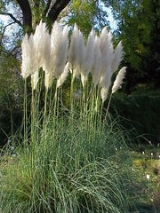
The species of Cortaderia are imposing tall grasses growing 1.5-3 m tall, with graceful white inflorescence plumes. They are in widespread use as ornamental plantOrnamental plant
Ornamental plants are plants that are grown for decorative purposes in gardens and landscape design projects, as house plants, for cut flowers and specimen display...
s in horticultural use. The common name Pampas Grass, though strictly referring to C. selloana, is frequently applied to all species in the genus (and sometimes also, incorrectly, to Erianthus and Saccharum ravennae
Saccharum ravennae
Saccharum ravennae, with the common name Ravennagrass and locally known as ekra, is a species of grass in genus the Saccharum, the sugarcane genus...
).
Some species, notably C. selloana, C. jubata and C. rudiuscula, have become invasive species
Invasive species
"Invasive species", or invasive exotics, is a nomenclature term and categorization phrase used for flora and fauna, and for specific restoration-preservation processes in native habitats, with several definitions....
in a number of areas, including New Zealand, Hawaii
Hawaii
Hawaii is the newest of the 50 U.S. states , and is the only U.S. state made up entirely of islands. It is the northernmost island group in Polynesia, occupying most of an archipelago in the central Pacific Ocean, southwest of the continental United States, southeast of Japan, and northeast of...
, and regions with a Mediterranean climate
Mediterranean climate
A Mediterranean climate is the climate typical of most of the lands in the Mediterranean Basin, and is a particular variety of subtropical climate...
.