


Constitutional Council of France

Encyclopedia

Constitution of France
The current Constitution of France was adopted on 4 October 1958. It is typically called the Constitution of the Fifth Republic, and replaced that of the Fourth Republic dating from 1946. Charles de Gaulle was the main driving force in introducing the new constitution and inaugurating the Fifth...
on 4 October 1958, and its duty is to ensure that the principles and rules of the constitution are upheld.
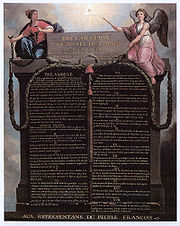
Its main activity is to rule on whether proposed statutes conform with the Constitution, after they have been voted by Parliament and before they are signed into law by the President of the Republic (a priori review); since 1 March 2010, individual citizens party to a trial or lawsuit can also ask for the Council to review whether the law applied in the case is constitutional. In 1971, the Council ruled that conformity with the Constitution entails conformity with two texts referred to by the preamble of that constitution: the Declaration of the Rights of Man and of the Citizen
Declaration of the Rights of Man and of the Citizen
The Declaration of the Rights of Man and of the Citizen is a fundamental document of the French Revolution, defining the individual and collective rights of all the estates of the realm as universal. Influenced by the doctrine of "natural right", the rights of man are held to be universal: valid...
and the preamble of the constitution of the Fourth Republic
French Fourth Republic
The French Fourth Republic was the republican government of France between 1946 and 1958, governed by the fourth republican constitution. It was in many ways a revival of the Third Republic, which was in place before World War II, and suffered many of the same problems...
, both of which list constitutional rights (e.g. freedom of speech
Freedom of speech
Freedom of speech is the freedom to speak freely without censorship. The term freedom of expression is sometimes used synonymously, but includes any act of seeking, receiving and imparting information or ideas, regardless of the medium used...
).
The Council and the enactment of legislation in France
- This article refers extensively to individual articles in the Constitution of France. The reader should refer to the official translation of the Constitution on the site of the French National AssemblyFrench National AssemblyThe French National Assembly is the lower house of the bicameral Parliament of France under the Fifth Republic. The upper house is the Senate ....
. Another recommended reading is the Constitutional Council overview on the Council web site.
The Government of France
Government of France
The government of the French Republic is a semi-presidential system determined by the French Constitution of the fifth Republic. The nation declares itself to be an "indivisible, secular, democratic, and social Republic"...
consists
Separation of powers
The separation of powers, often imprecisely used interchangeably with the trias politica principle, is a model for the governance of a state. The model was first developed in ancient Greece and came into widespread use by the Roman Republic as part of the unmodified Constitution of the Roman Republic...
of an executive branch (President of the Republic, Prime Minister
Prime Minister of France
The Prime Minister of France in the Fifth Republic is the head of government and of the Council of Ministers of France. The head of state is the President of the French Republic...
, ministers, and their services and affiliated organizations), a legislative branch (both houses of Parliament
Parliament of France
The French Parliament is the bicameral legislature of the French Republic, consisting of the Senate and the National Assembly . Each assembly conducts legislative sessions at a separate location in Paris: the Palais du Luxembourg for the Senate, the Palais Bourbon for the National Assembly.Each...
), and a judicial branch. The judicial branch is, unlike for instance the federal judiciary
United States federal courts
The United States federal courts make up the judiciary branch of federal government of the United States organized under the United States Constitution and laws of the federal government.-Categories:...
of the United States under the Supreme Court
Supreme Court of the United States
The Supreme Court of the United States is the highest court in the United States. It has ultimate appellate jurisdiction over all state and federal courts, and original jurisdiction over a small range of cases...
, not organized into a single hierarchy (administrative courts fall under the Council of State, civil and criminal courts under the Court of Cassation
Court of Cassation (France)
The French Supreme Court of Judicature is France's court of last resort having jurisdiction over all matters triable in the judicial stream but only scope of review to determine a miscarriage of justice or certify a question of law based solely on points of law...
), and some of its entities also have advisory functions. For historical reasons there has long been a hostility to having anything resembling a "Supreme Court", that is, a powerful court able to quash legislation. Whether the Council is a court is a subject of academic discussion, but some scholars consider it the supreme court
Supreme court
A supreme court is the highest court within the hierarchy of many legal jurisdictions. Other descriptions for such courts include court of last resort, instance court, judgment court, high court, or apex court...
of France.
The Constitution of the French Fifth Republic
French Fifth Republic
The Fifth Republic is the fifth and current republican constitution of France, introduced on 4 October 1958. The Fifth Republic emerged from the collapse of the French Fourth Republic, replacing the prior parliamentary government with a semi-presidential system...
distinguishes two distinct kinds of legislation: statute law, which is normally voted upon by Parliament
Parliament of France
The French Parliament is the bicameral legislature of the French Republic, consisting of the Senate and the National Assembly . Each assembly conducts legislative sessions at a separate location in Paris: the Palais du Luxembourg for the Senate, the Palais Bourbon for the National Assembly.Each...
(except for ordonnance
Ordonnance (French constitutional law)
In the Government of France, an ordonnance is a statute passed by the Council of Ministers in an area of law normally reserved for statute law passed by the Parliament of France....
s) and government regulations, which are enacted by the Prime Minister and his government as decree
Decree
A decree is a rule of law issued by a head of state , according to certain procedures . It has the force of law...
s and other regulations (arrêtés). Article 34 of the Constitution exhaustively lists the areas reserved for statute law: these include, for instance, criminal law
Criminal law
Criminal law, is the body of law that relates to crime. It might be defined as the body of rules that defines conduct that is not allowed because it is held to threaten, harm or endanger the safety and welfare of people, and that sets out the punishment to be imposed on people who do not obey...
.
Any regulation issued by the executive in the areas constitutionally reserved for statute law is unconstitutional unless it has been authorized as secondary legislation by a statute. Any citizen with an interest in the case can obtain the cancellation of these regulations by the Council of State, on grounds that the executive has exceeded its authority. Furthermore, the Council of State can quash regulations on grounds that they violate existing statute law, constitutional rights or the "general principles of law".
In addition, new acts can be referred to the Constitutional Council by a petition just prior to being signed into law by the President of the Republic. The most common circumstance for this is that 60 opposition members of the National Assembly, or 60 opposition members of the Senate request such a review.
If the Prime Minister thinks that some clauses of existing statute law instead belong to the domain of regulations, he can also ask the Council to reclassify these clauses as regulations.
Traditionally, France refused to accept the idea that courts could quash legislation enacted by Parliament (though administrative courts could quash regulations produced by the executive). This goes back to the French revolutionary era: pre-revolutionary courts had often used their power not to register laws and thus prevent their application for political purposes, and had blocked reforms. French courts when then prohibited from making rulings of a general nature. Also, it seemed that if courts could quash legislation after it had been enacted and taken into account by citizens, it would introduce legal uncertainties: how could a citizen plan his or her actions according to what is legal or not if laws could a posteriori be found not to hold ? Yet, in the late 20th century, courts, especially administrative courts, began applying the consequences of international treaties, including law of the European union
European Union
The European Union is an economic and political union of 27 independent member states which are located primarily in Europe. The EU traces its origins from the European Coal and Steel Community and the European Economic Community , formed by six countries in 1958...
, as superior to national law.
A 2009 reform, effective on 1 March 2010, enables parties to a lawsuit or trial to question the constitutionnality of the law that is being applied to them. The procedure, known as question prioritaire de constitutionnalité, is grossly as follows: the question is raised before the trial judge and, if it has merit, it is forwarded to the appropriate supreme court (Council of State if the referral comes from an administrative court, Cour de Cassation for other courts). The supreme court collects such referrals and submits them to the Constitutional Council. If the Constitutional Council rules a law to be unconstitutional, this law is struck down from the law books; this decision is valid for everybody and not only for the cases at hand.
Powers and tasks
The Council has two main areas of power:- The first is the supervision of elections, both presidential and parliamentaryParliament of FranceThe French Parliament is the bicameral legislature of the French Republic, consisting of the Senate and the National Assembly . Each assembly conducts legislative sessions at a separate location in Paris: the Palais du Luxembourg for the Senate, the Palais Bourbon for the National Assembly.Each...
and ensuring the legitimacy of referendumReferendumA referendum is a direct vote in which an entire electorate is asked to either accept or reject a particular proposal. This may result in the adoption of a new constitution, a constitutional amendment, a law, the recall of an elected official or simply a specific government policy. It is a form of...
s (Articles 58, 59 and 60). They issue the official results, they ensure proper conduct and fairness, and they see that campaign spending limits are adhered to. The Council is the supreme authority in these matters. The Council can declare an election to be invalid if improperly conducted, or if the elected candidate used illegal methods, or if he spent for his campaign over the legal limits. - The second area of Council power is the interpretation of the fundamental meanings of the constitution, procedure, legislation, and treaties. The Council can declare dispositions of laws to be contrary to the Constitution of FranceConstitution of FranceThe current Constitution of France was adopted on 4 October 1958. It is typically called the Constitution of the Fifth Republic, and replaced that of the Fourth Republic dating from 1946. Charles de Gaulle was the main driving force in introducing the new constitution and inaugurating the Fifth...
or to the principles of constitutional value that it has deduced from the Constitution or from the Declaration of the Rights of Man and of the CitizenDeclaration of the Rights of Man and of the CitizenThe Declaration of the Rights of Man and of the Citizen is a fundamental document of the French Revolution, defining the individual and collective rights of all the estates of the realm as universal. Influenced by the doctrine of "natural right", the rights of man are held to be universal: valid...
. It also may declare laws to be in contravention of treatiesTreatyA treaty is an express agreement under international law entered into by actors in international law, namely sovereign states and international organizations. A treaty may also be known as an agreement, protocol, covenant, convention or exchange of letters, among other terms...
which France has signed, such as the European Convention on Human RightsEuropean Convention on Human RightsThe Convention for the Protection of Human Rights and Fundamental Freedoms is an international treaty to protect human rights and fundamental freedoms in Europe. Drafted in 1950 by the then newly formed Council of Europe, the convention entered into force on 3 September 1953...
. Their declaring that a law is contrary to constitutional or treaty dispositions renders it invalid. The Council also may impose reservations as to the interpretation of certain provisions in statutes. The decisions of the Council are binding on all authorities.
In some cases, examination of laws by the Council is compulsory. Organic bills, those which fundamentally affect government and treaties, need to be assessed by the Council before they are considered ratified (Article 61-1 and 54). Amendments concerning the rules governing parliamentary procedures need to be considered by the Council, as well. Guidance may be sought from the Council in regard to whether reform should come under statute law (voted by Parliament) or whether issues are considered as règlement (regulation) to be adopted with decree
Decree
A decree is a rule of law issued by a head of state , according to certain procedures . It has the force of law...
of the prime minister
Prime Minister of France
The Prime Minister of France in the Fifth Republic is the head of government and of the Council of Ministers of France. The head of state is the President of the French Republic...
. The re-definition of legislative dispositions as regulatory matters initially constituted a significant share of the (then light) caseload of the Council.
In the case of other statutes, seeking the oversight of the Council is not compulsory. However, the president of the Republic, the president of the Senate, the president of the Assembly, the prime minister
Prime Minister of France
The Prime Minister of France in the Fifth Republic is the head of government and of the Council of Ministers of France. The head of state is the President of the French Republic...
, or 60 members of the National Assembly, or 60 senators can submit a statute for examination by the Council before its signing into law by the President. In general, it is the parliamentary opposition
Opposition (politics)
In politics, the opposition comprises one or more political parties or other organized groups that are opposed to the government , party or group in political control of a city, region, state or country...
which brings laws that it deems to infringe civil rights before the Council.
Another task of the council, of lesser importance in terms of number of referrals, is the reclassification of statute law into the domain of regulations, on the Prime Minister's request. This happens when the Prime Minister and his government wish to alter law that has been enacted as statute law, but should instead belong to regulations according to the Constitution. The Prime Minister has to obtain reclassification from the Council prior to taking any decree
Decree
A decree is a rule of law issued by a head of state , according to certain procedures . It has the force of law...
changing the regulations. This, however, is nowadays only a small fraction of the Council's activity: in 2008, out 140 of decisions, only 5 concerned reclassifications.
Thus, it can be argued that the Council's role as a constraint to the government is likely to increase over the years.
History and evolution
While since the 19th century the judicial review that the Constitutional Council brings to bear on the acts of the executive branch has played an increasingly large role, the politicians that framed the successive French institutions have long been reluctant to have the judiciary review legislation. The argument was that un-elected judges should not be able to overrule directly the decisions of the democratically-elected legislature. This may also have reflected the poor impression that the political action of the parlementParlement
Parlements were regional legislative bodies in Ancien Régime France.The political institutions of the Parlement in Ancien Régime France developed out of the previous council of the king, the Conseil du roi or curia regis, and consequently had ancient and customary rights of consultation and...
s – courts of justice under the ancien régime monarchy – had left: these courts often had chosen to block legislation in order to further the privileges of a small caste. Whatever the reasons, the idea was that legislation was a political tool, and that the responsibility of legislation should be borne by the legislative body.
Originally, the Council was meant to have rather technical responsibilities: ensuring that national elections were fair, arbitrating the division between statute law (from the legislative) and regulation (from the executive), etc. The Council role of safekeeping fundamental rights was probably not originally intended by the drafters of the Constitution of the French Fifth Republic
French Fifth Republic
The Fifth Republic is the fifth and current republican constitution of France, introduced on 4 October 1958. The Fifth Republic emerged from the collapse of the French Fourth Republic, replacing the prior parliamentary government with a semi-presidential system...
: it was thought that Parliament should be able to see for itself that it did not infringe on such rights. However, the Council's activity considerably extended in the 1970s.
From 1958 to 1970, under Charles de Gaulle
Charles de Gaulle
Charles André Joseph Marie de Gaulle was a French general and statesman who led the Free French Forces during World War II. He later founded the French Fifth Republic in 1958 and served as its first President from 1959 to 1969....
's presidency, the Constitutional Council was sometimes described as a "cannon aimed at Parliament", protecting the executive branch against encroachment by statute law voted by Parliament. All but one referral to the Constitutional Council came from the Prime Minister, against acts of Parliament, and the Council agreed to partial annulments in all cases. The only remaining referral came from the President of the Senate, Gaston Monnerville
Gaston Monnerville
Gaston Monnerville was a French politician and lawyer.The grandson of a slave, he grew up in French Guiana and went to Toulouse to complete his studies. A brilliant student, he became a lawyer in 1918 and worked with César Campinchi, a lawyer who later became an influential politician...
, against the 1962 referendum
French presidential election referendum, 1962
A referendum on the direct election of the President was held in France on 28 October 1962. It was approved by 62.3% of voters with a 77.0% turnout...
on the direct election of the President of the Republic, which Charles de Gaulle supported; and the Council ruled itself "incompetent" to cancel the direct expression of the will of the French people.
In 1971, however, the Council ruled unconstitutional (Decision 71-44DC) some provisions of a law changing the rules for the incorporation of private nonprofit associations, because they infringed on freedom of association, one of the principles given in the 1789 Declaration of the Rights of Man and of the Citizen
Declaration of the Rights of Man and of the Citizen
The Declaration of the Rights of Man and of the Citizen is a fundamental document of the French Revolution, defining the individual and collective rights of all the estates of the realm as universal. Influenced by the doctrine of "natural right", the rights of man are held to be universal: valid...
; they used the fact that the preamble of the French constitution briefly referred to those principles to justify their decision. For the first time, a statute was declared unconstitutional not because it infringed on technical legal principles, but because it was deemed to infringe on personal freedoms.
In 1974, the possibility to request a constitutional review was extended to 60 members of the National Assembly or 60 senators. Soon, the political opposition seized that opportunity to request the review of all controversial acts.
The Council increasingly has frowned upon "rider
Rider (legislation)
In legislative procedure, a rider is an additional provision added to a bill or other measure under the consideration by a legislature, having little connection with the subject matter of the bill. Riders are usually created as a tactic to pass a controversial provision that would not pass as its...
s" (cavaliers) – amendments or clauses introduced into bills but having no relationship to the original topic of the bill; for instance, "budgetary riders" in the Budget bill, or "social riders" in the Social security budget bill. See legislative riders in France.
In January 2005, Pierre Mazeaud
Pierre Mazeaud
Pierre Mazeaud is a French jurist, politician and alpinist.In February 2004, he was appointed president of the Constitutional Council of France by President of the Republic Jacques Chirac, replacing Yves Guéna, until he was succeeded by Jean-Louis Debré in February 2007...
, then president of the Council, announced that the Council would take a stricter view of language of a non-prescriptive character introduced in laws, sometimes known as "legislative neutrons". Instead of prescribing or prohibiting, as advocated by Portalis
Jean-Étienne-Marie Portalis
Jean-Étienne-Marie Portalis was a French jurist and politician in time of the French Revolution and the First Empire...
, such language makes statements about the state of the world, or wishes about what it should be. Previously, this language was considered devoid of juridical effects and thus harmless; but Mazeaud contended that introducing vague language devoid of juridical consequences just dilutes law unnecessarily. He denounced the use of law as an instrument of political communication, expressing vague wishes instead for effective legislation. Mazeaud also said that, because of the constitutional objective that law should be accessible and understandable, law should be precise and clear, and devoid of details or equivocal formulas. The practice of putting into laws remarks or wishes with no clear legal consequences has been a long-standing concern of French jurists.
, one law out of two, including the budget, was sent to the Council at the request of the opposition. In January 2005, Pierre Mazeaud, then president of the Council, publicly deplored the inflation of the number of constitutional review requests motivated by political concerns, without much legal argumentation to back them on constitutional grounds.
The French constitutional law of 23 July 2008
French constitutional law of 23 July 2008
The Constitutional law on the Modernisation of the Institutions of the Fifth Republic was enacted into French constitutional law by the Parliament of France in July 2008, to reform state institutions.-History:...
amended article 61 of the Constitution. It now allows for courts to submit questions of unconstitutionality of laws to the Constitutional Council. The Court of Cassation
Court of Cassation (France)
The French Supreme Court of Judicature is France's court of last resort having jurisdiction over all matters triable in the judicial stream but only scope of review to determine a miscarriage of justice or certify a question of law based solely on points of law...
(supreme court over civil and criminal courts) and the Council of State (supreme court over administrative courts) filter the requests coming from the courts under them.
Lois organiques and other decisions organizing how this system functions were subsequently adopted, and the system was activated on 1 March 2010.
Controversies
In 1995, Roland DumasRoland Dumas
Roland Dumas is a lawyer and French Socialist politician who served notably as Foreign Minister under President François Mitterrand from 1984 to 1986 and from 1988 to 1993...
was appointed president of the Council by François Mitterrand
François Mitterrand
François Maurice Adrien Marie Mitterrand was the 21st President of the French Republic and ex officio Co-Prince of Andorra, serving from 1981 until 1995. He is the longest-serving President of France and, as leader of the Socialist Party, the only figure from the left so far elected President...
. Roland Dumas attracted major controversy twice. First, he appeared in scandals regarding the Elf Aquitaine
Elf Aquitaine
Elf Aquitaine was a French oil company which merged with TotalFina to form TotalFinaElf. The new company changed its name to Total in 2003...
oil company, with many details regarding his mistress
Mistress (lover)
A mistress is a long-term female lover and companion who is not married to her partner; the term is used especially when her partner is married. The relationship generally is stable and at least semi-permanent; however, the couple does not live together openly. Also the relationship is usually,...
and his expensive tastes in clothing appearing in the press. Then, the Council put forth some highly controversial opinions in a decision related to the International Criminal Court
International Criminal Court
The International Criminal Court is a permanent tribunal to prosecute individuals for genocide, crimes against humanity, war crimes, and the crime of aggression .It came into being on 1 July 2002—the date its founding treaty, the Rome Statute of the...
, in Decision 98–408 DC, declaring that the sitting President of the Republic could be tried criminally only by the High Court of Justice, a special court organized by Parliament and originally meant for cases of high treason. This, in essence, ensured that Jacques Chirac
Jacques Chirac
Jacques René Chirac is a French politician who served as President of France from 1995 to 2007. He previously served as Prime Minister of France from 1974 to 1976 and from 1986 to 1988 , and as Mayor of Paris from 1977 to 1995.After completing his studies of the DEA's degree at the...
would not face criminal charges until he left office. This controversial decision is now moot since the rules of responsibility of the President of the Republic were redefined by the French constitutional law of 23 July 2008
French constitutional law of 23 July 2008
The Constitutional law on the Modernisation of the Institutions of the Fifth Republic was enacted into French constitutional law by the Parliament of France in July 2008, to reform state institutions.-History:...
.
In 1999, because of the Elf scandal, Roland Dumas put himself on leave from the Council and Yves Guéna
Yves Guéna
Yves Guéna is a French politician. In 1940, he joined the Free French Forces in the United Kingdom. He received several decorations for his courage....
assumed the interim presidency.
In 2005, the Council attracted some limited controversy when Valéry Giscard d'Estaing and Simone Veil
Simone Veil
Simone Veil, DBE is a French lawyer and politician who served as Minister of Health under Valéry Giscard d'Estaing, President of the European Parliament and member of the Constitutional Council of France....
campaigned for the proposed European Constitution, which was submitted to the French voters in a referendum. Simone Veil had done so after obtaining a leave of absence
Leave of absence
Leave of absence is a term used to describe a period of time that one is to be away from his/her primary job, while maintaining the status of employee...
from the Council, which was criticized by some, including Jean-Louis Debré
Jean-Louis Debré
Jean-Louis Debré is a conservative French political figure. He was President of the National Assembly of France from 2002 to 2007 and has been President of the Constitutional Council since 2007.-Biography:Debré was born in Toulouse...
, president of the National Assembly
French National Assembly
The French National Assembly is the lower house of the bicameral Parliament of France under the Fifth Republic. The upper house is the Senate ....
, as a dubious procedure – to follow their reasoning, what is the use of prohibiting appointed members of the council from conducting partisan politics if they can put themselves on leave for the duration of the campaign? She defended herself by pointing out to precedent and famously remarked "How is that his business? He has no lesson to teach me." about Debré.
Membership
In addition to the former presidents of the Republic, the Council is made up of nine members who serve non-renewable terms of nine years, one third of whom are appointed every three years; three members each are appointed by the president of the Republic, the president of the National AssemblyFrench National Assembly
The French National Assembly is the lower house of the bicameral Parliament of France under the Fifth Republic. The upper house is the Senate ....
, and the president of the Senate
French Senate
The Senate is the upper house of the Parliament of France, presided over by a president.The Senate enjoys less prominence than the lower house, the directly elected National Assembly; debates in the Senate tend to be less tense and generally enjoy less media coverage.-History:France's first...
, and former presidents of the Republic who have chosen to sit in the council (which they may not do if they become directly involved in politics). The president of the Council is selected by the president of the Republic.
Following from the 2008 constitutional revision
French constitutional law of 23 July 2008
The Constitutional law on the Modernisation of the Institutions of the Fifth Republic was enacted into French constitutional law by the Parliament of France in July 2008, to reform state institutions.-History:...
, appointments to the Council will be subject to a Parliamentary approval process (Constitution, articles 13 and 56). , these provisions are not operational yet since the relevant procedures have not yet been set in law.
A quorum
Quorum
A quorum is the minimum number of members of a deliberative assembly necessary to conduct the business of that group...
of 7 members is imposed unless exceptional circumstances are noted. Votes are by majority of the present members; the president of the Council has a casting vote
Casting vote
A casting vote is a vote given to the presiding officer of a council or legislative body to resolve a deadlock and which can be exercised only when such a deadlock exists...
in case of an equal split. For decisions about the incapacity of the President of the Republic, a majority of the members of the council is needed.
, the current members are:
- Jean-Louis DebréJean-Louis DebréJean-Louis Debré is a conservative French political figure. He was President of the National Assembly of France from 2002 to 2007 and has been President of the Constitutional Council since 2007.-Biography:Debré was born in Toulouse...
, president of the Council, appointed president of the Council by President of the Republic Jacques ChiracJacques ChiracJacques René Chirac is a French politician who served as President of France from 1995 to 2007. He previously served as Prime Minister of France from 1974 to 1976 and from 1986 to 1988 , and as Mayor of Paris from 1977 to 1995.After completing his studies of the DEA's degree at the...
on 23 February 2007; - Pierre SteinmetzPierre SteinmetzPierre Steinmetz is a member of the Constitutional Council of France since 2004.-External links:...
, appointed by the president of the Republic in February 2004; - Jacqueline de GuillenchmidtJacqueline de GuillenchmidtJacqueline de Guillenchmidt is a member of the Constitutional Council of France since 2004.Previously she was a member of Conseil supérieur de l'audiovisuel.-External links:...
, appointed by the president of the Senate in February 2004; - Renaud Denoix de Saint MarcRenaud Denoix de Saint MarcRenaud Denoix de Saint Marc is a French lawyer.From 23 April 1995 he served as head of the French Council of State as vice-president up to his retirement on 25 September 2006...
, appointed by the president of the Senate in February 2007; - Guy CanivetGuy CanivetGuy Canivet is a French judge., he is president of the Court of Cassation and as such is the highest judge in France....
, appointed by the president of the National Assembly in February 2007; - Michel CharasseMichel CharasseMichel Charasse is a member of the Senate of France. He represents the Puy-de-Dôme department, and is a member of the European Democratic and Social Rally....
, appointed by the president of the Republic in March 2010; - Hubert HaenelHubert HaenelHubert Haenel is a French politician and a member of the Senate of France. He represents the Haut-Rhin department and is a member of the Union for a Popular Movement Party....
, appointed by the president of the Senate in March 2010; - Jacques BarrotJacques BarrotJacques Barrot is a French politician, who has served as European Commissioner for Justice , after four years as Commissioner for Transport and Commissioner for Regional Policy for eight months . He is also one of five vice-presidents of the 27-member Barroso Commission...
, appointed by the president of the National Assembly in March 2010; - Claire Bazy-MalaurieClaire Bazy-MalaurieClaire Bazy-Malaurie is a member of the Constitutional Council of France.-External links:*...
, appointed by the president of the Republic in August 2010; - Valéry Giscard d'EstaingValéry Giscard d'EstaingValéry Marie René Georges Giscard d'Estaing is a French centre-right politician who was President of the French Republic from 1974 until 1981...
, former president of the Republic; - Jacques ChiracJacques ChiracJacques René Chirac is a French politician who served as President of France from 1995 to 2007. He previously served as Prime Minister of France from 1974 to 1976 and from 1986 to 1988 , and as Mayor of Paris from 1977 to 1995.After completing his studies of the DEA's degree at the...
, former president of the Republic.
The members of the Council, except for former presidents of the Republic, are sworn in by the president of the Republic.
The members of the Council should abstain from partisanship
Partisan (political)
In politics, a partisan is a committed member of a political party. In multi-party systems, the term is widely understood to carry a negative connotation - referring to those who wholly support their party's policies and are perhaps even reluctant to acknowledge correctness on the part of their...
. They should refrain from making declarations that could lead them to be suspected of partisanship. The possibility for former presidents to sit in the Council is a topic of moderate controversy; some see it as incompatible with the absence of partisanship.
René Coty
René Coty
René Jules Gustave Coty was President of France from 1954 to 1959. He was the second and last president under the French Fourth Republic.-Early life and politics:...
, Vincent Auriol
Vincent Auriol
Vincent Jules Auriol was a French politician who served as the first President of the Fourth Republic from 1947 to 1954. He also served as interim President of the Provisional Government from November to December 1946, making him one of only three people who were heads of state of the French...
, Valéry Giscard d'Estaing
Valéry Giscard d'Estaing
Valéry Marie René Georges Giscard d'Estaing is a French centre-right politician who was President of the French Republic from 1974 until 1981...
and Jacques Chirac
Jacques Chirac
Jacques René Chirac is a French politician who served as President of France from 1995 to 2007. He previously served as Prime Minister of France from 1974 to 1976 and from 1986 to 1988 , and as Mayor of Paris from 1977 to 1995.After completing his studies of the DEA's degree at the...
are the only former presidents to have sat in the Council.
Location
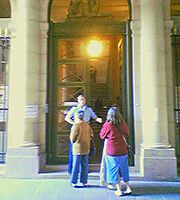
Palais Royal
The Palais-Royal, originally called the Palais-Cardinal, is a palace and an associated garden located in the 1st arrondissement of Paris...
in Paris, near the Conseil d'État.
See also
- ConstitutionalismConstitutionalismConstitutionalism has a variety of meanings. Most generally, it is "a complex of ideas, attitudes, and patterns of behavior elaborating the principle that the authority of government derives from and is limited by a body of fundamental law"....
- Constitutional economicsConstitutional economicsConstitutional economics is a research program in economics and constitutionalism that has been described as extending beyond the definition of 'the economic analysis of constitutional law' in explaining the choice "of alternative sets of legal-institutional-constitutional rules that constrain the...
- JudiciaryJudiciaryThe judiciary is the system of courts that interprets and applies the law in the name of the state. The judiciary also provides a mechanism for the resolution of disputes...
- Justice in FranceJustice in FranceIn France, judges are considered civil servants exercising one of the sovereign powers of the state, and, accordingly, only French citizens are eligible for judgeship. France's independent judiciary enjoys special statutory protection from the executive branch...
- JurisprudenceJurisprudenceJurisprudence is the theory and philosophy of law. Scholars of jurisprudence, or legal theorists , hope to obtain a deeper understanding of the nature of law, of legal reasoning, legal systems and of legal institutions...
- Rule According to Higher LawRule according to higher lawThe rule according to a higher law means that no written law may be enforced by the government unless it conforms with certain unwritten, universal principles of fairness, morality, and justice...
Books
- Frédéric Monera, L'idée de République et la jurisprudence du Conseil constitutionnel, L.G.D.J., 2004, ISBN 2-275-02524-3
- Henry Roussillon, Le Conseil constitutionnel, 6th ed., DallozDallozDalloz is a French publisher specialized in legal matters.The company was founded in 1845 by Désiré Dalloz, and notably publishes the Recueil Dalloz.-External links:...
, 2008, ISBN 978-2-247-07852-3 - Pierre Avril, Jean Gicquel, Le Conseil constitutionnel, 5th ed., Montchrestien, 2005, ISBN 2-7076-1376-2
- Louis Favoreu, Loïc Philip, Le Conseil constitutionnel, 7th ed., P.U.F., 2005. (Que sais je ? series, #1724), ISBN 2-13-053079-6
- Michel Verpeaux, Maryvonne Bonnard, eds.; Le Conseil Constitutionnel, La Documentation Française, 2007, ISBN 978-2-247-07852-3
- Alec Stone, The Birth of Judicial Politics in France: The Constitutional Council in Comparative Perspective, Oxford University Press, ISBN 0-19-507034-8
- Martin A. Rogoff, "French Constitutional Law: Cases and Materials" – Durham, North Carolina: Carolina Academic Press, 2010.http://www.cap-press.com/books/isbn/9781594606540/French+Constitutional+Law
Articles
- Michael H. Davis, The Law/Politics Distinction, the French Conseil Constitutionnel, and the U. S. Supreme CourtSupreme Court of the United StatesThe Supreme Court of the United States is the highest court in the United States. It has ultimate appellate jurisdiction over all state and federal courts, and original jurisdiction over a small range of cases...
, The American Journal of Comparative Law, Vol. 34, No. 1 (Winter, 1986), pp. 45–92 - F. L. Morton, Judicial Review in France: A Comparative Analysis, The American Journal of Comparative Law, Vol. 36, No. 1 (Winter, 1988), pp. 89–110
- James Beardsley, Constitutional Review in France, The Supreme Court Review, Vol. 1975, (1975), pp. 189–259