

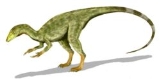
Compsognathidae

Encyclopedia
Compsognathidae is a family of small carnivorous
dinosaur
s, generally conservative in form, from the Jurassic
and Cretaceous
Periods. Compsognathids lie at or near the origin of feathers—skin impressions are known from four genera, Compsognathus
, Sinosauropteryx
, Sinocalliopteryx
, and Juravenator
. While Juravenator, Sinosauropteryx, and Sinocalliopteryx show evidence of a covering of simple, primitive feathers, Juravenator and Compsognathus also show evidence of scales on the tail or hind legs.
The position of the Compsognathidae within the Coelurosaur
group is uncertain; some hold the family as the basalmost of the coelurosaurs, while others as part of the Maniraptora
.
to include Coelurus
(Late Jurassic
, North America), Compsognathus
(Late Jurassic, Europe), Sinosauropteryx
(Early Cretaceous
, Asia) and an unnamed Compsognathus
-like form (Early Cretaceous, South America; this dinosaur has since been placed in the new genus Mirischia
). However, this taxonomy has not been widely adopted. Sereno (2005) points out that Compsognathidae has priority of name, even if dinosaurs such as Coelurus or Ornitholestes belongs in the same family as Compsognathus.
Carnivore
A carnivore meaning 'meat eater' is an organism that derives its energy and nutrient requirements from a diet consisting mainly or exclusively of animal tissue, whether through predation or scavenging...
dinosaur
Dinosaur
Dinosaurs are a diverse group of animals of the clade and superorder Dinosauria. They were the dominant terrestrial vertebrates for over 160 million years, from the late Triassic period until the end of the Cretaceous , when the Cretaceous–Paleogene extinction event led to the extinction of...
s, generally conservative in form, from the Jurassic
Jurassic
The Jurassic is a geologic period and system that extends from about Mya to Mya, that is, from the end of the Triassic to the beginning of the Cretaceous. The Jurassic constitutes the middle period of the Mesozoic era, also known as the age of reptiles. The start of the period is marked by...
and Cretaceous
Cretaceous
The Cretaceous , derived from the Latin "creta" , usually abbreviated K for its German translation Kreide , is a geologic period and system from circa to million years ago. In the geologic timescale, the Cretaceous follows the Jurassic period and is followed by the Paleogene period of the...
Periods. Compsognathids lie at or near the origin of feathers—skin impressions are known from four genera, Compsognathus
Compsognathus
Compsognathus was a small, bipedal, carnivorous theropod dinosaur. The animal was the size of a turkey and lived around 150 million years ago, the early Tithonian stage of the late Jurassic Period, in what is now Europe. Paleontologists have found two well-preserved fossils, one in Germany...
, Sinosauropteryx
Sinosauropteryx
Sinosauropteryx was the first genus of dinosaur outside of Avialae to be found with evidence of feathers. They were covered with "furry" coats of very simple filament-like feathers...
, Sinocalliopteryx
Sinocalliopteryx
Sinocalliopteryx is a genus of compsognathid dinosaur from the Lower Cretaceous Yixian Formation of China...
, and Juravenator
Juravenator
Juravenator is a genus of small coelurosaurian dinosaur, which lived in the area which would someday become the Jura mountains of Germany, about 151 or 152 million years ago. It is known from a single, juvenile specimen...
. While Juravenator, Sinosauropteryx, and Sinocalliopteryx show evidence of a covering of simple, primitive feathers, Juravenator and Compsognathus also show evidence of scales on the tail or hind legs.
The position of the Compsognathidae within the Coelurosaur
Coelurosauria
Coelurosauria is the clade containing all theropod dinosaurs more closely related to birds than to carnosaurs. In the past, it was used to refer to all small theropods, although this classification has been abolished...
group is uncertain; some hold the family as the basalmost of the coelurosaurs, while others as part of the Maniraptora
Maniraptora
Maniraptora is a clade of coelurosaurian dinosaurs which includes the birds and the dinosaurs that were more closely related to them than to Ornithomimus velox. It contains the major subgroups Avialae, Deinonychosauria, Oviraptorosauria and Therizinosauria. Ornitholestes and the Alvarezsauroidea...
.
Taxonomic issues
In 2003, O.W.M. Rauhut redefined the family CoeluridaeCoeluridae
Coeluridae is a historically polyphyletic family of generally small, carnivorous dinosaurs from the late Jurassic Period...
to include Coelurus
Coelurus
Coelurus is a genus of coelurosaur dinosaur from the Late Jurassic period . The name means "hollow tail", referring to its hollow tail vertebrae...
(Late Jurassic
Late Jurassic
The Late Jurassic is the third epoch of the Jurassic Period, and it spans the geologic time from 161.2 ± 4.0 to 145.5 ± 4.0 million years ago , which is preserved in Upper Jurassic strata. In European lithostratigraphy, the name "Malm" indicates rocks of Late Jurassic age...
, North America), Compsognathus
Compsognathus
Compsognathus was a small, bipedal, carnivorous theropod dinosaur. The animal was the size of a turkey and lived around 150 million years ago, the early Tithonian stage of the late Jurassic Period, in what is now Europe. Paleontologists have found two well-preserved fossils, one in Germany...
(Late Jurassic, Europe), Sinosauropteryx
Sinosauropteryx
Sinosauropteryx was the first genus of dinosaur outside of Avialae to be found with evidence of feathers. They were covered with "furry" coats of very simple filament-like feathers...
(Early Cretaceous
Early Cretaceous
The Early Cretaceous or the Lower Cretaceous , is the earlier or lower of the two major divisions of the Cretaceous...
, Asia) and an unnamed Compsognathus
Compsognathus
Compsognathus was a small, bipedal, carnivorous theropod dinosaur. The animal was the size of a turkey and lived around 150 million years ago, the early Tithonian stage of the late Jurassic Period, in what is now Europe. Paleontologists have found two well-preserved fossils, one in Germany...
-like form (Early Cretaceous, South America; this dinosaur has since been placed in the new genus Mirischia
Mirischia
Mirischia is a small extinct genus of compsognathid dinosaur from the Albian stage of Brazil. Though presently known only from a pelvis and incomplete hind limbs, it preserves enough information to show that it should be recognized as a distinct species...
). However, this taxonomy has not been widely adopted. Sereno (2005) points out that Compsognathidae has priority of name, even if dinosaurs such as Coelurus or Ornitholestes belongs in the same family as Compsognathus.