Sinocalliopteryx

Encyclopedia
Sinocalliopteryx is a genus
of compsognathid dinosaur
from the Lower Cretaceous Yixian Formation
of China
(Jianshangou Beds, dating to 124.6 Ma). While similar to the related Huaxiagnathus
, Sinocalliopteryx is larger, and at 2.37 meters (7.78 ft) in length, it is the largest known compsognathid genus, and the large size of this "giant compsognathid" lent Sinocalliopteryx its specific name, S. gigas, meaning 'giant.' Sinocalliopteryx is also distinguished from Huaxiagnathus, as well as other compsognathids, by its relatively long hands in relation to its arms, which were also longer overall than in most compsognathids, a feature possibly related to its size.
. The integument of Sinocalliopteryx differ in length across the body, with the longest protofeathers covering the hips, base of the tail, and back of the thighs. These longest protofeathers measured up to 10 centimeters (4 in) in length. Interestingly, protofeathers were also found on the metatarsus (upper part of the foot). While these were not nearly as long or modern as the corresponding feathers of "four-winged" dinosaurs such as Microraptor
and Pedopenna
, they do indicate that foot-feathers or similar structures first arose in dinosaurs much more primitive than previously known.
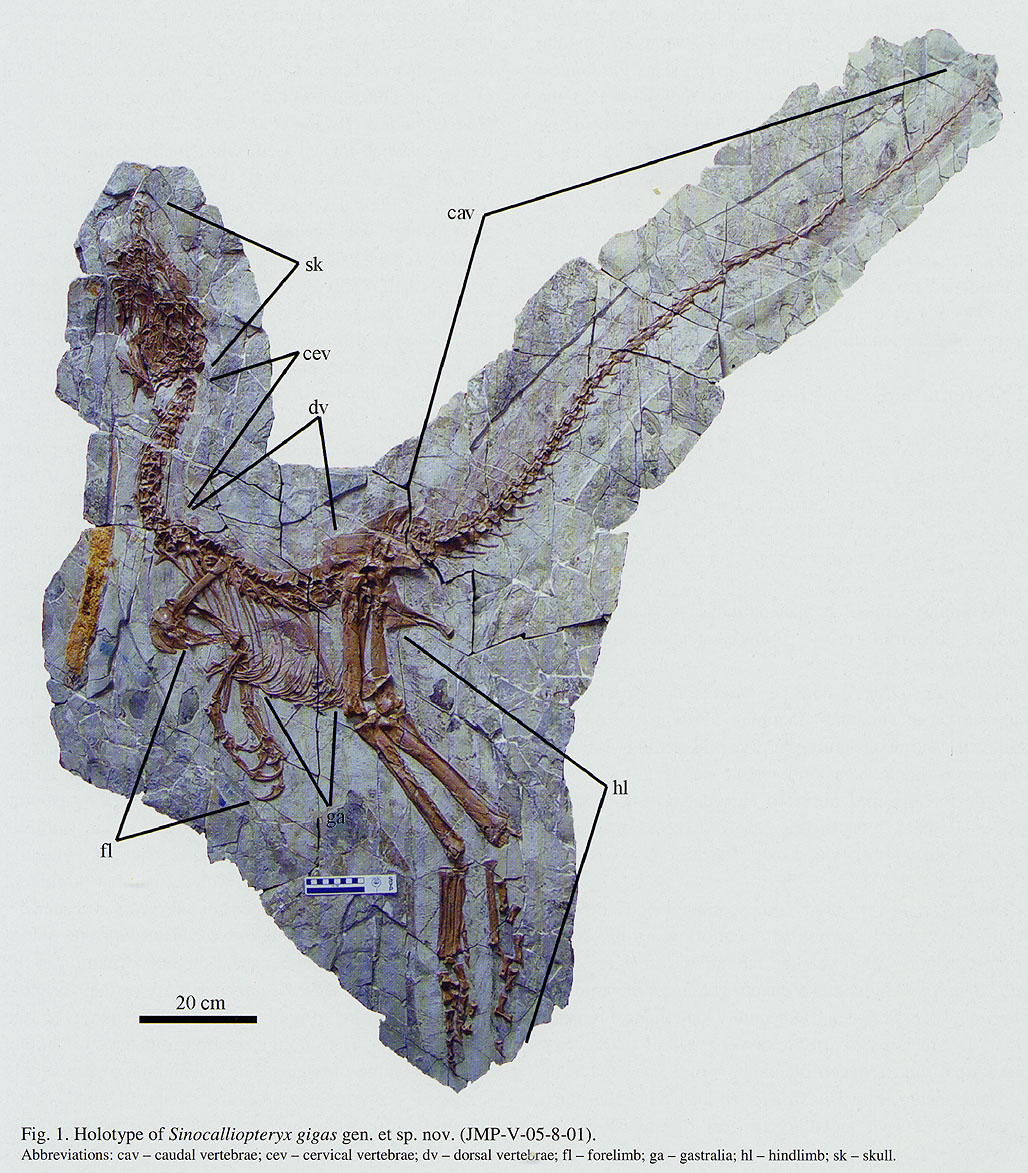
The well-preserved skeleton of Sinocalliopteryx contained the partial leg of a dromaeosaurid within the abdominal cavity, comprising a complete lower leg and foot with toes and claws in their natural, articulated position. While the leg is very large in relation to the abdominal cavity, it is clearly situated within it, lying between the ribs. Ji and colleagues, who described Sinocalliopteryx in 2007, suggested that this could indicate it preyed upon the smaller, bird-like dinosaur. This discovery indicated that Sinocalliopteryx may have been an agile, active, "fierce" predator, especially since other compsognathids have been found with (presumably fast-moving) lizards and small mammals in their abdominal cavities.
In addition to the dromaeosaurid leg, four irregularly-shaped stones were found in the abdomen, with no similar stones present in any other portions of the skeleton or embedded in the surrounding rock. The authors interpreted these as gastroliths (gizzard
stones) similar to those found with Nqwebasaurus
and Baryonyx
. Other theropods, such as Caudipteryx
and a Mongolia
n ornithomimid, were also found with gastoliths, though in those cases the stones were much more numerous and smaller in size. Ji and colleagues speculated that, since the later two dinosaurs were probably primarily herbivores, the number and size of gastroliths may correspond with diet; that is, herbivores ingested many small stones, while carnivores ingested only a few larger stones to aid in digestion.
The large size of Sinocalliopteryx compared to its relatives is also notable, and may indicate a trend towards large size among compsognathids (a group well known for their small size compared to other, giant theropod dinosaurs), similar to the trends towards larger sizes in other dinosaurian lineages.
For an image of Sinocalliopteryx http://www5b.biglobe.ne.jp/~hilihili/keitou/mizika/dino/dinogazou/umou-kyouryu002.jpg
Genus
In biology, a genus is a low-level taxonomic rank used in the biological classification of living and fossil organisms, which is an example of definition by genus and differentia...
of compsognathid dinosaur
Dinosaur
Dinosaurs are a diverse group of animals of the clade and superorder Dinosauria. They were the dominant terrestrial vertebrates for over 160 million years, from the late Triassic period until the end of the Cretaceous , when the Cretaceous–Paleogene extinction event led to the extinction of...
from the Lower Cretaceous Yixian Formation
Yixian Formation
The Yixian Formation is a geological formation in Jinzhou, Liaoning, People's Republic of China, that spans 11 million years during the early Cretaceous period...
of China
China
Chinese civilization may refer to:* China for more general discussion of the country.* Chinese culture* Greater China, the transnational community of ethnic Chinese.* History of China* Sinosphere, the area historically affected by Chinese culture...
(Jianshangou Beds, dating to 124.6 Ma). While similar to the related Huaxiagnathus
Huaxiagnathus
Huaxiagnathus is a genus of theropod dinosaur from the Lower Cretaceous of China. It was a compsognathid, large for that group at about half a meter longer than Compsognathus and larger specimens of Sinosauropteryx, with the largest specimen about 1.8 meters in length.The name Huaxiagnathus is...
, Sinocalliopteryx is larger, and at 2.37 meters (7.78 ft) in length, it is the largest known compsognathid genus, and the large size of this "giant compsognathid" lent Sinocalliopteryx its specific name, S. gigas, meaning 'giant.' Sinocalliopteryx is also distinguished from Huaxiagnathus, as well as other compsognathids, by its relatively long hands in relation to its arms, which were also longer overall than in most compsognathids, a feature possibly related to its size.
Description
Like many other theropods of the Yixian Formation, Sinocalliopteryx was preserved with "protofeathers," simple filamentous integument (structures covering the skin), very similar to that found in SinosauropteryxSinosauropteryx
Sinosauropteryx was the first genus of dinosaur outside of Avialae to be found with evidence of feathers. They were covered with "furry" coats of very simple filament-like feathers...
. The integument of Sinocalliopteryx differ in length across the body, with the longest protofeathers covering the hips, base of the tail, and back of the thighs. These longest protofeathers measured up to 10 centimeters (4 in) in length. Interestingly, protofeathers were also found on the metatarsus (upper part of the foot). While these were not nearly as long or modern as the corresponding feathers of "four-winged" dinosaurs such as Microraptor
Microraptor
Microraptor is a genus of small, four-winged dromaeosaurid dinosaurs. Numerous well-preserved fossil specimens have been recovered from Liaoning, China...
and Pedopenna
Pedopenna
Pedopenna is a genus of small, feathered, maniraptoran dinosaur from the Daohugou Beds in China. It is possibly older than Archaeopteryx, though the age of the Daohugou Beds where it was found is debated...
, they do indicate that foot-feathers or similar structures first arose in dinosaurs much more primitive than previously known.
The well-preserved skeleton of Sinocalliopteryx contained the partial leg of a dromaeosaurid within the abdominal cavity, comprising a complete lower leg and foot with toes and claws in their natural, articulated position. While the leg is very large in relation to the abdominal cavity, it is clearly situated within it, lying between the ribs. Ji and colleagues, who described Sinocalliopteryx in 2007, suggested that this could indicate it preyed upon the smaller, bird-like dinosaur. This discovery indicated that Sinocalliopteryx may have been an agile, active, "fierce" predator, especially since other compsognathids have been found with (presumably fast-moving) lizards and small mammals in their abdominal cavities.
In addition to the dromaeosaurid leg, four irregularly-shaped stones were found in the abdomen, with no similar stones present in any other portions of the skeleton or embedded in the surrounding rock. The authors interpreted these as gastroliths (gizzard
Gizzard
The gizzard, also referred to as the ventriculus, gastric mill, and gigerium, is an organ found in the digestive tract of some animals, including birds, reptiles, earthworms and some fish. This specialized stomach constructed of thick, muscular walls is used for grinding up food; often rocks are...
stones) similar to those found with Nqwebasaurus
Nqwebasaurus
Nqwebasaurus is the name given to a genus of dinosaur from the Tithonian to Valanginian . It was a basal coelurosaur related to Ornitholestes. Its fossils were found in South Africa in the Kirkwood Formation, which is called Nqweba in the native language of the Xhosa...
and Baryonyx
Baryonyx
Baryonyx is a genus of carnivorous saurischian dinosaur first discovered in clay pits just south of Dorking, England, and later reported from fossils found in northern Spain and Portugal. It is known to contain only one species, Baryonyx walkeri...
. Other theropods, such as Caudipteryx
Caudipteryx
Caudipteryx is a genus of peacock-sized theropod dinosaurs that lived in the Aptian age of the early Cretaceous Period . They were feathered and remarkably birdlike in their overall appearance....
and a Mongolia
Mongolia
Mongolia is a landlocked country in East and Central Asia. It is bordered by Russia to the north and China to the south, east and west. Although Mongolia does not share a border with Kazakhstan, its western-most point is only from Kazakhstan's eastern tip. Ulan Bator, the capital and largest...
n ornithomimid, were also found with gastoliths, though in those cases the stones were much more numerous and smaller in size. Ji and colleagues speculated that, since the later two dinosaurs were probably primarily herbivores, the number and size of gastroliths may correspond with diet; that is, herbivores ingested many small stones, while carnivores ingested only a few larger stones to aid in digestion.
The large size of Sinocalliopteryx compared to its relatives is also notable, and may indicate a trend towards large size among compsognathids (a group well known for their small size compared to other, giant theropod dinosaurs), similar to the trends towards larger sizes in other dinosaurian lineages.
External links
- Photo of specimen. Retrieved 2007-APR-02.
For an image of Sinocalliopteryx http://www5b.biglobe.ne.jp/~hilihili/keitou/mizika/dino/dinogazou/umou-kyouryu002.jpg