


Juravenator

Encyclopedia
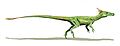
Juravenator is a genus
of small (70 cm long) coelurosaurian dinosaur
, which lived in the area which would someday become the Jura mountains
of Germany
, about 151 or 152 million years ago. It is known from a single, juvenile specimen. The fossil, found in 1998 by amateur paleontologist Klaus-Dieter Weiß in a lime pit near Eichstätt
, had been nicknamed Borsti in German, a name commonly given to bristle-haired dogs, on the assumption the creature was endowed with bristly protofeathers.
, making it a close relative of Compsognathus
, which preserved evidence of scales on the tail of one specimen, but also of Sinosauropteryx
and Sinocalliopteryx
, for which there is fossil evidence of a downy, feather-like covering. However, a patch of fossilized Juravenator skin (from the tail base and hind leg) shows primarily normal dinosaur scales, as well as traces of what may be simple feathers. Paleontologist Xu Xing, in his comments on the find in the journal Nature, initially suggested that the presence of scales on the tail of Juravenator could mean that the feather coat of early feathered dinosaurs was more variable than seen in modern birds. Xu also questioned the interpretation of Juravenator as a compsognathid, suggesting the extensive scaly hide could be a primitive trait, though Compsognathus itself also preserves scales on its tail. Xu considered it most likely that Juravenator and other primitive feathered dinosaurs simply possessed more extensive scales on their bodies than modern birds, which retain scales only on the feet and lower legs.
Xu's interpretation was supported by further study of the Juravenator fossil. The first follow-up study to the initial description reported that faint impressions of filamentous structures, possibly primitive feathers, were present along the top of the tail and hips. A more in-depth study, published in 2010, examined the specimen under ultra-violet light. The examination under UV revealed a more extensive covering of filament-like structures, similar in anatomy to the primitive feathers of other compsognathids, including Sinosauropteryx.
, subsequent studies have found problems with the initial study that produced those findings. Rather than grouping it with Sinosauropteryx and other compsognathids, Butler et al. found that it was not a compsognathid, but rather a basal member of the group Maniraptora
. Studies conflict on whether or not compsognathids belong to this later group or are more primitive. Additional work published by Luis Chiappe and Ursula Göhlich in 2010 found that Juravenator was most similar in anatomy to Compsognathus, and that it probably did belong to Compsognathidae if that is actually a natural group. They also suggested that "compsognathids", including Juravenator, may form a grade of primitive coelurosaurs rather than a monophyletic clade
.
 Comparisons between the scleral ring
s of Juravenator and modern birds and reptiles indicate that it may have been nocturnal.
Genus
In biology, a genus is a low-level taxonomic rank used in the biological classification of living and fossil organisms, which is an example of definition by genus and differentia...
of small (70 cm long) coelurosaurian dinosaur
Dinosaur
Dinosaurs are a diverse group of animals of the clade and superorder Dinosauria. They were the dominant terrestrial vertebrates for over 160 million years, from the late Triassic period until the end of the Cretaceous , when the Cretaceous–Paleogene extinction event led to the extinction of...
, which lived in the area which would someday become the Jura mountains
Jura mountains
The Jura Mountains are a small mountain range located north of the Alps, separating the Rhine and Rhone rivers and forming part of the watershed of each...
of Germany
Germany
Germany , officially the Federal Republic of Germany , is a federal parliamentary republic in Europe. The country consists of 16 states while the capital and largest city is Berlin. Germany covers an area of 357,021 km2 and has a largely temperate seasonal climate...
, about 151 or 152 million years ago. It is known from a single, juvenile specimen. The fossil, found in 1998 by amateur paleontologist Klaus-Dieter Weiß in a lime pit near Eichstätt
Eichstätt
Eichstätt is a town in the federal state of Bavaria, Germany, and capital of the District of Eichstätt. It is located along the Altmühl River, at , and had a population of 13,078 in 2002. It is home to the Katholische Universität Eichstätt-Ingolstadt, the lone Catholic university in Germany. The...
, had been nicknamed Borsti in German, a name commonly given to bristle-haired dogs, on the assumption the creature was endowed with bristly protofeathers.
Feathers and scales
Juravenator was originally classified as a member of the family CompsognathidaeCompsognathidae
Compsognathidae is a family of small carnivorous dinosaurs, generally conservative in form, from the Jurassic and Cretaceous Periods. Compsognathids lie at or near the origin of feathers—skin impressions are known from four genera, Compsognathus, Sinosauropteryx, Sinocalliopteryx, and Juravenator...
, making it a close relative of Compsognathus
Compsognathus
Compsognathus was a small, bipedal, carnivorous theropod dinosaur. The animal was the size of a turkey and lived around 150 million years ago, the early Tithonian stage of the late Jurassic Period, in what is now Europe. Paleontologists have found two well-preserved fossils, one in Germany...
, which preserved evidence of scales on the tail of one specimen, but also of Sinosauropteryx
Sinosauropteryx
Sinosauropteryx was the first genus of dinosaur outside of Avialae to be found with evidence of feathers. They were covered with "furry" coats of very simple filament-like feathers...
and Sinocalliopteryx
Sinocalliopteryx
Sinocalliopteryx is a genus of compsognathid dinosaur from the Lower Cretaceous Yixian Formation of China...
, for which there is fossil evidence of a downy, feather-like covering. However, a patch of fossilized Juravenator skin (from the tail base and hind leg) shows primarily normal dinosaur scales, as well as traces of what may be simple feathers. Paleontologist Xu Xing, in his comments on the find in the journal Nature, initially suggested that the presence of scales on the tail of Juravenator could mean that the feather coat of early feathered dinosaurs was more variable than seen in modern birds. Xu also questioned the interpretation of Juravenator as a compsognathid, suggesting the extensive scaly hide could be a primitive trait, though Compsognathus itself also preserves scales on its tail. Xu considered it most likely that Juravenator and other primitive feathered dinosaurs simply possessed more extensive scales on their bodies than modern birds, which retain scales only on the feet and lower legs.
Xu's interpretation was supported by further study of the Juravenator fossil. The first follow-up study to the initial description reported that faint impressions of filamentous structures, possibly primitive feathers, were present along the top of the tail and hips. A more in-depth study, published in 2010, examined the specimen under ultra-violet light. The examination under UV revealed a more extensive covering of filament-like structures, similar in anatomy to the primitive feathers of other compsognathids, including Sinosauropteryx.
Classification
While first classified as a member of the family CompsognathidaeCompsognathidae
Compsognathidae is a family of small carnivorous dinosaurs, generally conservative in form, from the Jurassic and Cretaceous Periods. Compsognathids lie at or near the origin of feathers—skin impressions are known from four genera, Compsognathus, Sinosauropteryx, Sinocalliopteryx, and Juravenator...
, subsequent studies have found problems with the initial study that produced those findings. Rather than grouping it with Sinosauropteryx and other compsognathids, Butler et al. found that it was not a compsognathid, but rather a basal member of the group Maniraptora
Maniraptora
Maniraptora is a clade of coelurosaurian dinosaurs which includes the birds and the dinosaurs that were more closely related to them than to Ornithomimus velox. It contains the major subgroups Avialae, Deinonychosauria, Oviraptorosauria and Therizinosauria. Ornitholestes and the Alvarezsauroidea...
. Studies conflict on whether or not compsognathids belong to this later group or are more primitive. Additional work published by Luis Chiappe and Ursula Göhlich in 2010 found that Juravenator was most similar in anatomy to Compsognathus, and that it probably did belong to Compsognathidae if that is actually a natural group. They also suggested that "compsognathids", including Juravenator, may form a grade of primitive coelurosaurs rather than a monophyletic clade
Clade
A clade is a group consisting of a species and all its descendants. In the terms of biological systematics, a clade is a single "branch" on the "tree of life". The idea that such a "natural group" of organisms should be grouped together and given a taxonomic name is central to biological...
.
Paleobiology
Sclerotic ring
Sclerotic rings are rings of bone found in the eyes of several groups of vertebrate animals, except for mammals and crocodilians. They can be made up of single bones or small bones together. They are believed to have a role in supporting the eye, especially in animals whose eyes are not spherical,...
s of Juravenator and modern birds and reptiles indicate that it may have been nocturnal.