
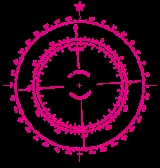
A
compass rose, sometimes called a
windrose, is a figure on a
compassA compass is a navigational instrument that shows directions in a frame of reference that is stationary relative to the surface of the earth. The frame of reference defines the four cardinal directions – north, south, east, and west. Intermediate directions are also defined...
,
mapA map is a visual representation of an area—a symbolic depiction highlighting relationships between elements of that space such as objects, regions, and themes....
,
nautical chartA nautical chart is a graphic representation of a maritime area and adjacent coastal regions. Depending on the scale of the chart, it may show depths of water and heights of land , natural features of the seabed, details of the coastline, navigational hazards, locations of natural and man-made aids...
or monument used to display the orientation of the
cardinal directionThe four cardinal directions or cardinal points are the directions of north, east, south, and west, commonly denoted by their initials: N, E, S, W. East and west are at right angles to north and south, with east being in the direction of rotation and west being directly opposite. Intermediate...
s — North, East, South and West - and their intermediate points. It is also the term for the graduated markings found on the traditional magnetic compass. Today, the idea of a compass rose is found on, or featured in, almost all navigation systems, including
nautical chartA nautical chart is a graphic representation of a maritime area and adjacent coastal regions. Depending on the scale of the chart, it may show depths of water and heights of land , natural features of the seabed, details of the coastline, navigational hazards, locations of natural and man-made aids...
s,
non-directional beaconA non-directional beacon is a radio transmitter at a known location, used as an aviation or marine navigational aid. As the name implies, the signal transmitted does not include inherent directional information, in contrast to other navigational aids such as low frequency radio range, VHF...
s (NDB),
VHF omnidirectional rangeVOR, short for VHF omnidirectional radio range, is a type of radio navigation system for aircraft. A VOR ground station broadcasts a VHF radio composite signal including the station's identifier, voice , and navigation signal. The identifier is typically a two- or three-letter string in Morse code...
(VOR) systems, global-positioning systems (GPS), and similar equipment and devices.
Compass Points
The compass rose is an old design element found on
compassA compass is a navigational instrument that shows directions in a frame of reference that is stationary relative to the surface of the earth. The frame of reference defines the four cardinal directions – north, south, east, and west. Intermediate directions are also defined...
es,
mapA map is a visual representation of an area—a symbolic depiction highlighting relationships between elements of that space such as objects, regions, and themes....
s and even monuments (e.g. the
Tower of the WindsThe Tower of the Winds, also called horologion , is an octagonal Pentelic marble clocktower on the Roman agora in Athens. The structure features a combination of sundials, a water clock and a wind vane...
in
AthensAthens , is the capital and largest city of Greece. Athens dominates the Attica region and is one of the world's oldest cities, as its recorded history spans around 3,400 years. Classical Athens was a powerful city-state...
, the pavement in Dougga, Tunis, during Roman times) to show
cardinal directionThe four cardinal directions or cardinal points are the directions of north, east, south, and west, commonly denoted by their initials: N, E, S, W. East and west are at right angles to north and south, with east being in the direction of rotation and west being directly opposite. Intermediate...
s and frequently intermediate direction. The "rose" term arises from the fairly ornate figures used with early compasses. Older sources sometimes use the term "compass star", or
stella maris ("star of the sea"), to refer to the compass rose.
Early forms of the compass rose were known as
wind roses, since no differentiation was made between a directional point and the wind which emanated from that direction. (Today, the term "
wind roseA wind rose is a graphic tool used by meteorologists to give a succinct view of how wind speed and direction are typically distributed at a particular location. Historically, wind roses were predecessors of the compass rose , as there was no differentiation between a cardinal direction and the wind...
" is often reserved for the object used by meteorologists to depict wind frequencies from different directions at a location.)
The modern compass rose has eight principal winds. Listed clockwise, these are:
| Compass Point | Abbr. | Direction | Traditional Wind |
| North |
N |
0° |
TramontaneTramontane is a classical name for a northern wind. The exact form of the name and precise direction varies from country to country. The word came to English from Italian tramontana, which developed from Latin trānsmontānus , "beyond the mountains/across the mountains", referring to the alps in...
|
| North-East |
NE |
45° |
Greco or Gregale The Gregale is a Mediterranean wind that can occur during times when a low pressure area moves through the area to the south of Malta and causes a strong, cool, northeasterly wind to affect the island...
|
| East |
E |
90° |
Levante This is a disambiguation page. Levante may refer to*Levant, the lands in the eastern Mediterranean, covering Syria, Lebanon, Israel, Palestine, Jordan, Iraq.*Levante, Spain, the eastern Iberian coastal region of Spain...
|
| South-East |
SE |
135° |
SciroccoSirocco, scirocco, , jugo or, rarely, siroc is a Mediterranean wind that comes from the Sahara and reaches hurricane speeds in North Africa and Southern Europe. It is known in North Africa by the Arabic word qibli or ghibli Sirocco, scirocco, , jugo or, rarely, siroc is a Mediterranean wind...
|
| South |
S |
180° |
Ostro Ostro is the traditional Italian name of a southerly wind in the Mediterranean Sea, especially the Adriatic. Its name is derived from the Latin name Auster, which also meant a southerly wind and is part of the etymology of Australia... or Mezzogiorno |
| South-West |
SW |
225° |
Libeccio The libeccio is the westerly or south-westerly wind which predominates in northern Corsica all year round; it frequently raises high seas and may give violent westerly squalls. In summer it is most persistent, but in winter it alternates with the Tramontane... or Garbino |
| West |
W |
270° |
Ponente |
| North-West |
NW |
315° |
Maestro or MistralThe mistral is a strong, cold and usually dry regional wind in France, coming from the north or northwest, which accelerates when it passes through the valleys of the Rhone and the Durance Rivers to the coast of the Mediterranean around the Camargue region. It affects the northeast of the plain...
|
Although modern compasses uses the names of the eight principal directions (N, NE, E, SE, etc.), older compasses use the traditional Italianate wind names of Medieval origin (Tramontana, Greco, Levante, etc.)
16-point roses are constructed by bisecting the angles to come up with intermediate compass points, known as half-winds, at 22° each. The names of the half-winds are simply combinations of the principal winds to either side, e.g. North-northeast (NNE), East-northeast (ENE), etc.
32-point compass roses are constructed by bisecting these angles, and coming up with quarter-winds at 11° angles. Quarter-wind names are constructed with the names "X by Y", which can be read as "one quarter wind from X toward Y", e.g. North-by-east (NbE) is one quarter wind from North towards East, Northeast-by-north (NEbN) is one quarter wind from Northeast toward North.
Naming all 32 points on the rose is called
boxing the compassBoxing the compass is the action of naming all thirty-two points of the compass in clockwise order. Such names are formed by the initials of the cardinal directions and their intermediate ordinal directions, and are very handy to refer to a heading in a general or colloquial fashion, without...
.
The 32-point rose has the uncomfortable number of 11° between points, but is easily found by halving divisions and may have been easier for those not using a 360° circle. Using
gradiansThe gradian is a unit of plane angle, equivalent to of a turn. It is also known as gon, grad, or grade . One grad equals of a degree or of a radian...
, of which there are 400 in a circle, the sixteen-point rose will have twenty-five gradians per point.
History
Linguistic athropological studies have shown that most peoples have four points of
cardinal directionThe four cardinal directions or cardinal points are the directions of north, east, south, and west, commonly denoted by their initials: N, E, S, W. East and west are at right angles to north and south, with east being in the direction of rotation and west being directly opposite. Intermediate...
. The directional names are derived either from (1) locally-specific geographic features ("towards the hills", "towards the sea"); (2) celestial bodies (especially the sun); (3) atmospheric features (winds, temperature); (4) application of generic directions to cardinal directions (e.g. uptown/downtown for north/south). Mobile populations tend to adopt sunrise and sunset for East and West, and the direction from where different winds blow to denote North and South.
Classical compass rose
The
ancient GreekAncient Greek is the stage of the Greek language in the periods spanning the times c. 9th–6th centuries BC, , c. 5th–4th centuries BC , and the c. 3rd century BC – 6th century AD of ancient Greece and the ancient world; being predated in the 2nd millennium BC by Mycenaean Greek...
s originally maintained distinct and separate systems of points and winds. The four Greek
cardinal pointsThe four cardinal directions or cardinal points are the directions of north, east, south, and west, commonly denoted by their initials: N, E, S, W. East and west are at right angles to north and south, with east being in the direction of rotation and west being directly opposite. Intermediate...
(arctos, anatole, mesembria and dusis) were based on celestial bodies and used for orientation. The four Greek
windsIn Greek mythology, the Anemoi were Greek wind gods who were each ascribed a cardinal direction from which their respective winds came , and were each associated with various seasons and weather conditions...
(Boreas, Notos, Eurus, Zephyrus) were confined to
meteorologyMeteorology is the interdisciplinary scientific study of the atmosphere. Studies in the field stretch back millennia, though significant progress in meteorology did not occur until the 18th century. The 19th century saw breakthroughs occur after observing networks developed across several countries...
. Nonetheless, both systems were gradually conflated, and wind names came to eventually denote cardinal directions as well.
In his meteorological studies,
AristotleAristotle was a Greek philosopher and polymath, a student of Plato and teacher of Alexander the Great. His writings cover many subjects, including physics, metaphysics, poetry, theater, music, logic, rhetoric, linguistics, politics, government, ethics, biology, and zoology...
identified ten distinct winds: two north-south winds (Aparctias, Notos) and three sets of east-west winds blowing from different latitudes - the
Arctic circleThe Arctic Circle is one of the five major circles of latitude that mark maps of the Earth. For Epoch 2011, it is the parallel of latitude that runs north of the Equator....
(Meses, Thrascias), the
summer solsticeThe summer solstice occurs exactly when the axial tilt of a planet's semi-axis in a given hemisphere is most inclined towards the star that it orbits. Earth's maximum axial tilt to our star, the Sun, during a solstice is 23° 26'. Though the summer solstice is an instant in time, the term is also...
horizon (Caecias, Argestes), the
equinoxAn equinox occurs twice a year, when the tilt of the Earth's axis is inclined neither away from nor towards the Sun, the center of the Sun being in the same plane as the Earth's equator...
(Apeliotes, Zephyrus) and the
winter solsticeWinter solstice may refer to:* Winter solstice, astronomical event* Winter Solstice , former band* Winter Solstice: North , seasonal songs* Winter Solstice , 2005 American film...
(Eurus, Lips). However, Aristotle's system was asymmetric. To restore balance,
TimosthenesTimosthenes of Rhodes was a Greek navigator and geographer.In the 280s-270s BCE, Timosthenes served as the admiral and chief pilot of the navy of King Ptolemy II Philadelphus of Egypt. He wrote a periplus in ten books , and was much admired and cited by other geographers such as Eratosthenes and...
of Rhodes added two more winds to produce the classical 12-wind rose, and began using the winds to denote geographical direction in navigation.
EratosthenesEratosthenes of Cyrene was a Greek mathematician, poet, athlete, geographer, astronomer, and music theorist.He was the first person to use the word "geography" and invented the discipline of geography as we understand it...
deducted two winds from Aristotle's system, to produce the classical 8-wind rose.
The
RomansAncient Rome was a thriving civilization that grew on the Italian Peninsula as early as the 8th century BC. Located along the Mediterranean Sea and centered on the city of Rome, it expanded to one of the largest empires in the ancient world....
(e.g.
SenecaLucius Annaeus Seneca was a Roman Stoic philosopher, statesman, dramatist, and in one work humorist, of the Silver Age of Latin literature. He was tutor and later advisor to emperor Nero...
,
PlinyGaius Plinius Secundus , better known as Pliny the Elder, was a Roman author, naturalist, and natural philosopher, as well as naval and army commander of the early Roman Empire, and personal friend of the emperor Vespasian...
) adopted the Greek 12-wind system, and replaced its names with Latin equivalents, e.g. Septentrio, Subsolanus, Auster, Favonius, etc. Uniquely,
VitruviusMarcus Vitruvius Pollio was a Roman writer, architect and engineer, active in the 1st century BC. He is best known as the author of the multi-volume work De Architectura ....
came up with a 24-wind rose.
According to the chronicler
EinhardEinhard was a Frankish scholar and courtier. Einhard was a dedicated servant of Charlemagne and his son Louis the Pious; his main work is a biography of Charlemagne, the Vita Karoli Magni, "one of the most precious literary bequests of the early Middle Ages."-Public life:Einhard was from the eastern...
(c.830), the Frankish king
CharlemagneCharlemagne was King of the Franks from 768 and Emperor of the Romans from 800 to his death in 814. He expanded the Frankish kingdom into an empire that incorporated much of Western and Central Europe. During his reign, he conquered Italy and was crowned by Pope Leo III on 25 December 800...
himself came up with his own names for the classical 12 winds. He named the four cardinal winds on the roots
Nord (etymology uncertain, could be "wet", meaning from the rainy lands),
Ost (shining place, sunrise),
Sund (sunny lands) and
Vuest (dwelling place, meaning evening). Intermediate winds were constructed as simple compound names of these four (e.g. "Nordostdroni", the "northeasterly" wind). These Carolingian names are the source of the modern compass point names found in nearly all modern west European languages. (e.g. North, East, South and West in
EnglishEnglish is a West Germanic language that arose in the Anglo-Saxon kingdoms of England and spread into what was to become south-east Scotland under the influence of the Anglian medieval kingdom of Northumbria...
; Nord, Est, Sud, Ouest in
FrenchFrench is a Romance language spoken as a first language in France, the Romandy region in Switzerland, Wallonia and Brussels in Belgium, Monaco, the regions of Quebec and Acadia in Canada, and by various communities elsewhere. Second-language speakers of French are distributed throughout many parts...
, etc.)
The following table gives a rough equivalence of the classical 12-wind rose with the modern compass directions (Note: the directions are imprecise since it is not clear at what angles the classical winds are supposed to be with each other; some have argued that they should be equally spaced at 30 degrees each; for more details, see the article on
Classical compass windsthumb|250px|The [[Tower of the Winds]] in [[Athens]]Classical compass winds refers to the naming and association of winds in Mediterranean classical antiquity with the points of geographic direction and orientation...
).
| Wind |
Greek |
Roman |
Frankish |
| N |
Aparctias ὰπαρκτίας |
Septentrio |
Nordroni |
| NNE |
Meses (μέσης) or Boreas (βoρέας) |
Aquilo |
Nordostroni |
| NE |
Caicias (καικίας) |
Caecias |
Ostnordroni |
| E |
Apeliotes (ὰπηλιώτης) |
Subsolanus |
Ostroni |
| SE |
Eurus (εΰρος) |
Vulturnus |
Ostsundroni |
| SSE |
Euronotus (εὺρόνοtος) |
Euronotus |
Sundostroni |
| S |
Notos (νόtος) |
Auster |
Sundroni |
| SSW |
Libonotos (λιβόνοtος) |
Libonotus or Austroafricus |
Sundvuestroni |
| SW |
Lips (λίψ) |
Africus |
Vuestsundroni |
| W |
Zephyrus (ζέφυρος) |
Favonius |
Vuestroni |
| NW |
Argestes (ὰργέστης) |
Corus |
Vuestnordroni |
| NNW |
Thrascias (θρασκίας) |
Thrascias or Circius |
Nordvuestroni |
Sidereal compass rose
The "sidereal" compass rose demarcates the compass points by the position of
starA star is a massive, luminous sphere of plasma held together by gravity. At the end of its lifetime, a star can also contain a proportion of degenerate matter. The nearest star to Earth is the Sun, which is the source of most of the energy on Earth...
s in the night sky, rather than winds.
ArabArab people, also known as Arabs , are a panethnicity primarily living in the Arab world, which is located in Western Asia and North Africa. They are identified as such on one or more of genealogical, linguistic, or cultural grounds, with tribal affiliations, and intra-tribal relationships playing...
navigators in the
Red SeaThe Red Sea is a seawater inlet of the Indian Ocean, lying between Africa and Asia. The connection to the ocean is in the south through the Bab el Mandeb strait and the Gulf of Aden. In the north, there is the Sinai Peninsula, the Gulf of Aqaba, and the Gulf of Suez...
and the
Indian OceanThe Indian Ocean is the third largest of the world's oceanic divisions, covering approximately 20% of the water on the Earth's surface. It is bounded on the north by the Indian Subcontinent and Arabian Peninsula ; on the west by eastern Africa; on the east by Indochina, the Sunda Islands, and...
, who depended on
celestial navigationCelestial navigation, also known as astronavigation, is a position fixing technique that has evolved over several thousand years to help sailors cross oceans without having to rely on estimated calculations, or dead reckoning, to know their position...
, were using a 32-point sidereal compass rose before the end of the 10th C. In the northern hemisphere, the steady Pole Star (
PolarisPolaris |Alpha]] Ursae Minoris, commonly North Star or Pole Star, also Lodestar) is the brightest star in the constellation Ursa Minor. It is very close to the north celestial pole, making it the current northern pole star....
) was used for the N-S axis; the less-steady Southern Cross had to do for the southern hemipshere, as the southern pole star,
Sigma OctantisSigma Octantis is a magnitude 5.6 star in the constellation Octans most notable for being the current South Star. Sigma Octantis is approximately 270 light years from Earth, and is classified as a giant, with a spectral type of F0 III...
, is too dim to be easily seen from Earth with the naked eye. The other thirty points on the sidereal rose were determined by the rising and setting positions of fifteen bright stars of the northern hemisphere. Reading from North to South, in their rising positions, these are:
| Point |
Star |
| N |
PolarisPolaris |Alpha]] Ursae Minoris, commonly North Star or Pole Star, also Lodestar) is the brightest star in the constellation Ursa Minor. It is very close to the north celestial pole, making it the current northern pole star....
|
| NbE |
"the Guards" (Ursa MinorUrsa Minor , also known as the Little Bear, is a constellation in the northern sky. Like the Great Bear, the tail of the Little Bear may also be seen as the handle of a ladle, whence the name Little Dipper... ) |
| NNE |
Alpha Ursa MajorUrsa Major , also known as the Great Bear, is a constellation visible throughout the year in most of the northern hemisphere. It can best be seen in April...
|
| NEbN |
Alpha CassiopeiaeAlpha Cassiopeiae is a second magnitude star in the constellation Cassiopeia, with the traditional name Schedar, sometimes spelt Shedir. Though listed as the alpha star by Johann Bayer, Schedar's visual brightness closely rivals the beta star in the constellation, Caph...
|
| NE |
CapellaCapella is the brightest star in the constellation Auriga, the sixth brightest star in the night sky and the third brightest star in the northern celestial hemisphere, after Arcturus and Vega. Although it appears to be a single star to the naked eye, it is actually a star system of four stars in...
|
| NEbE |
VegaVega is the brightest star in the constellation Lyra, the fifth brightest star in the night sky and the second brightest star in the northern celestial hemisphere, after Arcturus...
|
| ENE |
Arcturus |
| EbN |
the Pleiades Pleiades can refer to:Astronomy and science*Pleiades , an open cluster of stars in the constellation Taurus**Pleiades in folklore and literature, interpretations and traditional meanings of the star cluster among various human cultures...
|
| E |
Altair |
| EbS |
Orion's belt The term Orion's Belt or the Belt of Orion may refer to:* Orion's Belt, an asterism consisting of three bright stars in a row in the constellation Orion* Orion's Belt, a 1985 film* Orion's Belt, a browser game...
|
| ESE |
SiriusSirius is the brightest star in the night sky. With a visual apparent magnitude of −1.46, it is almost twice as bright as Canopus, the next brightest star. The name "Sirius" is derived from the Ancient Greek: Seirios . The star has the Bayer designation Alpha Canis Majoris...
|
| SEbE |
Beta Scorpionis Beta Scorpii is a star system in the constellation Scorpius. It has the traditional names Acrab, Akrab or Elacrab, all come from al-'Aqrab, the Scorpion, for the whole constellation, as well as Graffias, a name it shares with Xi Scorpii...
|
| SE |
AntaresAntares is a red supergiant star in the Milky Way galaxy and the sixteenth brightest star in the nighttime sky . Along with Aldebaran, Spica, and Regulus it is one of the four brightest stars near the ecliptic...
|
| SEbS |
Alpha CentauriAlpha Centauri is the brightest star in the southern constellation of Centaurus...
|
| SSE |
CanopusCanopus |Alpha]] Carinae) is the brightest star in the southern constellation of Carina and Argo Navis, and the second brightest star in the night-time sky, after Sirius. Canopus's visual magnitude is −0.72, and it has an absolute magnitude of −5.53.Canopus is a supergiant of spectral...
|
| SbE |
Achenar |
The western half of the rose would be the same stars in their setting position. The true position of these stars is only approximate to their theoretical equidistant rhumbs on the sidereal compass. As a practical matter, as sometimes these stars were not visible, or too high to be convenient, there were "alternate" stars nearby that could be used instead.
The Mariner's compass rose
In Europe, the Classical 12-wind system continued to be taught in academic settings during the Medieval era, but seafarers in the
Mediterranean SeaThe Mediterranean Sea is a sea connected to the Atlantic Ocean surrounded by the Mediterranean region and almost completely enclosed by land: on the north by Anatolia and Europe, on the south by North Africa, and on the east by the Levant...
came up with their own distinct 8-wind system. The mariners used names derived from the
Mediterranean lingua francaThe Mediterranean Lingua Franca or Sabir was a pidgin language used as a lingua franca in the Mediterranean Basin from the 11th to the 19th century.-History:...
- the
ItalianItalian is a Romance language spoken mainly in Europe: Italy, Switzerland, San Marino, Vatican City, by minorities in Malta, Monaco, Croatia, Slovenia, France, Libya, Eritrea, and Somalia, and by immigrant communities in the Americas and Australia...
-tinged patois among Medieval sailors, composed principally of
LigurianLigurian is a Gallo-Romance language spoken in Liguria in Northern Italy, parts of the Mediterranean coastal zone of France, Monaco and in the villages of Carloforte and Calasetta in Sardinia. Genoese , spoken in Genoa, the capital of Liguria, is its most important dialect...
, mixed with
VenetianVenetian or Venetan is a Romance language spoken as a native language by over two million people, mostly in the Veneto region of Italy, where of five million inhabitants almost all can understand it. It is sometimes spoken and often well understood outside Veneto, in Trentino, Friuli, Venezia...
,
SicilianSicilian is a Romance language. Its dialects make up the Extreme-Southern Italian language group, which are spoken on the island of Sicily and its satellite islands; in southern and central Calabria ; in the southern parts of Apulia, the Salento ; and Campania, on the Italian mainland, where it is...
, Provençal,
CatalanCatalan is a Romance language, the national and only official language of Andorra and a co-official language in the Spanish autonomous communities of Catalonia, the Balearic Islands and Valencian Community, where it is known as Valencian , as well as in the city of Alghero, on the Italian island...
,
GreekGreek is an independent branch of the Indo-European family of languages. Native to the southern Balkans, it has the longest documented history of any Indo-European language, spanning 34 centuries of written records. Its writing system has been the Greek alphabet for the majority of its history;...
and Arabic terms from around the Mediterranean basin.
- (N) Tramontana
- (NE) Greco (or Bora)
- (E) Levante
- (SE) Scirocco (or Exaloc)
- (S) Ostro (or Mezzogiorno)
- (SW) Libeccio (or Garbino)
- (W) Ponente
- (NW) Maestro (or Mistral)
The exact origin of the mariner's eight-wind rose is obscure. Only two of its point names (
Ostro,
Libeccio) have Classical etymologies, the rest of the names seem to be autonomously derived. Two Arabic words stand out:
Scirocco (SE) from
al-SharqMashriq or Mashreq is derived from the Arabic consonantal root sh-r-q relating to the east or the sunrise, and essentially means "east"...
(east) and the variant
Garbino (SW), from
al-Gharbal-Gharbiyah "the western one" derives from Ġarb "west" and may refer to:* Al Gharbiyah Region, Bahrain* Għarb, Malta* Gharbia Governorate, Egypt...
(west). This suggests the mariner's rose was probably acquired by southern Italian seafarers not from their classical Roman ancestors, but rather from Arab-Norman Sicily in the 11th-12th C. The coasts of the
MaghrebThe Maghreb is the region of Northwest Africa, west of Egypt. It includes five countries: Morocco, Algeria, Tunisia, Libya, and Mauritania and the disputed territory of Western Sahara...
and
MashriqMashriq or Mashreq is derived from the Arabic consonantal root sh-r-q relating to the east or the sunrise, and essentially means "east"...
are SW and SE of Sicily respectively; the
Greco (a NE wind), reflects the position of Byzantine-held Calabria-Apulia to the northeast of Arab Sicily, while the
Maestro (a NW wind) is a reference to the Mistral wind that blows from the southern French coast towards northwest Sicily.
The 32-point compass used for navigation in the
Mediterranean SeaThe Mediterranean Sea is a sea connected to the Atlantic Ocean surrounded by the Mediterranean region and almost completely enclosed by land: on the north by Anatolia and Europe, on the south by North Africa, and on the east by the Levant...
by the 14th C., had increments of 11° between points. Only the eight main winds (N, NE, E, SE, S, SW, W, NW) were given special names. The eight half-winds just combined the names of the two main winds, e.g. Greco-Tramontana for NNE, Greco-Levante for ENE, and so on. Quarter-winds were more cumbersomely phrased, with the closest main wind named first and the other main wind second, e.g. "Quarto di Tramontana verso Greco" (literally, "one quarter wind from North towards Northeast", i.e. North by East), and "Quarto di Greco verso Tramontana" ("one quarter wind from NE towards North", i.e. Northeast by North).
Boxing the compassBoxing the compass is the action of naming all thirty-two points of the compass in clockwise order. Such names are formed by the initials of the cardinal directions and their intermediate ordinal directions, and are very handy to refer to a heading in a general or colloquial fashion, without...
(naming all 32 winds) was expected of all Medieval mariners.
Depiction on Nautical Charts
In the earliest Medieval
portolan chartPortolan charts are navigational maps based on realistic descriptions of harbours and coasts. They were first made in the 14th century in Italy, Portugal and Spain...
s of the 14th Century, compass roses were depicted as mere collections of color-coded compass rhumb lines: black for the eight main winds, green for the eight half-winds and red for the sixteen quarter-winds. The average portolan chart had sixteen such roses (or confluence of lines), spaced out equally around the circumference of a large implicit circle.
The cartographer Cresques Abraham of Majorca, in his
Catalan AtlasThe Catalan Atlas is the most important Catalan map of the medieval period. It was produced by the Majorcan cartographic school and is attributed to Cresques Abraham , a Jewish book illuminator who was self-described as being a master of the maps of the world as well as compasses...
of 1375, was the first to draw an ornate compass rose on a map. By the end of the 15th C, Portuguese cartographers began drawing multiple ornate compass roses throughout the chart, one upon each of the sixteen circumference roses (unless the illustration conflicted with coastal details).
Medieval Italian cartographers typically had a simple arrowhead or circumflex-hatted T (an allusion to the compass needle) to designate the north, while the
Majorcan cartographic schoolThe Majorcan cartographic school is the term coined by historians to refer to the collection of cartographers, cosmographers and navigational instrument-makers that flourished in Majorca in the 14th and 15th Centuries. The label is usually inclusive of those who worked in mainland Catalonia...
typically used a stylized
Pole StarThe term "Pole Star" usually refers to Polaris, which is the current northern pole star, also known as the North Star.In general, however, a pole star is a visible star, especially a prominent one, that is approximately aligned with the Earth's axis of rotation; that is, a star whose apparent...
for its northmark. The use of the
fleur-de-lisThe fleur-de-lis or fleur-de-lys is a stylized lily or iris that is used as a decorative design or symbol. It may be "at one and the same time, political, dynastic, artistic, emblematic, and symbolic", especially in heraldry...
as northmark was introduced by
Pedro ReinelPedro Reinel was a Portuguese cartographer of the 16th century, author of one of the oldest signed Portuguese nautical chart . That is a portolan type of chart, covering western Europe and part of Africa, and already reflecting the explorations made by Diogo Cão in 1482-1485. With his son Jorge...
, and has become customary in later compass roses. Old compass roses also often used a
Christian crossThe Christian cross, seen as a representation of the instrument of the crucifixion of Jesus Christ, is the best-known religious symbol of Christianity...
at Levante (E), indicating the direction of
Jerusalem from the point of view of the Mediterranean sea.
The twelve Classical winds (or a subset of them) were also sometimes depicted on portolan charts, albeit not on a compass rose, but rather separately on small disks or coins on the edges of the map.
The
ArabArab people, also known as Arabs , are a panethnicity primarily living in the Arab world, which is located in Western Asia and North Africa. They are identified as such on one or more of genealogical, linguistic, or cultural grounds, with tribal affiliations, and intra-tribal relationships playing...
sailors navigated by a 32-point compass rose during the
Middle AgesThe Middle Ages is a periodization of European history from the 5th century to the 15th century. The Middle Ages follows the fall of the Western Roman Empire in 476 and precedes the Early Modern Era. It is the middle period of a three-period division of Western history: Classic, Medieval and Modern...
.
The compass rose was also depicted on
traverse boardThe traverse board is a memory aid formerly used in dead reckoning navigation to easily record the speeds and directions sailed during a watch. Even an illiterate crew member could use the traverse board....
s used to record compass headings.
Modern depictions
The contemporary compass rose appears as two rings, one smaller and set inside the other. The outside ring denotes
true cardinal directionThe four cardinal directions or cardinal points are the directions of north, east, south, and west, commonly denoted by their initials: N, E, S, W. East and west are at right angles to north and south, with east being in the direction of rotation and west being directly opposite. Intermediate...
s while the smaller inside ring denotes
magnetic cardinal directions.
True northTrue north is the direction along the earth's surface towards the geographic North Pole.True geodetic north usually differs from magnetic north , and from grid north...
refers to the geographical location of the
north poleThe North Pole, also known as the Geographic North Pole or Terrestrial North Pole, is, subject to the caveats explained below, defined as the point in the northern hemisphere where the Earth's axis of rotation meets its surface...
while
magnetic north refers to the direction towards which the north pole of a magnetic object (as found in a
compassA compass is a navigational instrument that shows directions in a frame of reference that is stationary relative to the surface of the earth. The frame of reference defines the four cardinal directions – north, south, east, and west. Intermediate directions are also defined...
) will point. The angular difference between
true and
magnetic north is called variation, which varies depending on location. The angular difference between magnetic heading and compass heading is called
deviationMagnetic deviation is the error induced in a compass by local magnetic fields, which must be allowed for, along with magnetic declination, if accurate bearings are to be calculated....
which varies by vessel and its heading.
The Compass Rose is used as the symbol of the worldwide
Anglican CommunionThe Anglican Communion is an international association of national and regional Anglican churches in full communion with the Church of England and specifically with its principal primate, the Archbishop of Canterbury...
of churches.
In popular culture
- HMS Compass Rose is a fictional Royal Navy
The Royal Navy is the naval warfare service branch of the British Armed Forces. Founded in the 16th century, it is the oldest service branch and is known as the Senior Service...
Flower class corvetteThe Flower-class corvette was a class of 267 corvettes used during World War II, specifically with the Allied navies as anti-submarine convoy escorts during the Battle of the Atlantic...
in the novel The Cruel Sea.
- In the adventure game
An adventure game is a video game in which the player assumes the role of protagonist in an interactive story driven by exploration and puzzle-solving instead of physical challenge. The genre's focus on story allows it to draw heavily from other narrative-based media such as literature and film,...
, Beyond ZorkBeyond Zork was an interactive fiction computer game written by Brian Moriarty and released by Infocom in 1987...
, a compass rose is a flower that can control the direction of the wind.
- The Compass Rose is the name of a significant tavern in Mercedes Lackey
Mercedes "Misty" Lackey is a best-selling American author of fantasy novels. Many of her novels and trilogies are interlinked and set in the world of Velgarth, mostly in and around the country of Valdemar...
's ValdemarVelgarth is the planetary setting created by Mercedes Lackey, the author of the Valdemar Saga novels. The continents are not named. The Valdemar Saga primarily focuses on the story of the nation of Valdemar, and according to Mercedes Lackey’s , there are twenty-seven novels and six anthologies.-...
fantasyFantasy is a genre of fiction that commonly uses magic and other supernatural phenomena as a primary element of plot, theme, or setting. Many works within the genre take place in imaginary worlds where magic is common...
novels.
- An 8-point compass rose is a prominent feature in the logo of the Seattle Mariners
The Seattle Mariners are a professional baseball team based in Seattle, Washington. Enfranchised in , the Mariners are a member of the Western Division of Major League Baseball's American League. Safeco Field has been the Mariners' home ballpark since July...
Major League BaseballMajor League Baseball is the highest level of professional baseball in the United States and Canada, consisting of teams that play in the National League and the American League...
club.
- A compass rose was the logo of Varig
VARIG was the first airline founded in Brazil, in 1927. From 1965 until 1990 it was Brazil's leading and almost only international airline...
, the largest airline in BrazilBrazil , officially the Federative Republic of Brazil , is the largest country in South America. It is the world's fifth largest country, both by geographical area and by population with over 192 million people...
for many decades until its bankruptcy in 2006.
Usage
- NATO symbol uses four point star
- Hong Kong Correctional Services
Hong Kong Correctional Services is responsible for prisoners and prisons in Hong Kong. The Commissioner of Correctional Services reports to the Secretary for Security....
's crest uses four point star
External links