

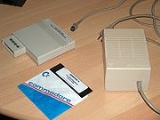
Commodore REU

Encyclopedia
Commodore
's RAM Expansion Unit (REU) range of external RAM
add-ons for their Commodore 64
/128
home computer
s was announced at the same time as the C128. The REUs came in three models, initially the 1700 (128 KB
) and 1750 , and later the 1764 . Creative Micro Designs
also made a 2 MB REU, called the 1750 XL.
, the memory inside the REU could only be accessed by memory-transfers (STORE/LOAD/SWAP/COMPAREs) between the main memory and the REU memory, thus, giving an equivalent to a (slow) small memory window. Additionally, the C128's built-in BASIC 7.0
had three statements,
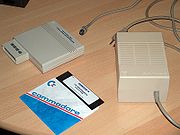 Officially, only the 1700 and 1750 were supported on the C128. The model, the 1764, was released for the C64 at the same time. However, aside from a bundled 2.5 ampere
C64 power supply unit (the factory unit could not support the 1764), there were only minor differences between the three models.
In practice, the difference between the 1764 and the earlier units had little effect on compatibility, and people used 1700s and 1750s successfully with the C64, and 1764s successfully with the C128, although the C64's stock power supply was inadequate to reliably handle the power load of any of them. Some dealers unbundled the 1764 and the power supply in order to sell the power supply to C64 users, and/or upgrade the 1764 to .
Because of memory chip
shortages in the late 1980s, the 1750 was only produced in small quantities. However it was not difficult to upgrade a 1700 or 1764 to . Several firms did this commercially, either selling upgraded units or upgrading customer-supplied units.
In the early 1990s, DIY
modification schemes to increase the capacity of an REU to one megabyte
or higher appeared on various online services.
The 1700 and 1750 had a resistor
at position R4 that, according to Commodore engineer Fred Bowen, compensated for subtle differences in the expansion port on the C64 and C128. The 1764 lacked that resistor. Bowen and other CBM engineers recommended against using a 1764 with a C128 unless the resistor was added, or a 1700/1750 with a C64 unless the resistor was removed.
It was possible to check for the presence of a 1750 by reading memory address
4, which was 1 on a 1750, and 0 on a 1700 or 1764. However, since this procedure would not distinguish between a 1700 and a 1764, many programmers wrote to the RAM
itself to find out the amount of memory installed.
, their relatively small installed base relative to the huge installed base of the C64 made software developers hesitant to invest much time and effort in supporting it, and the lack of commercial support kept sales lower than they otherwise might have been.
The REUs came with software to utilize the extra memory as a RAM disk
, but the RAM disk's compatibility with commercial software was spotty, as some commercial software relied heavily on various quirks of the Commodore 1541
floppy drive. Additionally, many commercial programs simply overwrote the memory space occupied by the RAM disk software.
The GEOS
operating system had built in support for the REU as a RAM disk
, as did the C128's version of CP/M
, and some disk copy programs used the REU to facilitate high-speed copying with a single disk drive. GEOS as well as other programs even used the REU for quick memory transfers within the host machine's main memory by storing a memory block into the REU and then fetching it back to another location. Using this method, only the actual data to be transferred needed to travel on the machine's data bus—unlike the ordinary method, which had the computer's CPU
do the transfer, thus spending at least three quarters of the bus capacity on instruction fetches and only one quarter or less on payload data.
Due to its high speed relative to Commodore's floppy drives or even the commercially available hard drives, the REU also became popular with BBS
operators.
Commodore International
Commodore is the commonly used name for Commodore Business Machines , the U.S.-based home computer manufacturer and electronics manufacturer headquartered in West Chester, Pennsylvania, which also housed Commodore's corporate parent company, Commodore International Limited...
's RAM Expansion Unit (REU) range of external RAM
Random-access memory
Random access memory is a form of computer data storage. Today, it takes the form of integrated circuits that allow stored data to be accessed in any order with a worst case performance of constant time. Strictly speaking, modern types of DRAM are therefore not random access, as data is read in...
add-ons for their Commodore 64
Commodore 64
The Commodore 64 is an 8-bit home computer introduced by Commodore International in January 1982.Volume production started in the spring of 1982, with machines being released on to the market in August at a price of US$595...
/128
Commodore 128
The Commodore 128 home/personal computer was the last 8-bit machine commercially released by Commodore Business Machines...
home computer
Home computer
Home computers were a class of microcomputers entering the market in 1977, and becoming increasingly common during the 1980s. They were marketed to consumers as affordable and accessible computers that, for the first time, were intended for the use of a single nontechnical user...
s was announced at the same time as the C128. The REUs came in three models, initially the 1700 (128 KB
Kilobyte
The kilobyte is a multiple of the unit byte for digital information. Although the prefix kilo- means 1000, the term kilobyte and symbol KB have historically been used to refer to either 1024 bytes or 1000 bytes, dependent upon context, in the fields of computer science and information...
) and 1750 , and later the 1764 . Creative Micro Designs
Creative Micro Designs
Creative Micro Designs is a computer technologies company which today sells PCs and related equipment, but which started out in 1987 selling self-designed firmware updates and hardware for the Commodore 64 and C128 8-bit home/personal computers....
also made a 2 MB REU, called the 1750 XL.
Hardware description
Although the C128 could access more than of RAM through bank switchingBank switching
Bank switching is a technique to increase the amount of usable memory beyond the amount directly addressable by the processor. It can be used to configure a system differently at different times; for example, a ROM required to start a system from diskette could be switched out when no longer...
, the memory inside the REU could only be accessed by memory-transfers (STORE/LOAD/SWAP/COMPAREs) between the main memory and the REU memory, thus, giving an equivalent to a (slow) small memory window. Additionally, the C128's built-in BASIC 7.0
Commodore BASIC
Commodore BASIC, also known as PET BASIC, is the dialect of the BASIC programming language used in Commodore International's 8-bit home computer line, stretching from the PET of 1977 to the C128 of 1985...
had three statements,
STASH,FETCH, and SWAP, for storing and retrieving data from the REU.Ampere
The ampere , often shortened to amp, is the SI unit of electric current and is one of the seven SI base units. It is named after André-Marie Ampère , French mathematician and physicist, considered the father of electrodynamics...
C64 power supply unit (the factory unit could not support the 1764), there were only minor differences between the three models.
In practice, the difference between the 1764 and the earlier units had little effect on compatibility, and people used 1700s and 1750s successfully with the C64, and 1764s successfully with the C128, although the C64's stock power supply was inadequate to reliably handle the power load of any of them. Some dealers unbundled the 1764 and the power supply in order to sell the power supply to C64 users, and/or upgrade the 1764 to .
Because of memory chip
Integrated circuit
An integrated circuit or monolithic integrated circuit is an electronic circuit manufactured by the patterned diffusion of trace elements into the surface of a thin substrate of semiconductor material...
shortages in the late 1980s, the 1750 was only produced in small quantities. However it was not difficult to upgrade a 1700 or 1764 to . Several firms did this commercially, either selling upgraded units or upgrading customer-supplied units.
In the early 1990s, DIY
Do it yourself
Do it yourself is a term used to describe building, modifying, or repairing of something without the aid of experts or professionals...
modification schemes to increase the capacity of an REU to one megabyte
Megabyte
The megabyte is a multiple of the unit byte for digital information storage or transmission with two different values depending on context: bytes generally for computer memory; and one million bytes generally for computer storage. The IEEE Standards Board has decided that "Mega will mean 1 000...
or higher appeared on various online services.
Model differences
The 1700s circuit board was identical to that of the 1750, and a trace marked J1 indicated the size of the chips used. On the 1750 and 1764, this trace was cut.The 1700 and 1750 had a resistor
Resistor
A linear resistor is a linear, passive two-terminal electrical component that implements electrical resistance as a circuit element.The current through a resistor is in direct proportion to the voltage across the resistor's terminals. Thus, the ratio of the voltage applied across a resistor's...
at position R4 that, according to Commodore engineer Fred Bowen, compensated for subtle differences in the expansion port on the C64 and C128. The 1764 lacked that resistor. Bowen and other CBM engineers recommended against using a 1764 with a C128 unless the resistor was added, or a 1700/1750 with a C64 unless the resistor was removed.
It was possible to check for the presence of a 1750 by reading memory address
Memory address
A digital computer's memory, more specifically main memory, consists of many memory locations, each having a memory address, a number, analogous to a street address, at which computer programs store and retrieve, machine code or data. Most application programs do not directly read and write to...
$DF00's bitBit
A bit is the basic unit of information in computing and telecommunications; it is the amount of information stored by a digital device or other physical system that exists in one of two possible distinct states...
4, which was 1 on a 1750, and 0 on a 1700 or 1764. However, since this procedure would not distinguish between a 1700 and a 1764, many programmers wrote to the RAM
Random-access memory
Random access memory is a form of computer data storage. Today, it takes the form of integrated circuits that allow stored data to be accessed in any order with a worst case performance of constant time. Strictly speaking, modern types of DRAM are therefore not random access, as data is read in...
itself to find out the amount of memory installed.
REU software support
Very little software made use of the REUs. Like other add-on products from CommodoreCommodore International
Commodore is the commonly used name for Commodore Business Machines , the U.S.-based home computer manufacturer and electronics manufacturer headquartered in West Chester, Pennsylvania, which also housed Commodore's corporate parent company, Commodore International Limited...
, their relatively small installed base relative to the huge installed base of the C64 made software developers hesitant to invest much time and effort in supporting it, and the lack of commercial support kept sales lower than they otherwise might have been.
The REUs came with software to utilize the extra memory as a RAM disk
RAM disk
A RAM disk or RAM drive is a block of RAM that a computer's software is treating as if the memory were a disk drive...
, but the RAM disk's compatibility with commercial software was spotty, as some commercial software relied heavily on various quirks of the Commodore 1541
Commodore 1541
The Commodore 1541 , made by Commodore International, was the best-known floppy disk drive for the Commodore 64 home computer. The 1541 was a single-sided 170 kilobyte drive for 5¼" disks...
floppy drive. Additionally, many commercial programs simply overwrote the memory space occupied by the RAM disk software.
The GEOS
GEOS (8-bit operating system)
GEOS is an operating system from Berkeley Softworks . Originally designed for the Commodore 64 and released in 1986, it provided a graphical user interface for this popular 8-bit computer.GEOS closely resembled early versions of Mac OS and included a graphical word processor and paint program...
operating system had built in support for the REU as a RAM disk
RAM disk
A RAM disk or RAM drive is a block of RAM that a computer's software is treating as if the memory were a disk drive...
, as did the C128's version of CP/M
CP/M
CP/M was a mass-market operating system created for Intel 8080/85 based microcomputers by Gary Kildall of Digital Research, Inc...
, and some disk copy programs used the REU to facilitate high-speed copying with a single disk drive. GEOS as well as other programs even used the REU for quick memory transfers within the host machine's main memory by storing a memory block into the REU and then fetching it back to another location. Using this method, only the actual data to be transferred needed to travel on the machine's data bus—unlike the ordinary method, which had the computer's CPU
Central processing unit
The central processing unit is the portion of a computer system that carries out the instructions of a computer program, to perform the basic arithmetical, logical, and input/output operations of the system. The CPU plays a role somewhat analogous to the brain in the computer. The term has been in...
do the transfer, thus spending at least three quarters of the bus capacity on instruction fetches and only one quarter or less on payload data.
Due to its high speed relative to Commodore's floppy drives or even the commercially available hard drives, the REU also became popular with BBS
Bulletin board system
A Bulletin Board System, or BBS, is a computer system running software that allows users to connect and log in to the system using a terminal program. Once logged in, a user can perform functions such as uploading and downloading software and data, reading news and bulletins, and exchanging...
operators.