


Codex Zographensis

Encyclopedia
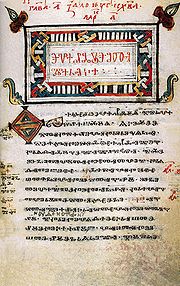
Illuminated manuscript
An illuminated manuscript is a manuscript in which the text is supplemented by the addition of decoration, such as decorated initials, borders and miniature illustrations...
Gospel Book
Gospel Book
The Gospel Book, Evangelion, or Book of the Gospels is a codex or bound volume containing one or more of the four Gospels of the Christian New Testament...
that was found in the Bulgarian Zograf Monastery
Zograf Monastery
The Saint George the Zograf Monastery or Zograf Monastery is a Bulgarian Orthodox monastery on Mount Athos in Greece...
on Mount Athos
Mount Athos
Mount Athos is a mountain and peninsula in Macedonia, Greece. A World Heritage Site, it is home to 20 Eastern Orthodox monasteries and forms a self-governed monastic state within the sovereignty of the Hellenic Republic. Spiritually, Mount Athos comes under the direct jurisdiction of the...
in 1843 by Croatian writer and diplomat Antun Mihanović
Antun Mihanovic
Antun Mihanović was a notable Croatian poet and lyricist, most famous for writing the national anthem of Croatia, which was put to music by Josif Runjanin and adopted in 1891. Klanjec, his birthplace, holds a monument to him and a gallery of his works.Mihanović studied law and worked as a military...
, and which dates from the late 10th or early 11th century.
Along with the slightly older Codex Marianus
Codex Marianus
The Codex Marianus ) is a Glagolitic fourfold Gospel Book from the beginning of eleventh century , which is , one of the oldest manuscript witnesses to the Old Church Slavonic language, one of the two fourfold gospels being part of the Old Church Slavonic canon, which contains a parts written by...
it is an important document for its use of the round Glagolitic script, the oldest recorded Slavic alphabet. Codex is also a part of the Old Church Slavonic canon, exhibiting linguistic features of the Western Bulgarian (Macedonian) provenience.
The manuscript contains 304 parchment
Parchment
Parchment is a thin material made from calfskin, sheepskin or goatskin, often split. Its most common use was as a material for writing on, for documents, notes, or the pages of a book, codex or manuscript. It is distinct from leather in that parchment is limed but not tanned; therefore, it is very...
folios, of which the foremost have not been preserved, and thus begins with Matthew 3:11
Matthew 3:11
Matthew 3:11 is the tenth verse of the third chapter of the Gospel of Matthew in the New Testament. The verse occurs in the section relating the preachings of John the Baptist. In this verse he predicts that he will be followed by someone much greater than himself...
. The first 288 folios are written in Glagolitic and contain the Gospel text. In addition, several additional folios from the middle of the manuscript are missing. At the end of the 11th or beginning of the 12th century some missing folios (from 41 to 57) were replaced with 17 new ones, written in square Glagolitic. They were themselves most likely a palimpsest
Palimpsest
A palimpsest is a manuscript page from a scroll or book from which the text has been scraped off and which can be used again. The word "palimpsest" comes through Latin palimpsēstus from Ancient Greek παλίμψηστος originally compounded from πάλιν and ψάω literally meaning “scraped...
. The rest of the 16 folios contain 13th-century synaxarium
Synaxarium
Synaxarion, Synexarion, pl. Synaxaria —Latin: Synaxarium, Synexarium—the name given in the Eastern Orthodox, Oriental Orthodox and Eastern Catholic Churches to a compilation of hagiographies corresponding roughly to the martyrology of the Roman Church.There are two kinds of synaxaria:*Simple...
.
Codex's existence was made public by Izmail Sreznevsky
Izmail Sreznevsky
Izmail Ivanovich Sreznevsky was a towering figure in 19th-century Slavic studies.His father, Ivan Sreznevsky, was a prolific translator of Latin poetry who taught at the Demidov Lyceum in Yaroslavl before moving to Kharkov University. It was in Kharkov that Sreznevsky graduated in philology and...
in 1856. In 1860 Monks from the Zograf monastery gifted the Codex to Russian emperor Alexander II
Alexander II of Russia
Alexander II , also known as Alexander the Liberator was the Emperor of the Russian Empire from 3 March 1855 until his assassination in 1881...
who donated it to Russian National Library
Russian National Library
The National Library of Russia in St Petersburg, known as the State Public Saltykov-Shchedrin Library from 1932 to 1992 , is the oldest public library in Russia...
, where the Codex is being kept today. Parts of Codex Zographensis were published by Russian linguist Izmail Sreznevsky
Izmail Sreznevsky
Izmail Ivanovich Sreznevsky was a towering figure in 19th-century Slavic studies.His father, Ivan Sreznevsky, was a prolific translator of Latin poetry who taught at the Demidov Lyceum in Yaroslavl before moving to Kharkov University. It was in Kharkov that Sreznevsky graduated in philology and...
in 1856. The first to describe the codex was Viktor I. Grigorovič in 1877, and two years later the Glagolitic part of the codex was published in edition of Croatian Slavist Vatroslav Jagić
Vatroslav Jagic
Vatroslav Jagić was a Croatian language researcher and a famous expert in Slavic languages in the second half of the 19th century.-Life:...
in Berlin as Quattuor evangeliorum codex glagoliticus olim Zographensis nunc Petropolitanus, completely transcribed in Cyrillic, with introduction and extensive philological commentary in Latin
Latin
Latin is an Italic language originally spoken in Latium and Ancient Rome. It, along with most European languages, is a descendant of the ancient Proto-Indo-European language. Although it is considered a dead language, a number of scholars and members of the Christian clergy speak it fluently, and...
. Jagić's edition has been republished in Graz
Graz
The more recent population figures do not give the whole picture as only people with principal residence status are counted and people with secondary residence status are not. Most of the people with secondary residence status in Graz are students...
in 1954. Other scholars who have extensively studied the language of Codex Zographensis include the Czech Josef Kurz and the Pole Leszek Moszyński.
Analysing the language of the codex it was established that the style and antiquity of the text is nonuniform, second part being more archaic than the first part. Some scholars explain this by gradual adaptation to the language of the source whence manuscript originated. Generally, phonology of the language of Codex Zographensis is very archaic - vocalizations of strong yers
Havlík's law
Havlík's law is a Slavic rhythmic law dealing with the reduced vowels in Proto-Slavic. It is named for the Czech scholar Antonín Havlík , who determined the pattern in 1889. While Havlík's law was a precursor to the loss of the jers, that process is part of the individual history of the various...
are rare, epenthetic l is preserved, though in the most parts of the manuscript yers are being assimilated. It is a bit less archaic with respect to morphology and syntax, though the forms of definite declension of adjectives and older forms of participles are well-preserved (e.g. prošь, nošь and rarely prosivъ, nosivъ).
Further reading
- V. Jagić: Studien über das altslovenische Zographosevangelium. Archiv für slavische Philologie I, II, 1876-1877.
- N. Grunskij: K Zografskomu evangeliju. In: Sbornik Otdelenija russkogo jazyka i slovesnosti Akademii Nauk LXXXIII, No. 3, 1907.
- N. van Wijk: Palaeoslovenica. I. O prototypie cerkiewno-sl/owian'skiego "Codex Zographensis". Rocznik Slawistyczny IX, 1921.
- N. van Wijk: Ešče raz o Zografskom četveroevangelii. Slavia I, 1922/23.
- J. Kurz: K Zografskému evangeliu. Slavia IX, 1930/31, XI, 1932.
External links
- Codex Zographensis transliterated in 7-bit ASCII, at the Corpus Cyrillo-Methodianum Helsingiense