

Clintonia

Encyclopedia
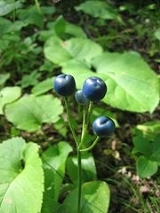
The genus Clintonia contains the bead lilies, which flower and then fruit into berries
. Plant
s of this genus
are distributed across North America
and eastern Asia
. This genus was named after De Witt Clinton, an 18th-century botanist and U.S. politician
.
The genus include plants without stems
, growing from underground rhizome
s. They have elliptic, clasping leaves with parallel venation and flowers arranged in small umbel
s. The flowers parts are by 6: tepal
s, etamins, ovule
s. Their fruit is an ovoid berry.
There are five or six species of Clintonia:
Berry
The botanical definition of a berry is a fleshy fruit produced from a single ovary. Grapes are an example. The berry is the most common type of fleshy fruit in which the entire ovary wall ripens into an edible pericarp. They may have one or more carpels with a thin covering and fleshy interiors....
. Plant
Plant
Plants are living organisms belonging to the kingdom Plantae. Precise definitions of the kingdom vary, but as the term is used here, plants include familiar organisms such as trees, flowers, herbs, bushes, grasses, vines, ferns, mosses, and green algae. The group is also called green plants or...
s of this genus
Genus
In biology, a genus is a low-level taxonomic rank used in the biological classification of living and fossil organisms, which is an example of definition by genus and differentia...
are distributed across North America
North America
North America is a continent wholly within the Northern Hemisphere and almost wholly within the Western Hemisphere. It is also considered a northern subcontinent of the Americas...
and eastern Asia
Asia
Asia is the world's largest and most populous continent, located primarily in the eastern and northern hemispheres. It covers 8.7% of the Earth's total surface area and with approximately 3.879 billion people, it hosts 60% of the world's current human population...
. This genus was named after De Witt Clinton, an 18th-century botanist and U.S. politician
Politician
A politician, political leader, or political figure is an individual who is involved in influencing public policy and decision making...
.
The genus include plants without stems
Plant stem
A stem is one of two main structural axes of a vascular plant. The stem is normally divided into nodes and internodes, the nodes hold buds which grow into one or more leaves, inflorescence , conifer cones, roots, other stems etc. The internodes distance one node from another...
, growing from underground rhizome
Rhizome
In botany and dendrology, a rhizome is a characteristically horizontal stem of a plant that is usually found underground, often sending out roots and shoots from its nodes...
s. They have elliptic, clasping leaves with parallel venation and flowers arranged in small umbel
Umbel
An umbel is an inflorescence which consists of a number of short flower stalks which are equal in length and spread from a common point, somewhat like umbrella ribs....
s. The flowers parts are by 6: tepal
Tepal
Tepals are elements of the perianth, or outer part of a flower, which include the petals or sepals. The term tepal is more often applied specifically when all segments of the perianth are of similar shape and color, or undifferentiated, which is called perigone...
s, etamins, ovule
Ovule
Ovule means "small egg". In seed plants, the ovule is the structure that gives rise to and contains the female reproductive cells. It consists of three parts: The integument forming its outer layer, the nucellus , and the megaspore-derived female gametophyte in its center...
s. Their fruit is an ovoid berry.
There are five or six species of Clintonia:
- C. andrewsianaClintonia andrewsianaClintonia andrewsiana is a species of flowering plant in the lily family known by the common names Andrews clintonia and red clintonia. It is native to Oregon and northern California, where it grows in shady, moist areas of the coastal redwood forests. It is a rhizomatous perennial herb growing 30...
- C. borealis
- C. udensis
- C. umbellulataClintonia umbellulataClintonia umbellulata is a perennial herb of the Lilly family. It is found in the deciduous forests of the southeast United States and blooms in the late spring....
- C. unifloraClintonia unifloraClintonia uniflora is a species of flowering plant in the lily family known by several common names, including bride's bonnet and queen's cup. This rhizomatous perennial, a member of the bead lily genus, is native to the mountains of western North America from California to Alberta. It grows in the...