


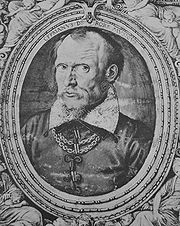
Cipriano de Rore

Encyclopedia
Franco-Flemish School
In music, the Franco-Flemish School or more precisely the Netherlandish School refers, somewhat imprecisely, to the style of polyphonic vocal music composition in Europe in the 15th and 16th centuries, and to the composers who wrote it...
composer of the Renaissance
Renaissance music
Renaissance music is European music written during the Renaissance. Defining the beginning of the musical era is difficult, given that its defining characteristics were adopted only gradually; musicologists have placed its beginnings from as early as 1300 to as late as the 1470s.Literally meaning...
, active in Italy. Not only was he central representative of the generation of Franco-Flemish composers after Josquin des Prez
Josquin Des Prez
Josquin des Prez [Josquin Lebloitte dit Desprez] , often referred to simply as Josquin, was a Franco-Flemish composer of the Renaissance...
who went to live and work in Italy, but he was one of the most prominent composers of madrigals in the middle of the 16th century. His experimental, chromatic, and highly expressive style had a decisive influence on the subsequent development of that secular music form.
Early years
Little is known of Rore's early life. His probable birth years (1515/1516) are known from his age at death (49, recorded on his tombstone in the cathedral in ParmaParma
Parma is a city in the Italian region of Emilia-Romagna famous for its ham, its cheese, its architecture and the fine countryside around it. This is the home of the University of Parma, one of the oldest universities in the world....
), and his probable birthplace was a small town in Flanders, Ronse
Ronse
Ronse is a Belgian city and a municipality in the Flemish province of East Flanders. The municipality only comprises the city of Ronse proper.- Early settlements to 14th century :...
(Renaix), right on the boundary between the French- and Dutch
Dutch language
Dutch is a West Germanic language and the native language of the majority of the population of the Netherlands, Belgium, and Suriname, the three member states of the Dutch Language Union. Most speakers live in the European Union, where it is a first language for about 23 million and a second...
-speaking areas. Recent research has established that his parents were Celestinus Rore (died before 1564) and Barbara van Coppenolle, and he had at least two siblings, Franciscus and Celestinus. The family was active in Ronse at least since 1400, and their coat of arms appeared both on his personal seal and his tombstone in Parma Cathedral.
Where he got his musical training is unknown. Based on a suggestive phrase in a 1559 madrigal dedicated to Margaret of Parma, the illegitimate daughter of Holy Roman Emperor
Holy Roman Emperor
The Holy Roman Emperor is a term used by historians to denote a medieval ruler who, as German King, had also received the title of "Emperor of the Romans" from the Pope...
Charles V
Charles V, Holy Roman Emperor
Charles V was ruler of the Holy Roman Empire from 1519 and, as Charles I, of the Spanish Empire from 1516 until his voluntary retirement and abdication in favor of his younger brother Ferdinand I and his son Philip II in 1556.As...
, which implied a long association with her, he may have accompanied her when she went to Naples in 1533, prior to marrying into the Medici family. Margaret was born in a town within walking distance of Rore's birthplace. Prior to that speculative trip Rore may have had some early music instruction in Antwerp. Many gifted singers from the Netherlands went to Italy as children or adolescents, often when discovered by visiting nobility; both Lassus and Giaches de Wert traveled to southern Italy in similar circumstances. When Margaret married Alessandro de' Medici in 1536, Rore may have gone his own way; however, he is believed to have received some of his music education in Italy during his period of service with Margaret.
Venice and Ferrara
While it has long been claimed that he studied in Venice with Adrian WillaertAdrian Willaert
Adrian Willaert was a Flemish composer of the Renaissance and founder of the Venetian School. He was one of the most representative members of the generation of northern composers who moved to Italy and transplanted the polyphonic Franco-Flemish style there....
, and that he was a singer at San Marco, no specific documentation of either of these events has been found; some dedicatory material in his Venetian publications mentions him as a "disciple" or "follower", but not specifically as a student. Yet he was closely connected with Willaert and his associates for much of his career, and visited Venice at least once before 1542. Beginning in this year, documentation on Rore's whereabouts becomes more clear. A letter written November 3, 1542 indicates he was at Brescia, where he was known to have remained until April 16, 1545. It was during this period that he began to acquire fame as a composer, publishing, with the assistance of the Venetian printer Scotto, his first book of madrigals in 1542, as well as two books of motets in 1544 and 1545. The reprints of these works two years later by both Scotto and Gardane indicated their high regard. Their technical mastery, and stylistic indebtedness to Willaert and his circle, make an early connection with Venice a reasonable supposition.
Rore then went to Ferrara, where payment records show he was maestro di cappella (choirmaster) beginning on May 6, 1546. This was the beginning of an extraordinarly productive portion of his life; while in the service of Duke Ercole II d'Este he wrote masses, motets, chansons, and of course madrigals, many of which were topical, some involving matters concerning the court itself. In 1556 Duke Ercole awarded Rore a benefice for his exceptional service. Also during the Ferrara years, Rore began cultivating his relations with the court of Albrecht V of Bavaria in Munich, sending them music, and having 26 motets produced in an elaborately illustrated manuscript with miniatures by Hans Müelich. In 1558 he requested a leave of absence from his employer in Ferrara in order to return to his homeland to care for his ailing parents. He stopped in Munich on the way, reaching the city on May 1, where he assisted in preparation of the motet manuscript, and posed for the Müelich portrait. A document of September 1558 places him in Flanders, where he was helping his sister-in-law with estate matters on the death of Celistinus, his brother. By December he had returned to Ferrara.
Departure from Ferrara; last years
In July 1559 he left his post in Ferrara again, possibly because the new Duke Alfonso II d'Este preferred Francesco Viola, a member of an old Ferrara family, to the foreigner. Once again he went north to his homeland; this time he was not to return to Este service.The situation in his homeland had deteriorated due to the ravages of the Wars of Independence, and when he reached it in autumn 1559, he found that his home town, Ronse, had been destroyed. Unable to regain his employment in Ferrara, he re-entered the service of the House of Farnese, and after a stay in Antwerp, returned to Italy again, this time to Parma, in 1560. Unhappy there – Parma was not an intellectual and cultural center on the level of Ferrara or Venice – he left in 1563, briefly taking the prestigious position of maestro di cappella at St. Mark's on the death of his mentor Adrian Willaert. However he only kept this post into 1564, at which time he returned to Parma; he gave as his reason for departing Venice the disorder in the chapel and an insufficient salary.
He died at Parma the next year, of unknown causes, at the age of only 49, and was buried in the cathedral in that city. Lodovico Rore, his nephew, erected his tombstone, indicating in the epitaph that his name would not be forgotten, even in the distant future.
Music and influence
Rore was one of the most influential composers in the middle of the sixteenth century, mainly through the dissemination of his madrigals. His 1542 book was an extraordinary event, and recognized as such at the time: it established five voices as the norm, rather than four, and it married the polyphonicPolyphony
In music, polyphony is a texture consisting of two or more independent melodic voices, as opposed to music with just one voice or music with one dominant melodic voice accompanied by chords ....
texture of the Netherlandish motet
Motet
In classical music, motet is a word that is applied to a number of highly varied choral musical compositions.-Etymology:The name comes either from the Latin movere, or a Latinized version of Old French mot, "word" or "verbal utterance." The Medieval Latin for "motet" is motectum, and the Italian...
with the Italian secular form, bringing a seriousness of tone which was to become one of the predominant trends in madrigal composition all the way into the seventeenth century. All of the lines of development in the madrigal in the late century can be traced to ideas first seen in Rore; according to Alfred Einstein, his only true spiritual successor was Claudio Monteverdi
Claudio Monteverdi
Claudio Giovanni Antonio Monteverdi – 29 November 1643) was an Italian composer, gambist, and singer.Monteverdi's work, often regarded as revolutionary, marked the transition from the Renaissance style of music to that of the Baroque period. He developed two individual styles of composition – the...
, another revolutionary. In his sacred music, however, Rore was more backward-looking, showing his connection to his Netherlandish roots: his masses, for example, are reminiscent of the work of Josquin des Prez
Josquin Des Prez
Josquin des Prez [Josquin Lebloitte dit Desprez] , often referred to simply as Josquin, was a Franco-Flemish composer of the Renaissance...
.
Rore wrote 107 madrigals that are securely attributed to him; 16 secular Latin compositions, similar in form to madrigals; at least seven chanson
Chanson
A chanson is in general any lyric-driven French song, usually polyphonic and secular. A singer specialising in chansons is known as a "chanteur" or "chanteuse" ; a collection of chansons, especially from the late Middle Ages and Renaissance, is also known as a chansonnier.-Chanson de geste:The...
s; 53 motet
Motet
In classical music, motet is a word that is applied to a number of highly varied choral musical compositions.-Etymology:The name comes either from the Latin movere, or a Latinized version of Old French mot, "word" or "verbal utterance." The Medieval Latin for "motet" is motectum, and the Italian...
s, of which 51 survive; a Passion according to Saint John; five settings of the mass
Mass (music)
The Mass, a form of sacred musical composition, is a choral composition that sets the invariable portions of the Eucharistic liturgy to music...
; some Magnificat
Magnificat
The Magnificat — also known as the Song of Mary or the Canticle of Mary — is a canticle frequently sung liturgically in Christian church services. It is one of the eight most ancient Christian hymns and perhaps the earliest Marian hymn...
s; and a handful of other works.
Sacred music
While Rore is best known for his Italian madrigals, he was also a prolific composer of sacred music, both masses and motets. Josquin was his point of departure, and he developed many of his techniques from the older composer's style. Rore's first three masses are a response to the challenge of his heritage and to the music of his predecessor, Josquin. In addition to five masses, he wrote about 80 motets, many psalms, secular motets, and a setting of the St. John Passion.Secular music
It was as a composer of madrigals, however, that Rore achieved enduring fame. He was one of the most influential madrigalist in the middle of the 16th century. His madrigals were primarily published between 1542 and 1565. His early madrigals reflect the styles of Willaert with the use of clear diction, thick and continuous counterpoint, intensive imitation, and overlying cadences. They are mostly for four or five voices, with one for six and another for eight. The tone of his writing tends toward the serious, especially as contrasted with the light character of the work of the early madrigalists. Rore chose not to write madrigals of frivolous nature in order to focus on serious and noble texts, such as from Petrarch and tragedies presented at Ferrara. Rore also concentrated on delineating the varying mood of the text. Furthermore, he often ignored the structure of the line, line division, and rhyme, and did not deem it necessary that the musical and poetic lines correspond. Moreover, Rore executed all of his many different stylistic characteristics in order to express the meaning of words and furthermore of the poem as an entire unit.In addition, Rore interestingly experimented with chromaticism. Rore, one of Vicentino's
Nicola Vicentino
Nicola Vicentino was an Italian music theorist and composer of the Renaissance. He was one of the most visionary musicians of the age, inventing, among other things, a microtonal keyboard, and devising a practical system of chromatic writing two hundred years before the rise of equal...
contemporaries, executed his theories regarding chromaticism. Moreover, he was appreciated for his sophisticated use of counterpoint. He also used canonical techniques and imitation in in his madrigals. Furthermore, he used all the resources of polyphony as they had developed in the early 16th century in the service of setting secular texts. Rore used a wide variety of techniques ranging from strict imitation to simple polyphony, from bland diatonic to distant harmonies, and from syllabic to florid melismatic declamation. He proved to be the model whom many of the great madrigalists of the late sixteenth century followed, including Claudio Monteverdi. According to Alfred Einstein in The Italian Madrigal (1949): Rore's true spiritual successor was Monteverdi. Einstein also said, "Rore holds the key to the whole development of the Italian madrigal after 1550."
Rore also composed secular Latin motets, a relatively unusual "cross-over" form in the mid-16th century. These motets, being a secular variation of a normally sacred form, paralleled the sacred madrigal, the madrigale spirituale
Madrigale spirituale
A madrigale spirituale is a madrigal, or madrigal-like piece of music, with a sacred rather than a secular text...
, which was a sacred variation on a popular secular form. Stylistically these motets are similar to his madrigals, and he published them throughout his career; occasionally they appeared in collections of madrigals, such as in his posthumous Fifth Book for five voices (1566), and he also included some in a collection of motets for five voices published in 1545.
Secular
- I madrigali (Venice, 1542, five voices)
- Il primo libro de madregali cromatici (Venice, 1544, five voices; enlargement of 1542 publication)
- Il secondo libro de madregali (Venice, 1544, five voices)
- Il terzo libro di madrigali, (Venice, 1548, five voices)
- Musica ... sopra le stanze del Petrarcha ... libro terzo (Venice, 1548, five voices)
- Il primo libro de madrigali (Ferrara, 1550, five voices) (also contains chansons in French)
- Il quarto libro d'imadregali (Venice, five voices)
- Il secondo libro de madregali, (Venice, 1557, four voices)
- Li madrigali libro quarto, (Venice, 1562, five voices)
- Le vive fiamme de' vaghi e dilettevoli madrigali, (Venice, 1565, four and five voices) (also contains secular Latin pieces)
- Il quinto libro de madrigali (1566, five voices) (also contains secular Latin pieces)
- Numerous additional works in anthologies, between 1547 and 1570
Sacred
- Motectorum liber primus (Venice, 1544, five voices)
- Motetta (Venice, 1545, five voices)
- Il terzo libro di motetti (Venice, 1549, five voices)
- Passio Domini Nostri Jesu Christi secundum Joannem (Paris, 1557; two to six voices)
- Motetta (Venice, 1563, four voices)
- Sacrae cantiones (Venice, 1595; five to seven voices)