


CinemaScope

Encyclopedia
CinemaScope was an anamorphic
lens series used for shooting wide screen movies from 1953 to 1967. Its creation in 1953, by the president of 20th Century-Fox, marked the beginning of the modern anamorphic format
in both principal photography
and movie projection
.
The anamorphic lenses theoretically allowed the process to create an image of up to a 2.66:1 aspect ratio
, almost twice as wide as the previously ubiquitous Academy format's 1.37:1 ratio. Although the CinemaScope lens system was quickly made obsolete by new technological developments, primarily advanced by Panavision
, the anamorphic format has continued to this day. In film-industry jargon
, the shortened form, 'Scope, is still widely used by both filmmakers and projectionists, although today it generally refers to any 2.35:1 or 2.39:1 presentation or, sometimes, the use of anamorphic lensing or projection in particular. Bausch & Lomb
won a 1954 Oscar for its development of the CinemaScope lens.
developed and patented a new film process that he called Anamorphoscope in 1926. It was this process that would later form the basis for CinemaScope. Chrétien's process was based on lenses that employed an optical trick which produced an image twice as wide as that produced with conventional lenses, using an optical system called hypergonar, compressing (at shoot time) and dilating (at projection time) the image laterally. Later, in New York
, a premiere of Chrétien's new process impressed the major Hollywood film studios of the time, who were eager to win back lost audiences from television’s allure.
Twentieth Century-Fox bought the rights of the Anamorphoscope. However, the format needed more development before it would be ready to use. The first of Chrétien's lenses were quickly transported to Hollywood where they were further analyzed. From this analysis the basis of CinemaScope was formed. Twentieth Century-Fox's pre-production
of The Robe
was halted so that the film could be changed to a CinemaScope production, what Fox president Spyros Skouras
called the future of filmmaking
. With the introduction of CinemaScope, Fox and other companies would be able to re-assert its distinction from its new competitor — television
.
The initial implementation of that which would eventually be called CinemaScope employed the best of the so-called "Chrétien-formula" anamorphoscopes. As these adapter lenses proved to have significant optical and operational defects ("swale" and loss-of-squeeze at close camera-to subject distances, plus the requirement of two camera assistants), Bausch & Lomb, Fox's prime contractor for the production of these lenses, initially produced an improved "Chrétien-formula" adapter lens design (CinemaScope Adapter Type I), and subsequently produced a dramatically improved and patented "Bausch & Lomb formula" adapter lens design (CinemaScope Adapter Type II), and, finally, produced "Bausch & Lomb formula" "combined" lens designs, which incorporated both the "prime" lens and the anamorphic lens in one unit (initially in 35, 40, 50, 75, 100 and 152 focal lengths, and, later, including a 25mm focal length). These "combined" lenses continue to be used to this day, especially in special effects units, although other manufacturers' lenses are often preferred for so-called "production" applications on account of their significantly lighter weight, or lower distortion, or a combination of both characteristics.
In order to better hide so-called "negative assembly" splices, the ratio of the image was later changed by others to 2.39:1 and, finally, to 2.40:1, although all professional cameras are capable of shooting 2.55:1 (special 'Scope aperture plate) or 2.66:1 (standard "Full"/"Silent" aperture plate, preferred by many producers and all optical houses), and 2.35:1 or 2.39:1 or 2.40:1 is simply a hard-matted version of the others.
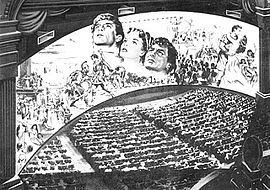 The Robe
was the first film to start production in CinemaScope, a project that was selected by Fox because of its epic nature. During production, two other films, How to Marry a Millionaire
and Beneath the 12-Mile Reef
went into production. Millionaire finished production first, before The Robe, but because of its importance, The Robe was released first.
Fox
utilized its influential people to promote CinemaScope. With the success of The Robe and How to Marry a Millionaire, the process enjoyed success in Hollywood. Fox licensed the process to many of the major film studios
including Columbia
, Warner Bros.
, Universal
, MGM and Walt Disney Productions
.
The Walt Disney Company was one of the first companies to license the CinemaScope process from Fox, and among the features and shorts they filmed with it, created one of the best-regarded examples of early CinemaScope productions with the live-action
epic 20,000 Leagues Under the Sea
.
Due to initial uncertainty a number of films were shot simultaneously with anamorphic and regular lenses. Despite early success with the process, Fox did not stick to their claim of shooting every production with the process. CinemaScope as a trade name was reserved for "A" productions, while "B" productions
in black and white commenced in 1956 at Fox under the trade name, "RegalScope."
Previously stereo sound in the commercial cinema had always employed separate sound films, Walt Disney's 1940 release 'Fantasia
' had used a three-channel soundtrack played from separate optical film. Early post-war stereo systems used with Cinerama
and some 3D films had used multichannel audio played from a separate magnetic film. Fox had initially intended to use 3 channel stereo from magnetic film for CinemaScope.
However, Hazard E. Reeves
' sound company had devised a method of coating 35mm stock with magnetic stripes and designed a 3 channel (left, center, right) system based on three .063" (1.6mm) wide stripes, one on each edge of the film outside the perforations, and one between the picture and the perforations in approximately the position of a standard optical soundtrack. Later it was found possible to add a narrower .029" (0.74mm) stripe between the picture and perforations on the other side of the film; this fourth track was used for a surround channel, also sometimes known at the time as an "effects" channel. In order to avoid hiss on the surround/effects channel from distracting the audience the surround speakers were switched on by a 12 kHz tone recorded on the surround track only whilst wanted surround program material was present.
This 4-track magnetic sound system was also used for some non-CinemaScope films, for example Fantasia was re-released in 1956 and 1969 with the original Fantasound
track transferred to 4-track magnetic.
and 3-D
. Cinerama was relatively unaffected by CinemaScope, as it was a quality-controlled process that played in select venues, similar to the IMAX
films of recent years. 3-D was hurt, however, by studio advertising surrounding CinemaScope's promise that it was the "miracle you see without glasses." Technical difficulties in presentation spelled the true end for 3-D, but studio hype was quick to hail it a "victory" for CinemaScope.
In April 1953, a technique simply now known as "wide-screen" appeared and was soon adopted as a standard by all "flat" film productions in the US. In this process, a fully exposed 1.37:1 Academy ratio
-area is cropped in the projector to a wide-screen aspect ratio by the use of an aperture plate, also known as a soft matte
. Most films shot today use this technique, cropping the top and bottom of a 1.37:1 image to produce one at a ratio of 1.85:1.
Aware of Fox's upcoming CinemaScope productions, Paramount introduced this technique in March's release of Shane with the 1.66:1 aspect ratio, although the film was not shot with this ratio originally in mind. Universal-International followed suit in May with a 1.85:1 aspect ratio for Thunder Bay
. By summer of 1953, Paramount, Universal, MGM, Columbia, and even Fox's B-unit contractors, under the banner of "Panoramic Productions" had switched from filming flat shows in a 1.37:1 format, and used variable flat wide-screen aspect ratios in their filming.
The fundamental technique that CinemaScope utilised was not patentable because the anamorphoscope had been known for centuries. Anamorphosis
had been used in visual media such as Hans Holbein
's painting, The Ambassadors
(1533). Some studios thus sought to develop their own system rather than pay Fox.
In response to the demands for a higher visual resolution spherical widescreen process, Paramount
created an optical process, VistaVision
, which shot horizontally on the 35 mm film roll, and then printed down to standard 4-perf vertical 35 mm. Thus, a negative with a finer grain was created and release prints had less grain. The first Paramount film in VistaVision was White Christmas
. VistaVision died out in the late 1950s, with the introduction of faster film stocks.
RKO
used the Superscope
process in which the standard 35 mm image was cropped and then optically squeezed in post-production
to create an anamorphic image on film. Today's Super 35 is a variation of this process.
Another process called Techniscope
was developed by Technicolor Inc.
in the early 1960s, using normal 35 mm cameras modified for two perforations per (half) frame instead of the regular four and later converted into an anamorphic print. Techniscope was mostly used in Europe
, especially with low budget films.
Many European countries and studios used the standard anamorphic process for their wide-screen films, identical in technical specifications to CinemaScope, and renamed to avoid the copyrights of Fox
. Some of these include Euroscope, Franscope, and Naturama
(the latter used by Republic Pictures
). In 1953, Warner Brothers also planned to develop an identical anamorphic process called Warnerscope, but after the premiere of CinemaScope, Warners decided to license it from Fox instead.
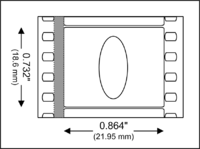 Although CinemaScope was capable of producing a 2.66:1 image, the addition of magnetic sound tracks for multi-channel sound reduced this to 2.55:1.
The fact that the image was expanded horizontally when projected meant that there could be visible graininess and brightness problems. To combat this, larger film formats were developed (initially a too-costly 55 mm for Carousel
and The King and I
) and then abandoned (both films were eventually reduction printed at 35 mm, although the aspect ratio was kept at 2.55:1). Later Fox re-released The King and I in the 65/70 mm format. The initial problems with grain and brightness were eventually reduced thanks to improvements in film stock
and lenses.
The CinemaScope lenses were optically flawed, however, by the fixed anamorphic element, which caused the anamorphic effect to gradually drop off as objects approached closer to the lens. The effect was that close-up
s would slightly overstretch an actor's face, a problem that soon became referred to as "the mumps
". This problem was avoided at first by composing wider shots, but as anamorphic technology lost its novelty, directors and cinematographers sought compositional freedom from these limitations. Issues with the lenses also made it difficult to photograph animation using the CinemaScope process. Nevertheless, many animated short
films and a few features were filmed in CinemaScope during the 1950s, including Walt Disney's Lady and the Tramp
(1955).
was initially founded in late 1953 as a manufacturer of anamorphic lens adapters for movie projectors screening CinemaScope films, capitalizing on the success of the new anamorphic format and filling in the gap created by Bausch and Lomb's inability to mass produce the needed adapters for movie theaters fast enough. Looking to expand beyond projector lenses, Panavision founder Robert Gottschalk
soon improved upon the anamorphic camera lenses by creating a new lens set that included dual rotating anamorphic elements which were interlocked with the lens focus gearing. This innovation allowed the Panavision lenses to keep the plane of focus at a constant anamorphic ratio of 2x, thus avoiding the over-stretched "mumps" effect found in CinemaScope. After screening a demo reel comparing the two systems, many US studios adopted the Panavision anamorphic lenses. The Panavision technique was also considered more attractive to the industry because it was more affordable than CinemaScope and was not owned or licensed-out by a rival studio. Confusingly, some studios, particularly MGM, continued to use the CinemaScope credit even though they had switched to Panavision lenses. Virtually all MGM "CinemaScope" films after 1958 are actually in Panavision. By the mid-1960s even Fox had begun to abandon CinemaScope for Panavision (famously at the demand of Frank Sinatra
for Von Ryan's Express
). Fox eventually capitulated completely to third-party lenses by 1967. Caprice, a spy spoof with Doris Day
, was Fox's final film in CinemaScope.
Fox originally intended CinemaScope films to use magnetic stereo sound only, and although in certain areas, such as Los Angeles and New York City, the vast majority of theaters were equipped for 4-track magnetic sound (4-track magnetic sound achieving nearly 90 percent penetration of theaters in the greater Los Angeles area) the owners of many smaller theaters were dissatisfied with contractually having to install expensive three- or four-track magnetic stereo, and because of the technical nature of sound installations, drive-in theaters had trouble presenting stereophonic sound at all. Due to these conflicts, and because other studios were starting to release anamorphic prints with standard optical soundtracks, Fox revoked their policy of stereo-only presentations in 1957, and added a half-width optical soundtrack, while keeping the magnetic tracks for those theaters that were able to present their films with stereophonic sound. These so-called "mag-optical" prints provided a somewhat sub-standard optical sound and were also expensive to produce. It made little economic sense to supply those theaters which had only mono sound systems with an expensive striped print. Eventually Fox, and others, elected to supply the majority of their prints in standard mono optical sound form, with magnetic striped prints reserved for those theaters capable of playing them.
Magnetic striped prints were expensive to produce; each print cost at least twice as much as a print with a standard optical soundtrack only. Furthermore these striped prints wore out faster than optical prints and caused more problems in use, such as flakes of oxide clogging the replay heads.
Due to these problems, and also because many cinemas never installed the necessary playback equipment, magnetic sound prints started to be made in small quantities for "roadshow" screenings only, with the main release using standard mono optical sound prints. As time went by roadshow screenings were increasingly made using 70mm film, and the use of striped 35mm prints declined further. Many CinemaScope films from the 1960s and 1970s were never released in stereo at all. Finally the introduction in 1976 of Dolby Stereo
, which provided a similar performance to striped magnetic prints but more reliably and at a far lower cost, caused the 4-track magnetic system to become totally obsolete.
, which was shot with Panavision
optics but used the credit as a throwback to the films it references, and the Don Bluth
films Anastasia
and Titan A.E.
at Bluth's insistence. Nonetheless, these films are not true CinemaScope as they use modern lenses. CinemaScope's association with anamorphic projection is still so embedded in mass consciousness that all anamorphic prints are now referred to generically as "'Scope" prints.
In the 1963 Jean-Luc Godard
film Contempt
(Le Mepris), filmmaker Fritz Lang
makes a disparaging comment about CinemaScope: "Oh, it wasn't meant for human beings. Just for snakes - and funerals." Ironically, Contempt was shot in CinemaScope.
The 1988 John Waters
film Hairspray uses the trademark as a crack on the weight of an overweight teenage girl who wants to star on a TV dance show: "please; this show isn't broadcasted in CinemaScope!". A 2002 Broadway musical version of Hairspray
and a 2007 film adaptation of the Broadway show
retain this joke as part of the lyrics of one of the show's songs, "(The Legend of) Miss Baltimore Crabs".
Anamorphosis
Anamorphosis or anamorphism may refer to any of the following:*Anamorphosis, in art, the representation of an object as seen, for instance, altered by reflection in a mirror...
lens series used for shooting wide screen movies from 1953 to 1967. Its creation in 1953, by the president of 20th Century-Fox, marked the beginning of the modern anamorphic format
Anamorphic format
Anamorphic format is a term that can be used either for: the cinematography technique of capturing a widescreen picture on standard 35 mm film, or other visual recording media, with a non-widescreen native aspect ratio; or a photographic projection format in which the original image requires an...
in both principal photography
Principal photography
thumb|300px|Film production on location in [[Newark, New Jersey]].Principal photography is the phase of film production in which the movie is filmed, with actors on set and cameras rolling, as distinct from pre-production and post-production....
and movie projection
Movie projector
A movie projector is an opto-mechanical device for displaying moving pictures by projecting them on a projection screen. Most of the optical and mechanical elements, except for the illumination and sound devices, are present in movie cameras.-Physiology:...
.
The anamorphic lenses theoretically allowed the process to create an image of up to a 2.66:1 aspect ratio
Aspect ratio (image)
The aspect ratio of an image is the ratio of the width of the image to its height, expressed as two numbers separated by a colon. That is, for an x:y aspect ratio, no matter how big or small the image is, if the width is divided into x units of equal length and the height is measured using this...
, almost twice as wide as the previously ubiquitous Academy format's 1.37:1 ratio. Although the CinemaScope lens system was quickly made obsolete by new technological developments, primarily advanced by Panavision
Panavision
Panavision is an American motion picture equipment company specializing in cameras and lenses, based in Woodland Hills, California. Formed by Robert Gottschalk as a small partnership to create anamorphic projection lenses during the widescreen boom in the 1950s, Panavision expanded its product...
, the anamorphic format has continued to this day. In film-industry jargon
Jargon
Jargon is terminology which is especially defined in relationship to a specific activity, profession, group, or event. The philosophe Condillac observed in 1782 that "Every science requires a special language because every science has its own ideas." As a rationalist member of the Enlightenment he...
, the shortened form, 'Scope, is still widely used by both filmmakers and projectionists, although today it generally refers to any 2.35:1 or 2.39:1 presentation or, sometimes, the use of anamorphic lensing or projection in particular. Bausch & Lomb
Bausch & Lomb
Bausch & Lomb, an American company based in Rochester, New York, is one of the world's leading suppliers of eye health products, such as contact lenses and lens care products today. In addition to this main activity, in recent years the area of medical technology has been developed...
won a 1954 Oscar for its development of the CinemaScope lens.
Origins
A French inventor named Henri ChrétienHenri Chrétien
Henri Jacques Chrétien was a French astronomer and an inventor.Born in Paris, France, his most famous invention is the anamorphic widescreen process, that resulted in the CinemaScope, and the co-invention of the Ritchey-Chrétien telescope , which was anadvanced type of astronomical telescope, now...
developed and patented a new film process that he called Anamorphoscope in 1926. It was this process that would later form the basis for CinemaScope. Chrétien's process was based on lenses that employed an optical trick which produced an image twice as wide as that produced with conventional lenses, using an optical system called hypergonar, compressing (at shoot time) and dilating (at projection time) the image laterally. Later, in New York
New York
New York is a state in the Northeastern region of the United States. It is the nation's third most populous state. New York is bordered by New Jersey and Pennsylvania to the south, and by Connecticut, Massachusetts and Vermont to the east...
, a premiere of Chrétien's new process impressed the major Hollywood film studios of the time, who were eager to win back lost audiences from television’s allure.
Twentieth Century-Fox bought the rights of the Anamorphoscope. However, the format needed more development before it would be ready to use. The first of Chrétien's lenses were quickly transported to Hollywood where they were further analyzed. From this analysis the basis of CinemaScope was formed. Twentieth Century-Fox's pre-production
Pre-production
Pre-production or In Production is the process of preparing all the elements involved in a film, play, or other performance.- In film :...
of The Robe
The Robe (film)
The Robe is a 1953 American Biblical epic film that tells the story of a Roman military tribune who commands the unit that crucifies Jesus. The film was made by 20th Century Fox and is notable for being the first film released in the widescreen process CinemaScope.It was directed by Henry Koster...
was halted so that the film could be changed to a CinemaScope production, what Fox president Spyros Skouras
Spyros Skouras
Spyros Panagiotis Skouras was an American motion picture pioneer and movie executive who was the president of the 20th Century Fox from 1942 to 1962...
called the future of filmmaking
Filmmaking
Filmmaking is the process of making a film, from an initial story, idea, or commission, through scriptwriting, casting, shooting, directing, editing, and screening the finished product before an audience that may result in a theatrical release or television program...
. With the introduction of CinemaScope, Fox and other companies would be able to re-assert its distinction from its new competitor — television
Television
Television is a telecommunication medium for transmitting and receiving moving images that can be monochrome or colored, with accompanying sound...
.
The initial implementation of that which would eventually be called CinemaScope employed the best of the so-called "Chrétien-formula" anamorphoscopes. As these adapter lenses proved to have significant optical and operational defects ("swale" and loss-of-squeeze at close camera-to subject distances, plus the requirement of two camera assistants), Bausch & Lomb, Fox's prime contractor for the production of these lenses, initially produced an improved "Chrétien-formula" adapter lens design (CinemaScope Adapter Type I), and subsequently produced a dramatically improved and patented "Bausch & Lomb formula" adapter lens design (CinemaScope Adapter Type II), and, finally, produced "Bausch & Lomb formula" "combined" lens designs, which incorporated both the "prime" lens and the anamorphic lens in one unit (initially in 35, 40, 50, 75, 100 and 152 focal lengths, and, later, including a 25mm focal length). These "combined" lenses continue to be used to this day, especially in special effects units, although other manufacturers' lenses are often preferred for so-called "production" applications on account of their significantly lighter weight, or lower distortion, or a combination of both characteristics.
Early implementations
The original expectation was that CinemaScope would use a separate film for sound (see Audio below) thus enabling the full "silent" 1.33:1 aperture to be available for the picture with a 2:1 anamorphic sqeeze applied that would allow an aspect ratio of 2.66:1. When, however, it was found possible to add magnetic stripes to the film to produce a composite picture/sound print, the ratio of the image was reduced to 2.55:1. This reduction was kept to a minimum by reducing the width of the normal KS perforations so that they were nearly square, but of DH height, thus, the CinemaScope, or CS perf was born, known colloquially as "fox-holes". Later still an optical soundtrack was added reducing the aspect ratio further to 2.35:1. This change also meant a shift in the optical centre of the image.In order to better hide so-called "negative assembly" splices, the ratio of the image was later changed by others to 2.39:1 and, finally, to 2.40:1, although all professional cameras are capable of shooting 2.55:1 (special 'Scope aperture plate) or 2.66:1 (standard "Full"/"Silent" aperture plate, preferred by many producers and all optical houses), and 2.35:1 or 2.39:1 or 2.40:1 is simply a hard-matted version of the others.
The Robe (film)
The Robe is a 1953 American Biblical epic film that tells the story of a Roman military tribune who commands the unit that crucifies Jesus. The film was made by 20th Century Fox and is notable for being the first film released in the widescreen process CinemaScope.It was directed by Henry Koster...
was the first film to start production in CinemaScope, a project that was selected by Fox because of its epic nature. During production, two other films, How to Marry a Millionaire
How to Marry a Millionaire
How to Marry a Millionaire is a 1953 romantic comedy film made by 20th Century Fox, directed by Jean Negulesco and produced and written by Nunnally Johnson. The screenplay was based on the plays The Greeks Had a Word for It by Zoe Akins and Loco by Dale Eunson and Katherine Albert. The music score...
and Beneath the 12-Mile Reef
Beneath the 12-Mile Reef
Beneath the 12-Mile Reef is a 1953 American adventure film directed by Robert D. Webb. The screenplay by A. I. Bezzerides was inspired by Romeo and Juliet by William Shakespeare...
went into production. Millionaire finished production first, before The Robe, but because of its importance, The Robe was released first.
Fox
20th Century Fox
Twentieth Century Fox Film Corporation — also known as 20th Century Fox, or simply 20th or Fox — is one of the six major American film studios...
utilized its influential people to promote CinemaScope. With the success of The Robe and How to Marry a Millionaire, the process enjoyed success in Hollywood. Fox licensed the process to many of the major film studios
Movie studio
A movie studio is a term used to describe a major entertainment company or production company that has its own privately owned studio facility or facilities that are used to film movies...
including Columbia
Columbia Pictures
Columbia Pictures Industries, Inc. is an American film production and distribution company. Columbia Pictures now forms part of the Columbia TriStar Motion Picture Group, owned by Sony Pictures Entertainment, a subsidiary of the Japanese conglomerate Sony. It is one of the leading film companies...
, Warner Bros.
Warner Bros.
Warner Bros. Entertainment, Inc., also known as Warner Bros. Pictures or simply Warner Bros. , is an American producer of film and television entertainment.One of the major film studios, it is a subsidiary of Time Warner, with its headquarters in Burbank,...
, Universal
Universal Studios
Universal Pictures , a subsidiary of NBCUniversal, is one of the six major movie studios....
, MGM and Walt Disney Productions
Walt Disney Pictures
Walt Disney Pictures is an American film studio owned by The Walt Disney Company. Walt Disney Pictures and Television, a subsidiary of the Walt Disney Studios and the main production company for live-action feature films within the Walt Disney Motion Pictures Group, based at the Walt Disney...
.
The Walt Disney Company was one of the first companies to license the CinemaScope process from Fox, and among the features and shorts they filmed with it, created one of the best-regarded examples of early CinemaScope productions with the live-action
Live action
In filmmaking, video production, and other media, the term live action refers to cinematography, videography not produced using animation...
epic 20,000 Leagues Under the Sea
20,000 Leagues Under the Sea (1954 film)
20,000 Leagues Under the Sea is a 1954 adventure film starring Kirk Douglas as Ned Land, James Mason as Captain Nemo, Paul Lukas as Professor Pierre Aronnax, and Peter Lorre as Conseil. It was the first science fiction film produced by Walt Disney Productions, as well as the only science-fiction...
.
Due to initial uncertainty a number of films were shot simultaneously with anamorphic and regular lenses. Despite early success with the process, Fox did not stick to their claim of shooting every production with the process. CinemaScope as a trade name was reserved for "A" productions, while "B" productions
B movie
A B movie is a low-budget commercial motion picture that is not definitively an arthouse or pornographic film. In its original usage, during the Golden Age of Hollywood, the term more precisely identified a film intended for distribution as the less-publicized, bottom half of a double feature....
in black and white commenced in 1956 at Fox under the trade name, "RegalScope."
Audio
Fox officials were keen that the sound of their new wide-screen film format should be as impressive as the picture, and that meant it should include true stereophonic sound.Previously stereo sound in the commercial cinema had always employed separate sound films, Walt Disney's 1940 release 'Fantasia
Fantasia (film)
Fantasia is a 1940 American animated film produced by Walt Disney and released by Walt Disney Productions. The third feature in the Walt Disney Animated Classics series, the film consists of eight animated segments set to pieces of classical music conducted by Leopold Stokowski, seven of which are...
' had used a three-channel soundtrack played from separate optical film. Early post-war stereo systems used with Cinerama
Cinerama
Cinerama is the trademarked name for a widescreen process which works by simultaneously projecting images from three synchronized 35 mm projectors onto a huge, deeply-curved screen, subtending 146° of arc. It is also the trademarked name for the corporation which was formed to market it...
and some 3D films had used multichannel audio played from a separate magnetic film. Fox had initially intended to use 3 channel stereo from magnetic film for CinemaScope.
However, Hazard E. Reeves
Hazard E. Reeves
Hazard E. Reeves was a pioneer in sound and sound electronics, and introduced magnetic stereophonic sound to motion pictures...
' sound company had devised a method of coating 35mm stock with magnetic stripes and designed a 3 channel (left, center, right) system based on three .063" (1.6mm) wide stripes, one on each edge of the film outside the perforations, and one between the picture and the perforations in approximately the position of a standard optical soundtrack. Later it was found possible to add a narrower .029" (0.74mm) stripe between the picture and perforations on the other side of the film; this fourth track was used for a surround channel, also sometimes known at the time as an "effects" channel. In order to avoid hiss on the surround/effects channel from distracting the audience the surround speakers were switched on by a 12 kHz tone recorded on the surround track only whilst wanted surround program material was present.
This 4-track magnetic sound system was also used for some non-CinemaScope films, for example Fantasia was re-released in 1956 and 1969 with the original Fantasound
Fantasound
Fantasound was a stereophonic sound reproduction system developed by the engineers of Walt Disney studios for its 1940 animated film Fantasia, the first commercial film to be released in stereo. Fantasound led to the development of what is known today as surround sound.-Origins:Walt Disney's...
track transferred to 4-track magnetic.
Rival processes
CinemaScope itself was a response to early "realism" processes CineramaCinerama
Cinerama is the trademarked name for a widescreen process which works by simultaneously projecting images from three synchronized 35 mm projectors onto a huge, deeply-curved screen, subtending 146° of arc. It is also the trademarked name for the corporation which was formed to market it...
and 3-D
3-D film
A 3-D film or S3D film is a motion picture that enhances the illusion of depth perception...
. Cinerama was relatively unaffected by CinemaScope, as it was a quality-controlled process that played in select venues, similar to the IMAX
IMAX
IMAX is a motion picture film format and a set of proprietary cinema projection standards created by the Canadian company IMAX Corporation. IMAX has the capacity to record and display images of far greater size and resolution than conventional film systems...
films of recent years. 3-D was hurt, however, by studio advertising surrounding CinemaScope's promise that it was the "miracle you see without glasses." Technical difficulties in presentation spelled the true end for 3-D, but studio hype was quick to hail it a "victory" for CinemaScope.
In April 1953, a technique simply now known as "wide-screen" appeared and was soon adopted as a standard by all "flat" film productions in the US. In this process, a fully exposed 1.37:1 Academy ratio
Academy ratio
The Academy ratio of 1.375:1 is an aspect ratio of a frame of 35mm film when used with 4-perf pulldown. It was standardized by the Academy of Motion Picture Arts and Sciences as the standard film aspect ratio in 1932, although similar-sized ratios were used as early as 1928.The Academy ratio is...
-area is cropped in the projector to a wide-screen aspect ratio by the use of an aperture plate, also known as a soft matte
Open matte
Open matte is a filming technique that involves matting out the top and bottom of the film frame in the movie projector for the widescreen theatrical release and then scanning the film without a matte for a full screen home video release.Usually, non-anamorphic 4-perf films are filmed directly on...
. Most films shot today use this technique, cropping the top and bottom of a 1.37:1 image to produce one at a ratio of 1.85:1.
Aware of Fox's upcoming CinemaScope productions, Paramount introduced this technique in March's release of Shane with the 1.66:1 aspect ratio, although the film was not shot with this ratio originally in mind. Universal-International followed suit in May with a 1.85:1 aspect ratio for Thunder Bay
Thunder Bay (film)
Thunder Bay is a 1953 American adventure film directed by Anthony Mann and starring James Stewart in their second non-western collaboration.- Plot :...
. By summer of 1953, Paramount, Universal, MGM, Columbia, and even Fox's B-unit contractors, under the banner of "Panoramic Productions" had switched from filming flat shows in a 1.37:1 format, and used variable flat wide-screen aspect ratios in their filming.
The fundamental technique that CinemaScope utilised was not patentable because the anamorphoscope had been known for centuries. Anamorphosis
Anamorphosis
Anamorphosis or anamorphism may refer to any of the following:*Anamorphosis, in art, the representation of an object as seen, for instance, altered by reflection in a mirror...
had been used in visual media such as Hans Holbein
Hans Holbein the Younger
Hans Holbein the Younger was a German artist and printmaker who worked in a Northern Renaissance style. He is best known as one of the greatest portraitists of the 16th century. He also produced religious art, satire and Reformation propaganda, and made a significant contribution to the history...
's painting, The Ambassadors
The Ambassadors (Holbein)
The Ambassadors is a painting by Hans Holbein the Younger in the National Gallery, London. As well as being a double portrait, the painting contains a still life of several meticulously rendered objects, the meaning of which is the cause of much debate...
(1533). Some studios thus sought to develop their own system rather than pay Fox.
In response to the demands for a higher visual resolution spherical widescreen process, Paramount
Paramount Pictures
Paramount Pictures Corporation is an American film production and distribution company, located at 5555 Melrose Avenue in Hollywood. Founded in 1912 and currently owned by media conglomerate Viacom, it is America's oldest existing film studio; it is also the last major film studio still...
created an optical process, VistaVision
VistaVision
VistaVision is a higher resolution, widescreen variant of the 35mm motion picture film format which was created by engineers at Paramount Pictures in 1954....
, which shot horizontally on the 35 mm film roll, and then printed down to standard 4-perf vertical 35 mm. Thus, a negative with a finer grain was created and release prints had less grain. The first Paramount film in VistaVision was White Christmas
White Christmas (film)
White Christmas is a 1954 Technicolor musical film starring Bing Crosby and Danny Kaye that features the songs of Irving Berlin, including the titular "White Christmas"...
. VistaVision died out in the late 1950s, with the introduction of faster film stocks.
RKO
RKO Pictures
RKO Pictures is an American film production and distribution company. As RKO Radio Pictures Inc., it was one of the Big Five studios of Hollywood's Golden Age. The business was formed after the Keith-Albee-Orpheum theater chains and Joseph P...
used the Superscope
Superscope
Superscope may refer to:* Superscope, an anamorphic widescreen and full screen process Also, the name of the company that developed Superscope 235: Superscope Inc., founded in 1954 by the Tushinsky Brothers....
process in which the standard 35 mm image was cropped and then optically squeezed in post-production
Post-production
Post-production is part of filmmaking and the video production process. It occurs in the making of motion pictures, television programs, radio programs, advertising, audio recordings, photography, and digital art...
to create an anamorphic image on film. Today's Super 35 is a variation of this process.
Another process called Techniscope
Techniscope
Techniscope or 2-Perf is a 35mm motion picture camera film format introduced by Technicolor Italia in 1963. The Techniscope format uses a two film-perforation negative pulldown per frame, instead of the standard four-perforation frame usually exposed in 35mm film photography...
was developed by Technicolor Inc.
Technicolor
Technicolor is a color motion picture process invented in 1916 and improved over several decades.It was the second major process, after Britain's Kinemacolor, and the most widely used color process in Hollywood from 1922 to 1952...
in the early 1960s, using normal 35 mm cameras modified for two perforations per (half) frame instead of the regular four and later converted into an anamorphic print. Techniscope was mostly used in Europe
Europe
Europe is, by convention, one of the world's seven continents. Comprising the westernmost peninsula of Eurasia, Europe is generally 'divided' from Asia to its east by the watershed divides of the Ural and Caucasus Mountains, the Ural River, the Caspian and Black Seas, and the waterways connecting...
, especially with low budget films.
Many European countries and studios used the standard anamorphic process for their wide-screen films, identical in technical specifications to CinemaScope, and renamed to avoid the copyrights of Fox
20th Century Fox
Twentieth Century Fox Film Corporation — also known as 20th Century Fox, or simply 20th or Fox — is one of the six major American film studios...
. Some of these include Euroscope, Franscope, and Naturama
Naturama
-Films produced in Naturama format:*Maverick Queen *Lisbon *Accused of Murder *Affair in Reno *Duel at Apache Wells *Hell's Crossroads...
(the latter used by Republic Pictures
Republic Pictures
Republic Pictures was an independent film production-distribution corporation with studio facilities, operating from 1934 through 1959, and was best known for specializing in westerns, movie serials and B films emphasizing mystery and action....
). In 1953, Warner Brothers also planned to develop an identical anamorphic process called Warnerscope, but after the premiere of CinemaScope, Warners decided to license it from Fox instead.
Technical difficulties
The fact that the image was expanded horizontally when projected meant that there could be visible graininess and brightness problems. To combat this, larger film formats were developed (initially a too-costly 55 mm for Carousel
Carousel (film)
Carousel is a 1956 film adaptation of the 1945 Rodgers and Hammerstein musical of the same name which, in turn, was based on Ferenc Molnár's non-musical play Liliom. The 1956 Carousel film stars Gordon MacRae and Shirley Jones, and was directed by Henry King...
and The King and I
The King and I (1956 film)
The King and I is a 1956 musical film made by 20th Century Fox, directed by Walter Lang and produced by Charles Brackett and Darryl F. Zanuck. The screenplay by Ernest Lehman is based on the Richard Rodgers and Oscar Hammerstein II musical The King and I, based in turn on the book Anna and the King...
) and then abandoned (both films were eventually reduction printed at 35 mm, although the aspect ratio was kept at 2.55:1). Later Fox re-released The King and I in the 65/70 mm format. The initial problems with grain and brightness were eventually reduced thanks to improvements in film stock
Film stock
Film stock is photographic film on which filmmaking of motion pictures are shot and reproduced. The equivalent in television production is video tape.-1889–1899:...
and lenses.
The CinemaScope lenses were optically flawed, however, by the fixed anamorphic element, which caused the anamorphic effect to gradually drop off as objects approached closer to the lens. The effect was that close-up
Close-up
In filmmaking, television production, still photography and the comic strip medium a close-up tightly frames a person or an object. Close-ups are one of the standard shots used regularly with medium shots and long shots . Close-ups display the most detail, but they do not include the broader scene...
s would slightly overstretch an actor's face, a problem that soon became referred to as "the mumps
Mumps
Mumps is a viral disease of the human species, caused by the mumps virus. Before the development of vaccination and the introduction of a vaccine, it was a common childhood disease worldwide...
". This problem was avoided at first by composing wider shots, but as anamorphic technology lost its novelty, directors and cinematographers sought compositional freedom from these limitations. Issues with the lenses also made it difficult to photograph animation using the CinemaScope process. Nevertheless, many animated short
Short subject
A short film is any film not long enough to be considered a feature film. No consensus exists as to where that boundary is drawn: the Academy of Motion Picture Arts and Sciences defines a short film as "an original motion picture that has a running time of 40 minutes or less, including all...
films and a few features were filmed in CinemaScope during the 1950s, including Walt Disney's Lady and the Tramp
Lady and the Tramp
Lady and the Tramp is a 1955 American animated film produced by Walt Disney and released to theaters on June 22, 1955, by Buena Vista Distribution. The fifteenth animated feature in the Walt Disney Animated Classics series, it was the first animated feature filmed in the CinemaScope widescreen...
(1955).
Decline
Lens manufacturer PanavisionPanavision
Panavision is an American motion picture equipment company specializing in cameras and lenses, based in Woodland Hills, California. Formed by Robert Gottschalk as a small partnership to create anamorphic projection lenses during the widescreen boom in the 1950s, Panavision expanded its product...
was initially founded in late 1953 as a manufacturer of anamorphic lens adapters for movie projectors screening CinemaScope films, capitalizing on the success of the new anamorphic format and filling in the gap created by Bausch and Lomb's inability to mass produce the needed adapters for movie theaters fast enough. Looking to expand beyond projector lenses, Panavision founder Robert Gottschalk
Robert Gottschalk
Robert Gottschalk was an American camera technician and founder of Panavision.- Early Life :His father, Gustav, was an architect who built a number of hotels in Chicago, IL, where he lived with his wife, Anna. Gustav's success left the family well-off financially and influenced Gottschalk's...
soon improved upon the anamorphic camera lenses by creating a new lens set that included dual rotating anamorphic elements which were interlocked with the lens focus gearing. This innovation allowed the Panavision lenses to keep the plane of focus at a constant anamorphic ratio of 2x, thus avoiding the over-stretched "mumps" effect found in CinemaScope. After screening a demo reel comparing the two systems, many US studios adopted the Panavision anamorphic lenses. The Panavision technique was also considered more attractive to the industry because it was more affordable than CinemaScope and was not owned or licensed-out by a rival studio. Confusingly, some studios, particularly MGM, continued to use the CinemaScope credit even though they had switched to Panavision lenses. Virtually all MGM "CinemaScope" films after 1958 are actually in Panavision. By the mid-1960s even Fox had begun to abandon CinemaScope for Panavision (famously at the demand of Frank Sinatra
Frank Sinatra
Francis Albert "Frank" Sinatra was an American singer and actor.Beginning his musical career in the swing era with Harry James and Tommy Dorsey, Sinatra became an unprecedentedly successful solo artist in the early to mid-1940s, after being signed to Columbia Records in 1943. Being the idol of the...
for Von Ryan's Express
Von Ryan's Express
Von Ryan's Express is a 1965 World War II adventure film starring Frank Sinatra and Trevor Howard, based on a novel by David Westheimer, and directed by Mark Robson.-Plot:...
). Fox eventually capitulated completely to third-party lenses by 1967. Caprice, a spy spoof with Doris Day
Doris Day
Doris Day is an American actress, singer and, since her retirement from show business, an animal rights activist. With an entertainment career that spanned through almost 50 years, Day started her career as a big band singer in 1939, but only began to be noticed after her first hit recording,...
, was Fox's final film in CinemaScope.
Fox originally intended CinemaScope films to use magnetic stereo sound only, and although in certain areas, such as Los Angeles and New York City, the vast majority of theaters were equipped for 4-track magnetic sound (4-track magnetic sound achieving nearly 90 percent penetration of theaters in the greater Los Angeles area) the owners of many smaller theaters were dissatisfied with contractually having to install expensive three- or four-track magnetic stereo, and because of the technical nature of sound installations, drive-in theaters had trouble presenting stereophonic sound at all. Due to these conflicts, and because other studios were starting to release anamorphic prints with standard optical soundtracks, Fox revoked their policy of stereo-only presentations in 1957, and added a half-width optical soundtrack, while keeping the magnetic tracks for those theaters that were able to present their films with stereophonic sound. These so-called "mag-optical" prints provided a somewhat sub-standard optical sound and were also expensive to produce. It made little economic sense to supply those theaters which had only mono sound systems with an expensive striped print. Eventually Fox, and others, elected to supply the majority of their prints in standard mono optical sound form, with magnetic striped prints reserved for those theaters capable of playing them.
Magnetic striped prints were expensive to produce; each print cost at least twice as much as a print with a standard optical soundtrack only. Furthermore these striped prints wore out faster than optical prints and caused more problems in use, such as flakes of oxide clogging the replay heads.
Due to these problems, and also because many cinemas never installed the necessary playback equipment, magnetic sound prints started to be made in small quantities for "roadshow" screenings only, with the main release using standard mono optical sound prints. As time went by roadshow screenings were increasingly made using 70mm film, and the use of striped 35mm prints declined further. Many CinemaScope films from the 1960s and 1970s were never released in stereo at all. Finally the introduction in 1976 of Dolby Stereo
Dolby Stereo
Dolby Stereo, is the trade mark that Dolby Laboratories used for the various analogue stereo cinema sound formats that they produced.Two basic systems used this name. The first was the 'Dolby SVA' system used with optical soundtracks on 35mm film...
, which provided a similar performance to striped magnetic prints but more reliably and at a far lower cost, caused the 4-track magnetic system to become totally obsolete.
Modern references
While the lens system has been retired for decades, Fox has used the trademark in recent years on at least three films: Down with LoveDown with Love
Down with Love is a 2003 romantic comedy film directed by Peyton Reed and written by Eve Ahlert and Dennis Drake. It stars Renée Zellweger and Ewan McGregor, and is a pastiche of the romantic comedies of the early 1960s starring Doris Day, Rock Hudson and Tony Randall such as Pillow Talk and Lover...
, which was shot with Panavision
Panavision
Panavision is an American motion picture equipment company specializing in cameras and lenses, based in Woodland Hills, California. Formed by Robert Gottschalk as a small partnership to create anamorphic projection lenses during the widescreen boom in the 1950s, Panavision expanded its product...
optics but used the credit as a throwback to the films it references, and the Don Bluth
Don Bluth
Donald Virgil "Don" Bluth is an American animator and independent studio owner. He is best known for his departure from The Walt Disney Company in 1979 and his subsequent directing of animated films such as The Secret of NIMH , An American Tail ,The Land Before Time , and All Dogs Go to Heaven ,...
films Anastasia
Anastasia (1997 film)
Anastasia is a 1997 American animated musical film produced and directed by Don Bluth and Gary Goldman. It was the first feature film to be released by Fox Animation Studios....
and Titan A.E.
Titan A.E.
Titan A.E. is an American animated post-apocalyptic science fiction film directed by Don Bluth and Gary Goldman released in 2000. The title refers to the spacecraft that is central to the plot, with A.E. meaning "After Earth."...
at Bluth's insistence. Nonetheless, these films are not true CinemaScope as they use modern lenses. CinemaScope's association with anamorphic projection is still so embedded in mass consciousness that all anamorphic prints are now referred to generically as "'Scope" prints.
In the 1963 Jean-Luc Godard
Jean-Luc Godard
Jean-Luc Godard is a French-Swiss film director, screenwriter and film critic. He is often identified with the 1960s French film movement, French Nouvelle Vague, or "New Wave"....
film Contempt
Contempt (film)
Contempt is a 1963 film directed by Jean-Luc Godard, based on the Italian novel Il disprezzo by Alberto Moravia. It stars Brigitte Bardot.-Plot:...
(Le Mepris), filmmaker Fritz Lang
Fritz Lang
Friedrich Christian Anton "Fritz" Lang was an Austrian-American filmmaker, screenwriter, and occasional film producer and actor. One of the best known émigrés from Germany's school of Expressionism, he was dubbed the "Master of Darkness" by the British Film Institute...
makes a disparaging comment about CinemaScope: "Oh, it wasn't meant for human beings. Just for snakes - and funerals." Ironically, Contempt was shot in CinemaScope.
The 1988 John Waters
John Waters (filmmaker)
John Samuel Waters, Jr. is an American filmmaker, actor, stand-up comedian, writer, journalist, visual artist, and art collector, who rose to fame in the early 1970s for his transgressive cult films...
film Hairspray uses the trademark as a crack on the weight of an overweight teenage girl who wants to star on a TV dance show: "please; this show isn't broadcasted in CinemaScope!". A 2002 Broadway musical version of Hairspray
Hairspray (musical)
Hairspray is a musical with music by Marc Shaiman, lyrics by Scott Wittman and Shaiman and a book by Mark O'Donnell and Thomas Meehan, based on the 1988 John Waters film Hairspray. The songs include 1960s-style dance music and "downtown" rhythm and blues...
and a 2007 film adaptation of the Broadway show
Hairspray (2007 film)
Hairspray is a 2007 musical film produced by Kolaja Productions and distributed by New Line Cinema. It was released in the United States, Canada, and the United Kingdom on July 20, 2007. The film is an adaptation of the 2002 Broadway musical of the same name, which in turn was based on John...
retain this joke as part of the lyrics of one of the show's songs, "(The Legend of) Miss Baltimore Crabs".
See also
- Anamorphic widescreenAnamorphic widescreenAnamorphic widescreen, when applied to DVD manufacture, is a video process that horizontally squeezes a widescreen image so that it can be stored in a standard 4:3 aspect ratio DVD image frame. Compatible playback equipment can then re-expand the horizontal dimension to show the original widescreen...
- List of film formats
- Super 35
- CinemaScope 55CinemaScope 55CinemaScope 55 was a large-format version of CinemaScope introduced by Twentieth Century Fox in 1955, which used a film width of 55.625 mm ....