


Chevrolet Opala

Encyclopedia
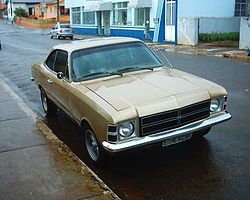
General Motors do Brasil
General Motors do Brazil is the largest subsidiary of the General Motors in South America and the second largest operation outside the United States. In 2005 it completed 80 years of operation in Brazil...
from 1969 to 1992. It was derived from the German Opel Rekord
Opel Rekord
The Opel Rekord was a large family car/executive car which was built in several generations by the German car manufacturer Opel.-Naming:The Rekord name evolved into the main name of the model; at first the name was used in close relationship with the Opel Olympia name, which pre-dated the Rekord...
and Commodore, but used GM USA sourced engines, two four-cylinder engines: the Chevrolet 153 4-cylinder from Chevy II/Nova
Chevrolet Nova
The Chevrolet Chevy II/Nova is a compact automobile manufactured by the Chevrolet division of General Motors produced in four generations for the 1962 through 1979 model years. Nova was the top model in the Chevy II lineup through 1968. The Chevy II nameplate was dropped, Nova becoming the...
which later got a new crankshaft and cylinders changing its size to 151 (usually mistaken as the Pontiac Iron Duke engine and the six-cylinder 250 from the contemporary line of North American car/light truck production. The Opala can also be considered a left-hand drive version of the first generation Holden Monaro
Holden Monaro
The Holden Monaro is an automobile that was produced by GM Holden Ltd, an Australian subsidiary of General Motors, between 1968 and 1977 and between 2001 and 2005...
. GM manufactured about one million units including the Opala sedan, Opala Coupé and the station wagon variation, the Opala Caravan. It was replaced by the Chevrolet Omega
Chevrolet Omega
Based on the Opel Omega A, the Chevrolet Omega A debuted in Brazil in 1992 with a choice of two engines — a 2.0 L four-cylinder and 3.0 L six-cylinder . From 1995, the engines were upgraded to a 2.2 L four and a 4.1 L six respectively...
in 1992, also an Opel spinoff. Before this car, Chevrolet only built light trucks and pick-up trucks, so, the Opala was its first passenger car made by GM in Brazil.
It was used by the Brazilian
Brazil
Brazil , officially the Federative Republic of Brazil , is the largest country in South America. It is the world's fifth largest country, both by geographical area and by population with over 192 million people...
Police for many years. The military dictatorship used the Opala for its agents through the 1970s. Its reliability and easy maintenance made the Opala the choice of many taxi drivers and also popular on racetracks.
Its 250 in³ engine (4.1 L) was used in its replacement, the Chevrolet Omega, but making use of Electronic Fuel Injection, in GLS and CD trims from 1995 to 1998. Some of the components and chassis were used for some exotic cars as Santa Matilde
Santa Matilde
The Santa Matilde, or SM4.1, is a sports car designed and produced in Brazil by Cia. Industrial Santa Matilde between 1977 and 1997.- Conception :...
, Puma GTB and some replicas as the Fera XK (Jaguar XK) and .
Early history
Installed in Brazil since January 1925, General Motors restricted itself to assemble, and then, manufacturing pick-ups, utilities and trucks until the mid-1960s. Only then was decided to produce its first national Chevrolet.The options oscillated between the large American cars from the traditional car line, like the Impala, and the lighter and economical models from German subsidiary Opel - Kadett, Olympia, Rekord and Commodore - that came to Brazil imported in small quantities. After hesitating between the small Kadett and the large Rekord/Commodore line, GMB opted for the second one, but later introduced the Kadett too.
On November 23, 1966, in a Press Conference at the Club Atlético Paulistano, in São Paulo, GM announced the start of Project 676, the future Chevrolet Opala.
Name controversy
The name Opala, comes from a precious stone, colourless when extracted from the soil, but that acquires multiple tones when exposed to light. It was also commented that it, the merger between OpelOpel
Adam Opel AG, generally shortened to Opel, is a German automobile company founded by Adam Opel in 1862. Opel has been building automobiles since 1899, and became an Aktiengesellschaft in 1929...
and Impala, as it was derived from the German Opel Rekord
Opel Rekord
The Opel Rekord was a large family car/executive car which was built in several generations by the German car manufacturer Opel.-Naming:The Rekord name evolved into the main name of the model; at first the name was used in close relationship with the Opel Olympia name, which pre-dated the Rekord...
, but one of its engines (the 230 in³, and later, 250 in³ straight-six) came from North American Chevrolet Impala
Chevrolet Impala
The Chevrolet Impala is a full-size automobile built by the Chevrolet division of General Motors introduced for the 1958 model year. Deriving its name from the southern African antelope, Chevrolet's most expensive passenger model through 1965 had become the best-selling automobile in the United...
. Even GM admits that was not set to, when that name - one of six finalists from thousands of suggestions - was disclosed by a journalist. Its rapid acceptance with the general public led to the approval of choice.
The debut
At the opening of the 6th São Paulo Auto Show, on November 23, 1968, Opala appeared on a rotating stage in a 16140 square feet (1,499.5 m²) stand. Around the novelty, spectacles including counting with the presence of Stirling MossStirling Moss
Sir Stirling Craufurd Moss, OBE FIE is a former racing driver from England...
and several models were enscenated every half hour.
The first model was the four-door sedan, in the trims "Especial" (Special) and "Luxo" (Luxe). Its attractive lines used the solution of curvy lines from the windscreen to rear fender, a shape that was referred to as "Coke Bottle style", already in use at the time, as it was first shown on 1967 Chevrolet Camaro, 1967 Pontiac Firebird
Pontiac Firebird
The Pontiac Firebird was built by the Pontiac division of General Motors between 1967 and 2002. The Firebird was introduced the same year as the automaker's platform-sharing model, the Chevrolet Camaro...
and 1968 Chevrolet Corvette
Chevrolet Corvette
The Chevrolet Corvette is a sports car by the Chevrolet division of General Motors that has been produced in six generations. The first model, a convertible, was designed by Harley Earl and introduced at the GM Motorama in 1953 as a concept show car. Myron Scott is credited for naming the car after...
, but some hints of the upcoming style were already clear on the 1965 Chevrolet Impala
Chevrolet Impala
The Chevrolet Impala is a full-size automobile built by the Chevrolet division of General Motors introduced for the 1958 model year. Deriving its name from the southern African antelope, Chevrolet's most expensive passenger model through 1965 had become the best-selling automobile in the United...
fastback coupé. The round headlamps (not squared, as in the Opel Rekord and Commodore), distinguished an egg crate grille, distinctively Chevrolet style (based on the U.S. 1968 Chevy II Nova), that separated the Opala from its European Opel siblings and the park/turning lamps, were fitted below, in the front bumper. In the back, a chrome strip with the "Chevrolet" name in black linked in the more expensive trim, the small rectangular taillights (similar to the U.S. 1967 Chevrolet Chevelle), in the extremities of the rear overhang, with the small reverse lights in the rear-bumper. Just above this was the fuel tank cap. The "Opala" badge (similar to the U.S. Chevrolet Impala font style), was fitted in the rear fenders, and the engine badges - 2500 or 3800 - next to the front doors. The chrome wheelcovers fitted just fine with the whitewall tires.
Both versions came standard with front bench seats (bucket seats weren't available at the beginning of production, but were later adopted) and steering-column shifter. The two models differed in trim levels: reverse lights, fuel tank lock and rear valance chrome strip were available only on "Luxo" model.
Engines
Under the hood, which opened backwards, the Opala offered three engine choices: the straight-4 153 in³ (2503 cc), the Pontiac Iron Duke-4 151 in³ (2497 cc) and the straight-6 230 in³ (3764 cc). The trio was of very traditional design, with cast iron cylinder block and head, overhead valves, pushrods and steel pressed rocker arms, whose spherical fulcrum was a proprietary GM's creation -Fuel feed from either one or two barrel carburetors.The Opala engines had been already used for years in the U.S.: the 153 in³ had emerged in the 1962 Chevrolet Nova
Chevrolet Nova
The Chevrolet Chevy II/Nova is a compact automobile manufactured by the Chevrolet division of General Motors produced in four generations for the 1962 through 1979 model years. Nova was the top model in the Chevy II lineup through 1968. The Chevy II nameplate was dropped, Nova becoming the...
, becoming the first inline four in Chevy since 1928, and the 230 in³ appeared in the 1963 Impala. The 151 in³ Pontiac Iron Duke was also found on AMC Jeeps and Eagle, and was known for versatility and toughness. Known for its reliability the 153 in³, was used as the corporation standard until the 1980s. The straight-six later served as a stationary engine, school bus engine and even forklifts.
The larger engine crankshaft bearings had seven supports (five in four cylinders) and the generous, if not even redundant, size of its inner moving parts helped with its durability and exceptional smoothness. The hydraulic valve lifters contributed to that later feature, easying maintenance.
The straight-six biggest limitation through the years was poor distribution of air-fuel ratio to the cylinders. Number one and six received the poorest, with higher percentage of air in the mixture, while the central ones tended to get richer mixture, unbalancing the stoichiometric engine efficiency. That bad feature was easily solved by installing a race intake manifold that sported two or three two-barrel carburetors, as in stock car racing. Only in 1994, with the Omega
Chevrolet Omega
Based on the Opel Omega A, the Chevrolet Omega A debuted in Brazil in 1992 with a choice of two engines — a 2.0 L four-cylinder and 3.0 L six-cylinder . From 1995, the engines were upgraded to a 2.2 L four and a 4.1 L six respectively...
and the multipoint injection, the problem was finally solved.
The performance of Opala 3.8L was actually very pleasing: with a top speed of 112.5 mi/h and acceleration time from 0 to 60 mi/h in about 11 seconds, was the fastest Brazilian car of its time, while it was losing the post after a year to the Dodge Dart
Dodge Dart
The Dodge Dart is an automobile built by the Dodge division of the Chrysler Corporation from 1960-1976 in North America, with production extended to later years in various other markets. The Dart was introduced as a lower-priced, shorter wheelbase, full-size Dodge in 1960 and 1961, became a...
whose 318 in³ V8 had all a straight six needed. The two 2.5L did not offer so much brio, but were torquey enough for everyday use. The main complain over the four-cylinder engines was about their roughness - so much rough, that at the time, GM employees called the Four "little Toyota", in allusion to the diesel engine installed other locally made Toyota Bandeirante (local name for the Land Cruiser).
The two versions, Especial and Luxo, had 3-speed manual gearbox, rear wheel drive, front independent suspension and rear live axle, both with helical springs. In front, the suspension elements were anchored to one side, set in unibody by screws, which only later would be known as subframe
Subframe
A subframe is a structural component of a vehicle, such as an automobile or an aircraft, that uses a discrete, separate structure within a larger body-on-frame or unit body to carry certain components, such as the engine, drivetrain, or suspension. The subframe is bolted and/or welded to the vehicle...
. The tires were the first tubeless to be used in a model manufactured in Brazil
Brazil
Brazil , officially the Federative Republic of Brazil , is the largest country in South America. It is the world's fifth largest country, both by geographical area and by population with over 192 million people...
, and used clutch
Clutch
A clutch is a mechanical device which provides for the transmission of power from one component to another...
spring type "Chinese hat", or diaphragmatic spring, which began to popularize in the world.
Engines:
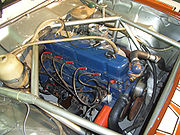
- 151 in³ 4-cylinder (2.5 L) - 98 hp Gross - (1974–1976)
- 151 in³ 4-cylinder (2.5 L) Ethanol - 98 hp Gross - (1980–1992)
- 151-S in³ 4-cylinder (2.5 L) - 80 hp Gross - (1974–1992)
- 153Chevrolet 153 4-cylinder engineThe 153-cubic-inch 153 was a straight-4 engine which was designed for use in the entry-level Chevy II/Nova. Usage of the 153 lasted until 1970 when the inline six was made the base powerplant with the Chevy II/Nova...
in³ 4-cylinder (2.5 L) - 80 hp Gross - (1968–1973) - 230 in³ 6-cylinder (3.8 L) - 125 hp Gross - (1968–1971)
- 250 in³ 6-cylinder (4.1 L) - 140 hp Gross - (1971–1975)
- 250 in³ 6-cylinder (4.1 L) - 148 hp Gross - (1975–1988)
- 250 in³ 6-cylinder Ethanol (4.1 L) - 155 hp Gross - (1984–1990)
- 250-S in³ 6-cylinder (4.1 L) - 171 hp Gross - (1976–1988)
The 250-S Engine
When the long-duration races restarted in Brazil, in 1973, the Opala found a great competitor, the Ford MaverickFord Maverick (North America)
The Ford Maverick was a compact car manufactured from April 1969-1977 in the United States, Canada, Mexico and from 1973-1979 in Brazil — employing a rear wheel drive platform dating to the original 1960 Falcon...
, which was powered by an engine whose displacement was almost one liter bigger. It took Bob Sharp and Jan Balder, that gained a second place in the "24 Hours of Interlagos", in August of that year in an Opala, to pressure GMB to field on race tracks a more powerful engine.
By coincidence, engine development manager, Roberto B. Beccardi, was working on this engine hopping-up project out of his own initiative, but he did lack impulse from factory and was not obtaining any approval.
This impulse came right from these two pilots.
Thus, in July 1974 GM started to offer the 250-S engine as an option for the Opala 4100. It was slightly different from the version that would be launched two years later: the project of the motor was similar to that of the four-cylinder units, did not get a vibration damper and the cooling fan came from the standard 2500, with four blades instead of six.
The Opala was now much faster than the Maverick GT, and Ford did not waste time. It quickly homologated a version with four-barrel carburetor, simply called "Quadrijet" in Brazilian parlance, and have no relationship with GM own Rochester Quadrajet carburetor, found on GM Corp. various V8 engines. In the racetracks, the accounting determinative factor for winning was pilots' skill and pit organization on the track. The rivals walked side-by-side.
Transmissions
- 3-speed Manual (steering column shifter)
- 4-speed Manual (floor-mounted shifter)
- 5-speed Manual (floor-mounted shifter)
- 3-speed Automatic (steering column or floor-mounted shifter)
- 4-speed Automatic (floor-mounted shifter)
External links
- Chevrolet Opala website in Portuguese
- The Opala history in Portuguese