
All Topics  
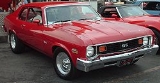
Chevrolet Nova

 
Chevrolet Nova

   Email Print
   Bookmark   Link


Chevrolet Nova


The Chevrolet Nova is an automobile
Automobile

An automobile or motor car is a wheeled motor vehicle for transportation passengers, which also carries its own car engine or motor. Most definitions of the term specify that automobiles are designed to run primarily on roads, to have seating for one to eight people, to typically have four wheels, and to be constructed principally f...
 produced in the United States
United States

The United States of America is a Federal government constitutional republic comprising U.S. state and a federal district. The country is situated mostly in central North America, where its Contiguous United States and Washington, D.C., the Capital districts and territories, lie between the Pacific Ocean and Atlantic Oceans, Borders of the U...
 from 1962 to 1979 by the Chevrolet
Chevrolet

Chevrolet is a brand of automobile, produced by General Motors . It is the top selling GM marque, with "Chevrolet" or "Chevy" being at times synonymous with GM....
 division of General Motors
General Motors

General Motors Corporation , founded in 1908, is the world's second-largest automaker after Toyota, ranked by 2008 global unit sales. GM was the global sales leader for 77 consecutive calendar years from 1931 to 2008....
 and from 1985 to 1988 by the NUMMI
NUMMI

New United Motor Manufacturing, Inc. is an automobile manufacturing factory in Fremont, California. The factory was an old General Motors Corporation plant originally opened in 1962 and is now a joint venture between GM and Toyota....
, a joint venture between General Motors and Toyota. In its original form it was the top model in the compact
Compact car

A compact , small family or c-segment car is a car classification of automobile which are larger than a supermini car and smaller than a large family car....
 Chevy II range and was marketed as the Chevrolet Chevy II Nova until the Chevy II name was dropped for the 1969 model year. In its latter form it was a front wheel drive subcompact car
Subcompact car

File:1973 Vega GT.jpgFile:Bluepinto.jpgA subcompact car is an automobile in a North American vehicle size class, encompassing vehicles smaller than compact cars....
 based on the Japanese Toyota Sprinter
Toyota Sprinter

The Toyota Sprinter was a compact car manufactured by the Japanese automaker Toyota as a variation of the Toyota Corolla. Each generation of the Corolla had a corresponding version of the Sprinter....
.

First/Second generation
1962–1965
After the rear-engine
Rear-engine design

In automobile design, a rear-engine design layout places the engine at the rear of the vehicle. The center of gravity of the engine itself is past the rear axle....
 Chevrolet Corvair
Chevrolet Corvair

The Chevrolet Corvair is a automobile produced by the Chevrolet division of General Motors from 1959 to 1969, for the 1960–1969 model years....
 was handily outsold by the conventional Ford Falcon in 1960, Chevrolet began work on a more conventional compact car that would eventually become the Chevy II.


Discussion
Ask a question about 'Chevrolet Nova'
Start a new discussion about 'Chevrolet Nova'
Answer questions from other users
Full Discussion Forum


Encyclopedia


The Chevrolet Nova is an automobile
Automobile

An automobile or motor car is a wheeled motor vehicle for transportation passengers, which also carries its own car engine or motor. Most definitions of the term specify that automobiles are designed to run primarily on roads, to have seating for one to eight people, to typically have four wheels, and to be constructed principally f...
 produced in the United States
United States

The United States of America is a Federal government constitutional republic comprising U.S. state and a federal district. The country is situated mostly in central North America, where its Contiguous United States and Washington, D.C., the Capital districts and territories, lie between the Pacific Ocean and Atlantic Oceans, Borders of the U...
 from 1962 to 1979 by the Chevrolet
Chevrolet

Chevrolet is a brand of automobile, produced by General Motors . It is the top selling GM marque, with "Chevrolet" or "Chevy" being at times synonymous with GM....
 division of General Motors
General Motors

General Motors Corporation , founded in 1908, is the world's second-largest automaker after Toyota, ranked by 2008 global unit sales. GM was the global sales leader for 77 consecutive calendar years from 1931 to 2008....
 and from 1985 to 1988 by the NUMMI
NUMMI

New United Motor Manufacturing, Inc. is an automobile manufacturing factory in Fremont, California. The factory was an old General Motors Corporation plant originally opened in 1962 and is now a joint venture between GM and Toyota....
, a joint venture between General Motors and Toyota. In its original form it was the top model in the compact
Compact car

A compact , small family or c-segment car is a car classification of automobile which are larger than a supermini car and smaller than a large family car....
 Chevy II range and was marketed as the Chevrolet Chevy II Nova until the Chevy II name was dropped for the 1969 model year. In its latter form it was a front wheel drive subcompact car
Subcompact car

File:1973 Vega GT.jpgFile:Bluepinto.jpgA subcompact car is an automobile in a North American vehicle size class, encompassing vehicles smaller than compact cars....
 based on the Japanese Toyota Sprinter
Toyota Sprinter

The Toyota Sprinter was a compact car manufactured by the Japanese automaker Toyota as a variation of the Toyota Corolla. Each generation of the Corolla had a corresponding version of the Sprinter....
.

First/Second generation


1962–1965


After the rear-engine
Rear-engine design

In automobile design, a rear-engine design layout places the engine at the rear of the vehicle. The center of gravity of the engine itself is past the rear axle....
 Chevrolet Corvair
Chevrolet Corvair

The Chevrolet Corvair is a automobile produced by the Chevrolet division of General Motors from 1959 to 1969, for the 1960–1969 model years....
 was handily outsold by the conventional Ford Falcon in 1960, Chevrolet began work on a more conventional compact car that would eventually become the Chevy II. The original Chevy II was of unibody construction and was available in two-door coupe
Coupé

A coup? or coupe is a closed car body style, the precise definition of which varies from manufacturer to manufacturer, and over time. Coup?s are often hardtopped sports cars or sporty variants of sedan body styles, with doors commonly reduced from 4 to 2, and a Close-coupled sedan interior offering either two seats or 2+2 seating ....
 and four-door sedan configurations as well as convertible
Convertible

A convertible is a type of automobile in which the roof can retract and fold away, converting it from an enclosed to an open-air vehicle. Many different car body styles are manufactured and marketed in convertible form....
 and station wagon
Station wagon

A station wagon in American English, Australian English, Canadian English and New Zealand English usage and an estate car in British English usage, is a passenger automobile with a car body style similar to a sedan but with the roofline following the full, sometimes extended rear cargo area, i.e. ending with a more vertical door...
 versions. Trim levels in 1962 were the 100 Series, 300 Series and Nova 400 Series.

Available engines for the Chevy II included a four-cylinder
Straight-4

The straight-4 or inline-4 engine is a four cylinder internal combustion engine with all four cylinder mounted in a straight line along the crankcase....
 and a inline six. The six-cylinder
Chevrolet Straight-6 engine

The Chevrolet straight-6 of the 1930s through 1970s was the base engine in many popular cars, including the Chevrolet Camaro....
 was actually the third generation engine, replacing the second generation Stovebolt. Rival manufacturer Chrysler
Chrysler

Chrysler LLC is an American automobile manufacturer that has manufactured automobiles since 1925. From 1998 to 2007, Chrysler and its subsidiaries were part of the German based DaimlerChrysler ....
 had earlier developed the Slant Six
Chrysler Slant 6 engine

The Slant-6, known within Chrysler as the G-engine, is one of Chrysler's two best known automobile engines, along with the Chrysler Hemi engine V8....
 in their Plymouth Valiant
Plymouth Valiant

The Plymouth Valiant is an automobile manufactured by the Plymouth automobile division of Chrysler Corporation in the United States from 1960 to 1976....
, a Chevy II competitor, when the cars were introduced to the public in late 1959 as 1960 models.

Although the Nova was not originally available with a V8 option, the engine bay was perfectly proportioned for one. It wasn't long before Chevrolet V8s were offered as dealer-installed options (between 1962 and 1963), up to and including the fuel injected version available in the Corvette
Chevrolet Corvette

The Chevrolet Corvette is a sports car that has been manufactured by General Motors since 1953. The car was originally designed by Harley Earl, and named by Myron Scott after the fast corvette....
. The combination of readily available V8 power and light weight made the Nova a popular choice of drag racers
Drag racing

Drag racing is a competition in which vehicles compete to be the first to cross a set finish line, usually from a dead stop, and in a straight line....
.

In 1962 and 1963 the Nova was available in a convertible
Convertible

A convertible is a type of automobile in which the roof can retract and fold away, converting it from an enclosed to an open-air vehicle. Many different car body styles are manufactured and marketed in convertible form....
 body style, and a two-door hardtop
Hardtop

A hardtop is a term for a rigid, rather than canvas, automobile roof. It has been used in several contexts: detachable hardtops, retractable hardtop roofs, and the so-called pillarless hardtop body style....
 was available from 1962 to 1965, although the hardtop was dropped when the 1964 models were first introduced, and subsequently brought back to the line later in the model year. Like all Chevy two door hardtops, the body style was marketed as the Sport Coupe.

For 1963, the Chevy II Nova Super Sport
Super Sport

Super Sport, or SS, is an option package offered by Chevrolet on many of its vehicle lines since 1961. Some of the better-known models to bear the SS badge include the Chevrolet Camaro, Chevrolet Chevelle, Chevrolet El Camino, Chevrolet Impala, and Chevrolet Nova....
 was released. As mentioned above, Novas could not officially have V8 engine
Engine

An engine is a mechanical device that produces some form of output from a given input.An engine whose purpose is to produce kinetic energy output from a fuel is called a Wiktionary:prime mover; alternatively, a motor is a device which produces kinetic energy from a preprocessed "fuel" ....
s at this time — the standard SS engine was the six-cylinder — but small-block V8 engine swaps were commonplace among enthusiasts. For 1964, the Chevy II's first factory V8 option was introduced, which was a V8. In 1965, a V8 was also available with up to .

Second generation (1966–1967)


1966 Novas saw a significant restyling, based in part on the Super Nova concept car
Concept car

A concept vehicle or show vehicle is a Automobile prototype made to showcase a concept, new styling, technology and more. They are often shown at Auto show to gauge customer reaction to new and radical designs which may or may not have a chance of being produced....
. In general, proportions were squared up but dimensions and features changed little. Engine options still included the basic inline four and six-cylinder engines and V8s of and (the latter offering now offering up to .

During this time, the four-cylinder engine was only offered in the base Chevy II 100 series models with the inline-six standard on the Nova and Super Sport models. In addition to the V8s, other optional engines included a six-cylinder and a six-cylinder
Straight-6

The straight-6 or inline-6 engine is a six cylinder internal combustion engine with all six cylinder mounted in a straight line along the crankcase....
, the latter a new offering for 1967. For 1966, Super Sport (SS) models did not carry the Nova name, but were badged as Chevy II Super Sports. However the ’66 Chevy II sales brochure clearly promoted the SS as the “Chevrolet Chevy II Nova Super Sport”.

Although Chevy IIs had the same body for both these years, 1967 models carried significant improvements in the area of safety equipment. A government-mandated energy-absoring steering column and safety steering wheel, soft interior parts such as armrests and sun visors, recessed instrument panel knobs, and front shoulder belt anchors, were included in all 1967 models.

Third generation


An extensive restyle came in 1968, when the station wagon and Sport Coupe were discontinued. This body style continued (with minor revisions) through 1974. One notable change was the front subframe assembly — as compared with Ford
Ford Motor Company

The Ford Motor Company is an United States multinational corporation and the world's List of automobile manufacturers#World Motor Vehicle Production by Manufacturer based on worldwide vehicle sales, following Toyota, General Motors, and Volkswagen Group....
, Chrysler and AMC
American Motors

American Motors Corporation was an United States automobile company formed on January 14, 1954 by the merger of the Nash-Kelvinator Corporation and the Hudson Motor Car Company....
, in whose cars the entire front suspension was integrated with the bodyshell, a separate subframe housing the powertrain and front suspension (similar to the front part of the frame of GM's full-size, full-framed vehicles) replaced the earlier style. Although the front subframe design was a Chevy II-exclusive design, the Camaro
Chevrolet Camaro

The Chevrolet Camaro is a pony car manufactured by the Chevrolet division of General Motors. It went on sale on September 29, 1966 for the 1967 model year and was designed as a competing model to the Ford Mustang....
 introduced a year earlier was the first to incorporate such a design; the redesigned Chevy II was pushed a year back to 1968 instead of 1967. 1968 was the final year that the Chevy II nameplate was used, although all 1968 models were "Chevy II Novas" with one single trim line.

The four-cylinder
Straight-4

The straight-4 or inline-4 engine is a four cylinder internal combustion engine with all four cylinder mounted in a straight line along the crankcase....
 engine
Internal combustion engine

The internal combustion engine is an engine in which the combustion of a fuel occurs in a combustion chamber inside and integral to the engine. In an internal combustion engine it is always the expansion of the high temperature and pressure gases that are produced by the combustion which apply force to the movable component of the engine, such as...
 was offered between 1968 and 1970, then was dropped due to lack of interest (besides its other usage in the Jeep DJ-5A a.k.a. the Postal Jeep). Far more popular were the six-cylinder and the base V8, which replaced the V8
V8 engine

A V8 engine is a V engine with eight cylinder s mounted on the crankcase in two banks of four cylinders, in most cases set at a right angle to each other but sometimes at a narrower angle, with all eight pistons driving a common crankshaft....
 offered in previous years. At mid-year, a semi-automatic transmission
Semi-automatic transmission

A semi-automatic transmission is a system which uses electronic sensors, processors and actuators to do gear shifts on the command of the driving....
 based on the Powerglide called the Torque-Drive was introduced as a low-cost option for shiftless motoring for both the four and six-cylinder engines. The two-speed Powerglide was still the only fully-automatic transmission
Automatic transmission

An automatic transmission is an automobile gearbox that can change gear ratios automatically as the vehicle moves, freeing the driver from having to shift gears manual transmission....
 available with most engines as the more desirable three-speed Turbo-Hydramatic was only available with the largest V8 engines.

The SS was transformed from a trim package to a performance option for 1968 and now included a V8 engine along with a heavy-duty suspension and other performance hardware. Front disc brakes were optional on the 1968 Nova SS. Optional engines included two versions of the big-block V8 rated at and . Both engines were offered with a choice of transmissions including the M-21 close-ratio four-speed manual, the M-22 heavy-duty "Rock Crusher" four-speed manual
Manual transmission

A manual transmission is a type of Transmission used in automotive applications. It generally utilizes a driver-operated clutch operated by a pedal or lever, for regulating torque transfer from the engine to the transmission, and a gear-shift either operated by hand or by foot ....
, or the three-speed Turbo-Hydramatic 400 for those who preferred automatic shifting.

1969


For 1969 the Chevy II nameplate was retired from the Nova range. The "Chevy II by Chevrolet" trunklid badge was replaced with "Nova by Chevrolet" and no other Chevy nameplates remained. However the ’69 Novas were promoted under the “Chevy Nova” model name in official Chevrolet sales literature.

Like other 1969 GM vehicles, locking steering columns were incorporated. Simulated vents were added below the Nova script, which was relocated to the front fender instead of the rear quarter panel. The V8 with four-barrel carburetor that came standard with the SS option was revised with a increase to while a two-barrel carbureted version of the V8 rated at was a new option on non-SS models. A new Turbo-Hydramatic 350 three-speed automatic was made available for non-SS Novas with six-cylinder and V8 engines, although the older two-speed Powerglide
Powerglide

The Powerglide is a two speed automatic transmission designed by General Motors. It was available primarily on Chevrolet automobiles from 1950 through the early 1970s, although a few Pontiac models in the 1950s also used this automatic transmission....
 continued to be available on the smaller engined Novas. 1969 SS models were the first Nova SS models to have standard front disc brakes.

1970


Basically a carryover from 1969; the side markers and taillight lenses for the 1970 Nova were wider and positioned slightly differently. This was the final year for the SS396. All other engines were carried over including the seldom-ordered four-cylinder which was in its final year. The car finally became simply the Chevrolet Nova this year after two years of transitional nameplates (Chevy II Nova in 1968 and Chevrolet Chevy Nova in 1969) Approximately 177 COPO Novas were ordered, with 175 converted by Yenko Chevrolet
Yenko Chevrolet

Yenko Chevrolet, located in Canonsburg, Pennsylvania, Pennsylvania, was one of largest custom muscle car shops of the late 1960s and early 1970s....
. The other two were sold in Canada
Canada

Canada is a country occupying most of northern North America, extending from the Atlantic Ocean in the east to the Pacific Ocean in the west and northward into the Arctic Ocean....
. The Nova was used in Trans-Am racing this year.

1971


1971 Novas were similar to the previous year but with the loss of the simulated fender vents and the discontinuation of the engine for the SS with the engine taking its place. 1971 also saw the introduction of the Rally Nova, a trim level that only lasted two years (until it resurfaced in 1977). The Rally kit included black or white stripes that ran the length of the car and around the back, a Rally Nova sticker on the driver's side of the hood, and Rally wheels.

The six-cylinder engine was now the standard Nova engine with the demise of the four-cylinder and six-cylinder engines. The and V8s were carried over from 1970 and all engines featured lowered compression ratios to enable the use of unleaded gasoline as a result of a GM corporate mandate that took effect with the 1971 model year.

After 1971, other GM divisions began rebadging
Badge engineering

Badge engineering is a term that describes the badge of one product as another. Due to the high cost of designing and engineering a totally new model, or establishing a new brand , it is often more cost-effective to rebadge a single product multiple times....
 the Nova as their new entry-level vehicle, such as the Pontiac Ventura
Pontiac Ventura

The Pontiac Ventura was an automobile produced by the Pontiac Motor Division of General Motors Corporation....
 II (once a trim option for full-size Pontiac
Pontiac

Pontiac is a brand of automobiles, produced by General Motors Corporation that has been sold in the United States, Canada and Mexico since 1926....
s to 1970), Oldsmobile Omega
Oldsmobile Omega

The Oldsmobile Omega was a compact car sold from 1973 through 1984 by the Oldsmobile division of General Motors. There were two generations of Omegas, both based on popular Chevrolet models, and both using the GM X platform architecture:...
 and the Buick Apollo
Buick Apollo

Not to be confused with Apollo , a sports coupe powered by Buick engines.File:Skywayaccident.jpgThe Buick Apollo was a compact car based on the GM X platform and manufactured from 1973 to 1975....
. Interestingly, the initials of the four model names spelled out the acronym NOVA (Nova, Omega, Ventura, Apollo).

1972

A virtual rerun of 1971, the 1972 Nova received only minor trim changes and both the Rally Nova and SS options were carried over. At mid-year a sunroof option became available on two-door models. Also, the optional Strato bucket seats available on coupes switched from the previous low-back design with adjustable headrests to the high back units with built-in headrests introduced the previous year on Camaros and Vegas.

1973–1974


The 1973 model year introduced a hatchback bodystyle based on the 2-door coupe. Following a government mandate for vehicles to be fitted with front and rear bumpers capable of absorbing a low-speed impact of , the front and rear of the Nova were restyled. The 1973 model was equipped with redesigned bumpers that were larger and stronger. 1974 models were the first to have shock-absorbing bumper mounts that made the bumpers stick out further from the body.

A modified rear side window shape was also introduced, eliminating the vent windows on both two- and four-door models. A revised rear suspension was adapted from the second generation Camaro with multi-leaf springs replacing the mono-leaf springs used on Novas since the original 1962 model. By this time, six-cylinder and V8 engines were de rigueur for American compact cars, with the and V8s becoming fairly common. Nova SS models offered a higher-performance V8. The 1973 Nova with a six-cylinder engine or 307|CID|L|abbr=on}} V8 were among the last Chevrolets to be offered with the now-outdated two-speed Powerglide
Powerglide

The Powerglide is a two speed automatic transmission designed by General Motors. It was available primarily on Chevrolet automobiles from 1950 through the early 1970s, although a few Pontiac models in the 1950s also used this automatic transmission....
 automatic transmission, which was in its final year. For 1974, it was replaced by a lightweight version of the three-speed Turbo-Hydramatic 350 already offered with the V8, which was the only V8 offered for 1974. These Novas where also fitted with a weight sensitive relay within the front bench seat that prevented the vehicle from being started until the driver's seatbelt had been fastened. Later, a law passed by Congress banned this type of device, declaring that it infringed on a driver's freedom of choice. The devices were not included in future Nova models.

1973 and 1974 introduced several new technologies to the Nova such as the adoption of steel belted radials. Also, the hatchback Nova models used a compact spare tire that included an inflator can with the vehicle. While many of these cars were sold with four-wheel drum brakes, front disk brakes were available as an extra-cost option.

A luxury-themed Nova Custom, later called the Nova LN, became part of the model lineup which included upgraded upholstery, full carpeting and more exterior trim. The SS option was still available but became more of a sporty trim package than a performance offering and now offered with any Nova engine, much like the 1963 to 1967 Nova SS.

An interesting model was the 'Spirit of America' Nova introduced in 1974. In anticipation of the US bicentennial in 1976, these vehicles were painted white and featured blue and red accent stripes as well as red and blue interior carpets and fabrics.

Oldsmobile
Oldsmobile

Oldsmobile was a brand name of automobile produced for most of its existence by General Motors. It was founded by Ransom E. Olds in 1897. In its 107-year history, it produced 35.2 million cars, including at least 14 million built at its Lansing, Michigan factory....
 and Buick
Buick

Buick is a marque of automobile sold in the United States, Canada, China, Taiwan, Qatar, Kuwait, and Israel by General Motors Corporation. Since the demise of Oldsmobile in 2004, it is GM's only North America-based entry-level luxury brand....
 entered the compact car market; both the Apollo
Buick Apollo

Not to be confused with Apollo , a sports coupe powered by Buick engines.File:Skywayaccident.jpgThe Buick Apollo was a compact car based on the GM X platform and manufactured from 1973 to 1975....
 and Omega
Oldsmobile Omega

The Oldsmobile Omega was a compact car sold from 1973 through 1984 by the Oldsmobile division of General Motors. There were two generations of Omegas, both based on popular Chevrolet models, and both using the GM X platform architecture:...
 debuted, using the same bodystyles from the Nova lineup. Additional options were included on these Nova-like models, such as lighting under the dashboard and in the glove compartment. Pontiac's final GTO
Pontiac GTO

The Pontiac GTO is an automobile built by Pontiac in the United States from 1964 to 1974, and by Holden in Australia from 2004 to 2006. It is often considered the first true muscle car....
 of this era was based on a facelifted 1974 Ventura
Pontiac Ventura

The Pontiac Ventura was an automobile produced by the Pontiac Motor Division of General Motors Corporation....
 coupe, itself based on the Nova, but fitted with a shaker hoodscoop from the Trans Am.

Fourth generation


A completely restyled Nova was introduced in 1975 and continued through 1979. Base coupes, including the hatchback, had fixed side windows (or optional flip-out windows) and vertical vents on the B-pillar. This generation is sometimes called the "Disco Nova" due to the popularity of disco
Disco

Disco is a genre of dance music that originated in and was initially popular among African American, gay and Hispanic and Latino Americans communities in the United States in the late 1960s....
 music during this era.

The base model carried the inline Six-cylinder , , two V8 engines ( and ) for 1976 only, were offered. Mated to a three speed automatic
Automatic transmission

An automatic transmission is an automobile gearbox that can change gear ratios automatically as the vehicle moves, freeing the driver from having to shift gears manual transmission....
, 3 speed manual or 4 speed - V8s only - Which remained the norm through the end of the decade (and the end of the rear-wheel drive X platform
GM X platform

There have been two X-body automobile platforms from General Motors Corporation. All X-bodies were small entry-level models....
).

The front suspension and subframe assembly was similar to the one used in the second generation GM F-body cars (the Camaro
Chevrolet Camaro

The Chevrolet Camaro is a pony car manufactured by the Chevrolet division of General Motors. It went on sale on September 29, 1966 for the 1967 model year and was designed as a competing model to the Ford Mustang....
 and Pontiac Firebird
Pontiac Firebird

The Pontiac Firebird was built by the Pontiac division of General Motors between 1967 and 2002.The Firebird was introduced the same year as its platform-sharing cousin, the Chevrolet Camaro....
), whereas the rear axle and suspension were carried over from the previous generation. All this made this car very solid but also heavy ( empty and curb weight)

Rm Disco Nova
The Nova lineup ranged from the stripped-down "S" model, base, Custom (1975 and 1978 to 1979, which in later years became the LN and Nova Concours replacement), and the luxury-themed LN (the LN was the first to sport metric displacement badges — either "4.3 LITER" or "5.7 LITRE"). The LN was replaced with the Nova Concours (1976 and 1977.) Custom and Concours models had a 3-taillight lens scheme much similar to the Impala
Chevrolet Impala

The Chevrolet Impala is a Full-size car automobile built by General Motors for their Chevrolet division. Ed Cole, Chevrolet's chief engineer in the late 1950s, defined the Impala as a "prestige car within the reach of the average American citizen."...
 with a Cadillac
Cadillac

Cadillac is a luxury vehicle marque owned by General Motors. Cadillac vehicles are sold in over 50 countries and territories, mainly in the United States, Canada, and Mexico....
-esque chrome laden front clip). All were intended as competition for the recently introduced Dodge Aspen
Dodge Aspen

The Dodge Aspen, produced from 1976 to 1980, was a compact car from Chrysler Corporation's Dodge division; its Plymouth -Badge engineering counterpart was the Volar?....
/Plymouth Volare and Ford Granada
Ford Granada

Ford Motor Company used the Ford Granada for unrelated vehicles sold in different markets:* The Ford Granada was built and marketed in Europe from 1972 to 1985 ...
/Mercury Monarch. From 1977 to 1978, there was also the Nova Rally (not to be confused with the Rally Nova of the early 1970s). These came with the , V8 engine, stiffer antiroll bar and some with the 4-speed Saginaw manual transmission.

Even Cadillac got into the act; the Nova's X platform was stretched by several inches, completely rebodied and fitted with an Oldsmobile fuel-injected V8 to become the Seville
Cadillac Seville

The Cadillac Seville is a luxury car that was manufactured by the Cadillac division of United States automaker General Motors as a limited production specialty model in the 1950s and 60s....
 for mid year 1975.

Buick's Apollo was renamed Buick Skylark
Buick Skylark

The Buick Skylark was a passenger car produced by the Buick division of General Motors. The model was made in six production runs. In each run, the car design varied dramatically due to changing technology and tastes, as well as new standards implemented over the years....
 after 1975 (during the 1975 model year, the Apollo nameplate was used for the 4-door sedan, while the coupe version was badged as the Skylark), while Pontiac's Ventura became the more luxurious Phoenix
Pontiac Phoenix

The Pontiac Phoenix was a compact car sold from 1977 to 1984 by the Pontiac division of General Motors. There were two generations of the Phoenix, both based on popular Chevrolet models, and both using the GM X platform architecture:...
 for 1978 (the Phoenix was the first X-body fitted with square headlights). These rebadged versions of the Nova had either the Chevrolet "porky but reliable" inline-six or Buick V6 as the base engine.

In the 1978 model year minor changes were made for the Nova including a more modern dual round gauge cluster to replace the long sweeping speedometer. Other minor changes included the steering wheel, which was updated to the same as the Caprice/Malibu. Some new colors were offered (as with the rest of the divisions) and some small trim added. During the 1977 model year of Ventura, the GM Iron Duke was the base engine (in response to the Arab Oil Embargo) coupled to a Borg-Warner T-50
Borg-Warner T-50

Borg-Warner T-50 is a gearbox from Borg-Warner. It was used in the Chevrolet Monza and other 1970's H-body cars as well as the 76 and up 5 speed mid sized gm's....
 transmission (it has no relationship to the T-5 found in third-generation GM F-bodies). The Ventura was replaced by the Phoenix in the middle of the 1977 model year.

Base V8 engines included Chevrolet and engines, and an Oldsmobile
Oldsmobile

Oldsmobile was a brand name of automobile produced for most of its existence by General Motors. It was founded by Ransom E. Olds in 1897. In its 107-year history, it produced 35.2 million cars, including at least 14 million built at its Lansing, Michigan factory....
  V8; Pontiac Venturas were not fitted with a Pontiac V8 from the factory after 1975, when Oldsmobile 260s and Buick 350s were installed as optional equipment. This led to civil action against GM.

The Nova SS continued for 1975 and 1976; when the SS was discontinued, the option code for the SS — RPO Z26 — continued as the Nova Rally until 1979.

A high-performance police version of the Nova was introduced for the 1975 model year, making it the first compact car certified for police duty in the US. Most were initially purchased by the Los Angeles County Sheriff's Department
Los Angeles County Sheriff's Department

The Los Angeles County Sheriff's Department is a local county law enforcement agency that serves Los Angeles County, California. It is the seventh largest law enforcement agency in the United States ....
 in 1976.

Upon introduction of the downsized GM A-body
GM A platform (RWD)

The General Motors Corporation A platform was a rear wheel drive mid-size car automobile platform designation used from 1964 to 1981. In 1982, GM introduced a new front wheel drive GM A platform , and existing intermediate rear wheel drive products were redesignated as GM G platform ....
 (later G-body
GM G platform (RWD)

The General Motors G platform was an automobile platform designation used for mid-sized rear wheel drive cars from 1982 to 1988. G-Bodies began production designated as GM A platform cars in 1978, but were redesignated to G when the GM A platform was introduced in 1982....
) mid-size car
Mid-size car

A mid-size car is the North American and Australian term for an automobile with a size between that of a Compact car and a full-size car. In Europe, cars of a similar size are often referred to as large family cars, or executive cars....
s in 1978, the X-body and downsized A-platform had similar exterior dimensions. The roomier and more modern downsized A-bodies outsold their X-body counterparts.

The Nova's final model year, 1979, saw few changes. The front end was revised with square headlights and a new grille for the short run. Production ended on December 22, 1978.

From model year 1980 onward, the Nova's original niche in the Chevrolet lineup was filled by front-wheel drive
Front-wheel drive

Front-wheel drive is a form of Internal combustion engine/transmission layout used in motor vehicles, where the engine drives the front wheels only....
 compacts including the Citation
Chevrolet Citation

The Chevrolet Citation was a compact car sold by the Chevrolet brand of United States automaker General Motors from 1980 through 1985. The Citation and its GM X platform siblings , were among the first compact front wheel drive vehicles sold by GM....
 (spring 1979 to 1985), and Corsica
Chevrolet Corsica

The Chevrolet Corsica is a front-wheel drive mid-sized automobile that was produced by General Motors from 1987 to 1996. The Corsica was built upon the GM L platform platform which was developed ....
 (spring 1987 to 1996).

Fifth generation


The Chevrolet Nova nameplate returned in 1985 as a front wheel drive subcompact vehicle produced from 1985 to 1988. It was manufactured in Fremont
Fremont

Fremont is the name of several locations in the United States of America; most are probably eponyms for John C. Fr?mont, "the Great Pathfinder":...
, California
California

California is a U.S. state on the West Coast of the United States of the United States, along the Pacific Ocean. It is bordered by Oregon to the north, Nevada to the east, Arizona to the southeast, and to the south the Mexico state of Baja California....
 by NUMMI
NUMMI

New United Motor Manufacturing, Inc. is an automobile manufacturing factory in Fremont, California. The factory was an old General Motors Corporation plant originally opened in 1962 and is now a joint venture between GM and Toyota....
, a joint venture between General Motors and Toyota of Japan. The new Nova was a rebadged and mildly restyled Japanese market Toyota Sprinter
Toyota Sprinter

The Toyota Sprinter was a compact car manufactured by the Japanese automaker Toyota as a variation of the Toyota Corolla. Each generation of the Corolla had a corresponding version of the Sprinter....
, a model sold in Japan as an upmarket version of the Toyota Corolla
Toyota Corolla

The Corolla is a line of subcompact car/compact cars produced by the Japanese automaker Toyota, which has become very popular throughout the world since the nameplate was first introduced in 1966....
. Nova shared the Corolla's AE82 platform, 4-cylinder engines and was available with 5-speed manual, 3-speed or 4-speed automatic transmissions.

Novas abroad


Argentina


In 1962 Argentina
Argentina

Argentina, officially the Argentine Republic , is a country in South America, constituted as a federation of 23 provinces and an autonomous city....
 assembled the first/second generation Chevy II until 1974 as Chevrolet 400, and the early third-generation (1968 model) Nova was as the Chevrolet Chevy from late 1969 through 1978, both models overlapping for several years, the Chevy II marketed as a family sedan while the Nova as a sporty alternative. An upscale model was produced from about 1973 with different trim, front turn indicators and taillights, a much better appointed interior with plastic "wood" trim, and called the Malibu. This Malibu was 100% a Chevy Nova, no relation to the American Chevelle. All engines provided to the public were inline-sixes. The first and second generations were available, depending on year and model, with the and engines.

The third generation ("Chevys") were produced with the and engines with specially tuned carburetors for sporting models. The "Chevy" metal decal for the third generation had the same font as the "Nova" decal of 1968–1974 American Novas, and was, for the first few years, in the rearmost section of both rear fenders. Later, it was moved to the rearmost section of both front fenders, as it was in the American cars from 1969. Sidemarker lights were not mandatory and changed much during the production run, from being deleted, to leaving a small chrome plate, to the same light as in the American cars. Rear deck decals just said "CHEVROLET" in chrome letters, obviating the typical "Model by Chevrolet" used in the American cars at the time. The hood decal was similar to the 1969 American Novas, the bow tie, in blue or just chrome. Initially, the Argentinian Chevy used very similar trim to the American counterpart, usually being more luxurious, as the car fitted in a much higher market niche, being a "big" car for the local standards. Even then there were standard, plain models, without accessories. Many were used for cab service. Interesting to note is that the interior layout, especially visible in the instrument panel, remained the American 1968 version for the whole run. The ignition switch was never moved to the steering column, for instance, so no steering lock was installed in the factory. Power steering began to be available from the factory at the end of the production run, V8s were never produced for the car, and automatic transmissions were available with both: steering column selectors or with a floor lever, but not for all models, only for luxury versions. Power windows were not available, tinted windows were darker than American versions, and the darker band on the upper edge of the windshield was not present.

Very popular accessories were vinyl roofs, rally wheels, sport steering wheels, bucket seats with high backs, and tufted leatherette upholstery (many sedans were produced this way). Interiors were mostly black. Steering wheels and instrument panels were for many years only black, as were seatbelts. American style interior color coordination was absent. The last year of the Nova in Argentina is called locally "Opus 78" (because the slogan of the publicity) and it was the most equipped, adding simil-leather bucket seats, air-conditioning, power steering, electric antenna, and a new dashboard with integrated central console. and a single four-barrel carburetor

Their Super Sports, "SS" counterparts were both coupes and 4-door sedans, the latter of which was unheard of in the US prior to the introduction of the 1994 Impala SS
Chevrolet Impala

The Chevrolet Impala is a Full-size car automobile built by General Motors for their Chevrolet division. Ed Cole, Chevrolet's chief engineer in the late 1950s, defined the Impala as a "prestige car within the reach of the average American citizen."...
. In fact, a majority were fitted with inline-sixes coupled to a ZF manual transmission
Manual transmission

A manual transmission is a type of Transmission used in automotive applications. It generally utilizes a driver-operated clutch operated by a pedal or lever, for regulating torque transfer from the engine to the transmission, and a gear-shift either operated by hand or by foot ....
 with floor lever 4 speeds, a single two-barrel Holey RX 7214-A carburetor giving out and a sporting exhaust note. Corsa, a local auto publication magazine tested a Chevy Coupé SS and obtained a 0–100 km/h (0–62 mph) time of 8.2 seconds.

Canada

The Nova was also sold in Canada
Canada

Canada is a country occupying most of northern North America, extending from the Atlantic Ocean in the east to the Pacific Ocean in the west and northward into the Arctic Ocean....
 from 1962 as the Acadian
Acadian (automobile)

'Acadian' was a make of automobile produced by General Motors Corporation of Canada from 1962 to 1971. The Acadian was introduced so that Canadian Pontiac-Buick dealers would have a compact model to sell, since the Pontiac Tempest was unavailable in Canada....
 (a GM Canada nameplate), with minimal trim and equipment modifications, until the early 1970s when it was renamed in keeping with its US cousin as the Pontiac Ventura II.

The urban legend

An urban legend
Urban legend

An urban legend, urban myth, or urban tale is a form of modern folklore consisting of stories thought to be factual by those circulating them....
 claims that the vehicle sold poorly in Spanish-speaking countries because its name, spaced no va, literally translates to "no go," as in "it doesn't go." This has since been debunked.

External links