
All Topics  
Chevrolet Impala

 
Chevrolet Impala

   Email Print
   Bookmark   Link


Chevrolet Impala


The Chevrolet Impala is a full-sized
Full-size car

A full-size car is a marketing term used in North America for an automobile larger than a mid-size car. In the United States, the United States Environmental Protection Agency uses "large car" to denote full-size cars....
 automobile
Automobile

An automobile or motor car is a wheeled motor vehicle for transportation passengers, which also carries its own car engine or motor. Most definitions of the term specify that automobiles are designed to run primarily on roads, to have seating for one to eight people, to typically have four wheels, and to be constructed principally f...
 built by General Motors
General Motors

General Motors Corporation , founded in 1908, is the world's second-largest automaker after Toyota, ranked by 2008 global unit sales. GM was the global sales leader for 77 consecutive calendar years from 1931 to 2008....
 for their Chevrolet
Chevrolet

Chevrolet is a brand of automobile, produced by General Motors . It is the top selling GM marque, with "Chevrolet" or "Chevy" being at times synonymous with GM....
 division. Ed Cole
Ed Cole

Edward Nicholas Cole was an automotive executive for General Motors Corporation.The son of a dairy farmer, Cole aspired to be an automotive engineer and enrolled in General Motors Institute....
, Chevrolet's chief engineer in the late 1950s, defined the Impala as a "prestige car within the reach of the average American citizen."

From 1958 until 1965, the Impala was Chevrolet's most expensive full-size car. In 1965, Chevrolet introduced the more-expensive Caprice
Chevrolet Caprice

The Chevrolet Caprice and Caprice Classic were full-sized automobiles produced by the Chevrolet division of General Motors in the United States and Canada from 1965 through 1996 model years and in Mexico from 1977 through 1983....
.

In the late sixties, the Impala was typically positioned just below the top luxury trim, the Caprice, and above the more economical models
Car model

A car model is a particular brand of vehicle sold under a marque. From an engineering point of view, a particular car model is usually defined and/or constrained by the use of a particular car chassis/bodywork combination or the same monocoque....
 like the Biscayne
Chevrolet Biscayne

The Chevrolet Biscayne was a series of automobile produced by Chevrolet for model years 1958 through 1972....
 or the Bel Air
Chevrolet Bel Air

The Chevrolet Bel Air is an automobile series produced by the Chevrolet division of General Motors from 1953?75. From 1950?52, hardtops in Chevrolet's premium Chevrolet Deluxe model range were designated with the Bel Air name, but it was not a distinct series of its own....
.


Discussion
Ask a question about 'Chevrolet Impala'
Start a new discussion about 'Chevrolet Impala'
Answer questions from other users
Full Discussion Forum


Encyclopedia


The Chevrolet Impala is a full-sized
Full-size car

A full-size car is a marketing term used in North America for an automobile larger than a mid-size car. In the United States, the United States Environmental Protection Agency uses "large car" to denote full-size cars....
 automobile
Automobile

An automobile or motor car is a wheeled motor vehicle for transportation passengers, which also carries its own car engine or motor. Most definitions of the term specify that automobiles are designed to run primarily on roads, to have seating for one to eight people, to typically have four wheels, and to be constructed principally f...
 built by General Motors
General Motors

General Motors Corporation , founded in 1908, is the world's second-largest automaker after Toyota, ranked by 2008 global unit sales. GM was the global sales leader for 77 consecutive calendar years from 1931 to 2008....
 for their Chevrolet
Chevrolet

Chevrolet is a brand of automobile, produced by General Motors . It is the top selling GM marque, with "Chevrolet" or "Chevy" being at times synonymous with GM....
 division. Ed Cole
Ed Cole

Edward Nicholas Cole was an automotive executive for General Motors Corporation.The son of a dairy farmer, Cole aspired to be an automotive engineer and enrolled in General Motors Institute....
, Chevrolet's chief engineer in the late 1950s, defined the Impala as a "prestige car within the reach of the average American citizen."

From 1958 until 1965, the Impala was Chevrolet's most expensive full-size car. In 1965, Chevrolet introduced the more-expensive Caprice
Chevrolet Caprice

The Chevrolet Caprice and Caprice Classic were full-sized automobiles produced by the Chevrolet division of General Motors in the United States and Canada from 1965 through 1996 model years and in Mexico from 1977 through 1983....
.

In the late sixties, the Impala was typically positioned just below the top luxury trim, the Caprice, and above the more economical models
Car model

A car model is a particular brand of vehicle sold under a marque. From an engineering point of view, a particular car model is usually defined and/or constrained by the use of a particular car chassis/bodywork combination or the same monocoque....
 like the Biscayne
Chevrolet Biscayne

The Chevrolet Biscayne was a series of automobile produced by Chevrolet for model years 1958 through 1972....
 or the Bel Air
Chevrolet Bel Air

The Chevrolet Bel Air is an automobile series produced by the Chevrolet division of General Motors from 1953?75. From 1950?52, hardtops in Chevrolet's premium Chevrolet Deluxe model range were designated with the Bel Air name, but it was not a distinct series of its own....
. The Impala, named for a southern African antelope
Impala

An impala is a medium-sized African antelope. The name impala comes from the Zulu language. They are found in savannas and thick bushveld in Kenya, Tanzania, Mozambique, northern Namibia, Botswana, Zambia, Zimbabwe, southern Angola, northeastern South Africa and Uganda....
, is most readily distinguished by a pair of three rather than two taillights at its rear. It competed in the market against other full-size cars such as the Ford Galaxie 500 and the Plymouth Fury
Plymouth Fury

The Plymouth Fury was an automobile made by the Plymouth automobile division of the Chrysler Corporation from 1956 to 1978. The Fury was introduced as a premium-priced halo vehicle ....
.

One of both General Motors' and America's most successful auto nameplates, the Impala was often the best-selling automobile in its formative years when full-sized cars dominated sales. The 1965 sales of over one million units in the U.S. still stands as a record. From 1958 through 1996, Impala sales
List of bestselling vehicle nameplates

This article contains a list of some of the bestselling passenger cars in automotive history since the introduction of the Benz Patent Motorwagen in 1886....
 were in excess of 13 million, more than any other full-size car in the history of the automobile. The current version of the Impala is the 8th best selling vehicle (of any kind) and 6th best selling car in the United States and has the distinction of being the top selling American nameplate sedan, according to Reuters
Reuters

Reuters Group Limited is a United_Kingdom-based, Canadian controlled news agency and former financial market data provider that provides reports from around the world to newspapers and broadcasters....
 Top 20 Best-selling Vehicles Scorecard for the calendar year of 2008.

Impala showcar

The Impala name was first used for the Corvette
Chevrolet Corvette

The Chevrolet Corvette is a sports car that has been manufactured by General Motors since 1953. The car was originally designed by Harley Earl, and named by Myron Scott after the fast corvette....
-based show car
Show car

A show car, sometimes called a dream car, is a custom-made automobile created specifically for public display, rather than sale. They are shown at auto shows and other exhibitions....
 at the 1956 General Motors Motorama
Motorama

Motorama was an auto show staged by General Motors Corporation from 1949 to 1961. These automobile extravaganzas were designed to whet public appetite and boost automobile sales with displays of fancy prototypes, concept vehicles and other special or halo vehicle....
. Painted emerald green
Paris Green

Paris Green is a common name for copper acetoarsenite, or C.I. Pigment Green 21, an extremely toxic blue green chemical with four main uses: pigment, animal poison , insecticide, and blue colorant for fireworks....
 metallic, with a white interior, the Impala featured hardtop
Hardtop

A hardtop is a term for a rigid, rather than canvas, automobile roof. It has been used in several contexts: detachable hardtops, retractable hardtop roofs, and the so-called pillarless hardtop body style....
 styling.

1958–1960


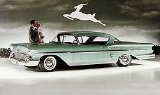
The Impala was introduced in 1958 as a new, upmarket, sporty trim package created for Bel Air
Chevrolet Bel Air

The Chevrolet Bel Air is an automobile series produced by the Chevrolet division of General Motors from 1953?75. From 1950?52, hardtops in Chevrolet's premium Chevrolet Deluxe model range were designated with the Bel Air name, but it was not a distinct series of its own....
 coupes and convertibles. Unique to the model were its six taillights, which set it apart from lower trim levels with only two lights on a side. This classic styling cue would become its trademark
TradeMark

TradeMark is a tall, primarily residential, skyscraper in Charlotte, North Carolina. It was completed in 2007 and has 28 floors. There are 200 hundred residential units....
. The Impala became a separate model in 1959 in both two- and four-door versions and became the best-selling car in the Chevrolet lineup. For 1960, it became the best-selling automobile in the United States
United States

The United States of America is a Federal government constitutional republic comprising U.S. state and a federal district. The country is situated mostly in central North America, where its Contiguous United States and Washington, D.C., the Capital districts and territories, lie between the Pacific Ocean and Atlantic Oceans, Borders of the U...
 and held that position for the next decade.

The Impala featured body-on-frame construction, using the "X" frame used on other Chevys, as well as Cadillac. The exception for the six-taillight rear end styling was the 1959 model, which used the "teardrop" taillight shape as all other Chevy models had.

1961-1964


The Impala was restyled on the existing GM B platform
GM B platform

The B platform, or B-body, was General Motors Corporation' full-size car rear-wheel drive automobile platform. It was closely related to the GM C platform and GM D platform and was used for coup?s, sedan s, and station wagons....
 for 1961. The new body styling was more trim and boxy than the 1958-60 models. Sport Coupe models featured a "bubbleback" roofline style for '61, and a unique model, the 2-door pillared sedan, was available for 1961 only. It was rarely ordered and a scarce collectible today. The rare Super Sport (SS) option debuted for 1961.

The 1962 model featured new "C" pillar styling for all models except the 4-door hardtop "Sport Sedan." Sport Coupe models now featured the "convertible roof" styling, shared with other GM "B" full-size hardtop coupes. This style proved extremely popular, and contributed to the desirability of the '62-'64 Impalas as collectibles. The "overhang" roof style of the sedans was replaced with a more attractive, wider "C" pillar with wraparound rear window. Engine choices for '62 settled down, the V8 discontinued and replaced by the , which could be ordered with any transmission. The small-block 283 was enlarged to , which added more engine choices for small-block fans. The Beach Boys produced a hit single, "409," referring to the Chevy, which became an iconic song for these cars. Impalas again featured premium interior appointments, plusher seats, and more chrome trim outside, including a full-width aluminum-and-chrome panel to house the triple-unit taillight assembly. Super Sport (SS) models featured that panel in a special engine-turned aluminum, which was also used to fill the side moldings, making the SS more distinctive in appearance. Due to reliability problems, the optional Turboglide automatic transmission was discontinued, leaving Powerglide the only autobox available until 1965.

Among collectors, the 1963 Impala is the most popular for its body style, even though it was almost mechanically identical to the 1962 Impala. The 1963 Impala's distinctive body style has crisp lines with pointed front and rear fenders which emphasize the long, low style of car design popular in the early 1960s. The rear taillight panel was aluminum, and was surrounded by a chrome border with the engine-turned surface on SS models. Engine choice was similar to '62, with the small-block and V8s the most popular choices. The Sport Sedan featured a new, creased roofline that proved popular. A new "coved" instrument panel was good-looking, but replaced the temperature gauge with "idiot lights" for hot and cold engine conditions. An optional factory tachometer was built into the dash, just above the steering wheel. It was rarely ordered, but gave the Super Sport models an extra feel of sportiness.

For 1964, the Impala was slightly restyled, reverting to a more rounded, softer look. Out back, the signature taillight assembly had an "upside-down U" shaped aluminum trim strip above the taillights, but the lights themselves were surrounded by a body-colored panel. The returned as the big-block option, but the 4X2 carburetor setup was no longer on the option list. SS models continued to feature the engine-turned aluminum trim. Rooflines were carried over from '63 unchanged. The 1964 model has been praised by Westcoast rap groups since in the 1990s, with endorsers such as Eazy-E
Eazy-E

Eric Lynn Wright , better known by the stage name Eazy-E, was an American Rapping, Hip hop production, and record executive from Compton, California....
, Dr. Dre
Dr. Dre

Andre Romelle Young , primarily known by his stage name Dr. Dre, is an American record producer, rapper, record executive, and actor. He is the founder and current CEO of Aftermath Entertainment and a former co-owner and artist of Death Row Records, also having produced albums for and overseeing the careers of many rappers signed to tho...
, Skee-Lo
Skee-Lo

Skee-Lo is a rapper who was moderately popular in the 1990s in music. He was born in Chicago, Illinois, and grew up in Riverside, California. He mostly rapped about Los Angeles, specifically the Crenshaw, Los Angeles, California area....
 and The Game
The Game (rapper)

Jayceon Terrell Taylor , better known by his stage name The Game, is an American rapper. He rose to fame in 2005 with the success of his debut album, The Documentary, and his two Grammy nominations....
 among many others.

1965-1970


Redesigned again in 1965, the Impala set an all-time industry annual sales record of more than 1 million units in the U.S., which has never been bettered. All new full-size Chevys eschewed the "X" frame for a full-width perimeter frame, a totally new body which featured curved, frameless side glass (for pillarless models), sharper angled windshield with newly-reshaped vent windows, and redesigned full-coil suspension. As with previous years, Impalas featured more chrome trim inside and out, with pleated tufted upholstery and door panels.

In 1965, Chevrolet introduced the Impala Caprice
Chevrolet Caprice

The Chevrolet Caprice and Caprice Classic were full-sized automobiles produced by the Chevrolet division of General Motors in the United States and Canada from 1965 through 1996 model years and in Mexico from 1977 through 1983....
. Beginning with the four-door hardtop sedan body, Impala Caprices received unique upholstery, wood grained accents on the dashboard and specialty pulls on the insides of the doors. The Impala Caprice was reintroduced as the Chevrolet Caprice in 1966, taking the top position in the full-size Chevrolet lineup. The Impala however, remained Chevrolet's top-selling model until the late 1970s. The 1967 model was redesigned along the lines of the 1963 Buick Riviera
Buick Riviera

The Buick Riviera is an automobile produced by Buick in the United States from the 1963 to 1999 model years, with 1,127,261 produced.A full-size coup? or personal luxury car, the early models of the Riviera in particular have been highly praised by automotive journalists and writers....
. The Coke bottle shape
Coke bottle styling

Coke bottle styling is a style of automobile bodies with outward curving fenders with a narrow center. Notable automobiles with this style include many muscle cars such as the Pontiac GTO, Chevrolet Camaro, and Dodge Charger ....
 was strengthened and the curves were biggest with the 1967-68 models. In keeping with Federal regulations, safety features were built into Impalas during the 1967 and '68 model years, including a fully collapsible energy-absorbing steering column, side marker lights, and shoulder belts for closed models. During the 1969 model year, for example, Impala production topped Caprice production by 611,000 units.

Right Hand Drive cars were manufactured in Canada for export to some countries such as Australia, UK etc., until 1969. They used a version of the 1965 Impala dash panel until 1969. Australian models were assembled in Australia from kits as this lessened tax on the cars.

Engine choices included the inline six-cylinder
Chevrolet Straight-6 engine

The Chevrolet straight-6 of the 1930s through 1970s was the base engine in many popular cars, including the Chevrolet Camaro....
 as well as the famous Chevy small-block
Chevrolet Small-Block engine

Chevrolet's small-block V8 is a not a single engine but a series of famous automobile engines built on the same basic small engine block. Retroactively referred to as the "Generation I" small-block, it is distinct from subsequent GM "Generation II" GM LT engine and "Generation III" GM LS engine engines....
 and big-block
Chevrolet Big-Block engine

The Chevrolet big block is a series of large displacement V8 engines that were developed in the USA during the 1950s and 1960s. As American automobiles grew in size and weight following the Second World War the engines powering them had to keep pace....
 V8s. Automatic buyers were given the option of the newly-introduced three-range Turbo Hydra-Matic transmission for the newly-introduced Mark IV big-block engine, displacing 396 cubic inches. The old "W" engine was discontinued early in the 1965 model year, so early-production '65s got the 409, where later-built cars had the as the big-block option. Two-range Powerglide, as well as Synchro-Mesh 3- and 4-speed manual transmissions were also available.

Straight-6
Straight-6

The straight-6 or inline-6 engine is a six cylinder internal combustion engine with all six cylinder mounted in a straight line along the crankcase....
:
  • Blue Flame
    Chevrolet Straight-6 engine

    The Chevrolet straight-6 of the 1930s through 1970s was the base engine in many popular cars, including the Chevrolet Camaro....
    , 1958-1962
  • Turbo Thrift
    Chevrolet Straight-6 engine

    The Chevrolet straight-6 of the 1930s through 1970s was the base engine in many popular cars, including the Chevrolet Camaro....
    , 1963-1965
  • Turbo Thrift
    Chevrolet Straight-6 engine

    The Chevrolet straight-6 of the 1930s through 1970s was the base engine in many popular cars, including the Chevrolet Camaro....
    , 1966-1969


Small-block V8:
  • to Turbo Fire
    Chevrolet Small-Block engine

    Chevrolet's small-block V8 is a not a single engine but a series of famous automobile engines built on the same basic small engine block. Retroactively referred to as the "Generation I" small-block, it is distinct from subsequent GM "Generation II" GM LT engine and "Generation III" GM LS engine engines....
    , 1957-1967
  • Turbo Fire
    Chevrolet Small-Block engine

    Chevrolet's small-block V8 is a not a single engine but a series of famous automobile engines built on the same basic small engine block. Retroactively referred to as the "Generation I" small-block, it is distinct from subsequent GM "Generation II" GM LT engine and "Generation III" GM LS engine engines....
    , 1968
  • to Turbo Fire
    Chevrolet Small-Block engine

    Chevrolet's small-block V8 is a not a single engine but a series of famous automobile engines built on the same basic small engine block. Retroactively referred to as the "Generation I" small-block, it is distinct from subsequent GM "Generation II" GM LT engine and "Generation III" GM LS engine engines....
    , 1961-1969
  • to Turbo Fire
    Chevrolet Small-Block engine

    Chevrolet's small-block V8 is a not a single engine but a series of famous automobile engines built on the same basic small engine block. Retroactively referred to as the "Generation I" small-block, it is distinct from subsequent GM "Generation II" GM LT engine and "Generation III" GM LS engine engines....
    , 1969-1980
  • to Turbo Fire
    Chevrolet Small-Block engine

    Chevrolet's small-block V8 is a not a single engine but a series of famous automobile engines built on the same basic small engine block. Retroactively referred to as the "Generation I" small-block, it is distinct from subsequent GM "Generation II" GM LT engine and "Generation III" GM LS engine engines....
    , 1970-1976


Big-block V8:
  • to W-series Turbo Thrust
    Chevrolet Big-Block engine

    The Chevrolet big block is a series of large displacement V8 engines that were developed in the USA during the 1950s and 1960s. As American automobiles grew in size and weight following the Second World War the engines powering them had to keep pace....
    , 1958-1961
  • to W-series Turbo Thrust
    Chevrolet Big-Block engine

    The Chevrolet big block is a series of large displacement V8 engines that were developed in the USA during the 1950s and 1960s. As American automobiles grew in size and weight following the Second World War the engines powering them had to keep pace....
    , mid-1961 to early 1965 (This engine was featured in the Beach Boys song "409".)
  • to Turbo-Jet
    Chevrolet Big-Block engine

    The Chevrolet big block is a series of large displacement V8 engines that were developed in the USA during the 1950s and 1960s. As American automobiles grew in size and weight following the Second World War the engines powering them had to keep pace....
    , mid-1965 to 1969
  • to Turbo-Jet
    Chevrolet Big-Block engine

    The Chevrolet big block is a series of large displacement V8 engines that were developed in the USA during the 1950s and 1960s. As American automobiles grew in size and weight following the Second World War the engines powering them had to keep pace....
    , 1966-1969
  • to Turbo-Jet
    Chevrolet Big-Block engine

    The Chevrolet big block is a series of large displacement V8 engines that were developed in the USA during the 1950s and 1960s. As American automobiles grew in size and weight following the Second World War the engines powering them had to keep pace....
    , 1970-1976


Impala SS


In 1961, the Impala SS
Super Sport

Super Sport, or SS, is an option package offered by Chevrolet on many of its vehicle lines since 1961. Some of the better-known models to bear the SS badge include the Chevrolet Camaro, Chevrolet Chevelle, Chevrolet El Camino, Chevrolet Impala, and Chevrolet Nova....
 (Super Sport) was introduced to the market. The SS badge was to become Chevrolet's signature of performance on many models, though it has often been an appearance package only. The Impala's SS package in 1961 was truly a performance package, beginning with the high-performance V8 engines available with , , and or the new V8, which was available with up to . The package also included upgraded tires on station wagon
Station wagon

A station wagon in American English, Australian English, Canadian English and New Zealand English usage and an estate car in British English usage, is a passenger automobile with a car body style similar to a sedan but with the roofline following the full, sometimes extended rear cargo area, i.e. ending with a more vertical door...
 wheels, springs, shocks and special sintered
Powder metallurgy

Powder metallurgy is a forming and fabrication technique consisting of three major processing stages. First, the primary material is physically Powder , divided into many small individual particles....
 metallic brake linings. Starting in 1962, the Impala SS could be had with any engine available in the Impala, down to the , inline-6. With one exception, from this point until 1969, the SS was an appearance package only, though the heavy-duty parts and big engines could still be ordered. From 1962-on, Super Sports were limited to the hardtop coupe and convertible coupe exclusively. The Super Sport package was known by Regular Production Option (RPO) Z03, from 1962-63, and again in 1968. As mentioned above, '62-64 Super Sports got engine-turned aluminum trim, which was replaced by a "blackout" trim strip in '65 which ran under the taillights. "Super Sport" script replaced the "Impala SS" badges in 1965 and 1966.

The exception was the Z24 option package available in combination with the standard Z03 Super Sport package. Starting in 1967 through 1969, buyers of Impala Z24s got cars badged as "SS427" models. The SS427 included a heavy-duty suspension and other performance goodies, as well as a Turbo-Jet V8 in either L36 ( in 1967-1968, in 1969) or L72 in 1968-1969. Special SS427 badging, inside and out, was the rule, but few were sold since muscle car enthusiasts were looking toward big-block intermediates such as the Chevelle
Chevrolet Chevelle

The Chevrolet Chevelle is a mid-sized automobile from Chevrolet debuting in 1964. It was produced from 1964 through 1977 and was one of General Motors' most successful cars....
 SS396 and Plymouth Road Runner
Plymouth Road Runner

The Plymouth Road Runner was the no-frills muscle car version of intermediate Plymouth Belvedere and Plymouth Satellite built by the Plymouth automobile division of the Chrysler Corporation in the United States between 1968 and 1980....
, which were lighter and faster off the line. From 1968 to 1969, Z24s could be ordered without the Z03 SS package, which meant SS427 equipment but no bucket seats or center console.

The Impala SS could be identified by "SS" emblems on the rear fenders and trunk lid. The Impala SS became its own series (separate model rather than an option package) for 1964. In 1968, the Impala SS once again became an option package. 1967 and 1968 SS427s got a special domed hood and body emblems, and the 1968 model featured "gills" on the front fenders in front of the wheel opening, possibly to remind people of its Corvette cousin. In 1969, the Impala SS was available only as the Z24 (SS427), coming exclusively with a V8 of , , or . This was the final year for the Impala SS until 1994. Those 1969 Impala SS cars were often considered "sleepers" in that there was no distinctive SS badging inside the car (again there was no Z03 offered that year), and a true 1969 Z24-optioned car is the rarest and most collectible of the SS427 years.

1969 was the last year that the Impala SS was offered with the Z24 package, but the only year in which front disc brakes and wheels were standard; that made the 1969 SS427 better than the previous version. Although the 427 was replaced by the Turbo-Jet V8 in 1970, the SS option was gone. Thus, the 1969 Impala SS427 got the best of both worlds, which is why it is so valuable and is often cloned today.

1971-1976


In 1971, the redesigned full-size B-body would be the largest full-size car ever offered by GM. However, the 1970s marked the impact of the 1973 energy crisis
Energy crisis

An energy crisis is any great Bottleneck in the supply of energy resources to an Economics. It usually refers to the shortage of Petroleum and additionally to electricity or other natural resources....
. Gasoline prices doubled between 1973 and 1979. Industry car sales plummeted 20 percent between 1973 and 1974, and for the first time in recent history, annual passenger car travel in the U.S. actually declined. The Impala's sales dropped to 176,376 units in 1975, the weakest since its introduction in 1958. In spite of the large size of these cars, an Econominder gauge package was offered on 1975 and 1976 models to keep track of gas mileage. Station wagons replaced the swinging tailgate with an unusual design where the back window retracted into the roof, which was abandoned on the subsequent redesign.

Starting in 1968, two coupe models were offered on Impalas, the "Sport Coupe" was the lower-priced hardtop coupe design, shared with other GM "B" body hardtop coupes, and the formal-roof "Custom Coupe" which was the Caprice Coupe body in Impala trim. Sport Coupe models were discontinued after 1975, leaving the Custom Coupe, with its wide "B" pillar and fixed rear window, the only 2-door Impala available in 1976. This body style was actually introduced for the 1974 model year, a precursor to Detroit's complete abandonment of pillarless body styles before the end of the Seventies.

The 1972 model introduced a "gaping" grille which extended below the bumper. The large size was partly because of federal bumper rules which required impact protection beginning in 1973, and the rear in 1974.

Powertrains consisted of V8 engines mostly (the 250 inline six was standard through 72, then the 2bbl 350 was standard from 73-76), offered with , , (through 72) or ; however, the long-familiar OHV six-cylinder Turbo Thrift engine continued to be standard on two-door hardtop coupe and four-door pillared sedan models through the end of the 1972 model year. Beginning in 1972, all engines were designed to run on unleaded gasoline. Catalytic converters were introduced in 1975. High Energy Ignition, or HEI, debuted on the 75 models as well, although it is said HEI was installed on some 1974 cars. The Impala convertible model was dropped after 1972, and continued as a Caprice until 1975.

Several new options were offered for the first time in 1975. In addition to the Econominder gauge package, new options included intermittent wipers and a divided 50-50 bench seat (with a choice of sport cloth or vinyl trim). Also in 1975, the dashboard, radio and climate control graphics were revised; the speedometer read up to , and had smaller numbers for kilometers per hour.

Although the "Super Sport" model was long since discontinued, two special models were offered:

  • A "Spirit of America" package. Offered in 1974 on Sport Coupe models, this was primarily a trim package featuring special white body paint, a white vinyl top, sports-styled dual remote outside rearview mirrors, special wheel covers, optional rally rims (sourced from the Chevrolet C10 truck, painted white), a vinyl bodyside molding insert, and pinstriping and interior trim in either red or blue. The interior trim also included color-keyed seat belts and floormats. Special fender badges (along with one on the dashboard) announced the package to passengers or passers-by.


  • A "Landau" model, for 1975-1976 models (and carried over into the late 1970s and 1980s). Like the "Spirit of America" package, this was primarily an appearance package. The model featured a choice of special paint colors, sports-styled dual remote outside rearview mirrors, color-keyed wheel covers, a landau
    Landau

    Landau or Landau in der Pfalz is an autonomous city surrounded by the S?dliche Weinstra?e district of southern Rhineland-Palatinate, Germany....
     vinyl roof
    Vinyl roof

    Vinyl roof refers to a vinyl covering for an automobile's top. This covering was originally designed to give the appearance of a convertible to models with a fixed roof, but eventually it evolved into a styling statement in its own right....
     (with chrome band across the roof), a vinyl bodyside molding insert, and pinstriping. Inside there were color-keyed seat belts and floormats. Fender and dashboard emblems rounded out the package.

1977–1985


The changes in the automobile marketplace resulted in Chevrolet redesigning the Impala once again in 1977 to meet changing demands. The new downsized
Downsize (automobile)

Downsizing in the automobile industry is the practice of redesigning a vehicle to retain the interior volume, and often the nameplate and styling of a larger car to a smaller, more efficient platform....
 Impalas were shorter, taller and narrower. The new Impala's frame was a shortened version of the one introduced in 1971 and would be utilized until 1996 when the B-body production line was shut down. The Impala was typical of smaller, lighter (even more so than the 1977 Chevelle), and more fuel efficient full-size American cars. Even with its smaller dimensions, the new Impala featured increased headroom, legroom and trunk space.

Production of the downsized model increased substantially versus 1976, and the Impala regained the number one US sales position. The redesigned 1977 Impala/Caprice was named Motor Trends car of the year.

No convertible models were offered. Pillarless hardtops were also discontinued, the result of rumors of Federal rollover standards looming in the near future. The relatively rare 1977-1979 coupes did have a double bent tempered rear window much like the Monte Carlo Aerocoupe.

Engine availability was reduced in 1977 when the Inline 6 was reintroduced with . Other options included and V8 engines. The V8 engine was optional in some years. Oldsmobile
Oldsmobile

Oldsmobile was a brand name of automobile produced for most of its existence by General Motors. It was founded by Ransom E. Olds in 1897. In its 107-year history, it produced 35.2 million cars, including at least 14 million built at its Lansing, Michigan factory....
's V8 diesel
Diesel

Diesel or diesel fuel in general is any fuel used in diesel engines. The most common is a specific fractional distillation of petroleum fuel oil, but alternatives that are not derived from petroleum, such as biodiesel, biomass to liquid or gas to liquid diesel, are increasingly being developed and adopted....
 engine also was available.

In 1980, a slight facelift took place, although the body style remained the same, and all the sheet metal was changed. From 1980-1990, all GM B-bodies shared similar doors that can be replaced by removing model-specific trim pieces.

Although the Impala (and the upscale Caprice) sold well into the early 1980s, the Impala was more of an entry-level vehicle along with fleet usage - especially with law enforcement. The Impala was discontinued in 1985, while the Caprice continued unchanged until 1990. The Caprice received a major redesign in 1991 and continued until 1996.

1994-1996


Chevimpalanewlogo
In 1991, the GM B platform was extensively redesigned, though it retained the same shortened frame
Chassis

A chassis consists of a Frame that supports an inanimate object, analogous to an animal's skeleton, for example in a motor vehicle or a firearm....
 design of the 1977 redesign.

The Impala SS badge was resurrected at the 1992 Detroit Auto Show as a concept car designed by GM designer Jon Moss. The concept car was two inches lower to the ground than the regular Caprice, and was powered by a engine. Eventually, the concept car's engine was replaced with a engine derived from the Corvette
Chevrolet Corvette

The Chevrolet Corvette is a sports car that has been manufactured by General Motors since 1953. The car was originally designed by Harley Earl, and named by Myron Scott after the fast corvette....
 in order to show the public what would be offered if put into production (an off-road specification V8 was eventually put into the engine bay of the prototype years later).

The 1994 Impala SS went into production 14 months later at GM's plant in Arlington, Texas
Arlington, Texas

Arlington is a city in Tarrant County, Texas, Texas within the Dallas?Fort Worth Metroplex. According to a U.S Census Bureau release, as of July 1, 2007 Arlington has an estimated population of 371,038....
, and was almost identical cosmetically to the concept car, the only noticeable change being the chromed bowtie logo on the grill (vs a red logo on the concept). The car was, in essence, a high-performance version of the Caprice. From a mechanical standpoint, it used the Caprice 9C1
9C1

9C1 is Chevrolet's Special Equipment Options code for a police package vehicle. The 9C1 package has heavier-duty features over a non-police vehicle as well as some options specific to the installation of police equipment....
 police package as its base and as such got most of the equipment formerly available only to law enforcement and government agencies. This included a sport-tuned suspension with reinforced shocks and struts, a high-capacity upgraded reverse flow cooling system, larger and more powerful four-wheel disc brakes, transmission cooler, dual exhaust, a higher-output electrical system, and other minor mechanical alterations. Not all of the police equipment was carried over however, as the Impala SS did not get the external oil-to-air engine oil cooler, nor were all the body mounts secured (the standard Caprice and Impala SS were assembled at the factory with the front 3 body mounts missing one of the rubber cushions, while the 9C1 was assembled with all rubber cushions in place), although both are popular aftermarket additions to the Impala SS by their owners.

The Impala SS was uniquely fitted with a standard 3.08 gear. The limited-slip rear differential was standard (as opposed to the option G80 on caprices) and suspension that was an inch lower. A retuned LT1
GM LT engine

General Motors Corporation' Generation II LT is a small block V8 engine. Making its debut in the 1992 Chevrolet Corvette, the new LT sought to draw upon the heritage of the ultimate small-block, the 1970 Chevrolet GM Small-Block engine#LT-1....
  small-block
Chevrolet Small-Block engine

Chevrolet's small-block V8 is a not a single engine but a series of famous automobile engines built on the same basic small engine block. Retroactively referred to as the "Generation I" small-block, it is distinct from subsequent GM "Generation II" GM LT engine and "Generation III" GM LS engine engines....
 V8 was standard on the Impala SS, making and of torque
Torque

Torque is the tendency of a force to rotate an object about an axis . Just as a force is a push or a pull, a torque can be thought of as a twist....
 (retuned from the prototype's rating). The primary difference between the LT1 in the Impala and the LT1 that was in the Corvette and Camaro was that the Impala engine was fitted with cast-iron
Iron

Iron is a chemical element with the symbol Fe and atomic number 26. Iron is a Group 8 element and period 4 element. Iron is lustrous and silvery in color....
 cylinder heads instead of aluminum ones, and a camshaft that was designed more for low-end torque than high-end horsepower. Another difference was that the Impala LT1 had 2 bolt main bearing caps while the Corvette LT1 had 4 bolt main bearing caps. The transmission used in the car was the 4L60E
GM 4L60-E transmission

The 4L60-E is a series of automatic transmissions from General Motors Corporation. Designed for longitudinal engine configurations, the series includes 4 forward gears....
, which was itself an upgraded and revised version of the previous 700R4. However, the transmission was not beefed up for the power of the LT1, and transmission failures after were commonplace.

Several other cars in the B-body line also shared a similar powertrain: these were the Chevrolet Caprice, Buick Roadmaster
Buick Roadmaster

The Roadmaster was an automobile built by the Buick division of General Motors. Buick first used the Roadmaster name between 1936 and 1958. In 1991, Buick again applied the Roadmaster name to its full-size rear-wheel drive sedan and station wagon models as a replacement for the Buick Estate....
, and the Cadillac Fleetwood
Cadillac Fleetwood

The Fleetwood Metal Body Company began business in Fleetwood, Pennsylvania on April 1, 1909 and continued as an independent automobile body builder until acquired in 1925 by the Fisher Body Company, a division of General Motors....
 which all shared the LT1 engine and 4L60E automatic transmission
Automatic transmission

An automatic transmission is an automobile gearbox that can change gear ratios automatically as the vehicle moves, freeing the driver from having to shift gears manual transmission....
.

Cosmetically, the Impala SS received body-colored trim, which helped reduce the sometimes "bloated" look of the standard Caprice, a unique single-bar grille with no hood ornament and, a rear deck spoiler. It was fitted with brushed aluminum wheels with 255/50ZR17 tires. Inside, the car came with a central console with cup holders (1994 and 1995 models) and a storage compartment, leather seats embroidered with the Impala SS logo, and a standard leather-wrapped steering wheel.

For the 1994 model year, it was available only in black with a grey interior. Due to a shortage of the unique 5-spoke aluminum wheels (manufactured by ROH in Australia), only 6,303 cars were sold. However, the wheel shortage was remedied for the 1995 model year and 21,434 cars were sold. In 1995, Dark Cherry Metallic and Dark Grey Green were added as exterior color options, and the body paneling on the rear quarter panel
Quarter panel

On an automobile, a quarter panel is a body panel that covers the section between the rear door and the trunk, or the front door and the hood....
 was altered to reflect the cosmetic effect formerly achieved by a window insert. 1996 was the last year of production with 41,941 units sold. The 1996 Impala SS production went late into the model year; some being produced as late as December 17, 1996. It saw minor interior alterations, with the digital speedometer being replaced by an analog one, along with a tachometer. The shifter was moved from the column to the center console, and the engine was given an OBD-II computer control system (the camshaft was reground to adjust for the new computer).

The entire B/D-body line, consisting of the Chevrolet Caprice, Impala SS, Buick Roadmaster
Buick Roadmaster

The Roadmaster was an automobile built by the Buick division of General Motors. Buick first used the Roadmaster name between 1936 and 1958. In 1991, Buick again applied the Roadmaster name to its full-size rear-wheel drive sedan and station wagon models as a replacement for the Buick Estate....
 and Cadillac Fleetwood
Cadillac Fleetwood

The Fleetwood Metal Body Company began business in Fleetwood, Pennsylvania on April 1, 1909 and continued as an independent automobile body builder until acquired in 1925 by the Fisher Body Company, a division of General Motors....
, was discontinued by General Motors, as GM wanted more assembly lines to be able to produce more profitable SUVs. Another fact was that the Caprice was the only B-body with a market share since fleet sales to law enforcement outnumbered sales of all other B-bodies.

2000-2005


The Impala name was "resurrected" for the 2000 model year to replace the mid-size Lumina
Chevrolet Lumina

The Chevrolet Lumina sedan and minivan were first introduced in 1989 for the 1990 model year as a new range of vehicles from the Chevrolet brand of General Motors to replace both the Chevrolet Celebrity sedan and coupe, and the Chevrolet Monte Carlo coupe....
. It was built at the Oshawa Car Assembly
Oshawa Car Assembly

Oshawa Car Assembly is a major car manufacturing facility in the city of Oshawa, Ontario, Ontario, Canada building various automobiles for General Motors....
 in Oshawa, Ontario
Oshawa, Ontario

Oshawa is a city in Ontario, Canada, on the Lake Ontario shoreline, approximately 60 kilometres east of downtown Toronto. It is commonly viewed as the eastern anchor of both the Greater Toronto Area and the Golden Horseshoe....
, Canada
Canada

Canada is a country occupying most of northern North America, extending from the Atlantic Ocean in the east to the Pacific Ocean in the west and northward into the Arctic Ocean....
. Unlike the earlier Impalas, this one was front-wheel drive
Front-wheel drive

Front-wheel drive is a form of Internal combustion engine/transmission layout used in motor vehicles, where the engine drives the front wheels only....
 and was available with a choice of two V6 engines. This car was based on the GM W platform
GM W platform

The W-body is an automobile platform from General Motors which underpins mid-size cars with front-wheel drive. The platform, originally code named GM10, began in 1982 under Chairman Roger B....
. A new Impala SS with a supercharged
Supercharger

A supercharger is an air Gas compressor used for forced induction of an internal combustion engine. The greater mass flow-rate provides more oxygen to support combustion than would be available in a naturally-aspirated engine, which allows more fuel to be provided and more work to be done per cycle, increasing the power output of the engine...
 V6 was brought out for the 2004 model year.

2002 Chevrolet Impala
The Impala was available in two trim levels from 2000 to 2002. The base model came equipped with cloth bench seats, the 3.4 liter (204 cu in) LA1 V6, and a 3-gauge instrument cluster. The LS came factory-equipped with cloth bucket seats upgradeable to leather with center console and floor shift, color-keyed "Impala" door scripts and trunk badge, anti-lock brakes, traction control system, keyless remote entry, integrated foglamps, 4-gauge instrument cluster, and the 3.8 liter (231 cu in) L36 V6. Options available on all models included a sunroof, OnStar system, rear decklid spoiler, Driver Information Center with built-in HomeLink system
HomeLink Wireless Control System

The HomeLink Wireless Control System is a radio frequency transmitter integrated into some automobiles that can be programmed to activate devices such as garage door openers, Wireless light switch, gate operator and locks, including those with rolling codes....
, heated power front seats, and 16 inch 1990s SS-inspired wheels. All options found or available on the LS were available on the base model. All models came equipped with power windows, door locks and mirrors.

In 2003, Chevrolet introduced the
LS Sport appearance package. Added to the LS model, it offered a 6-gauge cluster, front bumper extension, color-keyed tail light panels and a chrome exhaust pipe tip.

The 2004 to 2005 Impala SS came equipped with the 3.8 liter (231 cu in) supercharged
L67 V6 engine. It was rated at and had been previously used in the Pontiac Grand Prix
Pontiac Grand Prix

The Pontiac Grand Prix was an automobile produced by the Pontiac division of General Motors. First introduced as part of Pontiac's full-size model offering for the 1962 model year, the Grand Prix name was also applied to cars in the personal luxury car market segment and the mid-size offering, slotting below the large Pontiac Bonneville in th...
 
GTP, Buick Regal
Buick Regal

The Buick Regal is a mid-size car produced by General Motors' Buick division from 1973 through 2004, during which Buick also used the Buick Century name on mid-size models; the two frequently shared bodies and powertrains....
 
GS and Pontiac Bonneville
Pontiac Bonneville

The Pontiac Bonneville was an automobile built by the Pontiac division of General Motors from 1957 to 2005. It was introduced as a limited production performance convertible during the 1957 model year....
 
SSEI. The lightweight front wheel drive sedan was actually quicker than the vaunted 1990s Impala SS, with times pushing 6.5 seconds compared to the earlier models' 7.1.

Police Package

Chevy Impala Police
Also released with this version were the Police Package
Police car

File:Metropolitan Police car01.jpgA police car is the description for a vehicle used by police, to assist with their duties in patrolling and responding to incidents....
 and Undercover Police Package, named
9C1 and 9C3, respectively. Available only to law enforcement, it has had more success than its predecessor, the Lumina
Chevrolet Lumina

The Chevrolet Lumina sedan and minivan were first introduced in 1989 for the 1990 model year as a new range of vehicles from the Chevrolet brand of General Motors to replace both the Chevrolet Celebrity sedan and coupe, and the Chevrolet Monte Carlo coupe....
 9C3. The 9C1 was basically a base model with a stronger suspension and the 3.8 liter (231 cu in) V6 engine. It was only available in a few basic colors. Another addition was the "SURV MODE" switch which replaced the fog light switch found on the LS. This enabled the driver to turn off all lights in the vehicle and "hide"; something not allowed with the civilian models as automatic headlights were standard. The 9C3 was comparably equipped to the 9C1, but the ability to add other convenience options and more paint and interior choices set the 9C3 apart.

2006-present


The 2006 Impala was introduced at the 2005 Los Angeles Auto Show. Like the Buick LaCrosse
Buick LaCrosse

The Buick LaCrosse is a mid-size car produced by the Buick division of United States automaker General Motors since 2004 as the 2005 model year....
, this model uses the updated GM W platform
GM W platform

The W-body is an automobile platform from General Motors which underpins mid-size cars with front-wheel drive. The platform, originally code named GM10, began in 1982 under Chairman Roger B....
. The base engine is a 3.5 liter (214 cu in) V6 producing . The new Impala features new taillights, different from the four-circle style of the previous generation. The most notable news about the model, though, is the
SS model's use of the Generation IV small-block
GM LS engine

The LS series is a new design intended as the only V-8 engine utilized in General Motors Corporation' line of RWD cars and trucks. The LS series was a clean sheet design with little in common with the classic Chevrolet Small-Block engine....
 V8 in a front-wheel drive Chevrolet for the first time, and the first V8 in a Chevrolet sedan since the 1996 Caprice: the new 5.3 liter (325 cu in) V8 (with Displacement on Demand, now called Active Fuel Management or AFM) produces . With the use of the 5.3 liter LS4 V8, the Impala SS is capable of a 5.6 second time and a quarter-mile time of 14.2 seconds traveling at . The car is 200.4 inches (5,091 mm) long, high, and 72.9 inches (1,851 mm) wide. Available trim levels are LS, LT, LTZ and the aforementioned SS. Also updated are the 9C1 & 9C3 trim levels for Police Package models, which do not have the civilian SS's V8 engine available, but instead use the 3.9 liter (237 cu in) V6. The reason for this is that the Police Sedans utilize the SS radiator and cooling system as an upgrade from the standard 3.9 liter engine (used in the Impala LTZ). GM did not wish to design a specific radiator and cooling system to equip a low-production V8 police vehicle. Also, the heavy-duty steel wheels were not redesigned, and as such, the Police Sedan uses the original center caps or the older style wheel covers. A factory spoiler is an available option, and cruise control and a CD player are standard.

The interior has been completely redesigned. The 2006 Impala featured a wood trim center console with chrome accents on all major control buttons. The dashboard featured a chrome Impala logo embedded in the wood grain trim that runs across the front of the vehicle and onto the doors. The new control knobs found throughout the vehicle's cockpit are similar to those found in the new Buick models as well as the Cadillac DTS
Cadillac DTS

The Cadillac DTS is a full-size luxury vehicles from the Cadillac luxury vehicles of General Motors. The DTS replaces the Cadillac DeVille as that carmaker's largest luxury car for model year 2006, following the naming and styling direction set by the earlier Cadillac CTS and Cadillac STS....
, all of which feature a similar center console. Another interior revision is the location of the cupholders, which are now concealed beneath the mid-section of the vehicle's center console.

Safety

In the Insurance Institute for Highway Safety's crash tests, the Impala is given an overall "Acceptable" score for front impact collisions. and a "Good" score for side impacts. Side curtain airbags are standard for front and rear rows but torso type side airbags are unavailable.

2007

The Impala receives several new colors, and an AFM
Active Fuel Management

Active Fuel Management is a trademarked name for the automobile variable displacement technology from General Motors Corporation. It allows a V6 or V8 engine to "turn off" half of the cylinders under light-load conditions to improve Fuel economy in automobiles....
-equipped 3.9 liter (237 cu in) V6 for 2007, as well as a Regency-outfitted "Impala RSS". The RSS will include more aggressive rims, front/rear bumper and rocker panel extensions, a BMW M
BMW M

BMW M GmbH is a subsidiary of German car manufacturer BMW AG. Established in May 1972 with just eight employees, it grew to 400 employees by 1988....
-inspired spoiler and various interior upgrades. The 9C1 and 9C3 models receive an aluminized interior trim instead of the standard wood grain.

2008

FlexFuel
Flexible-fuel vehicle

A flexible-fuel vehicle or dual-fuel vehicle is an alternative fuel vehicle with a internal combustion engine designed to run on more than one fuel, usually gasoline blended with either ethanol fuel or methanol fuel, and both fuels are stored in the same common tank....
 Chevrolet Impala LT 2009.]] The Impala receives the FlexFuel
Flexible-fuel vehicle

A flexible-fuel vehicle or dual-fuel vehicle is an alternative fuel vehicle with a internal combustion engine designed to run on more than one fuel, usually gasoline blended with either ethanol fuel or methanol fuel, and both fuels are stored in the same common tank....
 feature seen in other GM vehicles on the LS, LT, LTZ, 9C1 and 9C3 models. The SS retains the same drivetrain and does not receive the FlexFuel feature due to the high performance nature of the powertrain. The Police Sedans receive the FlexFuel feature to compete against the Ford Crown Victoria Police Interceptor
Ford Crown Victoria Police Interceptor

The Crown Victoria Police Interceptor is the law enforcement version of the Ford Crown Victoria. It is one of the most widely-used automobiles in law enforcement departments of the United States and Canada....
, which also received a similar feature allowing it to utilize E85
E85

E85 is an alcohol fuel mixture that typically contains a mixture of up to 85% Methylated spirit fuel Ethanol fuel and gasoline or other hydrocarbon by volume....
. Also, the 9C1 and 9C3 begin coming equipped with an external trunk lock tumbler. Neither feature is available to the civilian version of the car.

50th Anniversary Edition

To commemorate the 50th year of Chevrolet Impala, a special 50th Anniversary Edition went on sale in Spring 2008. Based on the Impala LT, it adds the following:
  • FE3 Sport Suspension (replaces the FE1 Touring Suspension)
  • Four-wheel ABS
  • Eighteen-inch alloy wheels (replaces 16-inch wheels)
  • Rear spoiler
  • "50th Anniversary" Impala badge on the C-pillar
  • Two-tone, leather-trimmed seats and "50th" logo embroidered on the front headrests
  • Eight-way power-adjustable driver seat (replaces six-way adjustability)
  • Leather-wrapped steering wheel with accent-color thread (includes audio controls)
  • Ebony carpet
  • Ebony floor mats with accent threading
  • "50th" Anniversary emblem on the sill plates
  • Two premium exterior colors: Black Granite Metallic or Red Jewel Tintcoat


2009

The Impala receives three new premium exterior colors: Victory Red, Silver Ice Metallic, and Aqua Blue Metallic. A redesigned spoiler is also available.

Awards

The Impala was selected as the 2006 and 2007 Fleet Car of the Year by Automotive Fleet and Business Fleet magazines and won the 2006 CAA
Canadian Automobile Association

The Canadian Automobile Association is a non-profit federation, founded in 1913, of nine clubs across Canada, providing roadside assistance service, a complete range of auto touring and leisure travel services, insurance services, and member discounts with preferred companies....
 Pyramid Award for Environmental Initiatives for the launch of its new Ethanol Powered E-85 model.

Impala in NASCAR

In 2007, the Impala began to replace the Monte Carlo
Chevrolet Monte Carlo

The Chevrolet Monte Carlo was an American-made automobile. Originally introduced by Chevrolet for the 1970 model year , it has gone through six generations as of 2007....
 on the NASCAR
NASCAR

The National Association for Stock Car Auto Racing is the largest sanctioning body of stock cars in the United States. The three largest racing series sanctioned by NASCAR are the Sprint Cup Series, the Nationwide Series and the Camping World Truck Series....
 stock car racing
Stock car racing

Stock car racing is a form of automobile racing found mainly in the United States, Canada, New Zealand, Great Britain and Brazil. Traditionally, races are run on oval track racing measuring approximately ? mile to 2.66 miles length, but are also raced on road courses....
 circuit; more specifically, on all the scheduled racing events where NASCAR has mandated the use of a car with different (and some) new specifications, better known as the Car of Tomorrow
Car of Tomorrow

The Car of Tomorrow , sometimes called CoT or "Car of Today", is the car style for the NASCAR Sprint Cup Series. Larger and boxier than the design it replaced, the Car of Tomorrow is safer, costs less to maintain, and makes for closer competition....
, it was recently announced that in 2008 the Impala will be the only Chevrolet nameplate on the NASCAR Sprint Cup Series.

Next Generation

With the decline of W-body
GM W platform

The W-body is an automobile platform from General Motors which underpins mid-size cars with front-wheel drive. The platform, originally code named GM10, began in 1982 under Chairman Roger B....
 cars (e.g. Chevrolet Monte Carlo
Chevrolet Monte Carlo

The Chevrolet Monte Carlo was an American-made automobile. Originally introduced by Chevrolet for the 1970 model year , it has gone through six generations as of 2007....
 after 2007, Pontiac Grand Prix
Pontiac Grand Prix

The Pontiac Grand Prix was an automobile produced by the Pontiac division of General Motors. First introduced as part of Pontiac's full-size model offering for the 1962 model year, the Grand Prix name was also applied to cars in the personal luxury car market segment and the mid-size offering, slotting below the large Pontiac Bonneville in th...
 after 2008, and Buick LaCrosse
Buick LaCrosse

The Buick LaCrosse is a mid-size car produced by the Buick division of United States automaker General Motors since 2004 as the 2005 model year....
 after 2009, since the LaCrosse moves to the GM Epsilon II platform), the Impala is scheduled to be redesigned for the 2010 model year, however GM had yet to decide if the new car will be rear- or front-wheel drive as of last year. GM has cancelled plans to build a rear wheel drive Impala and has halted all work on the Zeta platform. The Impala will most likely be redesigned on the Epsilon platform for 2011 or 2012. Chevy has also decided to twin-turbocharge the engine with full race twin-scroll garret turbos using E85 as fuel. Optional additional supercharger (powered by gypsy tears) package will be available as an factory performance package.

External links