
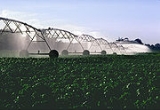
Center-pivot irrigation (sometimes called central pivot irrigation), also called circle irrigation, is a method of
cropAgriculture is the cultivation of animals, plants, fungi and other life forms for food, fiber, and other products used to sustain life. Agriculture was the key implement in the rise of sedentary human civilization, whereby farming of domesticated species created food surpluses that nurtured the...
irrigationIrrigation may be defined as the science of artificial application of water to the land or soil. It is used to assist in the growing of agricultural crops, maintenance of landscapes, and revegetation of disturbed soils in dry areas and during periods of inadequate rainfall...
in which equipment rotates around a pivot. A
circularA circle is a simple shape of Euclidean geometry consisting of those points in a plane that are a given distance from a given point, the centre. The distance between any of the points and the centre is called the radius....
area centered on the pivot is irrigated, often creating a circular pattern in crops when viewed from above.
How it works
Central pivot irrigation is a form of overhead (
sprinklerIrrigation sprinklers are sprinklers used on farms, golf courses, and yards, to provide water to vegetation and plants in the event of drought. They may also be used for recreation, as a cooling system, or to keep down the amount of airborne dust....
) irrigation consisting of several segments of pipe (usually galvanized steel or
aluminiumAluminium or aluminum is a silvery white member of the boron group of chemical elements. It has the symbol Al, and its atomic number is 13. It is not soluble in water under normal circumstances....
) joined together and supported by
trussIn architecture and structural engineering, a truss is a structure comprising one or more triangular units constructed with straight members whose ends are connected at joints referred to as nodes. External forces and reactions to those forces are considered to act only at the nodes and result in...
es, mounted on wheeled towers with sprinklers positioned along its length. The machine moves in a circular pattern and is fed with water from the pivot point at the center of the circle. The outside set of wheels sets the master pace for the rotation (typically once every three days). The inner sets of wheels are mounted at hubs between two segments and use angle sensors to detect when the bend at the joint exceeds a certain threshold, and thus, the wheels should be rotated to keep the segments aligned. Center pivots are typically less than 500m in length (circle radius) with the most common size being the standard 1/4 mile machine (400 m). To achieve uniform application, center pivots require a continuously variable emitter flow rate across the radius of the machine. Nozzle sizes are smallest at the inner spans to achieve low flow rates and increase with distance from the pivot point.

Most center pivot systems now have drops hanging from a u-shaped pipe called a gooseneck attached at the top of the pipe with sprinkler heads that are positioned a few feet (at most) above the crop, thus limiting
evaporativeEvaporation is a type of vaporization of a liquid that occurs only on the surface of a liquid. The other type of vaporization is boiling, which, instead, occurs on the entire mass of the liquid....
losses and wind drift. There are many different nozzle configurations available including static plate, moving plate and part circle. Pressure regulators are typically installed upstream of each nozzle to ensure each is operating at the correct design pressure. Drops can also be used with drag hoses or bubblers that deposit the water directly on the ground between crops. This type of system is known as LEPA (Low Energy Precision Application) and is often associated with the construction of small dams along the furrow length (termed furrow diking/dyking). Crops may be planted in straight rows or are sometimes planted in circles to conform to the travel of the center pivot.
Originally, most center pivots were water-powered. These were replaced by
hydraulicHydraulics is a topic in applied science and engineering dealing with the mechanical properties of liquids. Fluid mechanics provides the theoretical foundation for hydraulics, which focuses on the engineering uses of fluid properties. In fluid power, hydraulics is used for the generation, control,...
systems and electric motor-driven systems. Most systems today are driven by an
electric motorAn electric motor converts electrical energy into mechanical energy.Most electric motors operate through the interaction of magnetic fields and current-carrying conductors to generate force...
mounted at each tower.
For center pivot to be used, the terrain needs to be reasonably flat; but one major advantage of center pivots over alternative systems is the ability to function in undulating country. This advantage has resulted in increased irrigated acreage and water use in some areas. The system is in use, for example, in parts of the
United StatesAgriculture is a major industry in the United States and the country is a net exporter of food. As of the last census of agriculture in 2007, there were 2.2 million farms, covering an area of , an average of per farm.-History:...
,
AustraliaIrrigation in Australia is a widespread practice to supplement low rainfall levels in Australia with water from other sources to assist in the production of crops or pasture. As the driest inhabited continent, irrigation is required in many areas for production of crops for domestic and export use...
,
New ZealandNew Zealand is an island country in the south-western Pacific Ocean comprising two main landmasses and numerous smaller islands. The country is situated some east of Australia across the Tasman Sea, and roughly south of the Pacific island nations of New Caledonia, Fiji, and Tonga...
,
BrazilBrazil , officially the Federative Republic of Brazil , is the largest country in South America. It is the world's fifth largest country, both by geographical area and by population with over 192 million people...
and also in desert areas such as the
SaharaThe Sahara is the world's second largest desert, after Antarctica. At over , it covers most of Northern Africa, making it almost as large as Europe or the United States. The Sahara stretches from the Red Sea, including parts of the Mediterranean coasts, to the outskirts of the Atlantic Ocean...
and the Middle East.
Center pivot manufacturers

There are four major center pivot system manufacturers in the United States: Valmont Industries and their “Valley” products, Lindsay Corporation and their “Zimmatic” brand, Reinke Irrigation with their “Electrogator” machines, and T-L Irrigation who makes a hydrostatically powered system. Valley, Lindsay, and Reinke all manufacture systems powered by 480 volt electricity. T-L's variable-displacement hydraulic pump which is typically driven by motor on standard quarter section irrigators. Water application typically consist of brass impacts, drip tubes, rotating nozzles, and stationary sprays. These sprinklers are manufactured by Nelson Irrigation and Senniger Irrigation. Varying applications, soils, and crops require different volumes of water and application rates. Pivots often have a large bore impact sprinkler (called "big guns") located on the very end of the machine to aid in irrigating most number of acres possible. While these "end guns" may dramatically increase the irrigated area they suffer from poor uniformity and may have negative impacts on the entire pivot if not designed properly.
The largest maker of mechanized irrigation market is Valmont Industries. Valmont claims a market share between 35-45% of all new center pivots sold in the United States. Reinke is a privately held company which limits the ability for market researches to determine the exact number of center pivot sold. Reinke and Zimmatic compete to share between 30-35% of the irrigation market. Valley, Zimmatic, and Reinke manufacture modern irrigation equipment and consume about 75% and support networks of professional dealers. T-L Irrigation, also privately held, manufactures a hydraulically driven irrigator and markets throughout the United States and in more than 55 countries through independent agriculturally oriented equipment dealers(market share 25%).
Linear/lateral move irrigation machines
The above mentioned equipment can also be configured to move in a straight line where it is termed a linear move or lateral move irrigation system. In this case the water is supplied by an irrigation channel running the length of the field and positioned either at one side or midway across the field width. The motor and pump equipment is mounted on a cart adjacent to the supply channel that travels with the machine. Farmers may opt for linear moves to conform to existing rectangular field designs such as those converting from furrow irrigation. Lateral moves are far less common, rely on more complex guidance systems and require additional management compared to center pivot systems. Lateral moves are common in Australia and typically range between 500-1000m in length.
See also
- Ogallala Aquifer
The Ogallala Aquifer, also known as the High Plains Aquifer, is a vast yet shallow underground water table aquifer located beneath the Great Plains in the United States...
- Irrigation in Saudi Arabia
Center pivot irrigation in Saudi Arabia is typical of many isolated irrigation projects scattered throughout the arid and hyper-arid regions of the Earth. Fossil water is mined from depths as great as 1 km , pumped to the surface, and distributed via large centre pivot irrigation feeds...
- Irrigation
- Great Manmade River
The Great Man-Made River is a network of pipes that supplies water from the Sahara Desert in Libya, from the Nubian Sandstone Aquifer System fossil aquifer. It is the world's largest irrigation project....