

Castoridae

Encyclopedia
Beaver
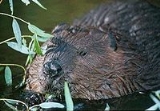
The beaver is a primarily nocturnal, large, semi-aquatic rodent. Castor includes two extant species, North American Beaver and Eurasian Beaver . Beavers are known for building dams, canals, and lodges . They are the second-largest rodent in the world...
and their fossil
Fossil
Fossils are the preserved remains or traces of animals , plants, and other organisms from the remote past...
relatives. This was once a highly diverse group of rodent
Rodent
Rodentia is an order of mammals also known as rodents, characterised by two continuously growing incisors in the upper and lower jaws which must be kept short by gnawing....
s, but is now restricted to a single genus, Castor.
Characteristics
Castorids are medium sized mammals, although large compared with most other rodents. They are semiaquatic, with sleek bodies and webbed hind feet, and are more agile in the water than on land. Their tails are flattened and scaly, adaptations that help them manoeuvre in the water.Castorids live in small family groups that each occupy a specific territory, based around a lodge and dam
Dam
A dam is a barrier that impounds water or underground streams. Dams generally serve the primary purpose of retaining water, while other structures such as floodgates or levees are used to manage or prevent water flow into specific land regions. Hydropower and pumped-storage hydroelectricity are...
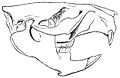
constructed from sticks and mud. They are herbivores, feeding on leaves and grasses in the summer, and woody plants such as willow in the winter. They have powerful incisor
Incisor
Incisors are the first kind of tooth in heterodont mammals. They are located in the premaxilla above and mandible below.-Function:...
s and the typical rodent dental formula
Dentition
Dentition pertains to the development of teeth and their arrangement in the mouth. In particular, the characteristic arrangement, kind, and number of teeth in a given species at a given age...
:
Evolution

Agnotocastor
Agnotocastor is an extinct member of the mammalian family Castoridae. Unlike its modern relative, this species took the place of muskrats in the rivers of North America during the Oligocene epoch....
,known from the late Eocene
Eocene
The Eocene Epoch, lasting from about 56 to 34 million years ago , is a major division of the geologic timescale and the second epoch of the Paleogene Period in the Cenozoic Era. The Eocene spans the time from the end of the Palaeocene Epoch to the beginning of the Oligocene Epoch. The start of the...
and Oligocene
Oligocene
The Oligocene is a geologic epoch of the Paleogene Period and extends from about 34 million to 23 million years before the present . As with other older geologic periods, the rock beds that define the period are well identified but the exact dates of the start and end of the period are slightly...
of North America
North America
North America is a continent wholly within the Northern Hemisphere and almost wholly within the Western Hemisphere. It is also considered a northern subcontinent of the Americas...
and Asia
Asia
Asia is the world's largest and most populous continent, located primarily in the eastern and northern hemispheres. It covers 8.7% of the Earth's total surface area and with approximately 3.879 billion people, it hosts 60% of the world's current human population...
(Rybczynski, 2007). Other early castorids included genera such as Steneofiber
Steneofiber
Steneofiber is an extinct genus of beaver from Eurasia.This small, 30 cm long creature probably lived in large fresh water lakes, like present day beavers. A semiaquatic lifestyle is indicated by the presence of a combing-claw, which living beavers use to waterproof their fur. Most likely, it...
, from the Oligocene and Miocene
Miocene
The Miocene is a geological epoch of the Neogene Period and extends from about . The Miocene was named by Sir Charles Lyell. Its name comes from the Greek words and and means "less recent" because it has 18% fewer modern sea invertebrates than the Pliocene. The Miocene follows the Oligocene...
of Europe, the earliest member of the subfamily Castorinae, which contains castorids closely related to living beavers (Korth, 2002). Their teeth were not well suited to gnawing wood, suggesting that this habit evolved at a later point, but they do appear adapted to semi-aquatic living. Later, such early species evolved into forms such as Palaeocastor
Palaeocastor
Palaeocastor is an extinct genus of beaver that lived in the North American Badlands during the late Oligocene period.-Habitat:...
from the Miocene
Miocene
The Miocene is a geological epoch of the Neogene Period and extends from about . The Miocene was named by Sir Charles Lyell. Its name comes from the Greek words and and means "less recent" because it has 18% fewer modern sea invertebrates than the Pliocene. The Miocene follows the Oligocene...
of Nebraska
Nebraska
Nebraska is a state on the Great Plains of the Midwestern United States. The state's capital is Lincoln and its largest city is Omaha, on the Missouri River....
. Palaeocastor was about the size of a muskrat, and dug corkscrew
Corkscrew
A corkscrew is a kitchen tool for drawing stopping corks from wine bottles. Generally, a corkscrew consists of a pointed metallic helix attached to a handle. The user grips the handle and screws the metal point into the cork, until the helix is firmly embedded, then a vertical pull on the...
-shaped burrows up to 2.5 m (8.2 ft) deep.
Pleistocene
The Pleistocene is the epoch from 2,588,000 to 11,700 years BP that spans the world's recent period of repeated glaciations. The name pleistocene is derived from the Greek and ....
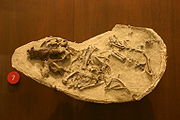
, including Trogontherium in Europe, and Castoroides
Castoroides
Castoroides, or Giant Beaver, is an extinct genus of enormous beavers that lived in North America during the Pleistocene. There are two known species:*Castoroides leiseyorum...
in North America. The latter animal was as large as a black bear
American black bear
The American black bear is a medium-sized bear native to North America. It is the continent's smallest and most common bear species. Black bears are omnivores, with their diets varying greatly depending on season and location. They typically live in largely forested areas, but do leave forests in...
, yet had a brain only marginally larger than that of modern beavers. Its shape suggests that it would have been a good swimmer, and it probably lived in swamp
Swamp
A swamp is a wetland with some flooding of large areas of land by shallow bodies of water. A swamp generally has a large number of hammocks, or dry-land protrusions, covered by aquatic vegetation, or vegetation that tolerates periodical inundation. The two main types of swamp are "true" or swamp...
y habitats (Savage and Long, 1986).
Taxonomy
McKenna and Bell (1997) divided Castoridae into two subfamilies, Castoroidinae and Castorinae. More recent studies (Korth, 2002; Rybczynski, 2007) have recognized two additional subfamilies of basal castorids, Agnotocastorinae and Palaeocastorinae, which is followed here. Within the family, Castorinae and Castoroidinae are sister taxa (Korth, 2002; Rybczynski, 2007); they share a more recent common ancestor with each other than with members of the other two subfamilies. Both subfamilies include semiaquatic species capable of constructing dams (Rybczynski, 2007). Palaeocastorinae includes beavers that are interpreted as fossorialFossorial
A fossorial organism is one that is adapted to digging and life underground such as the badger, the naked mole rat, and the mole salamanders Ambystomatidae...
(burrowing) (Rybczynski, 2007), as are nothodipoidins and Migmacastor
Migmacastor
Migmacastor is an extinct member of the beaver family, Castoridae, known from a single species, Migmacastor procumbodens. Only a single specimen has been reported, a skull from the late Oligocene or early Miocene of Nebraska . Features of the incisor teeth of Migmacastor indicate that they were...
(Korth, 2007b). The following taxonomy is based on Korth (2002, 2007a,b) and Rybczynski (2007), with preference given to the latter where the these differ.
- Family Castoridae
- †MigmacastorMigmacastorMigmacastor is an extinct member of the beaver family, Castoridae, known from a single species, Migmacastor procumbodens. Only a single specimen has been reported, a skull from the late Oligocene or early Miocene of Nebraska . Features of the incisor teeth of Migmacastor indicate that they were...
- Subfamily †Agnotocastorinae (paraphyletic)
- Tribe †Agnotocastorini
- †AgnotocastorAgnotocastorAgnotocastor is an extinct member of the mammalian family Castoridae. Unlike its modern relative, this species took the place of muskrats in the rivers of North America during the Oligocene epoch....
- †Neatocastor
- †Agnotocastor
- Tribe †Anchitheriomyini
- †AnchitheriomysAnchitheriomysAnchitheriomys is an extinct member of the beaver family, Castoridae. Until recently, it was placed in a closely related family of rodents, Eutypomyidae , but have since described a partial skull that shows similarities to another early beaver, Agnotocastor....
- †PropalaeocastorPropalaeocastorPropalaeocastor is a poorly-known extinct genus of beaver from the early Oligocene of Europe and Asia. Recently described material of a new species of Propalaeocastor, P...
- †Oligotheriomys
- †Anchitheriomys
- Tribe †Agnotocastorini
- Subfamily †Palaeocastorinae
- †PalaeocastorPalaeocastorPalaeocastor is an extinct genus of beaver that lived in the North American Badlands during the late Oligocene period.-Habitat:...
- †Capacikala
- †Pseudopalaeocastor
- Tribe †Euhapsini
- †Euhapsis
- †Fossorcastor
- †Palaeocastor
- Subfamily †Castoroidinae
- †Priusaulax (placement in Castoroidinae questionable)
- Tribe †Nothodipoidini
- †Eucastor
- †Microdipoides
- †Nothodipoides
- Tribe †Castoroidini (paraphyletic)
- †Monosaulax
- †Prodipoides
- †Dipoides
- †CastoroidesCastoroidesCastoroides, or Giant Beaver, is an extinct genus of enormous beavers that lived in North America during the Pleistocene. There are two known species:*Castoroides leiseyorum...
- †Procastoroides
- Tribe †Trogontheriini
- †Trogontherium
- †Boreofiber
- †Euroxenomys
- †Youngofiber
- †Asiacastor
- Subfamily Castorinae
- †Chalicomys (also incorrectly "Palaeomys")
- †SteneofiberSteneofiberSteneofiber is an extinct genus of beaver from Eurasia.This small, 30 cm long creature probably lived in large fresh water lakes, like present day beavers. A semiaquatic lifestyle is indicated by the presence of a combing-claw, which living beavers use to waterproof their fur. Most likely, it...
- †Zamolxifiber
- †Romanofiber
- †Schreuderia
- †Sinocastor
- †Hystricops
- Castor - modern beavers
- North American Beaver, Castor canadensis
- European BeaverEuropean BeaverThe Eurasian beaver or European beaver is a species of beaver, which was once widespread in Eurasia, where it was hunted to near extinction both for fur and for castoreum, a secretion of its scent gland believed to have medicinal properties...
, Castor fiber
- †Migmacastor