

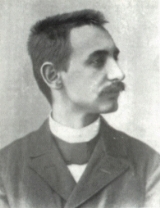
Carl Schlechter

Encyclopedia
Carl Schlechter was a leading Austria
n chess
master and theoretician at the turn of the 20th century. He is best known for drawing
a World Chess Championship
match with Emanuel Lasker
.
. He is sometimes deemed to be Jewish, though others dispute this. He began playing chess at the age of 13. His first and only teacher was an Austria-Hungarian chess problemist, Dr. Samuel Gold
.
From 1893 onwards he played in over 50 international chess tournaments. He won or shared first at Munich
1900 (the 12th DSB Congress
), Coburg
1904 (the 14th DSB Congress), Ostend
1906, Stockholm
1906, in the Vienna 1908 chess tournament
, in the Prague 1908 chess tournament
, in the Hamburg 1910 chess tournament
(the 17th DSB Congress), and thrice in the Trebitsch Memorial in Vienna (1911, 1912, 1913).
He played several matches; drew with Georg Marco
(+0 -0 =10) in 1893, drew with Marco and Adolf Zinkl
, both (+4 -4 =3) in 1894, drew with Dawid Janowski
(+2 -2 =3) in 1896, drew with Simon Alapin (+1 -1 =4) in 1899, beat Janowski (+6 -1 =3) in 1902, drew with Richard Teichmann
(+1 -1 =1) in 1904, and drew with Siegbert Tarrasch
(+3 -3 =10) in 1911.
for the World Chess Championship
(in Vienna and Berlin
). It is now generally accepted that Schlechter needed to score +2 win the match and thus he needed to win the tenth game. But, in the tenth game, tragedy struck: after first achieving a won game, he blundered into a clearly drawn position, and then blundered again which led to the loss of the game for him. The match ended tied at 5-5 (+1 -1 =8) and Lasker retained his title. For details on the match, see World Chess Championship 1910 (Lasker-Schlechter)
. In any case, Schlechter distinguished himself by being the first person in 16 years to seriously threaten to claim Lasker's world title.
, he thrice won Trebitsch Memorial in Vienna. In the last year of his life, he took third in Vienna, lost a match to Akiba Rubinstein
(+1 -2 =3), took second place in Berlin (Quadrangular, Milan Vidmar
won), tied for third place in Kaschau, and took third place in Berlin (Quadrangular, Emanuel Lasker
won). Schlechter died of pneumonia and starvation on 27 December 1918, and was buried in Budapest
on 31 December 1918.
–Hugo Fähndrich
trio propagated the Viennese chess school, founded by Max Weiss
in the 19th century.
Schlechter prepared the eighth and final edition of the famous Handbuch des Schachspiels
openings
treatise
. Published in eleven parts between 1912 and 1916, it totaled 1,040 pages and included contributions by Rudolf Spielmann
, Siegbert Tarrasch
, and Richard Teichmann
. International Master William Hartston
called it "a superb work, perhaps the last to encase successfully the whole of chess knowledge within a single volume."
He was a typical example of a gentleman chess player of old, offering courteous draws
to opponents who felt unwell. If his opponent arrived late for a game, Schlechter would inconspicuously subtract an equal amount of time from his own clock. He also mentored many of his rivals, including Oldřich Duras
.
by Thomas Glavinic
is closely based on Shchlechter. The book presents a fictionalised account of his 1910 World Chess Championship match with Lasker.
Austria
Austria , officially the Republic of Austria , is a landlocked country of roughly 8.4 million people in Central Europe. It is bordered by the Czech Republic and Germany to the north, Slovakia and Hungary to the east, Slovenia and Italy to the south, and Switzerland and Liechtenstein to the...
n chess
Chess
Chess is a two-player board game played on a chessboard, a square-checkered board with 64 squares arranged in an eight-by-eight grid. It is one of the world's most popular games, played by millions of people worldwide at home, in clubs, online, by correspondence, and in tournaments.Each player...
master and theoretician at the turn of the 20th century. He is best known for drawing
Tie (draw)
To tie or draw is to finish a competition with identical or inconclusive results. The word "tie" is usually used in North America for sports such as American football. "Draw" is usually used in the United Kingdom, Ireland and the Commonwealth of Nations and it is usually used for sports such as...
a World Chess Championship
World Chess Championship
The World Chess Championship is played to determine the World Champion in the board game chess. Men and women of any age are eligible to contest this title....
match with Emanuel Lasker
Emanuel Lasker
Emanuel Lasker was a German chess player, mathematician, and philosopher who was World Chess Champion for 27 years...
.
Early life
Schlechter was born into a Catholic family in ViennaVienna
Vienna is the capital and largest city of the Republic of Austria and one of the nine states of Austria. Vienna is Austria's primary city, with a population of about 1.723 million , and is by far the largest city in Austria, as well as its cultural, economic, and political centre...
. He is sometimes deemed to be Jewish, though others dispute this. He began playing chess at the age of 13. His first and only teacher was an Austria-Hungarian chess problemist, Dr. Samuel Gold
Samuel Gold
Samuel Gold was a Hungarian physician, journalist and composer of chess problems.-Biography:...
.
From 1893 onwards he played in over 50 international chess tournaments. He won or shared first at Munich
Munich
Munich The city's motto is "" . Before 2006, it was "Weltstadt mit Herz" . Its native name, , is derived from the Old High German Munichen, meaning "by the monks' place". The city's name derives from the monks of the Benedictine order who founded the city; hence the monk depicted on the city's coat...
1900 (the 12th DSB Congress
DSB Congress
The Deutschen Schachbund had been founded in Leipzig on 18 July 1877. When the next meeting took place in the Schützenhaus on 15 July 1879, sixty-two clubs had become member of the chess federation. Hofrat Rudolf von Gottschall became Chairman and Hermann Zwanziger the General Secretary...
), Coburg
Coburg
Coburg is a town located on the Itz River in Bavaria, Germany. Its 2005 population was 42,015. Long one of the Thuringian states of the Wettin line, it joined with Bavaria by popular vote in 1920...
1904 (the 14th DSB Congress), Ostend
Ostend
Ostend is a Belgian city and municipality located in the Flemish province of West Flanders. It comprises the boroughs of Mariakerke , Stene and Zandvoorde, and the city of Ostend proper – the largest on the Belgian coast....
1906, Stockholm
Stockholm
Stockholm is the capital and the largest city of Sweden and constitutes the most populated urban area in Scandinavia. Stockholm is the most populous city in Sweden, with a population of 851,155 in the municipality , 1.37 million in the urban area , and around 2.1 million in the metropolitan area...
1906, in the Vienna 1908 chess tournament
Vienna 1908 chess tournament
The Internationales Schachturnier Wien 1908 was held in honour of the sixtieth anniversary of Franz Joseph I of Austria’s elevation as monarch to the Austria-Hungary Empire. Twenty great masters played at the Wiener Schach-Club in Vienna, from March 23 to April 17, 1908.The results and standings:...
, in the Prague 1908 chess tournament
Prague 1908 chess tournament
The first International Prague Chess Tournament was held in honour of the sixtieth anniversary of Franz Joseph I of Austria's elevation as monarch to the Austria-Hungary Empire. Twenty great masters played in the pavilion of the Chamber of Commerce and Trade in Prague, from May 17 to June 13,...
, in the Hamburg 1910 chess tournament
Hamburg 1910 chess tournament
The Hamburg 1910 chess tournament was organized by Walter Robinow, the President of the Hamburg Chess Club .-Masters Tournament:Eighteen masters started but Franz Jakob withdrew after round 6....
(the 17th DSB Congress), and thrice in the Trebitsch Memorial in Vienna (1911, 1912, 1913).
He played several matches; drew with Georg Marco
Georg Marco
Georg Marco was a Romanian chess player.He was born in Chernivtsi , Bukovina...
(+0 -0 =10) in 1893, drew with Marco and Adolf Zinkl
Adolf Zinkl
Adolf Julius Zinkl was an Austrian chess master.-Tournament results:Born in Bohemia, he settled in Vienna, where he played in many tournaments in the 1890s...
, both (+4 -4 =3) in 1894, drew with Dawid Janowski
Dawid Janowski
Dawid Markelowicz Janowski was a leading Polish chess master and subsequent French citizen....
(+2 -2 =3) in 1896, drew with Simon Alapin (+1 -1 =4) in 1899, beat Janowski (+6 -1 =3) in 1902, drew with Richard Teichmann
Richard Teichmann
Richard Teichmann was a German chess master.He was known as "Richard the Fifth" because he often finished in fifth place in tournaments. But in Karlsbad 1911, he scored a convincing win, crushing Akiba Rubinstein and Carl Schlechter with the same line of the Ruy Lopez...
(+1 -1 =1) in 1904, and drew with Siegbert Tarrasch
Siegbert Tarrasch
Siegbert Tarrasch was one of the strongest chess players and most influential chess teachers of the late 19th century and early 20th century....
(+3 -3 =10) in 1911.
Lasker-Schlechter match
In 1910 Schlechter played a match against Emanuel LaskerEmanuel Lasker
Emanuel Lasker was a German chess player, mathematician, and philosopher who was World Chess Champion for 27 years...
for the World Chess Championship
World Chess Championship
The World Chess Championship is played to determine the World Champion in the board game chess. Men and women of any age are eligible to contest this title....
(in Vienna and Berlin
Berlin
Berlin is the capital city of Germany and is one of the 16 states of Germany. With a population of 3.45 million people, Berlin is Germany's largest city. It is the second most populous city proper and the seventh most populous urban area in the European Union...
). It is now generally accepted that Schlechter needed to score +2 win the match and thus he needed to win the tenth game. But, in the tenth game, tragedy struck: after first achieving a won game, he blundered into a clearly drawn position, and then blundered again which led to the loss of the game for him. The match ended tied at 5-5 (+1 -1 =8) and Lasker retained his title. For details on the match, see World Chess Championship 1910 (Lasker-Schlechter)
World Chess Championship 1910 (Lasker-Schlechter)
Emanuel Lasker faced Carl Schlechter in the 1910 World Chess Championship. It was played from January 7 to February 10, 1910 in Vienna and Berlin. The match was tied and Lasker retained his title.-Results:Best of 10 games...
. In any case, Schlechter distinguished himself by being the first person in 16 years to seriously threaten to claim Lasker's world title.
Later life
During World War IWorld War I
World War I , which was predominantly called the World War or the Great War from its occurrence until 1939, and the First World War or World War I thereafter, was a major war centred in Europe that began on 28 July 1914 and lasted until 11 November 1918...
, he thrice won Trebitsch Memorial in Vienna. In the last year of his life, he took third in Vienna, lost a match to Akiba Rubinstein
Akiba Rubinstein
Akiba Kiwelowicz Rubinstein was a famous Polish chess Grandmaster at the beginning of the 20th century. He was scheduled to play a match with Emanuel Lasker for the world championship in 1914, but it was cancelled because of the outbreak of World War I...
(+1 -2 =3), took second place in Berlin (Quadrangular, Milan Vidmar
Milan Vidmar
Milan Vidmar was a Slovene electrical engineer, chess player, chess theorist, philosopher, and writer. He was a specialist in power transformers and transmission of electric current.- Biography :...
won), tied for third place in Kaschau, and took third place in Berlin (Quadrangular, Emanuel Lasker
Emanuel Lasker
Emanuel Lasker was a German chess player, mathematician, and philosopher who was World Chess Champion for 27 years...
won). Schlechter died of pneumonia and starvation on 27 December 1918, and was buried in Budapest
Budapest
Budapest is the capital of Hungary. As the largest city of Hungary, it is the country's principal political, cultural, commercial, industrial, and transportation centre. In 2011, Budapest had 1,733,685 inhabitants, down from its 1989 peak of 2,113,645 due to suburbanization. The Budapest Commuter...
on 31 December 1918.
Assessment
The Carl Schlechter–Arthur KaufmannArthur Kaufmann
Arthur Kaufmann was an Austrian chess master.Born in Romania, he lived and played in Vienna. In 1892, he tied for 5-6th , shared 3rd in 1893/94 , twice took 2nd in 1896 and 1897/98, both behind Georg Marco. He drew a match with Marco in 1893.Because of illness, his career was broken for many...
–Hugo Fähndrich
Hugo Fähndrich
Hugo Fähndrich was an Austrian–Hungarian chess master.Born in Hungary, he moved to Vienna. In 19th/20th century, the Viennese chess school, founded by Max Weiss, was propagated by the Carl Schlechter–Arthur Kaufmann–Hugo Fahndrich trio....
trio propagated the Viennese chess school, founded by Max Weiss
Max Weiss
Miksa Weisz was an Austrian chess player born in the Kingdom of Hungary.Weiss was born in Sereď. Moving to Vienna, he studied mathematics and physics at the university, and later taught those subjects....
in the 19th century.
Schlechter prepared the eighth and final edition of the famous Handbuch des Schachspiels
Handbuch des Schachspiels
Handbuch des Schachspiels is a chess book, first published in 1843 by Tassilo von Heydebrand und der Lasa. It was one of the most important opening references for many decades...
openings
Chess opening
A chess opening is the group of initial moves of a chess game. Recognized sequences of opening moves are referred to as openings as initiated by White or defenses, as created in reply by Black. There are many dozens of different openings, and hundreds of named variants. The Oxford Companion to...
treatise
Treatise
A treatise is a formal and systematic written discourse on some subject, generally longer and treating it in greater depth than an essay, and more concerned with investigating or exposing the principles of the subject.-Noteworthy treatises:...
. Published in eleven parts between 1912 and 1916, it totaled 1,040 pages and included contributions by Rudolf Spielmann
Rudolf Spielmann
Rudolf Spielmann was an Austrian-Jewish chess player of the romantic school, and chess writer.-Career:He was a lawyer but never worked as one....
, Siegbert Tarrasch
Siegbert Tarrasch
Siegbert Tarrasch was one of the strongest chess players and most influential chess teachers of the late 19th century and early 20th century....
, and Richard Teichmann
Richard Teichmann
Richard Teichmann was a German chess master.He was known as "Richard the Fifth" because he often finished in fifth place in tournaments. But in Karlsbad 1911, he scored a convincing win, crushing Akiba Rubinstein and Carl Schlechter with the same line of the Ruy Lopez...
. International Master William Hartston
William Hartston
William Roland Hartston is an English chess player who played competitively from 1962 to 1987 with a highest Elo rating of 2515...
called it "a superb work, perhaps the last to encase successfully the whole of chess knowledge within a single volume."
He was a typical example of a gentleman chess player of old, offering courteous draws
Draw by agreement
In chess, a draw by agreement is the outcome of a game due to the agreement of both players to a draw. A player may offer a draw to his opponent at any stage of a game; if the opponent accepts, the game is a draw. The relevant portion of the FIDE laws of chess is article 9.1...
to opponents who felt unwell. If his opponent arrived late for a game, Schlechter would inconspicuously subtract an equal amount of time from his own clock. He also mentored many of his rivals, including Oldřich Duras
Oldrich Duras
Oldřich Duras was a leading Czech chess master of the early 20th century...
.
List of opening variations named after Schlechter
There are several "Schlechter Variations" in the chess openings:- Schlechter Gambit of the Bird's OpeningBird's OpeningBird's Opening is a chess opening characterised by the move:Bird's is a standard but never popular flank opening. White's strategic ideas involve control of the e5-square without occupying it, but his first move is also non-developing and slightly weakens his kingside...
1.f4 e5 2.fxe5 Nc6 - Schlechter Variation of the French DefenceFrench DefenceThe French Defence is a chess opening. It is characterised by the moves:The French has a reputation for solidity and resilience, though it can result in a somewhat cramped game for Black in the early stages...
1.e4 e6 2.d4 d5 3.Bd3 - Schlechter Variation of the Slav Defence 1.d4 d5 2.c4 c6 3.Nf3 Nf6 4.e3 g6 (or via a Grünfeld move-order, 1.d4 Nf6 2.c4 g6 3.Nc3 d5 4.e3 c6)
- Schlechter Variation of the Danish GambitDanish GambitThe Danish Gambit, known as the in German, and the in Dutch, is a chess opening that begins with the moves:...
1.e4 e5 2.d4 dxe5 3.c3 dxc3 4. Bc4 cxb2 5.Bxb2 d5
Notable chess games
- Fried-Schlechter, Vienna 1894, From's Gambit (A02), 0-1 A breezy 14-move win by Schlechter, who sacrifices his queen and mates his opponent's king in the middle of the board.
- Bernhard Fleissig-Schlechter, Vienna 1895, Polish Opening: General (A00), 0-1 One of Schlechter's most famous games, a scintillating win where Black sacrificed both his rooks and both his bishops.
- Schlechter-Steinitz, Cologne 1898 Vienna Game (C28), 1-0 Schlechter routs the former World Champion in 24 moves.
- Schlechter-Meitner, Vienna 1899, Italian Game: Classical Variation. Greco Gambit Moeller-Therkatz Attack (C54), 1-0 An interesting combination in the endgame: White sacrifices his queen, then makes a quiet move with his king - and black is unable to prevent a mate in two moves.
Popular culture
The central character of the 1998 novel Carl Haffner's Love of the DrawCarl Haffner's Love of the Draw
Carl Haffner’s Love of the Draw is a 1998 chess novel by Austrian writer Thomas Glavinic. It was Glavinic's first novel and is about a shy and withdrawn Viennese chess master who in 1910 challenges the World Champion for his title...
by Thomas Glavinic
Thomas Glavinic
Thomas Glavinic is an Austrian writer. With Kathrin Röggla and Daniel Kehlmann, he is among other young Austrian authors being perceived as significantly shaping the literary discussion in Austria.-Life:...
is closely based on Shchlechter. The book presents a fictionalised account of his 1910 World Chess Championship match with Lasker.