


British Commonwealth Occupation Force

Encyclopedia
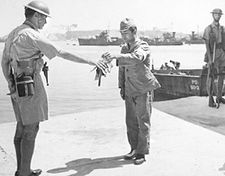
Australia
Australia , officially the Commonwealth of Australia, is a country in the Southern Hemisphere comprising the mainland of the Australian continent, the island of Tasmania, and numerous smaller islands in the Indian and Pacific Oceans. It is the world's sixth-largest country by total area...
n, Canadian, British
United Kingdom
The United Kingdom of Great Britain and Northern IrelandIn the United Kingdom and Dependencies, other languages have been officially recognised as legitimate autochthonous languages under the European Charter for Regional or Minority Languages...
, Indian
British Indian Army
The British Indian Army, officially simply the Indian Army, was the principal army of the British Raj in India before the partition of India in 1947...
and New Zealand
New Zealand
New Zealand is an island country in the south-western Pacific Ocean comprising two main landmasses and numerous smaller islands. The country is situated some east of Australia across the Tasman Sea, and roughly south of the Pacific island nations of New Caledonia, Fiji, and Tonga...
military forces in occupied Japan
Occupied Japan
At the end of World War II, Japan was occupied by the Allied Powers, led by the United States with contributions also from Australia, India, New Zealand and the United Kingdom. This foreign presence marked the first time in its history that the island nation had been occupied by a foreign power...
, from 21 February 1946 until the end of occupation in 1952. At its peak, BCOF comprised about 40,000 personnel, equal to about 25% of the number of US military personnel in Japan.
While US forces were responsible for military government, BCOF was responsible for supervising demilitarisation
Demilitarisation
Demilitarisation or demilitarization is the reduction of a nation's army, weapons, or military vehicles to an agreed minimum. Demilitarisation is usually the result of a peace treaty ending a war or a major conflict....
and the disposal of Japan's war industries.http://www.awm.gov.au/atwar/bcof.htm BCOF was also responsible for occupation of the western prefectures of Shimane
Shimane Prefecture
is a prefecture of Japan located in the Chūgoku region on Honshū island. The capital is Matsue. It is the second least populous prefecture in Japan, after its eastern neighbor Tottori. The prefecture has an area elongated from east to west facing the Chūgoku Mountain Range on the south side and to...
, Yamaguchi
Yamaguchi Prefecture
is a prefecture of Japan in the Chūgoku region on Honshū island. The capital is the city of Yamaguchi, in the center of the prefecture. The largest city, however, is Shimonoseki.- History :...
, Tottori
Tottori Prefecture
is a prefecture of Japan located in the Chūgoku region. The capital is the city of Tottori. It is the least populous prefecture in Japan.- History :Before the Meiji Restoration, Tottori encompassed the old provinces of Hōki and Inaba...
, Okayama
Okayama Prefecture
is a prefecture of Japan located in the Chūgoku region on Honshū island. The capital is the city of Okayama.- History :During the Meiji Restoration, the area of Okayama Prefecture was known as Bitchū Province, Bizen Province and Mimasaka Province.- Geography :...
, Hiroshima
Hiroshima Prefecture
is a prefecture of Japan located in the Chūgoku region on Honshu island. The capital is the city of Hiroshima.- History :The area around Hiroshima was formerly divided into Bingo Province and Aki Province. This location has been a center of trade and culture since the beginning of Japan's recorded...
and Shikoku
Shikoku
is the smallest and least populous of the four main islands of Japan, located south of Honshū and east of the island of Kyūshū. Its ancient names include Iyo-no-futana-shima , Iyo-shima , and Futana-shima...
Island. They were also supported by the Women's Auxiliary Service (Burma)
Women's Auxiliary Service (Burma)
The Women’s Auxiliary Service was formed on January 16, 1942 and disbanded in 1946. The WASs were a group of British and Australian women who manned Mobile Canteens for the troops of Burma Command in World War II...
. BCOF headquarters was at Kure
Kure, Hiroshima
is a city in Hiroshima prefecture, Japan.As of October 1, 2010, the city has an estimated population of 240,820 and a population density of 681 persons per km². The total area is 353.74 km².- History :...
.
For most of the occupation period Australia contributed the majority of the BCOF's personnel. The initial BCOF presence included the Australian 34th Infantry Brigade
Australian 34th Brigade
The Australian 34th Brigade was an Australian Army brigade. The brigade was formed in late 1945 following the end of World War II as part of the Australian contribution to the British Commonwealth Occupation Force in Japan...
, British 5th Infantry Brigade (from 2nd Infantry Division in India), Indian 268th Brigade
268th Indian Infantry Brigade
The 268th Indian Infantry Brigade was an Infantry formation of the Indian Army during World War II. It was formed in October 1942, by the re designation of 268th Indian Armoured Brigade. It was assigned to the 43rd Indian Armoured Division until March 1943. Then the 44th Indian Armoured Division...
and the 2nd New Zealand Expeditionary Force (in J Force
J Force
J Force was the name given to the New Zealand forces that were allocated to the British Commonwealth Occupation Force which occupied Japan following the end of the Second World War...
). Major General David Cowan
David Tennant Cowan
Major General David Tennant Cowan CB, CBE, DSO & Bar, MC , also known as "Punch" Cowan, was an officer in the British Army and British Indian Army in World War I and World War II...
commanded BRINJAP Division from 1945 to 1947. The position of commanding officer was always filled by Australians: Lt Gen. John Northcott
John Northcott
Lieutenant General Sir John Northcott KCMG, KCVO, CB was an Australian Army general who served as Chief of the General Staff during World War II, and commanded the British Commonwealth Occupation Force in the Occupation of Japan...
, February to June 1946; Lt Gen. Horace Robertson
Horace Robertson
Lieutenant General Sir Horace Clement Hugh Robertson KBE, DSO was a senior officer in the Australian Army who served in the First World War, the Second World War and the Korean War...
, June 1946 to November 1951, and; Lt Gen. William Bridgeford
William Bridgeford
Lieutenant General Sir William Bridgeford KBE, CB, MC was a senior officer in the Australian Army. He began his military career in 1913 and fought on the Western Front during the First World War, before rising to command the 3rd Infantry Division during the Bougainville campaign in the Second...
from November 1951 until the end of the occupation.
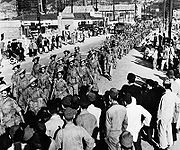
British Pacific Fleet
The British Pacific Fleet was a British Commonwealth naval force which saw action against Japan during World War II. The fleet was composed of British Commonwealth naval vessels. The BPF formally came into being on 22 November 1944...
initially provided most of the naval forces. The air contingent, known as BCAIR, initially comprised the Royal Australian Air Force
Royal Australian Air Force
The Royal Australian Air Force is the air force branch of the Australian Defence Force. The RAAF was formed in March 1921. It continues the traditions of the Australian Flying Corps , which was formed on 22 October 1912. The RAAF has taken part in many of the 20th century's major conflicts...
No. 81 Fighter Wing
No. 81 Wing RAAF
No. 81 Wing is the Royal Australian Air Force's air superiority wing. Formed during World War II, it operated in the South West Pacific theatre, flying P-40 Kittyhawks. Following the end of hostilities, it converted to P-51 Mustangs and was based in Japan as part of the Allied occupational forces...
, flying P-51 Mustangs, four Spitfire
Supermarine Spitfire
The Supermarine Spitfire is a British single-seat fighter aircraft that was used by the Royal Air Force and many other Allied countries throughout the Second World War. The Spitfire continued to be used as a front line fighter and in secondary roles into the 1950s...
squadrons (including No. 11 and No. 17 of the Royal Air Force
Royal Air Force
The Royal Air Force is the aerial warfare service branch of the British Armed Forces. Formed on 1 April 1918, it is the oldest independent air force in the world...
and No. 4
No. 4 Squadron, Indian Air Force
No. 4 Squadron, Indian Air Force , formed at Peshawar on 1 February 1942 under the command of Squadron Leader HU 'Bulbul' Khan, was the third Indian Air Force Squadron to be equipped with the Westland Lysander Army Co-operation aircraft...
of the Indian Air Force
Indian Air Force
The Indian Air Force is the air arm of the Indian armed forces. Its primary responsibility is to secure Indian airspace and to conduct aerial warfare during a conflict...
), and No. 14 squadron
No. 14 Squadron RNZAF
14 Squadron RNZAF was a squadron of the Royal New Zealand Air Force.- New Zealand fighters before 1941 :Until World War II, New Zealand's air force concentrated on training, transport and maritime attack. The vast distance of the Pacific Ocean seemed a defence against attack by air...
of the Royal New Zealand Air Force
Royal New Zealand Air Force
The Royal New Zealand Air Force is the air arm of the New Zealand Defence Force...
flying F4U Corsair.
During 1947, the BCOF began to wind down its presence in Japan. However, BCOF bases provided staging posts for Commonwealth forces deployed to the Korean War
Korean War
The Korean War was a conventional war between South Korea, supported by the United Nations, and North Korea, supported by the People's Republic of China , with military material aid from the Soviet Union...
, from 1949 onwards. BCOF was effectively wound-up in 1951, as control of Commonwealth forces in Japan was transferred to British Commonwealth Forces Korea
British Commonwealth Forces Korea
British Commonwealth Forces Korea was the formal name, from 1952, of the Commonwealth army, naval and air units serving with the United Nations in the Korean War. Australian, British, Canadian, Indian and New Zealand units were part of BCFK...
.