


Bishop of Dunblane

Encyclopedia
Diocese
A diocese is the district or see under the supervision of a bishop. It is divided into parishes.An archdiocese is more significant than a diocese. An archdiocese is presided over by an archbishop whose see may have or had importance due to size or historical significance...
of Dunblane
Dunblane
Dunblane is a small cathedral city and former burgh north of Stirling in the Stirling council area of Scotland. The town is situated off the A9 road, on the way north to Perth. Its main landmark is Dunblane Cathedral and the Allan Water runs through the town centre, with the Cathedral and the High...
/Strathearn
Strathearn
Strathearn or Strath Earn is the strath of the River Earn, in Scotland. It extends from Loch Earn in Perth and Kinross to the River Tay....
, one of medieval Scotland
Scotland
Scotland is a country that is part of the United Kingdom. Occupying the northern third of the island of Great Britain, it shares a border with England to the south and is bounded by the North Sea to the east, the Atlantic Ocean to the north and west, and the North Channel and Irish Sea to the...
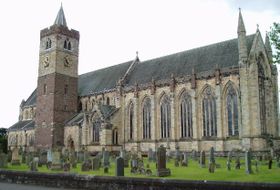
's thirteen bishoprics. It was based at Dunblane Cathedral
Dunblane Cathedral
Dunblane Cathedral is the larger of the two Church of Scotland parish churches serving Dunblane, near the city of Stirling, in central Scotland.-History:...
, now a parish church
Parish church
A parish church , in Christianity, is the church which acts as the religious centre of a parish, the basic administrative unit of episcopal churches....
of the Church of Scotland
Church of Scotland
The Church of Scotland, known informally by its Scots language name, the Kirk, is a Presbyterian church, decisively shaped by the Scottish Reformation....
. The bishopric itself certainly derives from an older Gaelic
Gaels
The Gaels or Goidels are speakers of one of the Goidelic Celtic languages: Irish, Scottish Gaelic, and Manx. Goidelic speech originated in Ireland and subsequently spread to western and northern Scotland and the Isle of Man....
Christian community. According to legend, the Christian community of Dunblane was derived from the mission of St. Bláán
Saint Blane
Saint Blane was a Bishop and Confessor in Scotland, born on the Isle of Bute, date unknown; died 590. His feast is kept on 10 August. He was a nephew of St. Cathan, and was educated in Ireland under Sts. Comgall and Kenneth; he became a monk, went to Scotland, and was eventually bishop among the...
, a saint originally associated with the monastery
Monastery
Monastery denotes the building, or complex of buildings, that houses a room reserved for prayer as well as the domestic quarters and workplace of monastics, whether monks or nuns, and whether living in community or alone .Monasteries may vary greatly in size – a small dwelling accommodating only...
of Cenn Garath (Kingarth
Kingarth
Kingarth is a historic village and parish on the Isle of Bute, off the coast of south-western Scotland. In the Early Middle Ages it was the site of a monastery and bishopric and the cult centre of Saints Cathan and Bláán ....
) on the Isle of Bute
Isle of Bute
Bute is an island in the Firth of Clyde in Scotland. Formerly part of the county of Buteshire, it now constitutes part of the council area of Argyll and Bute. Its resident population was 7,228 in April 2001.-Geography:...
. Although the bishopric had its origins in the 1150s or before, the cathedral was not build nor was the seat (cathedra) of the diocese fixed at Dunblane until the episcopate of Clement
Clement of Dunblane
Clement was a 13th century Dominican friar who was the first member of the Dominican Order in Britain and Ireland to become a bishop. In 1233, he was selected to lead the ailing diocese of Dunblane in Scotland, and faced a struggle to bring the bishopric of Dunblane to financial viability...
.
The Bishopric's links with Rome ceased to exist after the Scottish Reformation
Scottish Reformation
The Scottish Reformation was Scotland's formal break with the Papacy in 1560, and the events surrounding this. It was part of the wider European Protestant Reformation; and in Scotland's case culminated ecclesiastically in the re-establishment of the church along Reformed lines, and politically in...
, but continued, saving temporary abolition between 1638 and 1661, under the episcopal Church of Scotland
Church of Scotland
The Church of Scotland, known informally by its Scots language name, the Kirk, is a Presbyterian church, decisively shaped by the Scottish Reformation....
until the Revolution of 1688. Episcopacy in the established church in Scotland was permanently abolished in 1689.
List of bishops of Dunblane
| Tenure | Incumbent | Notes |
|---|---|---|
| fl. 1155 | M. de Dunblan M. de Dunblan M. de Dunblan is the way the first known Bishop of Dunblane is written in a copy of a papal bull of Pope Adrian IV preserved in England; the bull dates to 1155.... |
|
| 1155 x 1161-1165 x 1178 | Laurence of Dunblane Laurence of Dunblane Laurence [or Laurentius] is the first Bishop of Dunblane to be known by name. A document dating to 27 February 1155, had an M. de Dunblan, but no more is known of this man and it is unlikely that M. is a mistake for La..... |
|
| 1168 x 1178–1194 x 1198 | Simon of Dunblane Simon of Dunblane Simon is the third known 12th century Bishop of Dunblane. Nothing is known of Simon's background; there are numerous Simons in Scotland in this period, both native and foreign... |
|
| 1195 x 1198-1210 | Jonathan of Dunblane Jonathan of Dunblane Jonathan was a was churchman and prelate active in late twelfth- and early thirteenth century Strathearn, in the Kingdom of Scotland... |
|
| 1210 x 1214–1220 x 1225 | Abraham of Strathearn Abraham of Strathearn Abraham was an early 13th century Scottish cleric who held the position of Bishop of Dunblane. He was a chaplain to the Mormaer of Strathearn, Gille Brígte.... |
|
| 1223 x 1225-1226 | Radulf (bishop-elect) | Elect only. |
| 1226 x 1227-1231 | Osbert of Dunblane Osbert of Dunblane Osbert was an early 13th century cleric who held the position of Bishop of Dunblane . A mandate for a new election was issued in January 1226 after the presumed resignation of Osbert's predecessor Radulf. Osbert's name appears in the cartulary of Cambuskenneth Abbey, dating 1227 x 1231, where he... |
|
| 1233-1258 | Clement of Dunblane Clement of Dunblane Clement was a 13th century Dominican friar who was the first member of the Dominican Order in Britain and Ireland to become a bishop. In 1233, he was selected to lead the ailing diocese of Dunblane in Scotland, and faced a struggle to bring the bishopric of Dunblane to financial viability... |
|
| 1258 x 1259-1284 | Robert de Prebenda Robert de Prebenda Robert de Prebenda was a 13th century Anglo-French cleric who held the position of Bishop of Dunblane, Scotland.... |
|
| 1284-1291 x 1296 | William | |
| 1295 x 1296-1300 x 1301 | Alpín of Strathearn Alpín of Strathearn Alpín of Strathearn was late 13th century Scottish prelate and graduate of the University of Bologna. The description of him as being of "noble birth" and his appellation de Stratherne indicate he was probably from the kin-group of the mormaers of Strathearn... |
|
| 1301-1306 x 1307 | Nicholas of Arbroath Nicholas of Arbroath Nicholas O. Tiron , Abbot of Arbroath and Bishop of Dunblane, was a late 13th century and early 14th century churchman in the Kingdom of Scotland... |
Nicholas was previously Abbot of Arbroath Arbroath Arbroath or Aberbrothock is a former royal burgh and the largest town in the council area of Angus in Scotland, and has a population of 22,785... . |
| 1307-1319 x 1320 | Nicholas de Balmyle Nicholas de Balmyle Nicholas de Balmyle , also called Nicholas of St Andrews, was a Scottish administrator and prelate in the late 13th century and early 14th century... |
|
| 1295 x 1296-1300 x 1301 | Richard de Pontefract Richard de Pontefract Richard de Pontefract O. P. was an English Dominican friar active during the reign King Edward II. On June 25, 1320, King Edward petitioned the papacy for Richard to filled the see of Dunblane, vacant by the death of Nicholas de Balmyle... |
Nominated by Edward I of England Edward I of England Edward I , also known as Edward Longshanks and the Hammer of the Scots, was King of England from 1272 to 1307. The first son of Henry III, Edward was involved early in the political intrigues of his father's reign, which included an outright rebellion by the English barons... to Papacy. Nomination unsuccessful. |
| 1319 x 1322 | Roger de Balnebrich Roger de Balnebrich Roger de Balnebrich [de Balnebrech, de Balnebriech, de Ballinbreth] was a 14th century Scottish churchman. Roger received a university education, being styled Magister by August 1313, though it is not known where he took his degree; the degree, however, was almost certainly done in canon law... |
The cathedral chapter was divided on the successor of Nicolas de Balmyle; a long litigation between Roger and Maurice, Abbot of Inchaffray, took place at the Papal court, which resulted in the consecration of Maurice. |
| 1319 x 1322-1347 | Maurice of Inchaffray Maurice of Inchaffray Maurice was a 14th century Scottish cleric who became Prior of Inchmahome, Abbot of Inchaffray and then Bishop of Dunblane. He was Prior of Inchmahome Priory in Menteith after 1297. He became abbot of Inchaffray Abbey in Strathearn between March 1304 and October 1305... |
Previously Abbot of Inchaffray Abbot of Inchaffray The Abbot of Inchaffray, before 1221 Prior of Inchaffray, and then by the end of the 15th century, the Commendator of Inchaffray, was the head of the community of Augustinian canons of Inchaffray Abbey and their lands. Inchaffray is in Strathearn, in southern Perthshire, Scotland... . |
| 1347-1361 | William de Cambuslang William de Cambuslang William de Cambuslang was a 14th century Scottish churchman, presumably coming from a family based at or originating from Cambuslang near Glasgow.... |
|
| 1361-1371 x 1372 | Walter de Coventre Walter de Coventre Walter de Coventre was a 14th-century Scottish ecclesiastic. There is no direct evidence of his birthdate, his family, or his family's origin, although he may have come from the region around Abernethy , where a family with the name de Coventre is known to have lived... |
|
| 1372-1373 | Andrew Magnus Andrew Magnus Andrew Magnus was a 14th-century Scottish prelate. Of unknown background, he is recorded for the first time in a document dating to November 28, 1365, holding the position of Archdeacon of Dunblane... |
|
| 1380-1403 | Dúghall of Lorne | |
| 1403-1419 | Fionnlagh MacCailein Fionnlagh MacCailein Fionnlagh MacCailein or Finlay Colini was a medieval Scottish bishop. Both his early life and the details of his career as Bishop of Dunblane are not well known, however it is known that he held the latter bishopric between 1403 and his death in 1419... |
|
| 1419-1428 x 1429 | William Stephani William Stephani William Stephen, sometimes William Stephani [probably Stephenson], was a medieval prelate based in Scotland, who became Bishop of Orkney and then Bishop of Dunblane. A reader in divinity at the University of St Andrews at its first establishment, he was provided by Avignon Pope Benedict XIII as... |
Previously Bishop of Orkney Bishop of Orkney The Bishop of Orkney was the ecclesiastical head of the Diocese of Orkney, one of thirteen medieval bishoprics within the territory of modern Scotland. It included both Orkney and Shetland. It was based for almost all of its history at St... . |
| 1429-1446 | Michael Ochiltree Michael Ochiltree Michael Ochiltree [Ouchtre] was a 15th century Scottish prelate and administrator. A close associate of King James I of Scotland, from the late 1410s he rose in rank from canon to Dean of Dunblane and then Bishop of Dunblane... |
|
| 1446 x 1447 | Walter Stewart | Elected, but not conferred. |
| 1447-1466 | Robert Lauder Robert Lauder Robert Lauder, M.A., Bachelor of Canon Law , was a Scottish prelate and Nuncio of the 15th century. The Lauder family produced a large number of senior churchman in this period, and alongside Robert can be named William Lauder, Bishop of Glasgow, Alexander Lauder and Thomas Lauder, both... |
|
| 1466-1485 x 1487 | John Herspolz John Herspolz John Herspolz [also John Hepburn] was a 15th century Bishop of Dunblane. On the day of the resignation of the bishopric of Dunblane by Robert Lauder at the papal curia - September 12, 1466 - Pope Paul II provided Herspolz as Lauder's successor.Herpolz's strange name suggests that he was not... |
|
| x 1467 | John Spalding | Failed crown nomination. |
| 1487-1526 | James Chisholm James Chisholm James Chisholm , Bishop of Dunblane, was the eldest son of Edmund Chisholm, the first Chisholm to own the estate of Cromlix in Dunblane parish, Strathearn, having moved from the Scottish Borders... |
Resigned title but not fruits, and kept a right of return to bishopric. He died in late 1545 or early 1546. |
| 1526-1564 | William Chisholm William Chisholm (d. 1564) William Chisholm , bishop of Dunblane, was the second son of Edmund Chisholm of Cromlix, near Dunblane, a son of Chisholm of that ilk in Roxburghshire, and half-brother of James Chisholm, who was bishop of Dunblane from 1486 to 1527, when he resigned his see, with the consent of Pope Clement VII... (uncle) |
|
| 1564-1569 | William Chisholm William Chisholm (d. 1593) William Chisholm II , bishop of Dunblane and bishop of Vaison, was a son of Chisholm of Cromlix, and nephew to William Chisholm I, bishop of Dunblane from 1527 to 1564, to whom he was appointed coadjutor by a brief of Pope Pius IV dated 1 June 1561.... (newphew) |
Coadjutor since 1561. Deposed in 1569. Rehabilitated as bishop between 18 March 1587, and 27 May 1589, when the rehabilitation was annulled. |
| 1573 x 1575-1603 | Andrew Graham | |
| 1603-1615 | George Graham George Graham (bishop) George Graeme , Bishop of Dunblane and Bishop of Orkney, was a late sixteenth- and early seventeenth century Church of Scotland prelate. He was the younger son of George Graeme of Inchbrakie and Marion/Mary Rollo, daughter of Rollo of Duncrub... |
Translated to Bishoric of Orkney Bishop of Orkney The Bishop of Orkney was the ecclesiastical head of the Diocese of Orkney, one of thirteen medieval bishoprics within the territory of modern Scotland. It included both Orkney and Shetland. It was based for almost all of its history at St... . |
| 1615-1635 | Adam Bellenden Adam Bellenden Adam Bellenden was a 17th century Scottish churchman.He was the son of Sir John Bellenden of Auchnoul, Lord Justice Clerk, by his spouse Jane, daughter of Walter Seton of Touch.... |
Translated to Bishoric of Aberdeen Bishop of Aberdeen The Bishop of Aberdeen was the ecclesiastical head of the Diocese of Aberdeen, one of Scotland's 13 medieval bishoprics, whose first recorded bishop is an early 12th century cleric named Nechtan... . |
| 1636-1638 | James Wedderburn James Wedderburn (bishop) James Wedderburn , bishop of Dunblane, was the second son of John Wedderburn, a mariner and shipowner from Dundee, and Margaret Lindsay. James Wedderburn , a playwright and early Scottish proponent of Protestantism, was his grandfather.... |
13 December 1638, episcopacy outlawed in Scotland and all bishops deprived of their sees. This was in effect until the Restoration of 1661. |
| 1661-1671 | Robert Leighton | Became Archbishop of Glasgow Archbishop of Glasgow The Bishop of Glasgow, from 1492 Archbishop of Glasgow, was the ecclesiastical head of the Diocese of Glasgow and then, as Archbishop of Glasgow, the Archdiocese of Glasgow... in October 1671. |
| 1673-1684 | James Ramsay James Ramsay (bishop) James Ramsay , bishop of Dunblane, bishop of Ross, was son of Robert Ramsay . The latter was successively minister of Dundonald , of Blackfriars or College Church, Glasgow , and of the High Church , Glasgow ; was dean of the faculty of Glasgow University 1646 and 1650–1, rector in 1648, and... |
Translated to the Bishopric of Ross Bishop of Ross The Bishop of Ross was the ecclesiastical head of the Diocese of Ross, one of Scotland's 13 medieval bishoprics. The first recorded bishop appears in the late 7th century as a witness to Adomnán of Iona's Cáin Adomnáin. The bishopric was based at the settlement of Rosemarkie until the mid-13th... ., April 1684. |
| 1684-1689 | Robert Douglas Robert Douglas (bishop) Robert Douglas was a seventeenth- and early eighteenth Scottish churchman. Son of Robert Douglas of Kinmonth, a relative of the Earls of Angus, he was educated at King's College, Aberdeen, before beginning life as a preacher around 1650... |
Deprived of bishopric when episcopacy was permanently abolished in the Church of Scotland Church of Scotland The Church of Scotland, known informally by its Scots language name, the Kirk, is a Presbyterian church, decisively shaped by the Scottish Reformation.... following the Glorious Revolution Glorious Revolution The Glorious Revolution, also called the Revolution of 1688, is the overthrow of King James II of England by a union of English Parliamentarians with the Dutch stadtholder William III of Orange-Nassau... . |