

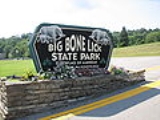
Big Bone Lick State Park

Encyclopedia
Big Bone Lick State Park is located at Big Bone
in Boone County, Kentucky
. It is located on Beaver Road and between the communities of Beaverlick
and Rabbit Hash. The name of the park comes from the Pleistocene
megafauna
fossil
s found there. The mammoth
s and other creatures are believed to have been drawn to this location by a salt lick
. It bills itself as "the birthplace of American paleontology
" a term which dates from the 1807 expedition by William Clark and his brother General
George Rogers Clark
.
In 2002, the National Park Service
designated Big Bone Lick State Park as an official Lewis and Clark Heritage Trail Site. The Park was also listed in 1972 on the National Register of Historic Places
, and was further listed as a National Natural Landmark
in February 2009.
and a 1,000 pound
mastodon
skull as well as a gift shop.
The park also features several nature trails, including the Outdoor Museum with Discovery Trail that includes a boardwalk around a marsh bog
diorama with recreations of a woolly mammoth
, a mastodon
, a ground sloth
, bison
, and scavengers feeding on carcasses and skeletal remains. The Discovery Trail winds through several habitats, including grassland
, wetland
and savanna
, and is accessible to the physically challenged.
A small bison
herd is also maintained on-site.
Big Bone, Kentucky
Big Bone is an unincorporated community in southern Boone County, Kentucky, United States. It is bounded on the west by the Ohio River, and Rabbit Hash, on the south by Big Bone Creek, which empties into the river at Big Bone Landing. The northern extent is along Hathaway Road, and the eastern...
in Boone County, Kentucky
Boone County, Kentucky
Boone County is a county located in the U.S. state of Kentucky. It was formed in 1798. The population was 118,811 in the 2010 Census. Its county seat is Burlington. The county is named for frontiersman Daniel Boone...
. It is located on Beaver Road and between the communities of Beaverlick
Beaverlick, Kentucky
Beaverlick is an unincorporated community in Boone County, Kentucky, United States. Beaverlick is located along U.S. Route 42 and U.S. Route 127 west of Walton....
and Rabbit Hash. The name of the park comes from the Pleistocene
Pleistocene
The Pleistocene is the epoch from 2,588,000 to 11,700 years BP that spans the world's recent period of repeated glaciations. The name pleistocene is derived from the Greek and ....
megafauna
Megafauna
In terrestrial zoology, megafauna are "giant", "very large" or "large" animals. The most common thresholds used are or...
fossil
Fossil
Fossils are the preserved remains or traces of animals , plants, and other organisms from the remote past...
s found there. The mammoth
Mammoth
A mammoth is any species of the extinct genus Mammuthus. These proboscideans are members of Elephantidae, the family of elephants and mammoths, and close relatives of modern elephants. They were often equipped with long curved tusks and, in northern species, a covering of long hair...
s and other creatures are believed to have been drawn to this location by a salt lick
Salt lick
A mineral lick is a natural mineral deposit where animals in nutrient-poor ecosystems can obtain essential mineral nutrients...
. It bills itself as "the birthplace of American paleontology
Paleontology
Paleontology "old, ancient", ὄν, ὀντ- "being, creature", and λόγος "speech, thought") is the study of prehistoric life. It includes the study of fossils to determine organisms' evolution and interactions with each other and their environments...
" a term which dates from the 1807 expedition by William Clark and his brother General
General
A general officer is an officer of high military rank, usually in the army, and in some nations, the air force. The term is widely used by many nations of the world, and when a country uses a different term, there is an equivalent title given....
George Rogers Clark
George Rogers Clark
George Rogers Clark was a soldier from Virginia and the highest ranking American military officer on the northwestern frontier during the American Revolutionary War. He served as leader of the Kentucky militia throughout much of the war...
.
In 2002, the National Park Service
National Park Service
The National Park Service is the U.S. federal agency that manages all national parks, many national monuments, and other conservation and historical properties with various title designations...
designated Big Bone Lick State Park as an official Lewis and Clark Heritage Trail Site. The Park was also listed in 1972 on the National Register of Historic Places
National Register of Historic Places
The National Register of Historic Places is the United States government's official list of districts, sites, buildings, structures, and objects deemed worthy of preservation...
, and was further listed as a National Natural Landmark
National Natural Landmark
The National Natural Landmark program recognizes and encourages the conservation of outstanding examples of the natural history of the United States. It is the only natural areas program of national scope that identifies and recognizes the best examples of biological and geological features in...
in February 2009.
Attractions
A new visitor's center was officially opened on November 18, 2004, but this was only the first stage of a much larger project now in quest of funding. The museum center features fossils, American artAmerican Art
American Art is the debut album of the band Weatherbox. It was released on May 8, 2007 on Doghouse Records. The album received critical acclaim from several sources including underground music distribution company Smartpunk, who lauded the band's style:...
and a 1,000 pound
Pound (mass)
The pound or pound-mass is a unit of mass used in the Imperial, United States customary and other systems of measurement...
mastodon
Mastodon
Mastodons were large tusked mammal species of the extinct genus Mammut which inhabited Asia, Africa, Europe, North America and Central America from the Oligocene through Pleistocene, 33.9 mya to 11,000 years ago. The American mastodon is the most recent and best known species of the group...
skull as well as a gift shop.
The park also features several nature trails, including the Outdoor Museum with Discovery Trail that includes a boardwalk around a marsh bog
Bog
A bog, quagmire or mire is a wetland that accumulates acidic peat, a deposit of dead plant material—often mosses or, in Arctic climates, lichens....
diorama with recreations of a woolly mammoth
Woolly mammoth
The woolly mammoth , also called the tundra mammoth, is a species of mammoth. This animal is known from bones and frozen carcasses from northern North America and northern Eurasia with the best preserved carcasses in Siberia...
, a mastodon
Mastodon
Mastodons were large tusked mammal species of the extinct genus Mammut which inhabited Asia, Africa, Europe, North America and Central America from the Oligocene through Pleistocene, 33.9 mya to 11,000 years ago. The American mastodon is the most recent and best known species of the group...
, a ground sloth
Ground sloth
Ground sloths are a diverse group of extinct sloths, in the mammalian superorder Xenarthra. Their most recent survivors lived in the Antilles, where it has been proposed they may have survived until 1550 CE; however, the youngest AMS radiocarbon date reported is 4190 BP, calibrated to c. 4700 BP...
, bison
Bison
Members of the genus Bison are large, even-toed ungulates within the subfamily Bovinae. Two extant and four extinct species are recognized...
, and scavengers feeding on carcasses and skeletal remains. The Discovery Trail winds through several habitats, including grassland
Grassland
Grasslands are areas where the vegetation is dominated by grasses and other herbaceous plants . However, sedge and rush families can also be found. Grasslands occur naturally on all continents except Antarctica...
, wetland
Wetland
A wetland is an area of land whose soil is saturated with water either permanently or seasonally. Wetlands are categorised by their characteristic vegetation, which is adapted to these unique soil conditions....
and savanna
Savanna
A savanna, or savannah, is a grassland ecosystem characterized by the trees being sufficiently small or widely spaced so that the canopy does not close. The open canopy allows sufficient light to reach the ground to support an unbroken herbaceous layer consisting primarily of C4 grasses.Some...
, and is accessible to the physically challenged.
A small bison
Bison
Members of the genus Bison are large, even-toed ungulates within the subfamily Bovinae. Two extant and four extinct species are recognized...
herd is also maintained on-site.