

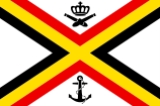
Belgian Navy

Encyclopedia
The Marine Component of the Belgian Army
, formerly the Belgian Naval Force, is the naval
service of Belgium
.
When after the Belgian Revolution
, the country became independent in 1830, a Dutch squadron blocked the Scheldt
estuarium
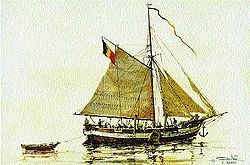
. To deal with this threat the Belgian Congress ordered two brigantine
s to be built, which bore the names Congrès and Les Quatre Journées. After the French army, led by Marshal of France
Etienne Gérard
, captured the citadel of Antwerp in 1832, the captured Dutch gun boats were pressed into Belgian service. In 1840 the Belgian government bought the schooner
Louise Marie and in 1845 the brig
Duc de Brabant. In 1865, the Belgian government discarded its navy and pursued a minimalistic naval policy. This meant that at the outbreak of World War I
, Belgium had no navy.
 The War caused this policy to change and in 1917 a Corps of Destroyers and Sailors was created. The Belgian naval personnel served onboard French mine sweepers and provided the artillerymen for Belgian merchant ships. The Treaty of Versailles
allocated Belgium 11 torpedo boats and 26 mine sweepers. Because of budgetary reasons, Belgium again abolished its navy. In 1939, against the looming threat of a new war with Germany, Belgium once again resurrected its navy as the Naval Corps. This new navy lasted barely a year until the German invasion of May 1940.
During World War II
many members of this naval corps, together with Belgian fishermen and merchant sailors escaped to England with the explicit wish of fighting the German occupiers. The Royal Navy took advantage of this opportunity to enlist the Belgians into separate groups of more or less entirely Belgian-manned ships. From 1940 to 1946, the Belgian Section of the British Royal Navy manned two corvettes, (Buttercup and Godetia), a squadron of MMS mine sweepers and three patrol boats (Phrontis, Electra and Kernot). In 1946, Britain generously donated the ships (along with its crews) to Belgium to become the backbone of the new Belgian Navy.
caused the Belgian government to restructure the Belgian Armed Forces in order to cope with the changed threats. This meant cutbacks and crimping the Armed Forces. With regards to the Belgian navy these cutbacks meant that one Wielingen class frigate was stricken and that three Tripartite class minehunters were sold to France
. In 2002, the government decided to impose a "single structure" on the armed forces in which the independent Belgian Navy ceased to exist. The former Navy became the Belgium Naval Component (COMOPSNAV) of the Armed Forces; it is also called the Marine.
On July 20, 2005, the Belgian government decided to buy two of the remaining six Dutch M-class
frigates to replace the two remaining frigates of the Wielingen class
(Wielingen and Westdiep) currently still in service with the Belgian Navy, which in turn might be sold to Bulgaria
. On December 21, 2005, the Dutch government sold the Karel Doorman (F827) and Willem Van Der Zaan (F829) to Belgium. The two ships were sold for about 250 million Euros. These two M-class frigates entered service with the Belgian Navy where they were renamed Leopold I and Louise-Marie .
In October 2005, the Wielingen class frigate Wandelaar was officially handed over to the Bulgarian Navy
, which christened it as the Drăzki ('The Bolds'). The country's government plans to put an order for a second ship of the Wandelaar class together with a minesweeper, both second-hand.
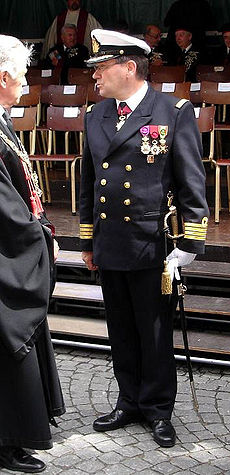
The current Commander of the Naval Component is Divisional Admiral
Jean-Paul Robyns.
In times of peace the Belgian Navy has the following roles:
in the Naval Component:
Military of Belgium
The Belgian Army is the national military of Belgium. The Belgian Army was established after Belgium became independent in October 1830...
, formerly the Belgian Naval Force, is the naval
Navy
A navy is the branch of a nation's armed forces principally designated for naval and amphibious warfare; namely, lake- or ocean-borne combat operations and related functions...
service of Belgium
Belgium
Belgium , officially the Kingdom of Belgium, is a federal state in Western Europe. It is a founding member of the European Union and hosts the EU's headquarters, and those of several other major international organisations such as NATO.Belgium is also a member of, or affiliated to, many...
.
Early history
The Belgian Navy was created as the Marine Royale in 1831. This force has operated in various forms throughout Belgian history.When after the Belgian Revolution
Belgian Revolution
The Belgian Revolution was the conflict which led to the secession of the Southern provinces from the United Kingdom of the Netherlands and established an independent Kingdom of Belgium....
, the country became independent in 1830, a Dutch squadron blocked the Scheldt
Scheldt
The Scheldt is a 350 km long river in northern France, western Belgium and the southwestern part of the Netherlands...
estuarium
Estuary
An estuary is a partly enclosed coastal body of water with one or more rivers or streams flowing into it, and with a free connection to the open sea....
. To deal with this threat the Belgian Congress ordered two brigantine
Brigantine
In sailing, a brigantine or hermaphrodite brig is a vessel with two masts, only the forward of which is square rigged.-Origins of the term:...
s to be built, which bore the names Congrès and Les Quatre Journées. After the French army, led by Marshal of France
Marshal of France
The Marshal of France is a military distinction in contemporary France, not a military rank. It is granted to generals for exceptional achievements...
Etienne Gérard
Étienne Maurice Gérard
Étienne Maurice Gérard, comte Gérard was a French general and statesman. He served under a succession of French governments including the ancien regime monarchy, the Revolutionary governments, the Restorations, the July Monarchy, the First and Second Republics, and the First Empire , becoming...
, captured the citadel of Antwerp in 1832, the captured Dutch gun boats were pressed into Belgian service. In 1840 the Belgian government bought the schooner
Schooner
A schooner is a type of sailing vessel characterized by the use of fore-and-aft sails on two or more masts with the forward mast being no taller than the rear masts....
Louise Marie and in 1845 the brig
Brig
A brig is a sailing vessel with two square-rigged masts. During the Age of Sail, brigs were seen as fast and manoeuvrable and were used as both naval warships and merchant vessels. They were especially popular in the 18th and early 19th centuries...
Duc de Brabant. In 1865, the Belgian government discarded its navy and pursued a minimalistic naval policy. This meant that at the outbreak of World War I
World War I
World War I , which was predominantly called the World War or the Great War from its occurrence until 1939, and the First World War or World War I thereafter, was a major war centred in Europe that began on 28 July 1914 and lasted until 11 November 1918...
, Belgium had no navy.
Treaty of Versailles
The Treaty of Versailles was one of the peace treaties at the end of World War I. It ended the state of war between Germany and the Allied Powers. It was signed on 28 June 1919, exactly five years after the assassination of Archduke Franz Ferdinand. The other Central Powers on the German side of...
allocated Belgium 11 torpedo boats and 26 mine sweepers. Because of budgetary reasons, Belgium again abolished its navy. In 1939, against the looming threat of a new war with Germany, Belgium once again resurrected its navy as the Naval Corps. This new navy lasted barely a year until the German invasion of May 1940.
During World War II
World War II
World War II, or the Second World War , was a global conflict lasting from 1939 to 1945, involving most of the world's nations—including all of the great powers—eventually forming two opposing military alliances: the Allies and the Axis...
many members of this naval corps, together with Belgian fishermen and merchant sailors escaped to England with the explicit wish of fighting the German occupiers. The Royal Navy took advantage of this opportunity to enlist the Belgians into separate groups of more or less entirely Belgian-manned ships. From 1940 to 1946, the Belgian Section of the British Royal Navy manned two corvettes, (Buttercup and Godetia), a squadron of MMS mine sweepers and three patrol boats (Phrontis, Electra and Kernot). In 1946, Britain generously donated the ships (along with its crews) to Belgium to become the backbone of the new Belgian Navy.
Post-Cold War
In the beginning of the nineties, the end of the Cold WarCold War
The Cold War was the continuing state from roughly 1946 to 1991 of political conflict, military tension, proxy wars, and economic competition between the Communist World—primarily the Soviet Union and its satellite states and allies—and the powers of the Western world, primarily the United States...
caused the Belgian government to restructure the Belgian Armed Forces in order to cope with the changed threats. This meant cutbacks and crimping the Armed Forces. With regards to the Belgian navy these cutbacks meant that one Wielingen class frigate was stricken and that three Tripartite class minehunters were sold to France
France
The French Republic , The French Republic , The French Republic , (commonly known as France , is a unitary semi-presidential republic in Western Europe with several overseas territories and islands located on other continents and in the Indian, Pacific, and Atlantic oceans. Metropolitan France...
. In 2002, the government decided to impose a "single structure" on the armed forces in which the independent Belgian Navy ceased to exist. The former Navy became the Belgium Naval Component (COMOPSNAV) of the Armed Forces; it is also called the Marine.
On July 20, 2005, the Belgian government decided to buy two of the remaining six Dutch M-class
Karel Doorman class frigate
The Karel Doorman class is a class of eight multi-purpose frigates of the Royal Netherlands Navy. The class is also known as the "Multi-purpose" or M class....
frigates to replace the two remaining frigates of the Wielingen class
Wielingen class frigate
The Wielingen class is a class of four multi-functional frigates built for the Belgian Navy. The ships are named after sandbanks in the North Sea, not far from the Belgian coast, or sea routes. The lead ship is named after the Wielingen sandbank....
(Wielingen and Westdiep) currently still in service with the Belgian Navy, which in turn might be sold to Bulgaria
Bulgaria
Bulgaria , officially the Republic of Bulgaria , is a parliamentary democracy within a unitary constitutional republic in Southeast Europe. The country borders Romania to the north, Serbia and Macedonia to the west, Greece and Turkey to the south, as well as the Black Sea to the east...
. On December 21, 2005, the Dutch government sold the Karel Doorman (F827) and Willem Van Der Zaan (F829) to Belgium. The two ships were sold for about 250 million Euros. These two M-class frigates entered service with the Belgian Navy where they were renamed Leopold I and Louise-Marie .
In October 2005, the Wielingen class frigate Wandelaar was officially handed over to the Bulgarian Navy
Bulgarian Navy
The Bulgarian Navy is the navy of Republic of Bulgaria and forms part of the Bulgarian Armed Forces. It has been largely overlooked in the reforms that Bulgaria had to go through in order to comply with NATO standards, mostly because of the great expense involved and the fact that naval assaults...
, which christened it as the Drăzki ('The Bolds'). The country's government plans to put an order for a second ship of the Wandelaar class together with a minesweeper, both second-hand.
The current Commander of the Naval Component is Divisional Admiral
Divisional Admiral
Divisional admiral or division admiral is a commissioned officer rank in several navies.It is a two-star flag rank, equivalent to the rank of rear admiral in the Royal Navy and the rank of rear admiral in the United States Navy.-Belgium:...
Jean-Paul Robyns.
Mission
In times of crisis and war the Belgian Navy will manage, with the support of its allies, the crises rising from the infringements to the principles of International law and/or from the Humans right and exercise the Belgian sovereignty in the maritime zones where the Navy is qualified, defend the lines maritime of communication, main roads and allied, and protect the ports against any air, surface or underwater attack.In times of peace the Belgian Navy has the following roles:
- To ensure the presence of Belgium at sea.
- To give a support for our diplomacy and our foreign trade.
- Technical and military collaboration with the allied countries.
- Participation in humane actions.
- Contribute to the nation in the maritime zones for which Belgium is responsible:
- Contribution to oceanographic search.
- Control of fishing
- Contribution to the control of pollution at sea.
- Participation in the plan of assistance in territorial waters
- Support for the customs and police operations
- Detection of wrecks of boats.
- Participation in rescues at sea.
- Contribution to the training of the commercial naval officers
- Control of territorial waters and the exclusive economic zone.
- If necessary, opening of the centre of hyperbare medicine to the population.
- Destruction of explosive devices at sea
- Preparation with the tasks to be carried out in times of crisis and war.
- Contribution to dissuasion at sea by the means of permanent allied squadrons.
Flag Officers
There are currently five officers of flag rankFlag Officer
A flag officer is a commissioned officer in a nation's armed forces senior enough to be entitled to fly a flag to mark where the officer exercises command. The term usually refers to the senior officers in an English-speaking nation's navy, specifically those who hold any of the admiral ranks; in...
in the Naval Component:
- Vice AdmiralVice AdmiralVice admiral is a senior naval rank of a three-star flag officer, which is equivalent to lieutenant general in the other uniformed services. A vice admiral is typically senior to a rear admiral and junior to an admiral...
Pierre Warnauts, Chief of Protocol to the Court - Vice AdmiralVice AdmiralVice admiral is a senior naval rank of a three-star flag officer, which is equivalent to lieutenant general in the other uniformed services. A vice admiral is typically senior to a rear admiral and junior to an admiral...
Michel Hellemans, Assistant Chief of Staff (ACOS) Intelligence and Security - Divisional AdmiralDivisional AdmiralDivisional admiral or division admiral is a commissioned officer rank in several navies.It is a two-star flag rank, equivalent to the rank of rear admiral in the Royal Navy and the rank of rear admiral in the United States Navy.-Belgium:...
Marc Ectors, Director of Operations and Training at the Cabinet of the Minister of Defence - Divisional AdmiralDivisional AdmiralDivisional admiral or division admiral is a commissioned officer rank in several navies.It is a two-star flag rank, equivalent to the rank of rear admiral in the Royal Navy and the rank of rear admiral in the United States Navy.-Belgium:...
Jean-Paul Robyns, Aide to the King and Commander of the Naval Component - Flotilla AdmiralFlotilla AdmiralFlotilla admiral is the lowest flag rank, a rank above captain, in the modern navies of Belgium, Denmark, Finland, Germany and Sweden. It corresponds to the ranks of commodore or rear admiral ....
Willy Temmerman, Defence attachéMilitary attachéA military attaché is a military expert who is attached to a diplomatic mission . This post is normally filled by a high-ranking military officer who retains the commission while serving in an embassy...
in Washington, D.C.Washington, D.C.Washington, D.C., formally the District of Columbia and commonly referred to as Washington, "the District", or simply D.C., is the capital of the United States. On July 16, 1790, the United States Congress approved the creation of a permanent national capital as permitted by the U.S. Constitution....
Frigates
Karel Doorman classKarel Doorman class frigate
The Karel Doorman class is a class of eight multi-purpose frigates of the Royal Netherlands Navy. The class is also known as the "Multi-purpose" or M class....
- F930 Leopold I (ex-HNLMS Karel Doorman)
- F931 Louise-Marie (ex-HNLMS Willem van der Zaan)
Mine Hunters
Tripartite classTripartite class minehunter
The Tripartite class is a class of mine warfare vessel used by the navies of Belgium, France and the Netherlands, as well as Pakistan, Indonesia, Latvia, and Bulgaria.-Description:...
- M915 AsterM915 AsterAster is a of the Belgian Naval Component, launched on December 16, 1985 at the Mercantile-Belyard shipyard in Rupelmonde and christened by Queen Paola of Belgium. The patronage of Aster was accepted by the city of Blankenberge...
- M916 BellisM916 BellisBellis is a of the Belgian Naval Component, launched on 14 February 1986 at the Mercantile-Belyard shipyard in Rupelmonde and christened by Ellen Goffinet-Rosman, the wife of the then Mayor of Arlon, on 18 September 1986. The patronage of the Bellis was accepted by the city of Arlon...
- M917 CrocusM917 CrocusCrocus is a minehunter of the Belgian Naval Component, launched on September 3, 1986 at the Mercantile-Belyard shipyard in Rupelmonde and christened by Mrs. Gaethofs-Schreurs, the wife of the then Mayor of Genk, on September 18, 1986. The patronage of the Crocus was accepted by the city of Genk...
- M921 LobeliaM921 LobeliaLobelia is a of the Belgian Naval Component, launched on 3 February 1988 at the Mercantile-Belyard shipyard in Rupelmonde and christened by Anne Van De Kerckhof, the wife of the then Mayor of Diest, on 25 February 1989. The patronage of the Lobelia was accepted by the city of Diest. It was the...
- M923 NarcisM923 NarcisNarcis is a of the Belgian Naval Component, launched on March 30, 1990, at the Mercantile-Belyard shipyard in Rupelmonde and christened by Mrs. Lafosse-De Backer, the wife of the then Mayor of Mons, on March 14, 1991. The patronage of the Narcis was accepted by the city of Mons. It was the ninth...
- M924 PrimulaM924 PrimulaPrimula is a of the Belgian Naval Component, launched on December 20, 1990 at the Mercantile-Belyard shipyard in Rupelmonde and christened by Mrs. Adriaensens, the wife of the then Mayor of Willebroek, on June 12, 1991. The patronage of the Primula was accepted by the city of Willebroek...
Support Vessels
- A960 Godetia, (1965-) Command and Logistic support ship
- A950 O/lt Valcke, (1960-) Ready Duty Ship
- A962 BelgicaRV BelgicaBelgica was and is the name of two Belgian research vessels, with a name derived ultimately from the Latin Gallia Belgica.See also...
, (1984-) Oceanographic Research Vessel - A963 Stern, (1980-) Ready Duty Ship
- A996 Albatros, (1967-) Ready Duty Ship
Patrol Boat
- P902 Liberation, a former river patrol boat built in 1954, now used during the Summer months at different locations for public relations
Auxiliary Vessels
- A952 Wesp, (1959-) Harbour Tug not authorised to leave Zeebrugge
- A954 Zeemeeuw, (1971-) Harbour Tug
- A955 Mier, (1959-) Harbour Tug not authorised to leave Zeebrugge
- A958 Zenobe Gramme, (1961-) Sailing Ship
- A995 Spich (2003-), Rigid Inflatable Boat
- A998 Werl (2003-), Rigid Inflatable Boat
- A983 Quatuor (2006-), Royal Yacht
- A984 Alpa (2009-), Royal Yacht
- A997 Spin, (1958-) Harbour Launch
Former Fleet List
Belgian Navy ships since 1945:- Wielingen class frigates
- F910 Wielingen, Wielingen class frigateWielingen class frigateThe Wielingen class is a class of four multi-functional frigates built for the Belgian Navy. The ships are named after sandbanks in the North Sea, not far from the Belgian coast, or sea routes. The lead ship is named after the Wielingen sandbank....
(decommissioned Summer 2007 and sold to Bulgaria) - F911 Westdiep, Wielingen class frigateWielingen class frigateThe Wielingen class is a class of four multi-functional frigates built for the Belgian Navy. The ships are named after sandbanks in the North Sea, not far from the Belgian coast, or sea routes. The lead ship is named after the Wielingen sandbank....
(decommissioned 5 October 2007 and sold to Bulgaria) - F912 Wandelaar, Wielingen class frigateWielingen class frigateThe Wielingen class is a class of four multi-functional frigates built for the Belgian Navy. The ships are named after sandbanks in the North Sea, not far from the Belgian coast, or sea routes. The lead ship is named after the Wielingen sandbank....
(decommissioned and sold to Bulgaria 2005) - F913 Westhinder, Wielingen class frigateWielingen class frigateThe Wielingen class is a class of four multi-functional frigates built for the Belgian Navy. The ships are named after sandbanks in the North Sea, not far from the Belgian coast, or sea routes. The lead ship is named after the Wielingen sandbank....
(decommissioned 1993, scrapped)
- F910 Wielingen, Wielingen class frigate
- Tripartite minehunter
- M918 Dianthus, Tripartite minehunter (sold to France 1993)
- M919 Fuchsia, Tripartite minehunter (sold to France 1993)
- M920 Iris, Tripartite minehunter (sold to France 1993)
- M922 Myosotis, Tripartite minehunter (sold to Bulgaria 2007)
- Algerine class minesweeperAlgerine class minesweeperThe Algerine-class was a class of minesweepers of the Royal Navy and the Commonwealth. 110 ships of the class were launched between 1942 and 1944 and served in World War II....
- M900 Adrien de Gerlache (ex HMS Liberty, acquired 1949 - decommissioned 1969)
- M901 Georges Lecointe (i) (ex HMS Cadmus, acquired 1950 - decommissioned 1959)
- M901 Georges Lecointe (ii) (ex HMCS Wallaceburg, acquired 1959 - decommissioned 1969)
- M902 Van Haverbeke (i) (ex HMS Ready - acquired 1951 - decommissioned 1960)
- M903 Dufour (i) (ex HMS Fancy - acquired 1951 - decommissioned 1959)
- M903 Dufour (ii) (ex HMCS Winnipeg - acquired 1959 - decommissioned 1966)
- M904 De Brouwer (i) (ex HMS Spanker - acquired 1953 - decommissioned 1966)
- M905 De Moor (ex HMS Rosario - acquired 1953 - decommissioned 1966)
- MSO class minesweeper (Aggressive classAggressive class minesweeperThe Aggressive class minesweepers are a class of US-built minesweepers. They are designated as MSO , distinguishing them from the smaller coastal MSCs and inshore MSIs...
)- M902 Van Haverbeke (ii) (ex USN MSO522 - acquired 1960 - decommissioned)
- M903 Dufour (ex USN AM498 - ex USN MSO522 - ex Norwegian Navy M951 Lagen - acquired 1966 - decommissioned 1985)
- M904 Debrouwer (ex USN AM499 - ex USN MSO499 - ex Norwegian Navy M952 Namsen - acquired 1966 - decommissioned 1993)
- M906 Breydel (ex USN AM504, ex USN MSO504, acquired 1956 - decommissioned 1993)
- M907 Artevelde (ex USN AM503, ex USN MSO503, acquired 1955 - decommissioned 1985)
- M908 Truffaut (ex USN AM515, ex USN MSO515, acquired 1956 - decommissioned 1993)
- M909 Bovesse (ex USN AM516, ex USN MSO516, acquired 1957 - decommissioned 1993)
- Pico (ex USN AM497 - ex USN MSO497 - ex Portuguese Navy M418 Pico - acquired 1974 for spares, subsequently stripped and abandoned, never commissioned)
- MSC class coastal minesweeper (akin to US Navy Minesweeper CoastalUSS Warbler (MSC-206)USS Warbler was a of the United States Navy, that saw service during the Vietnam War, and was later sold to the Republic of Fiji where she served as HMFS Kiro ....
)- M910 Diest (sold to Taiwan 1969)
- M911 Eeklo (sold to Taiwan 1969)
- M912 Lier (sold to Taiwan 1969)
- M913 Maaseik (sold to Taiwan 1969)
- M914 Roeselare (sold to Norway 1966)
- M915 Arlon (sold to Norway 1966)
- M916 Bastogne (sold to Norway 1966)
- M917 Charleroi (sold to Taiwan 1969)
- M918 Sint-Niklaas (sold to Taiwan 1969)
- M919 Sint-Truiden (sold to Greece 1969)
- M920 Diksmuide (sold to Taiwan 1969)
- M921 Herve (sold to Greece 1969)
- M922 Malmedy (sold to Greece 1969)
- M923 Blankenberge (sold to Greece 1969)
- M924 Laroche (sold to Greece 1969)
- M925 De Panne (retired from service 1969)
- M926 Mechelen (converted to research ship - decommissioned)
- M927 Spa (converted to munition transport and renumbered A963 - decommissioned and sold to a Dutch foundation, re-commissioned as museum ship AMS60 Bernisse)
- M928 Stavelot (decommissioned 1987)
- M929 Heist (decommissioned 1992)
- M930 Rochefort (decommissioned 1992)
- M931 Knokke (decommissioned 1976)
- M932 Nieuwpoort (decommissioned 1991)
- M933 Koksijde (decommissioned 1991)
- M934 Verviers (ex USN MSC259 - converted to minehunter 1972 - decommissioned 1988)
- M935 Veurne (ex USN MSC260 - converted to minehunter 1972 - decommissioned 1987)
- MSI class inshore minesweepers (similar to the British Ham or Ley class)
- M470 Temse (sold to South Korea 1970)
- M471 Hasselt (decommissioned 1989; transferred to Belgian Sea Cadet Corps in 1993)
- M472 Kortrijk (decommissioned 1989)
- M473 Lokeren (decommissioned 1987)
- M474 Turnhout (decommissioned 1991)
- M475 Tongeren (decommissioned 1991)
- M476 Merksem (decommissioned 1992)
- M477 Oudenaarde (decommissioned 1989)
- M478 Herstal (decommissioned 1991)
- M479 Huy (decommissioned 1990)
- M480 Seraing (decommissioned 1990)
- M481 Tournai (sold to South Korea 1970)
- M482 Visé (decommissioned 1991)
- M483 Ougrée (decommissioned 1992; she is in civilian ownership on the River MedwayRiver MedwayThe River Medway, which is almost entirely in Kent, England, flows for from just inside the West Sussex border to the point where it enters the Thames Estuary....
in ChathamChatham, MedwayChatham is one of the Medway towns located within the Medway unitary authority, in North Kent, in South East England.Although the dockyard has long been closed and is now being redeveloped into a business and residential community as well as a museum featuring the famous submarine, HMS Ocelot,...
, KentKentKent is a county in southeast England, and is one of the home counties. It borders East Sussex, Surrey and Greater London and has a defined boundary with Essex in the middle of the Thames Estuary. The ceremonial county boundaries of Kent include the shire county of Kent and the unitary borough of...
, EnglandEnglandEngland is a country that is part of the United Kingdom. It shares land borders with Scotland to the north and Wales to the west; the Irish Sea is to the north west, the Celtic Sea to the south west, with the North Sea to the east and the English Channel to the south separating it from continental...
(2007)) - M484 Dinant (decommissioned 1992)
- M485 Andenne (decommissioned 1991)
- Motorminesweeper 105 class
- M940 (decommissioned 1954)
- M941 (decommissioned 1954)
- M942 (decommissioned 1954)
- M943 (decommissioned 1954)
- M944 (decommissioned 1954)
- M945 (decommissioned 1954)
- M946 (decommissioned 1954)
- M947 (decommissioned 1954)
- Miscellaneous Combatant Vessels
- Barcock (boom defence vessel; ex-Royal Navy HMS Barcock; acquired 1946; returned 1949)
- Bootsman Jonson (minesweeper; ex-Kriegsmarine V1001; acquired 1944; decommissioned 1949)
- Bootsman Jonson 2 (minesweeper; ex-Kriegsmarine V1300; acquired 1948; decommissioned 1952)
- Patrol boats
- P900 Ijzer (decommissioned 1969; fate unknown)
- P901 Leie (decommissioned 1983; sold privately; acquired by Royal Belgian Sea Cadet CorpsRoyal Belgian Sea Cadet CorpsThe Royal Belgian Sea Cadet Corps is a voluntary youth organisation sponsored by the Belgian Navy.-Organisation:There are 7 units across Belgium, with a total membership of a few hundred cadets and officers. Units week every week or two weeks, usually on a Sunday, providing training and...
in later sale) - P902 Dender (sold in 1954 without being commissioned)
- P903 Meuse (decommissioned 1983; on display at Royal Museum of the Armed Forces and Military History, BrusselsBrusselsBrussels , officially the Brussels Region or Brussels-Capital Region , is the capital of Belgium and the de facto capital of the European Union...
) - P904 Sambre (decommissioned 1983; donated to Royal Belgian Sea Cadet CorpsRoyal Belgian Sea Cadet CorpsThe Royal Belgian Sea Cadet Corps is a voluntary youth organisation sponsored by the Belgian Navy.-Organisation:There are 7 units across Belgium, with a total membership of a few hundred cadets and officers. Units week every week or two weeks, usually on a Sunday, providing training and...
1985) - P905 Schelde (decommissioned 1983; on display at National Maritime Museum, Antwerp)
- P906 Semois (decommissioned 1983; sold privately 1985; sunk during storm in Alicante, Spain 1992)
- P907 Rupel (decommissioned 1983; sold privately 1985; awaiting overhaul by current owner)
- P908 Ourthe (decommissioned 1983; sold privately 1985; fate unknown)
- Auxiliary ships
- A950 Sub-Lieutenant Valcke (tug; built 1951; decommissioned 1980; sold privately)
- A951 Hommel (harbor tug; built in Germany 1953; decommissioned 1999)
- A952 Wesp (harbor tug; built in Germany 1953; decommissioned 1984)
- A952 Bij (harbour tug; built in The Netherlands 1959; decommissioned 1986)
- A955 Eupen (decommissioned 1966)
- A956 Krekel (harbour tug; built in Belgium 1961; decommissioned 1986)
- A957 Kamina (former German U-boat tender Herman von Wissmann; also wore pennant numbers AP907 and AP957; decommissioned 1967)
- A959 Mier (harbour tug; decommissioned 1984)
- A961 Zinnia (supply ship; decommissioned 1993; scrapped 2007)
- A962 Mechelen (ex-M926 Mechelen; converted to research ship 1963; decommissioned 1983)
- A963 Spa (ex-M927 Spa; converted to munitions transport ship 1978; decommissioned and sold 1993)
- A964 Heist (ex-M929 Heist; converted to auxiliary ship 1978; reconverted to M929 Heist 1985)
- A999 Barbara, Hovercraft (decomissioned 2009)
- Avila (royal yacht; on display at Royal Museum of the Armed Forces and Military History, BrusselsBrusselsBrussels , officially the Brussels Region or Brussels-Capital Region , is the capital of Belgium and the de facto capital of the European Union...
) - Inga 1 (tug; built 1959; abandoned in Belgian CongoBelgian CongoThe Belgian Congo was the formal title of present-day Democratic Republic of the Congo between King Leopold II's formal relinquishment of his personal control over the state to Belgium on 15 November 1908, and Congolese independence on 30 June 1960.-Congo Free State, 1884–1908:Until the latter...
1960) - MTL551 (motor transport launch; ex-US Navy MTL551; acquired 1947; sold 1953)
- Inland waterways barges
- A998 Ekster (munitions transport barge; acquired 1953; decommissioned 1979)
- FN1 (abandoned in Belgian CongoBelgian CongoThe Belgian Congo was the formal title of present-day Democratic Republic of the Congo between King Leopold II's formal relinquishment of his personal control over the state to Belgium on 15 November 1908, and Congolese independence on 30 June 1960.-Congo Free State, 1884–1908:Until the latter...
1960) - FN2 (abandoned in Belgian CongoBelgian CongoThe Belgian Congo was the formal title of present-day Democratic Republic of the Congo between King Leopold II's formal relinquishment of his personal control over the state to Belgium on 15 November 1908, and Congolese independence on 30 June 1960.-Congo Free State, 1884–1908:Until the latter...
1960) - FN3 (abandoned in Belgian CongoBelgian CongoThe Belgian Congo was the formal title of present-day Democratic Republic of the Congo between King Leopold II's formal relinquishment of his personal control over the state to Belgium on 15 November 1908, and Congolese independence on 30 June 1960.-Congo Free State, 1884–1908:Until the latter...
1960) - FN4 (decommissioned 1982)
- FN5 (decommissioned 1982)
- FN6 (decommissioned 1982)
External links
- official website of the Naval Component
- http://zm-fn.blogspot.com/, non-official blog of pictures of our old ships, in French.