

Battle of the Thames

Encyclopedia
The Battle of the Thames, also known as the Battle of Moraviantown, was a decisive American
victory in the War of 1812
. It took place on October 5, 1813, near present-day Chatham, Ontario
in Upper Canada
. It resulted in the death of the Shawnee
chief Tecumseh
, and the destruction of the Native American coalition which he led.
under William Henry Harrison
was attempting to recover Detroit and capture Fort Amherstburg
at Amherstburg
from the Right Division of the British Army in Upper Canada
, under Major General Henry Procter.
The British position depended on maintaining command of Lake Erie. The sparsely populated region produced insufficient crops and cattle to feed Procter's troops, the sailors of the British ships on the Lake, and above all the large numbers of Native warriors and their families gathered at Amherstburg under Tecumseh
, and supplies could effectively be brought to them only by the lake. Further, if naval command of Lake Erie ever passed to the Americans they would be able to land an army on the north shore at any point of their choosing, cutting off Procter from reinforcement from the east.
From the start of the war to the end of July 1813, the British ships, which since May 5, 1813 were led by Commander Robert Heriot Barclay
, had maintained control of the lake, and kept the American squadron under Master Commandant Oliver Hazard Perry
confined to Presque Isle harbour
. Barclay had then been forced by shortage of supplies to lift the blockade for two days, allowing Perry to get his ships across the sandbar at the entrance to the harbour.
Once it was fully armed and manned, Perry's superior squadron instituted a counter-blockade of Amherstburg, and supplies of food there rapidly ran short. Finally, with supplies almost exhausted, Barclay put out to seek battle with Perry. On September 13, Perry gained a complete victory in the Battle of Lake Erie
, after a hard-fought battle. On receiving Perry's hastily written note that "We have met the enemy and they are ours", Harrison knew that Procter would be forced to retreat, and ordered an advance. One thousand mounted troops began advancing along the lake shore to Detroit, and 2,500 foot soldiers were carried there and to Amherstburg by Perry's ships once the damage they had received in the battle had been repaired.
at the western end of Lake Ontario
. Tecumseh knew that this would remove all protection from the tribes in the confederation whose lands lay to the west of Detroit and attempted to dissuade Procter, saying:
Nevertheless, Fort Amherstburg could not be defended. Not only was there no food, but the guns had been removed from the fort to be mounted on Barclay's ships. Procter began to retreat up the Thames River on September 27. Tecumseh had no option but to go with him. Procter apparently agreed to a compromise by retreating only as far as Moraviantown. This was the highest point of the river to which batteaux could navigate, so was safe from outflanking moves by water. Also, some supplies could in theory be brought there overland from Burlington Heights, although the roads were very poor. However, Procter made no attempt to fortify this position. He was alleged to have left the main body of his army under his second-in-command, Colonel Augustus Warburton of the 41st Regiment, four miles downstream without orders, while proceeding ahead himself with his wife and family and the other women and dependents and his personal baggage.
The British retreat was badly managed, and the soldiers had been reduced to half rations. The British soldiers were becoming increasingly demoralized, and Tecumseh's warriors grew even more impatient with Procter for his unwillingness to stop and fight, giving Procter reason to fear a mutiny
by the warriors.
The Americans left a brigade under Duncan McArthur
to garrison Detroit and another under Lewis Cass
to garrison Sandwich. Harrison led the main body from Sandwich in pursuit of Procter on October 2. As they advanced, Harrison's men captured several abandoned boats and a steady stream of British stragglers. They caught up with the retreating British and Indians late on October 4. Tecumseh skirmished with the Americans near Chatham
to slow the American advance but the warriors were quickly overwhelmed. The batteaux carrying Warburton's reserve ammunition and the last of the food went aground and were left behind, to be captured by an American raiding party.
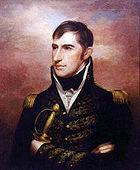 William Henry Harrison's force totaled at least 3,500 infantry
and cavalry
. He had a small detachment of regulars from the 27th U.S. Infantry and five brigades of Kentucky militia led by Isaac Shelby
, the sixty-three year-old governor of Kentucky and a hero of the American Revolutionary War
. He also had 1,000 volunteer cavalry under Colonel Richard Mentor Johnson
. Most were from Kentucky but some of them were from the River Raisin
area spurred on by the slogan "Remember the River Raisin
".
Procter had about 800 soldiers, mainly from the 41st Regiment. During 1813, the veterans of the 1st Battalion of the regiment, who had been serving in Upper Canada since the start of the war, and had suffered heavy casualties in several engagements during 1813 (including the Battle of Lake Erie, in which more than 150 men of the regiment had been serving aboard Barclay's ships), had been reinforced by the young soldiers of the 2nd Battalion. Most of the regiment's officers were dissatisfied with the leadership of Major General Procter, but the next in command, Colonel Warburton, refused to countenance any move to deprive Procter of command. Tecumseh led about 500 Native warriors.
or throwing up earthworks) so the ground presented no obstacle to the American mounted troops, while scattered trees masked the British fire. Tecumseh's warriors took up positions in a black ash swamp on the British right to flank
the Americans. Tecumseh himself rode along the British line, shaking hands with each officer, before joining his warriors.
General Harrison surveyed the battlefield and ordered James Johnson
(brother of Richard Mentor Johnson) to make a frontal attack against the British regulars with his mounted Kentucky riflemen. Despite the Indians' flanking fire, Johnson broke through, the British cannon having failed to fire. The exhausted, dispirited and half-starved British troops fired only one ragged fusillade before giving way. Immediately Procter and about 250 of his men fled from the field. The rest surrendered.
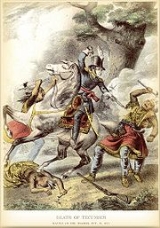
Tecumseh and his followers remained and carried on fighting. Richard Johnson charged into the Indian position at the head of about 20 horsemen to draw attention away from the main American force, but Tecumseh and his warriors answered with a volley of musket fire that stopped the cavalry charge. Fifteen of Johnson's men were killed or wounded, and Johnson was himself hit five times. Johnson's main force became bogged down in the mud of the swamp. Tecumseh is believed to have been killed in this fighting. The main force finally made its way through the swamp, and James Johnson's troops were freed from their attack on the British. With the American reinforcements converging and news of the death of Tecumseh spreading quickly, Indian resistance quickly dissolved.
Colonel Johnson may have been the soldier who shot Tecumseh, though the evidence is unclear. William Whitley
, a Revolutionary War
veteran, is another credited with the killing of Tecumseh. Whitley, of Crab Orchard, Kentucky
, volunteered for the raid on Tecumseh's camp, and was killed during the attack. Before his death, he requested that General Harrison have his scalp removed when his body was found and sent to his wife.
After the battle, American mounted troops moved on and burned Moraviantown, (marked today by the Fairfield Museum on Longwoods Road) a peaceful settlement of Christian Munsee
Indians who had no involvement in the conflict. Because the enlistments of the militia component of Harrison's army were about to expire, the Americans then retired to Detroit.
 Harrison reported that the British regulars had 12 killed and 22 wounded prisoners. Lieutenant Richard Bullock of the 41st Regiment, however, said that there were 12 killed and 36 wounded prisoners. British Lieutenant-Colonels Augustus Warburton and William Evans both reported, more than a year after the battle, that 18 were killed and 25 wounded. Harrison reported 601 British troops captured: a figure that included the prisoners taken during the retreat leading up to the battle and stragglers captured after it.
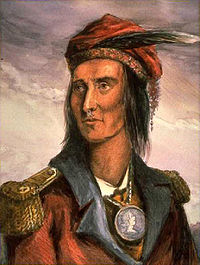
The Native Americans recorded their own casualties as 16 killed, including Tecumseh
and Roundhead
, although Harrison claimed that 33 dead warriors were found in the woods after the battle.
There are several versions of the American loss in the battle. Harrison stated 7 killed outright, 5 died of wounds and 17 wounded. Major Isaac Shelby said 7-8 killed outright, 4 died of wounds and about 20 wounded. Participants Robert McAfee and Peter Trisler, Jr., respectively gave 10 killed and 35 wounded and 14 killed and 20 wounded. Historian Samuel R. Brown stated 25 killed or fatally injured and 50 wounded in Johnson’s regiment and 2 killed and 6-7 wounded in the infantry, for a total of 27 killed and 56 or 57 wounded Harrison informed United States Secretary of War
John Armstrong, Jr.
that the only casualties inflicted on his command by the British troops at the battle were three men wounded: all of the rest were inflicted by the Indians.
) between raiding parties or other detachments, the Detroit front remained comparatively quiet for the rest of the war.
The death of Tecumseh was a crushing blow to the Indian alliance he had created, and it effectively dissolved following the battle. Shortly after the battle, Harrison signed an armistice at Detroit with the chiefs or representatives of several tribes. He then transferred most of his regulars eastward to the Niagara River and went himself to Washington where he was acclaimed a hero. However, a comparatively petty dispute with President James Madison
and John Armstrong resulted in him resigning his commission as Major General. Harrison's popularity grew, and he was eventually elected President of the United States
. Richard Mentor Johnson eventually became Vice President
to President Martin Van Buren
, based partly on the belief that he had killed Tecumseh.
Procter later rallied 246 men of the 41st regiment at the Grand River
. They were merged into a new 41st regiment which included soldiers from the 2nd battalion who had not been present at the battle. The experienced survivors of the 1st Battalion were drafted into the flank (grenadier and light) companies. Most of them were killed by a magazine explosion at the Siege of Fort Erie
.
The soldiers of the 41st who were taken prisoner at Moraviantown or the Battle of Lake Erie were exchanged or released towards the end of 1814. They had been held in encampments near present-day Sandusky, Ohio
, and had suffered severely from sickness during their captivity.
Historians have been somewhat kinder to Procter, noting that with the Americans in control of Lake Erie, the Detroit frontier was no longer tenable with the limited men and supplies available to Procter (although this was not disputed by the court).
United States
The United States of America is a federal constitutional republic comprising fifty states and a federal district...
victory in the War of 1812
War of 1812
The War of 1812 was a military conflict fought between the forces of the United States of America and those of the British Empire. The Americans declared war in 1812 for several reasons, including trade restrictions because of Britain's ongoing war with France, impressment of American merchant...
. It took place on October 5, 1813, near present-day Chatham, Ontario
Chatham, Ontario
Chatham is the largest community in the municipality of Chatham-Kent, Ontario. Formerly serving as the seat of Kent County, the governments of the former city of Chatham, the county of Kent, and its townships were merged into one entity known as the Municipality of Chatham-Kent in 1998.Located on...
in Upper Canada
Upper Canada
The Province of Upper Canada was a political division in British Canada established in 1791 by the British Empire to govern the central third of the lands in British North America and to accommodate Loyalist refugees from the United States of America after the American Revolution...
. It resulted in the death of the Shawnee
Shawnee
The Shawnee, Shaawanwaki, Shaawanooki and Shaawanowi lenaweeki, are an Algonquian-speaking people native to North America. Historically they inhabited the areas of Ohio, Virginia, West Virginia, Western Maryland, Kentucky, Indiana, and Pennsylvania...
chief Tecumseh
Tecumseh
Tecumseh was a Native American leader of the Shawnee and a large tribal confederacy which opposed the United States during Tecumseh's War and the War of 1812...
, and the destruction of the Native American coalition which he led.
Background
During the last months of 1812 and for much of 1813, the American Army of the NorthwestArmy of the Northwest (United States)
The Army of the Northwest was a U.S. Army unit formed at the outset of the War of 1812 and charged with control of the state of Ohio, the Indiana Territory, Michigan Territory and Illinois Territory.- Campaigns :...
under William Henry Harrison
William Henry Harrison
William Henry Harrison was the ninth President of the United States , an American military officer and politician, and the first president to die in office. He was 68 years, 23 days old when elected, the oldest president elected until Ronald Reagan in 1980, and last President to be born before the...
was attempting to recover Detroit and capture Fort Amherstburg
Fort Amherstburg
Fort Amherstburg was built by the Royal Canadian Volunteers at the mouth of the Detroit River to replace Fort Detroit, which Britain was required to cede to the United States of America in 1796 as a result of the Jay Treaty....
at Amherstburg
Amherstburg, Ontario
Amherstburg is a Canadian town near the mouth of the Detroit River in Essex County, Ontario. It is approximately south of the U.S...
from the Right Division of the British Army in Upper Canada
Upper Canada
The Province of Upper Canada was a political division in British Canada established in 1791 by the British Empire to govern the central third of the lands in British North America and to accommodate Loyalist refugees from the United States of America after the American Revolution...
, under Major General Henry Procter.
The British position depended on maintaining command of Lake Erie. The sparsely populated region produced insufficient crops and cattle to feed Procter's troops, the sailors of the British ships on the Lake, and above all the large numbers of Native warriors and their families gathered at Amherstburg under Tecumseh
Tecumseh
Tecumseh was a Native American leader of the Shawnee and a large tribal confederacy which opposed the United States during Tecumseh's War and the War of 1812...
, and supplies could effectively be brought to them only by the lake. Further, if naval command of Lake Erie ever passed to the Americans they would be able to land an army on the north shore at any point of their choosing, cutting off Procter from reinforcement from the east.
From the start of the war to the end of July 1813, the British ships, which since May 5, 1813 were led by Commander Robert Heriot Barclay
Robert Heriot Barclay
Robert Heriot Barclay was a British naval officer who was engaged in the Napoleonic Wars, and its North American counterpart, the War of 1812....
, had maintained control of the lake, and kept the American squadron under Master Commandant Oliver Hazard Perry
Oliver Hazard Perry
United States Navy Commodore Oliver Hazard Perry was born in South Kingstown, Rhode Island , the son of USN Captain Christopher Raymond Perry and Sarah Wallace Alexander, a direct descendant of William Wallace...
confined to Presque Isle harbour
Presque Isle Bay
Presque Isle Bay is a natural bay located off the coast of Erie, Pennsylvania, United States. Its embayment is about in length, about across at its widest point, and an average depth of about . The bay is bounded on the north and west by a recurved peninsula that makes up Presque Isle State Park...
. Barclay had then been forced by shortage of supplies to lift the blockade for two days, allowing Perry to get his ships across the sandbar at the entrance to the harbour.
Once it was fully armed and manned, Perry's superior squadron instituted a counter-blockade of Amherstburg, and supplies of food there rapidly ran short. Finally, with supplies almost exhausted, Barclay put out to seek battle with Perry. On September 13, Perry gained a complete victory in the Battle of Lake Erie
Battle of Lake Erie
The Battle of Lake Erie, sometimes called the Battle of Put-in-Bay, was fought on 10 September 1813, in Lake Erie off the coast of Ohio during the War of 1812. Nine vessels of the United States Navy defeated and captured six vessels of Great Britain's Royal Navy...
, after a hard-fought battle. On receiving Perry's hastily written note that "We have met the enemy and they are ours", Harrison knew that Procter would be forced to retreat, and ordered an advance. One thousand mounted troops began advancing along the lake shore to Detroit, and 2,500 foot soldiers were carried there and to Amherstburg by Perry's ships once the damage they had received in the battle had been repaired.
Proctor's retreat
Even before he received news of Barclay's defeat, Procter had made preparations to fall back on the British position at Burlington HeightsBurlington Heights
Burlington Heights refers to an area of flat land sitting elevated above the west end of Burlington Bay in the city of Hamilton, Ontario.The "Heights" were the location of a British Army post during the War of 1812. Afterwards, the former army barracks were used as a hospital for immigrants with...
at the western end of Lake Ontario
Lake Ontario
Lake Ontario is one of the five Great Lakes of North America. It is bounded on the north and southwest by the Canadian province of Ontario, and on the south by the American state of New York. Ontario, Canada's most populous province, was named for the lake. In the Wyandot language, ontarío means...
. Tecumseh knew that this would remove all protection from the tribes in the confederation whose lands lay to the west of Detroit and attempted to dissuade Procter, saying:
Our fleet has gone out, we know they have fought; we have heard the great guns but know nothing of what has happened to our Father with one Arm [Barclay, who had lost an arm in 1809]. Our ships have gone one way, and we are much astonished to see our Father [Procter] tying up everything and preparing to run the other, without letting his red children know what his intentions are ... We must compare our Father's conduct to [that of] a fat animal that carries its tail upon its back; but when affrighted, it drops it between its legs and runs off.
Nevertheless, Fort Amherstburg could not be defended. Not only was there no food, but the guns had been removed from the fort to be mounted on Barclay's ships. Procter began to retreat up the Thames River on September 27. Tecumseh had no option but to go with him. Procter apparently agreed to a compromise by retreating only as far as Moraviantown. This was the highest point of the river to which batteaux could navigate, so was safe from outflanking moves by water. Also, some supplies could in theory be brought there overland from Burlington Heights, although the roads were very poor. However, Procter made no attempt to fortify this position. He was alleged to have left the main body of his army under his second-in-command, Colonel Augustus Warburton of the 41st Regiment, four miles downstream without orders, while proceeding ahead himself with his wife and family and the other women and dependents and his personal baggage.
The British retreat was badly managed, and the soldiers had been reduced to half rations. The British soldiers were becoming increasingly demoralized, and Tecumseh's warriors grew even more impatient with Procter for his unwillingness to stop and fight, giving Procter reason to fear a mutiny
Mutiny
Mutiny is a conspiracy among members of a group of similarly situated individuals to openly oppose, change or overthrow an authority to which they are subject...
by the warriors.
The Americans left a brigade under Duncan McArthur
Duncan McArthur
right|thumb|350pxDuncan McArthur was a Federalist and National Republican politician from Ohio. He served as the 11th Governor of Ohio....
to garrison Detroit and another under Lewis Cass
Lewis Cass
Lewis Cass was an American military officer and politician. During his long political career, Cass served as a governor of the Michigan Territory, an American ambassador, a U.S. Senator representing Michigan, and co-founder as well as first Masonic Grand Master of the Grand Lodge of Michigan...
to garrison Sandwich. Harrison led the main body from Sandwich in pursuit of Procter on October 2. As they advanced, Harrison's men captured several abandoned boats and a steady stream of British stragglers. They caught up with the retreating British and Indians late on October 4. Tecumseh skirmished with the Americans near Chatham
Chatham, Ontario
Chatham is the largest community in the municipality of Chatham-Kent, Ontario. Formerly serving as the seat of Kent County, the governments of the former city of Chatham, the county of Kent, and its townships were merged into one entity known as the Municipality of Chatham-Kent in 1998.Located on...
to slow the American advance but the warriors were quickly overwhelmed. The batteaux carrying Warburton's reserve ammunition and the last of the food went aground and were left behind, to be captured by an American raiding party.
Forces
Infantry
Infantrymen are soldiers who are specifically trained for the role of fighting on foot to engage the enemy face to face and have historically borne the brunt of the casualties of combat in wars. As the oldest branch of combat arms, they are the backbone of armies...
and cavalry
Cavalry
Cavalry or horsemen were soldiers or warriors who fought mounted on horseback. Cavalry were historically the third oldest and the most mobile of the combat arms...
. He had a small detachment of regulars from the 27th U.S. Infantry and five brigades of Kentucky militia led by Isaac Shelby
Isaac Shelby
Isaac Shelby was the first and fifth Governor of the U.S. state of Kentucky and served in the state legislatures of Virginia and North Carolina. He was also a soldier in Lord Dunmore's War, the Revolutionary War, and the War of 1812...
, the sixty-three year-old governor of Kentucky and a hero of the American Revolutionary War
American Revolutionary War
The American Revolutionary War , the American War of Independence, or simply the Revolutionary War, began as a war between the Kingdom of Great Britain and thirteen British colonies in North America, and ended in a global war between several European great powers.The war was the result of the...
. He also had 1,000 volunteer cavalry under Colonel Richard Mentor Johnson
Richard Mentor Johnson
Richard Mentor Johnson was the ninth Vice President of the United States, serving in the administration of Martin Van Buren . He was the only vice-president ever elected by the United States Senate under the provisions of the Twelfth Amendment. Johnson also represented Kentucky in the U.S...
. Most were from Kentucky but some of them were from the River Raisin
River Raisin
The River Raisin is a river in southeastern Michigan, United States that flows through glacial sediments into Lake Erie. The area today is an agricultural and industrial center of Michigan. The river flows for almost , draining an area of in the Michigan counties of Lenawee, Monroe, Washtenaw,...
area spurred on by the slogan "Remember the River Raisin
Battle of Frenchtown
The Battle of Frenchtown, also known as the Battle of the River Raisin or the River Raisin Massacre, was a series of conflicts that took place from January 18–23, 1813 during the War of 1812...
".
Procter had about 800 soldiers, mainly from the 41st Regiment. During 1813, the veterans of the 1st Battalion of the regiment, who had been serving in Upper Canada since the start of the war, and had suffered heavy casualties in several engagements during 1813 (including the Battle of Lake Erie, in which more than 150 men of the regiment had been serving aboard Barclay's ships), had been reinforced by the young soldiers of the 2nd Battalion. Most of the regiment's officers were dissatisfied with the leadership of Major General Procter, but the next in command, Colonel Warburton, refused to countenance any move to deprive Procter of command. Tecumseh led about 500 Native warriors.
Battle
Shortly after daybreak on October 5, after ordering his troops to abandon their half-cooked breakfast and retreat a further two miles, Procter formed the British regulars in line of battle with a single 6-pounder cannon. He planned to trap Harrison on the banks of the Thames, driving the Americans off the road with cannon fire. However, he had taken no steps towards fortifying the position (e.g. by creating abatisAbatis
Abatis, abattis, or abbattis is a term in field fortification for an obstacle formed of the branches of trees laid in a row, with the sharpened tops directed outwards, towards the enemy. The trees are usually interlaced or tied with wire...
or throwing up earthworks) so the ground presented no obstacle to the American mounted troops, while scattered trees masked the British fire. Tecumseh's warriors took up positions in a black ash swamp on the British right to flank
Flanking maneuver
In military tactics, a flanking maneuver, also called a flank attack, is an attack on the sides of an opposing force. If a flanking maneuver succeeds, the opposing force would be surrounded from two or more directions, which significantly reduces the maneuverability of the outflanked force and its...
the Americans. Tecumseh himself rode along the British line, shaking hands with each officer, before joining his warriors.
General Harrison surveyed the battlefield and ordered James Johnson
James Johnson (Kentucky)
James Johnson was a U.S. Representative from Kentucky, brother of Richard Mentor Johnson and John Telemachus Johnson and uncle of Robert Ward Johnson....
(brother of Richard Mentor Johnson) to make a frontal attack against the British regulars with his mounted Kentucky riflemen. Despite the Indians' flanking fire, Johnson broke through, the British cannon having failed to fire. The exhausted, dispirited and half-starved British troops fired only one ragged fusillade before giving way. Immediately Procter and about 250 of his men fled from the field. The rest surrendered.
Tecumseh and his followers remained and carried on fighting. Richard Johnson charged into the Indian position at the head of about 20 horsemen to draw attention away from the main American force, but Tecumseh and his warriors answered with a volley of musket fire that stopped the cavalry charge. Fifteen of Johnson's men were killed or wounded, and Johnson was himself hit five times. Johnson's main force became bogged down in the mud of the swamp. Tecumseh is believed to have been killed in this fighting. The main force finally made its way through the swamp, and James Johnson's troops were freed from their attack on the British. With the American reinforcements converging and news of the death of Tecumseh spreading quickly, Indian resistance quickly dissolved.
Colonel Johnson may have been the soldier who shot Tecumseh, though the evidence is unclear. William Whitley
William Whitley
William Whitley , was an American pioneer born in what was then Augusta County, Virginia, the son of Solomon and Elizabeth Whitley...
, a Revolutionary War
American Revolutionary War
The American Revolutionary War , the American War of Independence, or simply the Revolutionary War, began as a war between the Kingdom of Great Britain and thirteen British colonies in North America, and ended in a global war between several European great powers.The war was the result of the...
veteran, is another credited with the killing of Tecumseh. Whitley, of Crab Orchard, Kentucky
Crab Orchard, Kentucky
Crab Orchard is a city in Lincoln County, Kentucky, United States. The population was 842 at the 2000 census. It is part of the Danville Micropolitan Statistical Area.-History:...
, volunteered for the raid on Tecumseh's camp, and was killed during the attack. Before his death, he requested that General Harrison have his scalp removed when his body was found and sent to his wife.
After the battle, American mounted troops moved on and burned Moraviantown, (marked today by the Fairfield Museum on Longwoods Road) a peaceful settlement of Christian Munsee
Christian Munsee
The Christian Munsee were a group of Lenape native American Indians, primarily Munsee-speaking, who converted to Christianity, following the teachings of the Moravian missionaries...
Indians who had no involvement in the conflict. Because the enlistments of the militia component of Harrison's army were about to expire, the Americans then retired to Detroit.
Casualties
The Native Americans recorded their own casualties as 16 killed, including Tecumseh
Tecumseh
Tecumseh was a Native American leader of the Shawnee and a large tribal confederacy which opposed the United States during Tecumseh's War and the War of 1812...
and Roundhead
Roundhead (Wyandot)
Roundhead , also known as Bark Carrier, Round Head, Stayeghtha, and Stiahta, was a Native American chief of the Wyandot tribe...
, although Harrison claimed that 33 dead warriors were found in the woods after the battle.
There are several versions of the American loss in the battle. Harrison stated 7 killed outright, 5 died of wounds and 17 wounded. Major Isaac Shelby said 7-8 killed outright, 4 died of wounds and about 20 wounded. Participants Robert McAfee and Peter Trisler, Jr., respectively gave 10 killed and 35 wounded and 14 killed and 20 wounded. Historian Samuel R. Brown stated 25 killed or fatally injured and 50 wounded in Johnson’s regiment and 2 killed and 6-7 wounded in the infantry, for a total of 27 killed and 56 or 57 wounded Harrison informed United States Secretary of War
United States Secretary of War
The Secretary of War was a member of the United States President's Cabinet, beginning with George Washington's administration. A similar position, called either "Secretary at War" or "Secretary of War," was appointed to serve the Congress of the Confederation under the Articles of Confederation...
John Armstrong, Jr.
John Armstrong, Jr.
John Armstrong, Jr. was an American soldier and statesman who was a delegate to the Continental Congress, U.S. Senator from New York, and Secretary of War.-Early life and Revolutionary War:...
that the only casualties inflicted on his command by the British troops at the battle were three men wounded: all of the rest were inflicted by the Indians.
Results
The American victory led to the re-establishment of American control over the Northwest frontier. Apart from skirmishes (such as the Battle of LongwoodsBattle of Longwoods
The Battle of Longwoods took place during the Anglo-American War of 1812. On 4 March 1814, a mounted American raiding party defeated an attempt by British regulars, volunteers from the Canadian militia and Native Americans to intercept them near Wardsville, in present-day Southwest Middlesex,...
) between raiding parties or other detachments, the Detroit front remained comparatively quiet for the rest of the war.
The death of Tecumseh was a crushing blow to the Indian alliance he had created, and it effectively dissolved following the battle. Shortly after the battle, Harrison signed an armistice at Detroit with the chiefs or representatives of several tribes. He then transferred most of his regulars eastward to the Niagara River and went himself to Washington where he was acclaimed a hero. However, a comparatively petty dispute with President James Madison
James Madison
James Madison, Jr. was an American statesman and political theorist. He was the fourth President of the United States and is hailed as the “Father of the Constitution” for being the primary author of the United States Constitution and at first an opponent of, and then a key author of the United...
and John Armstrong resulted in him resigning his commission as Major General. Harrison's popularity grew, and he was eventually elected President of the United States
President of the United States
The President of the United States of America is the head of state and head of government of the United States. The president leads the executive branch of the federal government and is the commander-in-chief of the United States Armed Forces....
. Richard Mentor Johnson eventually became Vice President
Vice President of the United States
The Vice President of the United States is the holder of a public office created by the United States Constitution. The Vice President, together with the President of the United States, is indirectly elected by the people, through the Electoral College, to a four-year term...
to President Martin Van Buren
Martin Van Buren
Martin Van Buren was the eighth President of the United States . Before his presidency, he was the eighth Vice President and the tenth Secretary of State, under Andrew Jackson ....
, based partly on the belief that he had killed Tecumseh.
Procter later rallied 246 men of the 41st regiment at the Grand River
Grand River (Ontario)
The Grand River is a large river in southwestern Ontario, Canada. From its source, it flows south through Grand Valley, Fergus, Elora, Waterloo, Kitchener, Cambridge, Paris, Brantford, Caledonia, and Cayuga before emptying into the north shore of Lake Erie south of Dunnville at Port Maitland...
. They were merged into a new 41st regiment which included soldiers from the 2nd battalion who had not been present at the battle. The experienced survivors of the 1st Battalion were drafted into the flank (grenadier and light) companies. Most of them were killed by a magazine explosion at the Siege of Fort Erie
Siege of Fort Erie
The Siege of Fort Erie was one of the last and most protracted engagements between British and American forces during the Niagara campaign of the American War of 1812...
.
The soldiers of the 41st who were taken prisoner at Moraviantown or the Battle of Lake Erie were exchanged or released towards the end of 1814. They had been held in encampments near present-day Sandusky, Ohio
Sandusky, Ohio
Sandusky is a city in the U.S. state of Ohio and the county seat of Erie County. It is located in northern Ohio and is situated on the shores of Lake Erie, almost exactly half-way between Toledo to the west and Cleveland to the east....
, and had suffered severely from sickness during their captivity.
Procter's court-martial
In May 1814, Procter was charged with negligence and improper conduct, though a court martial could not be held until December, when campaigning had ceased for the winter and a suitably senior board of officers could be assembled. They judged that Procter had managed the retreat badly, failing to secure his stores, and also disposed the troops ineffectively at Moraviantown. He was sentenced to be suspended from rank and pay for six months.Historians have been somewhat kinder to Procter, noting that with the Americans in control of Lake Erie, the Detroit frontier was no longer tenable with the limited men and supplies available to Procter (although this was not disputed by the court).