

Battle of Rakovor

Encyclopedia
The Battle of Wesenberg, Rakvere or Rakovor was a battle
fought on February 18, 1268, between the Livonian branch
of the Teutonic Knights
and a coalition of Russia
n princes. The Knights were beaten so thoroughly that they would not undertake a new campaign against Northern Russia for the following thirty years.
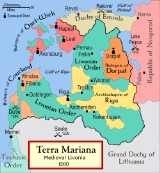
The two armies clashed within 7.5 kilometers (roughly 4.5 miles) from the Livonia
n town of Wesenberg (Rakvere
, Rakovor). Russian
forces, numbering up to 30,000 troops, were led by Dmitry of Pereslavl
(representing the Novgorod Republic
) together with his future son-in-law, Daumantas of Pskov
(representing the Pskov Republic
).
Apart from the knights, the Livonian army included Danish forces (right flank) and local Estonian
militia (left flank). The crusading
army was led by the Livonian Ordensmeister Otto von Lutterberg
.
The German forces deployed in their customary deep "boar's head" wedge of heavily armoured knights, called by the Russians the "great iron pig." These deep wedges had considerable penetrative power, but were unmaneuverable and vulnerable to flank attack due to the resulting narrow frontage of the army, facts which led to the ultimate defeat of the Knights at the Battle of Lake Peipus. As a result, the Germans attempted to remedy this situation at Rakvere by splitting their knightly assault force into two formations, deploying one wedge in the open and a second in ambush, so that when the first wedge was attacked on all sides by the Russians the second wedge would burst from ambush and in turn encircle the enemy.
The tactic worked well at first, as the wedge of German knights smashed the Novgorod and Pskov forces facing them, but then the second wedge, seeing the Russians in retreat, apparently assumed the battle was won and emerged from their ambush position to loot the Russian baggage. This abandonment of the battle plan led to the first wedge being encircled.
The fighting to reduce the first wedge was apparently terrific. "Neither our fathers nor grandfathers have witnessed such a terrible battle", reports the Novgorodian First Chronicle. At last the Novgorodian militia prevailed, although its leader, the posadnik
Mikhailo Fyodorovich, was killed in action.
The Russian princes pursued the knights up to Rakvere. Prince Daumantas of Pskov
, whose bravery was recognized even in the German chronicles of the battle, pursued the defeated knights all the way to the coast of the Baltic Sea
, and took substantial booty before returning to the Russian lines. Upon his return to his camp, Dmitry of Pereslavl discovered that it had been looted by another regiment of the knights. He decided to wait for the morning. Three days passed and no new attack ensued on the part of the knights. The Russian leaders claimed victory and returned to Novgorod in triumph.
Battle
Generally, a battle is a conceptual component in the hierarchy of combat in warfare between two or more armed forces, or combatants. In a battle, each combatant will seek to defeat the others, with defeat determined by the conditions of a military campaign...
fought on February 18, 1268, between the Livonian branch
Livonian Order
The Livonian Order was an autonomous Livonian branch of the Teutonic Order and a member of the Livonian Confederation from 1435–1561. After being defeated by Samogitians in the 1236 Battle of Schaulen , the remnants of the Livonian Brothers of the Sword were incorporated into the Teutonic Knights...
of the Teutonic Knights
Teutonic Knights
The Order of Brothers of the German House of Saint Mary in Jerusalem , commonly the Teutonic Order , is a German medieval military order, in modern times a purely religious Catholic order...
and a coalition of Russia
Russia
Russia or , officially known as both Russia and the Russian Federation , is a country in northern Eurasia. It is a federal semi-presidential republic, comprising 83 federal subjects...
n princes. The Knights were beaten so thoroughly that they would not undertake a new campaign against Northern Russia for the following thirty years.
The two armies clashed within 7.5 kilometers (roughly 4.5 miles) from the Livonia
Livonia
Livonia is a historic region along the eastern shores of the Baltic Sea. It was once the land of the Finnic Livonians inhabiting the principal ancient Livonian County Metsepole with its center at Turaida...
n town of Wesenberg (Rakvere
Rakvere
Rakvere is a town in northern Estonia and the county seat of Lääne-Viru County, 20 km south of the Gulf of Finland.-History:The earliest signs of human settlement dating back to the 3rd-5th centuries AD have been found on the present theatre hill. Probably to protect that settlement, a wooden...
, Rakovor). Russian
Russians
The Russian people are an East Slavic ethnic group native to Russia, speaking the Russian language and primarily living in Russia and neighboring countries....
forces, numbering up to 30,000 troops, were led by Dmitry of Pereslavl
Dmitry of Pereslavl
Dmitry Alexandrovich was Grand Prince of Vladimir-Suzdal from 1276 until 1281 and then from 1283 until 1293.Dmitry was the second son of Alexander Nevsky. When his elder brother Vasily died young, Dmitry remained the chief heir to his illustrious father. As early as 1259, he was left by Alexander...
(representing the Novgorod Republic
Novgorod Republic
The Novgorod Republic was a large medieval Russian state which stretched from the Baltic Sea to the Ural Mountains between the 12th and 15th centuries, centred on the city of Novgorod...
) together with his future son-in-law, Daumantas of Pskov
Daumantas of Pskov
Daumantas, later Dovmont , Christian name Timothy , ; c. 1240? – May 17, 1299), was a Lithuanian princeling best remembered as a military leader of the Pskov Republic between 1266 and 1299...
(representing the Pskov Republic
Pskov Republic
Pskov, known at various times as the Principality of Pskov or the Pskov Republic , was a medieval state on the south shore of Lake Pskov. The capital city, also named Pskov, was located at the southern end of the Peipus–Pskov Lake system at the southeast corner of Ugandi, about southwest of...
).
Apart from the knights, the Livonian army included Danish forces (right flank) and local Estonian
Estonians
Estonians are a Finnic people closely related to the Finns and inhabiting, primarily, the country of Estonia. They speak a Finnic language known as Estonian...
militia (left flank). The crusading
Northern Crusades
The Northern Crusades or Baltic Crusades were crusades undertaken by the Christian kings of Denmark and Sweden, the German Livonian and Teutonic military orders, and their allies against the pagan peoples of Northern Europe around the southern and eastern shores of the Baltic Sea...
army was led by the Livonian Ordensmeister Otto von Lutterberg
Otto von Lutterberg
Otto von Lutterberg was the Ordensmeister of the Livonian Order of the Teutonic Knights from 1266 to 1270, and was in command of the Livonian Order in 1268 when the Knights were heavily defeated by a Russian army at the Battle of Rakvere...
.
The German forces deployed in their customary deep "boar's head" wedge of heavily armoured knights, called by the Russians the "great iron pig." These deep wedges had considerable penetrative power, but were unmaneuverable and vulnerable to flank attack due to the resulting narrow frontage of the army, facts which led to the ultimate defeat of the Knights at the Battle of Lake Peipus. As a result, the Germans attempted to remedy this situation at Rakvere by splitting their knightly assault force into two formations, deploying one wedge in the open and a second in ambush, so that when the first wedge was attacked on all sides by the Russians the second wedge would burst from ambush and in turn encircle the enemy.
The tactic worked well at first, as the wedge of German knights smashed the Novgorod and Pskov forces facing them, but then the second wedge, seeing the Russians in retreat, apparently assumed the battle was won and emerged from their ambush position to loot the Russian baggage. This abandonment of the battle plan led to the first wedge being encircled.
The fighting to reduce the first wedge was apparently terrific. "Neither our fathers nor grandfathers have witnessed such a terrible battle", reports the Novgorodian First Chronicle. At last the Novgorodian militia prevailed, although its leader, the posadnik
Posadnik
Posadnik was the mayor in some East Slavic cities or towns. Most notably, the posadnik was the mayor of Novgorod and Pskov...
Mikhailo Fyodorovich, was killed in action.
The Russian princes pursued the knights up to Rakvere. Prince Daumantas of Pskov
Daumantas of Pskov
Daumantas, later Dovmont , Christian name Timothy , ; c. 1240? – May 17, 1299), was a Lithuanian princeling best remembered as a military leader of the Pskov Republic between 1266 and 1299...
, whose bravery was recognized even in the German chronicles of the battle, pursued the defeated knights all the way to the coast of the Baltic Sea
Baltic Sea
The Baltic Sea is a brackish mediterranean sea located in Northern Europe, from 53°N to 66°N latitude and from 20°E to 26°E longitude. It is bounded by the Scandinavian Peninsula, the mainland of Europe, and the Danish islands. It drains into the Kattegat by way of the Øresund, the Great Belt and...
, and took substantial booty before returning to the Russian lines. Upon his return to his camp, Dmitry of Pereslavl discovered that it had been looted by another regiment of the knights. He decided to wait for the morning. Three days passed and no new attack ensued on the part of the knights. The Russian leaders claimed victory and returned to Novgorod in triumph.