

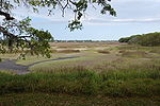
Battle of Bloody Marsh

Encyclopedia
The Battle of Bloody Marsh took place on July 18, 1742 (new style
) between Spanish
and British
forces, and the latter were victorious. Part of the War of Jenkin's Ear, the battle was for control of the road between the British forts of Frederica and St. Simons, to control St. Simons Island and the forts' coverage of sea routes, off the coast of present-day Georgia. The Province of Georgia
later claimed the island, which is now part of the U.S. state of Georgia
. The Battle of Gully Hole Creek
, a skirmish also won by the British, took place on the island the same day.
led the colonization of Georgia for Great Britain, and had chosen Savannah
as the principal port for the new colony. In the 1730s, Spain and Great Britain had been disputing control over the border between Georgia and La Florida
, where the Spanish had several settlements and forts.
Given a heightened threat of Spanish invasion, Oglethorpe sought to increase his southern defenses. Accompanied by rangers and two Native American
guides, Oglethorpe picked St. Simons Island as the site for a new town and fort. In 1734, Oglethorpe convinced the Parliament
and the colonial trustees to pay for a new military garrison. He recruited a company of British settlers to migrate with their families to live at Darien
, at the mouth of the Altamaha River
.
The trustees also selected a large new group of colonists for St. Simons Island. The ships bearing the settlers and supplies arrived at Tybee Island
early in 1736. From there, some went to the mainland while others traveled via periagua
s (also known as pirogues) to St. Simons Island to found the new town of Frederica. Frederica and its fort were built on the elbow of the Frederica River
to control approaches from both directions.
In 1737, Oglethorpe returned to England to acquire more funding and permission to raise a regiment of soldiers; he was successful in convincing Parliament of both. He was appointed commander-in- chief of all British forces (limited as they were) in the colonies of South Carolina and Georgia.
The conflicts on St. Simons Island were related to the War of Jenkins' Ear
, begun in 1739. Troops of the Spanish Coast guard Ia Isabela had boarded the British brig Rebecca and found that its captain, Robert Jenkins was smuggling. The Spanish officer Julio León Fandiño's cut off one of Jenkins' ears for his piracy. In retaliation for the boarding and assault on its officer (and related to tensions having built between the two nations), on October 30, 1739, Great Britain declared war on Spain.
The two forts lay about five miles apart on St. Simon's Island. Between the two ran a road the width of one wagon, named Military Road. This served to supply the garrison at Fort Federica and settlers in the nearby village from Fort St. Simons. The battle took place during a Spanish invasion of the island and present-day Georgia. General James Oglethorpe
commanded British troops to victory.
was the governor of La Florida. Spanish forces greatly outnumbered the British. On July 5, Montiano sailed to St. Simon through the firing guns of the British. The Spanish landed nearly 1900 men from more than 50 ships near Gascoigne Bluff
, close to the Frederica River. Oglethorpe and his men retreated from the fort before the Spanish could mount an assault. The Spanish took over Fort St. Simons the following day and began to scout out their opposition on foot.
They found the road between Fort St. Simons and Fort Frederica, but first assumed the narrow track was just a farm road. After realizing his mistake, Montiano sent about 300 men to reconnoiter the road. On July 18, Spanish troops and a group of British soldiers, under command of Nobel Jones, skirmished with each other. Defeated by the British, the Spanish soldiers told their opponents that a larger Spanish army was advancing along the road from Fort St. Simons to Frederica. Oglethorpe positioned some men as rear guards.
Oglethorpe left to get more forces. In another skirmish, the outnumbered British began to retreat. When they reached a bend in the road, Lieutenants Southerland and Macoy decided to stop, and their regiments and allied Indians hid in the dense forests. They watched as the Spanish broke rank, stacked arms and, taking out their kettles, prepared to cook dinner. The British forces attacked the Spanish off-guard, killing about 50 (estimates vary). British forces routed the Spanish, and Oglethorpe was credited with the victory.
Oglethorpe continued to press the Spanish, trying to dislodge them from the island. A few days later, approaching a Spanish settlement on the south side, he learned of a French man who had deserted the British and gone to the Spanish. Worried that the deserter might report the small number of British men, Oglethorpe spread out his drummers, to make them sound as if they were accompanying a larger force. He wrote to the deserter, addressing him as if a spy for the British, saying that the man just needed to continue his stories until Britain could send more men. The prisoner who was carrying the letter took it to the Spanish officers, as Oglethorpe had hoped. Lastly, Oglethorpe arranged for some British ships to sail near, to suggest more forces were arriving.
That same day, the British won the skirmish against the Spanish known as the Battle of Gully Hole Creek
on the island. The Spanish left St. Simons on 25 July, ending their last invasion of colonial Georgia.
Old Style and New Style dates
Old Style and New Style are used in English language historical studies either to indicate that the start of the Julian year has been adjusted to start on 1 January even though documents written at the time use a different start of year ; or to indicate that a date conforms to the Julian...
) between Spanish
Spain
Spain , officially the Kingdom of Spain languages]] under the European Charter for Regional or Minority Languages. In each of these, Spain's official name is as follows:;;;;;;), is a country and member state of the European Union located in southwestern Europe on the Iberian Peninsula...
and British
United Kingdom
The United Kingdom of Great Britain and Northern IrelandIn the United Kingdom and Dependencies, other languages have been officially recognised as legitimate autochthonous languages under the European Charter for Regional or Minority Languages...
forces, and the latter were victorious. Part of the War of Jenkin's Ear, the battle was for control of the road between the British forts of Frederica and St. Simons, to control St. Simons Island and the forts' coverage of sea routes, off the coast of present-day Georgia. The Province of Georgia
Province of Georgia
The Province of Georgia was one of the Southern colonies in British America. It was the last of the thirteen original colonies established by Great Britain in what later became the United States...
later claimed the island, which is now part of the U.S. state of Georgia
Georgia (U.S. state)
Georgia is a state located in the southeastern United States. It was established in 1732, the last of the original Thirteen Colonies. The state is named after King George II of Great Britain. Georgia was the fourth state to ratify the United States Constitution, on January 2, 1788...
. The Battle of Gully Hole Creek
Battle of Gully Hole Creek
The Battle of Gully Hole Creek was a skirmish in 1742 on St. Simons Island, Georgia, between Spanish troops from the Spanish colony of Florida and British colonial troops on St. Simons Island. It was won by the British...
, a skirmish also won by the British, took place on the island the same day.
Background
James OglethorpeJames Oglethorpe
James Edward Oglethorpe was a British general, member of Parliament, philanthropist, and founder of the colony of Georgia...
led the colonization of Georgia for Great Britain, and had chosen Savannah
Savannah, Georgia
Savannah is the largest city and the county seat of Chatham County, in the U.S. state of Georgia. Established in 1733, the city of Savannah was the colonial capital of the Province of Georgia and later the first state capital of Georgia. Today Savannah is an industrial center and an important...
as the principal port for the new colony. In the 1730s, Spain and Great Britain had been disputing control over the border between Georgia and La Florida
La Florida
La Florida is a commune of Chile located in Santiago Province, Santiago Metropolitan Region.-Demographics:According to the 2002 census of the National Statistics Institute, La Florida spans an area of and has 365,674 inhabitants . Of these, 365,563 lived in urban areas and 111 in rural areas...
, where the Spanish had several settlements and forts.
Given a heightened threat of Spanish invasion, Oglethorpe sought to increase his southern defenses. Accompanied by rangers and two Native American
Indigenous peoples of the Americas
The indigenous peoples of the Americas are the pre-Columbian inhabitants of North and South America, their descendants and other ethnic groups who are identified with those peoples. Indigenous peoples are known in Canada as Aboriginal peoples, and in the United States as Native Americans...
guides, Oglethorpe picked St. Simons Island as the site for a new town and fort. In 1734, Oglethorpe convinced the Parliament
Parliament of Great Britain
The Parliament of Great Britain was formed in 1707 following the ratification of the Acts of Union by both the Parliament of England and Parliament of Scotland...
and the colonial trustees to pay for a new military garrison. He recruited a company of British settlers to migrate with their families to live at Darien
Darien, Georgia
Darien is a city in McIntosh County, Georgia, United States. It lies on Georgia's coast at the mouth of the Altamaha River about 50 miles south of Savannah, and is part of the Brunswick, Georgia Metropolitan Statistical Area. The population of Darien was 1,719 at the 2000 census. The city is the...
, at the mouth of the Altamaha River
Altamaha River
The Altamaha River is a major river of the American state of Georgia. It flows generally eastward for 137 miles from its origin at the confluence of the Oconee River and Ocmulgee River towards the Atlantic Ocean, where it empties into the ocean near Brunswick, Georgia. There are no dams...
.
The trustees also selected a large new group of colonists for St. Simons Island. The ships bearing the settlers and supplies arrived at Tybee Island
Tybee Island, Georgia
Tybee Island is an island and city in Chatham County, Georgia near the city of Savannah in the southeastern United States. It is the easternmost point in the state of Georgia. As of the 2010 census, the city population was 2,990. Tybee Island is an island and city in Chatham County, Georgia near...
early in 1736. From there, some went to the mainland while others traveled via periagua
Periagua
Periagua is the term formerly used in the Caribbean and the eastern seaboard of North America for a range of small craft including canoes and small sailing vessels...
s (also known as pirogues) to St. Simons Island to found the new town of Frederica. Frederica and its fort were built on the elbow of the Frederica River
Frederica River
The Frederica River is an tidal river in Glynn County, Georgia. It forms the western boundary of Saint Simons Island of the Georgia Sea Islands. Fort Frederica National Monument is located on the eastern bank of the river on Saint Simons Island....
to control approaches from both directions.
In 1737, Oglethorpe returned to England to acquire more funding and permission to raise a regiment of soldiers; he was successful in convincing Parliament of both. He was appointed commander-in- chief of all British forces (limited as they were) in the colonies of South Carolina and Georgia.
The conflicts on St. Simons Island were related to the War of Jenkins' Ear
War of Jenkins' Ear
The War of Jenkins' Ear was a conflict between Great Britain and Spain that lasted from 1739 to 1748, with major operations largely ended by 1742. Its unusual name, coined by Thomas Carlyle in 1858, relates to Robert Jenkins, captain of a British merchant ship, who exhibited his severed ear in...
, begun in 1739. Troops of the Spanish Coast guard Ia Isabela had boarded the British brig Rebecca and found that its captain, Robert Jenkins was smuggling. The Spanish officer Julio León Fandiño's cut off one of Jenkins' ears for his piracy. In retaliation for the boarding and assault on its officer (and related to tensions having built between the two nations), on October 30, 1739, Great Britain declared war on Spain.
The two forts lay about five miles apart on St. Simon's Island. Between the two ran a road the width of one wagon, named Military Road. This served to supply the garrison at Fort Federica and settlers in the nearby village from Fort St. Simons. The battle took place during a Spanish invasion of the island and present-day Georgia. General James Oglethorpe
James Oglethorpe
James Edward Oglethorpe was a British general, member of Parliament, philanthropist, and founder of the colony of Georgia...
commanded British troops to victory.
Battle
The Spanish commander Don Manuel de MontianoManuel de Montiano
Manuel de Montiano y Luyando was a Spanish General and colonial administrator who served as Royal Governor of La Florida and Royal Governor of Panama...
was the governor of La Florida. Spanish forces greatly outnumbered the British. On July 5, Montiano sailed to St. Simon through the firing guns of the British. The Spanish landed nearly 1900 men from more than 50 ships near Gascoigne Bluff
Gascoigne Bluff
Gascoigne Bluff is a bluff next to the Frederica River on the western side of the island of St. Simons which was a Native American campground, the site of a Franciscan monastery named San Buenaventura, and the site of the Province of Georgia's first naval base....
, close to the Frederica River. Oglethorpe and his men retreated from the fort before the Spanish could mount an assault. The Spanish took over Fort St. Simons the following day and began to scout out their opposition on foot.
They found the road between Fort St. Simons and Fort Frederica, but first assumed the narrow track was just a farm road. After realizing his mistake, Montiano sent about 300 men to reconnoiter the road. On July 18, Spanish troops and a group of British soldiers, under command of Nobel Jones, skirmished with each other. Defeated by the British, the Spanish soldiers told their opponents that a larger Spanish army was advancing along the road from Fort St. Simons to Frederica. Oglethorpe positioned some men as rear guards.
Oglethorpe left to get more forces. In another skirmish, the outnumbered British began to retreat. When they reached a bend in the road, Lieutenants Southerland and Macoy decided to stop, and their regiments and allied Indians hid in the dense forests. They watched as the Spanish broke rank, stacked arms and, taking out their kettles, prepared to cook dinner. The British forces attacked the Spanish off-guard, killing about 50 (estimates vary). British forces routed the Spanish, and Oglethorpe was credited with the victory.
Oglethorpe continued to press the Spanish, trying to dislodge them from the island. A few days later, approaching a Spanish settlement on the south side, he learned of a French man who had deserted the British and gone to the Spanish. Worried that the deserter might report the small number of British men, Oglethorpe spread out his drummers, to make them sound as if they were accompanying a larger force. He wrote to the deserter, addressing him as if a spy for the British, saying that the man just needed to continue his stories until Britain could send more men. The prisoner who was carrying the letter took it to the Spanish officers, as Oglethorpe had hoped. Lastly, Oglethorpe arranged for some British ships to sail near, to suggest more forces were arriving.
That same day, the British won the skirmish against the Spanish known as the Battle of Gully Hole Creek
Battle of Gully Hole Creek
The Battle of Gully Hole Creek was a skirmish in 1742 on St. Simons Island, Georgia, between Spanish troops from the Spanish colony of Florida and British colonial troops on St. Simons Island. It was won by the British...
on the island. The Spanish left St. Simons on 25 July, ending their last invasion of colonial Georgia.
Aftermath
Oglethorpe was later appointed brigadier general. He left Georgia about 1744 and married an heiress in Britain, where he lived the rest of his life.See also
- Province of GeorgiaProvince of GeorgiaThe Province of Georgia was one of the Southern colonies in British America. It was the last of the thirteen original colonies established by Great Britain in what later became the United States...
: about Colonial Georgia - List of conflicts in the United States
- Invasion of Georgia (1742)Invasion of Georgia (1742)The 1742 Invasion of Georgia saw a Spanish military force invade and attempt to occupy the British colony of Georgia as part of the War of Jenkins' Ear. Local British forces under the command of the Governor James Oglethorpe rallied and defeated the Spaniards at the Battle of Bloody Marsh and the...
- Fort Frederica National MonumentFort Frederica National MonumentFort Frederica National Monument, on St. Simons Island, Georgia, preserves the archaeological remnants of a fort and town built by James Oglethorpe between 1736 and 1748 to protect the southern boundary of the British colony of Georgia from Spanish raids. About 630 British troops were stationed at...
(the Bloody Marsh Battle Site is a unit of the Fort Frederica National Monument)