
Banatsko Novo Selo is a village in northern
SerbiaSerbia , officially the Republic of Serbia , is a landlocked country located at the crossroads of Central and Southeast Europe, covering the southern part of the Carpathian basin and the central part of the Balkans...
, situated in the
municipalityA municipality is essentially an urban administrative division having corporate status and usually powers of self-government. It can also be used to mean the governing body of a municipality. A municipality is a general-purpose administrative subdivision, as opposed to a special-purpose district...
of
PančevoPančevo is a city and municipality located in the southern part of Serbian province of Vojvodina, 15 km northeast from Belgrade. In 2002, the city had a total population of 77,087, while municipality of Pančevo had 127,162 inhabitants. It is the administrative center of the South Banat...
,
South Banat DistrictSouth Banat District is a northeastern district of Serbia with the seat of the district in Pančevo. It borders Romania to the east. The district lies in the region of Banat, in the autonomous province of Vojvodina...
,
VojvodinaVojvodina, officially called Autonomous Province of Vojvodina is an autonomous province of Serbia. Its capital and largest city is Novi Sad...
province. The village has a Serb ethnic majority and its population numbering 7,416 people who are permanent residents(2002 census).
Banatsko Novo Selo is a village in northern
SerbiaSerbia , officially the Republic of Serbia , is a landlocked country located at the crossroads of Central and Southeast Europe, covering the southern part of the Carpathian basin and the central part of the Balkans...
, situated in the
municipalityA municipality is essentially an urban administrative division having corporate status and usually powers of self-government. It can also be used to mean the governing body of a municipality. A municipality is a general-purpose administrative subdivision, as opposed to a special-purpose district...
of
PančevoPančevo is a city and municipality located in the southern part of Serbian province of Vojvodina, 15 km northeast from Belgrade. In 2002, the city had a total population of 77,087, while municipality of Pančevo had 127,162 inhabitants. It is the administrative center of the South Banat...
,
South Banat DistrictSouth Banat District is a northeastern district of Serbia with the seat of the district in Pančevo. It borders Romania to the east. The district lies in the region of Banat, in the autonomous province of Vojvodina...
,
VojvodinaVojvodina, officially called Autonomous Province of Vojvodina is an autonomous province of Serbia. Its capital and largest city is Novi Sad...
province. The village has a Serb ethnic majority and its population numbering 7,416 people who are permanent residents(2002 census).
Name
The name is derived from the local region of
BanatThe Banat is a geographical and historical region in Central Europe currently divided between three countries: the eastern part lies in western Romania , the western part in northeastern Serbia , and a small...
(
Banatsko), while
Novo Selo literally means "New Village" in
SerbianSerbian is a form of Serbo-Croatian, a South Slavic language, spoken by Serbs in Serbia, Bosnia and Herzegovina, Montenegro, Croatia and neighbouring countries....
, hence the full meaning of the name would be "a new village of Banat".
The current official Serbian name of the village (confirmed as official in 1922) is
Banatsko Novo Selo (Банатско Ново Село), but it has previously also been known by different names throughout its history. Older Serbian name of the village (confirmed as official in 1854) was simply
Novo Selo (Ново Село), while in
GermanGerman is a West Germanic language, related to and classified alongside English and Dutch. With an estimated 90 – 98 million native speakers, German is one of the world's major languages and is the most widely-spoken first language in the European Union....
it has been known as
Neudorf,
Banater Neudorf, and
Pfefferthal, in
HungarianHungarian is a Uralic language, part of the Ugric group. With some 14 million speakers, it is one of the most widely spoken non-Indo-European languages in Europe....
it has been known as
Ujfalu (also as
Réva-Ujfalu and
Bánát-Ujfalu), and in
RomanianRomanian Romanian Romanian (or Daco-Romanian; obsolete spellings Rumanian, Roumanian; self-designation: română, limba română ("the Romanian language") or românește (lit. "in Romanian") is a Romance language spoken by around 24 to 28 million people, primarily in Romania and Moldova...
it has been known as
Satu Nou.
Geography
Banatsko Novo Selo is located on flat and fertile plains at 44°59′23"N 20°47′01"E (45.0554, 20.8858), approximately 15 km NW of Pančevo and 28 km NW of
BelgradeBelgrade is the capital and largest city of Serbia. It is located at the confluence of the Sava and Danube rivers, where the Pannonian Plain meets the Balkans. According to official results of Census 2011, the city has a population of 1,639,121. It is one of the 15 largest cities in Europe...
. It is located within the
South Banat DistrictSouth Banat District is a northeastern district of Serbia with the seat of the district in Pančevo. It borders Romania to the east. The district lies in the region of Banat, in the autonomous province of Vojvodina...
, in the Province of
VojvodinaVojvodina, officially called Autonomous Province of Vojvodina is an autonomous province of Serbia. Its capital and largest city is Novi Sad...
, which is in the northern part of
SerbiaSerbia , officially the Republic of Serbia , is a landlocked country located at the crossroads of Central and Southeast Europe, covering the southern part of the Carpathian basin and the central part of the Balkans...
.
The largest neighbouring settlement is Pančevo, but the region is also scattered with other smaller inhabited places, similar in size with Banatsko Novo Selo, such as
KačarevoKačarevo is a town in northern Serbia, situated in the municipality of Pančevo, South Banat District, Vojvodina province. The town has a Serb ethnic majority and its population numbering 7,624 people .- Name :...
and
DolovoDolovo is a village in Serbia. It is situated in the Pančevo municipality, in the South Banat District, Vojvodina province. The village has a Serb ethnic majority and its population is 6,835 . Dolovo is very peaceful village. It has three churches and one school....
. The village is also on the main
thoroughfareA thoroughfare is a place of transportation intended to connect one location to another. Highways, roads, and trails are examples of thoroughfares used by a variety of general traffic. On land a thoroughfare may refer to anything from a rough trail to multi-lane highway with grade separated...
between the capital city Belgrade, and
RomaniaRomania is a country located at the crossroads of Central and Southeastern Europe, on the Lower Danube, within and outside the Carpathian arch, bordering on the Black Sea...
.
The altitude above sea level is roughly about 105 meters, or 347 feet, and the
Postal CodeA postal code is a series of letters and/or digits appended to a postal address for the purpose of sorting mail. Once postal codes were introduced, other applications became possible.In February 2005, 117 of the 190 member countries of the Universal Postal Union had postal code systems...
is 26314.
History
The village was founded in 1765. It was settled by German settlers, but also by
SerbsThe Serbs are a South Slavic ethnic group of the Balkans and southern Central Europe. Serbs are located mainly in Serbia, Montenegro and Bosnia and Herzegovina, and form a sizable minority in Croatia, the Republic of Macedonia and Slovenia. Likewise, Serbs are an officially recognized minority in...
and
RomaniansThe Romanians are an ethnic group native to Romania, who speak Romanian; they are the majority inhabitants of Romania....
. Before the foundation of the village, two older settlement known as
Zeldoš and
Velika Dolina existed at this location. These settlements were populated by Serbs and Romanians. In 1767, 43 Romanian families from
PančevoPančevo is a city and municipality located in the southern part of Serbian province of Vojvodina, 15 km northeast from Belgrade. In 2002, the city had a total population of 77,087, while municipality of Pančevo had 127,162 inhabitants. It is the administrative center of the South Banat...
were settled in Novo Selo. In 1918, about 80 percent of the population of the village were ethnic
RomaniansThe Romanians are an ethnic group native to Romania, who speak Romanian; they are the majority inhabitants of Romania....
. Until 1959, Banatsko Novo Selo had a status of separate municipality.
More recently, on the April 5, 1999, during the
NATO Bombing Campaign of the
Kosovo WarThe term Kosovo War or Kosovo conflict was two sequential, and at times parallel, armed conflicts in Kosovo province, then part of FR Yugoslav Republic of Serbia; from early 1998 to 1999, there was an armed conflict initiated by the ethnic Albanian "Kosovo Liberation Army" , who sought independence...
there were unsubstantiated claims of Yugoslavian forces, led by Lt.Col. Zoran Damnjanović's air defense unit shot down up to two NATO aircraft between Banatsko Novo Selo and the neighbouring village of
DolovoDolovo is a village in Serbia. It is situated in the Pančevo municipality, in the South Banat District, Vojvodina province. The village has a Serb ethnic majority and its population is 6,835 . Dolovo is very peaceful village. It has three churches and one school....
.
Demographics
Ethnic groups (2002 census)
The number of reported inhabitants of the village in 2002 was 7,416, with 4,837 (65.85%) of the population being of
SerbianThe Serbs are a South Slavic ethnic group of the Balkans and southern Central Europe. Serbs are located mainly in Serbia, Montenegro and Bosnia and Herzegovina, and form a sizable minority in Croatia, the Republic of Macedonia and Slovenia. Likewise, Serbs are an officially recognized minority in...
descent and 2,036 (27.72%) of
RomanianThe Romanians are an ethnic group native to Romania, who speak Romanian; they are the majority inhabitants of Romania....
. There is also a small minority of people within the village of Roma descent (110 people or 1.50%), as well as smaller numbers of people belonging to other ethnic groups.
Historical population
- 1869: 6,944
- 1890: 7,391
- 1948: 6,129
- 1953: 6,378
- 1961: 7,225
- 1971: 7,872
- 1981: 7,963
- 1991: 7,987
- 2002: 7,416
Religion
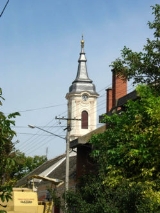
There are two Orthodox churches in the village: one of them was built in 1805 and was originally used by both,
SerbsThe Serbs are a South Slavic ethnic group of the Balkans and southern Central Europe. Serbs are located mainly in Serbia, Montenegro and Bosnia and Herzegovina, and form a sizable minority in Croatia, the Republic of Macedonia and Slovenia. Likewise, Serbs are an officially recognized minority in...
and
RomaniansThe Romanians are an ethnic group native to Romania, who speak Romanian; they are the majority inhabitants of Romania....
, but today it is used only by Romanians, and another one was built in 1877 and is used by the Serbs. In addition to the Orthodox churches there are also
Seventh-day AdventistThe Seventh-day Adventist Church is a Protestant Christian denomination distinguished by its observance of Saturday, the original seventh day of the Judeo-Christian week, as the Sabbath, and by its emphasis on the imminent second coming of Jesus Christ...
,
NazareneThe Church of the Nazarene is an evangelical Christian denomination that emerged from the 19th century Holiness movement in North America with its members colloquially referred to as Nazarenes. It is the largest Wesleyan-holiness denomination in the world. At the end of 2010, the Church of the...
and Baptist churches.
Economy
The main occupation of the villages people is in
agricultureAgriculture is the cultivation of animals, plants, fungi and other life forms for food, fiber, and other products used to sustain life. Agriculture was the key implement in the rise of sedentary human civilization, whereby farming of domesticated species created food surpluses that nurtured the...
. However, an increasing number of community members are establishing small and medium size enterprises, particularly in agricultural processing.
Recent/current community projects
There have been several community projects of late that attempted to enhance the wellbeing of locals, funded by money from both the municipality and residents, and also from money received from US aid. Projects include:
External links