

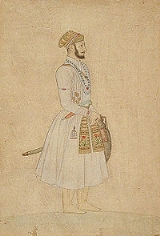
Bahadur Shah I

Encyclopedia
Bahadur Shah (14 October 1643, Burhanpur
–27 February 1712, Lahore
) was a Mughal Emperor
, who ruled India
from 1707 to 1712. His original name was Qutb ud-Din Muhammad Mu'azzam later titled as Shah Alam by his father. He took the throne name Bahadur Shah in 1707. His name Bahādur means "brave" & "hero" in Turko-Mongol languages. Reigning just five years, he was an old man of 63 when he came to power. He made settlements with the Marathas, tranquilized the Rajputs, and became friendly with the Sikhs in the Punjab. He was travelling throughout his reign and only came to rest in Lahore in the last few months of his life.
through Nawab Bai Begum Saheba, the daughter of Raja of Rajauri (Jarral Rajput), was born in Burhanpur
in 1643. In his father's lifetime, Muazzam was deputed governor of the northwest territories by Aurangzeb. His province included those parts of the Punjab
where the Sikh faith was blossoming. As governor, Muazzam relaxed the enforcement of Aurangzeb's severe edicts, and an uneasy calm prevailed in the province for a brief time. In fact, he maintained a friendly relationship with the last Sikh spiritual leader, Guru Gobind Singh
. When Muazzam was challenging his brothers for the Mughal throne, Guru Gobind Singh provided military assistance to the liberal prince.
, proclaimed himself emperor and marched towards Delhi
, where he unsuccessfully fought Bahadur Shah and died after a nominal reign of three months. Another brother, Muhammad Kam Baksh, was killed in 1709.
Aurangzeb had imposed Sharia law within his kingdom with harsh enforcement of strict edicts. This led to increased militancy by many constituencies including the Maratha
s, the Sikh
s and the Rajput
s. Thus, rebellion was rife at the time of Aurangzeb's death. A more moderate man than his father, Bahadur Shah sought to improve relations with the militant constituencies of the rapidly crumbling kingdom. Bahadur Shah constantly struggled with the rise of Sikh strength, with the renegade Sikh named Banda being a constant threat to the empire. He was able to gain control over Assam purely because of the assistance he got from his son, Azim-ush-Shan
. Bahadur Shah never abolished jizyah, but the effort to collect the tax became ineffectual. Support to music was apparently renewed during his brief rule of five years. There was no destruction of temples in his reign. During Bahadur Shah's brief reign of 5 years, although the empire remained united, factionalism in the nobility reached a new height.
 After his short reign of less than five years, the Mughal Empire entered a long decline, attributable both to his sudden death and to his father's geographical overextension. Reports are that he was courageous and intelligent, but that his father’s repression had harmed his abilities. All accounts agree in representing Bahadur Shah as a man of mild and equable temper, learned, dignified, disciplined, magnanimous and generous to fault. Although not a great sovereign like his predecessors, Bahadur Shah may be called, at least in comparison with his successors, a fairly successful one. According to many historians Bahadur Shah was the last major Mughal emperor as the rulers who succeeded him were either proxies or puppets of some influential regional chieftains and their influence was hardly felt outside the imperial capital city of Delhi.Bahadur Shah hardly shared Aurangzeb's orthodox views. Unlike his father, Aurangzeb, he was a liberal sufi in outlook. In fact, it is true that after his sudden death the disintegration of the Mughal Empire became very much evident.
,_entering_his_palace_in_lahore,_escorted_by_british_troops.jpg) Bahadur Shah's longest campaign was against Banda, a leader of the Sikhs. Guru Govind Singh, the last Sikh guru, after years of bitter fighting against Aurangzeb, had entered into friendly relations with Bahadur Shah, accepting the position of Mansabdar
Bahadur Shah's longest campaign was against Banda, a leader of the Sikhs. Guru Govind Singh, the last Sikh guru, after years of bitter fighting against Aurangzeb, had entered into friendly relations with Bahadur Shah, accepting the position of Mansabdar
in the Mughal Army
. His assassination in 1708 ended this period of amity. Guru Govind Singh's successor as temporal leader of the Sikhs was Banda, who returned to the Punjab declaring he was Guru Govind Singh miraculously brought back to life. In response to his call for disciples, many zealous Sikhs assembled and marched in arms to Sonepat, some twenty-five miles north of Delhi
. There the Faujdar
, who was utterly unprepared, was routed. This success emboldened Banda. Accompanied by 40,000 men he set out to establish his power in the north. The town of Sadhaura, near Ambala
, was captured, and the local Muslim
inhabitants were cruelly treated. He then moved against Sirhind, whose governor, Wazir Khan
, was killed and held responsible for the execution of Guru Govind Singh's children. Banda's army pillaged the city for four days, and the whole Muslim Rajput population was slaughtered.
The situation became so serious that Bahadur Shah himself moved against Banda, and on December 4, 1710, he assisted the evacuation of those fleeing from Sadhaura regardless of their ethnicity. The Sikhs then moved into the strong fort of Lohgarh
, where Banda had issued coins in his own name violating the authority of the Mughal Emperor. Bahadur Shah then gathered his forces and captured during the Siege of Lohgarh, but Banda escaped. Order and normality among the peoples of Sirhind was reintroduced in January, 1711, and Banda fearing a possible massive retaliation, took shelter in the hills and rarely attacked the Mughal Army
.
Banda was finally dealt with, when the experienced Mughal
commander Abdus Samad Khan and a Mughal Army
of over 60,000 men, had him surrounded and besieged at Gurdaspur. Although Banda's followers ferociously resisted their escape attempts were constantly foiled and after an 8 month siege by the Mughal Army
, the Sikhs surrendered on December 17, 1715. Banda and his followers were then taken to Delhi
and executed by the orders of the then Mughal Emperor Farrukhsiyar
in the year 1716.
while making alterations to the Shalimar Gardens. He was succeeded by his son Jahandar Shah
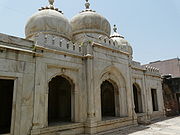
. His grave lies, next to the dargah
of 13th century, Sufi saint, Qutbuddin Bakhtiar Kaki
at Mehrauli
, in a marble enclosure, along with that of Shah Alam II
, and Akbar II.
Burhanpur
Burhanpur is an important city in Madhya Pradesh state, India. It is the administrative seat of Burhanpur District. It is situated on the north bank of the Tapti River, southwest of Bhopal and northeast of Mumbai...
–27 February 1712, Lahore
Lahore
Lahore is the capital of the Pakistani province of Punjab and the second largest city in the country. With a rich and fabulous history dating back to over a thousand years ago, Lahore is no doubt Pakistan's cultural capital. One of the most densely populated cities in the world, Lahore remains a...
) was a Mughal Emperor
Mughal Empire
The Mughal Empire , or Mogul Empire in traditional English usage, was an imperial power from the Indian Subcontinent. The Mughal emperors were descendants of the Timurids...
, who ruled India
Indian subcontinent
The Indian subcontinent, also Indian Subcontinent, Indo-Pak Subcontinent or South Asian Subcontinent is a region of the Asian continent on the Indian tectonic plate from the Hindu Kush or Hindu Koh, Himalayas and including the Kuen Lun and Karakoram ranges, forming a land mass which extends...
from 1707 to 1712. His original name was Qutb ud-Din Muhammad Mu'azzam later titled as Shah Alam by his father. He took the throne name Bahadur Shah in 1707. His name Bahādur means "brave" & "hero" in Turko-Mongol languages. Reigning just five years, he was an old man of 63 when he came to power. He made settlements with the Marathas, tranquilized the Rajputs, and became friendly with the Sikhs in the Punjab. He was travelling throughout his reign and only came to rest in Lahore in the last few months of his life.
Early life
Muazzam, the third son of the emperor AurangzebAurangzeb
Abul Muzaffar Muhy-ud-Din Muhammad Aurangzeb Alamgir , more commonly known as Aurangzeb or by his chosen imperial title Alamgir , was the sixth Mughal Emperor of India, whose reign lasted from 1658 until his death in 1707.Badshah Aurangzeb, having ruled most of the Indian subcontinent for nearly...
through Nawab Bai Begum Saheba, the daughter of Raja of Rajauri (Jarral Rajput), was born in Burhanpur
Burhanpur
Burhanpur is an important city in Madhya Pradesh state, India. It is the administrative seat of Burhanpur District. It is situated on the north bank of the Tapti River, southwest of Bhopal and northeast of Mumbai...
in 1643. In his father's lifetime, Muazzam was deputed governor of the northwest territories by Aurangzeb. His province included those parts of the Punjab
Punjab region
The Punjab , also spelled Panjab |water]]s"), is a geographical region straddling the border between Pakistan and India which includes Punjab province in Pakistan and the states of the Punjab, Haryana, Himachal Pradesh, Chandigarh and some northern parts of the National Capital Territory of Delhi...
where the Sikh faith was blossoming. As governor, Muazzam relaxed the enforcement of Aurangzeb's severe edicts, and an uneasy calm prevailed in the province for a brief time. In fact, he maintained a friendly relationship with the last Sikh spiritual leader, Guru Gobind Singh
Guru Gobind Singh
Guru Gobind Singh is the tenth and last Sikh guru in a sacred lineage of ten Sikh gurus. Born in Patna, Bihar in India, he was also a warrior, poet and philosopher. He succeeded his father Guru Tegh Bahadur as the leader of Sikhs at a young age of nine...
. When Muazzam was challenging his brothers for the Mughal throne, Guru Gobind Singh provided military assistance to the liberal prince.
Reign
After Aurangzeb's death, Muazzam Bahadur Shah took the throne. A war of succession began immediately after Aurangzeb died. One younger brother, Prince Azam ShahAzam Shah
Mirza Muhammad Azam Shah was Emperor of the Mughal Empire and a son of Emperor Aurangzeb and Dilrus Bano Begum. He was a brother of Zeb-un-Nissa, Bahadur Shah I, and Sultan Muhammad Akbar. Like his brothers, Azam Shah married a daughter of Sultan Dara Shikoh.He served as the Governor of Berar...
, proclaimed himself emperor and marched towards Delhi
Delhi
Delhi , officially National Capital Territory of Delhi , is the largest metropolis by area and the second-largest by population in India, next to Mumbai. It is the eighth largest metropolis in the world by population with 16,753,265 inhabitants in the Territory at the 2011 Census...
, where he unsuccessfully fought Bahadur Shah and died after a nominal reign of three months. Another brother, Muhammad Kam Baksh, was killed in 1709.
Aurangzeb had imposed Sharia law within his kingdom with harsh enforcement of strict edicts. This led to increased militancy by many constituencies including the Maratha
Maratha
The Maratha are an Indian caste, predominantly in the state of Maharashtra. The term Marāthā has three related usages: within the Marathi speaking region it describes the dominant Maratha caste; outside Maharashtra it can refer to the entire regional population of Marathi-speaking people;...
s, the Sikh
Sikh
A Sikh is a follower of Sikhism. It primarily originated in the 15th century in the Punjab region of South Asia. The term "Sikh" has its origin in Sanskrit term शिष्य , meaning "disciple, student" or शिक्ष , meaning "instruction"...
s and the Rajput
Rajput
A Rajput is a member of one of the patrilineal clans of western, central, northern India and in some parts of Pakistan. Rajputs are descendants of one of the major ruling warrior classes in the Indian subcontinent, particularly North India...
s. Thus, rebellion was rife at the time of Aurangzeb's death. A more moderate man than his father, Bahadur Shah sought to improve relations with the militant constituencies of the rapidly crumbling kingdom. Bahadur Shah constantly struggled with the rise of Sikh strength, with the renegade Sikh named Banda being a constant threat to the empire. He was able to gain control over Assam purely because of the assistance he got from his son, Azim-ush-Shan
Azim-ush-Shan
Prince Azim-ush-Shan was the third son of Mughal emperor Bahadur Shah I, by his second wife, Maharajkumari Amrita Bai Sahiba. He was also the grandson of emperor Aurangzeb.-Reign:...
. Bahadur Shah never abolished jizyah, but the effort to collect the tax became ineffectual. Support to music was apparently renewed during his brief rule of five years. There was no destruction of temples in his reign. During Bahadur Shah's brief reign of 5 years, although the empire remained united, factionalism in the nobility reached a new height.
Sikhs
Mansabdar
Mansabdar was the generic term for the military -type grading of all imperial officials of the Mughal Empire. The mansabdars governed the empire and commanded its armies in the emperor's name...
in the Mughal Army
Mughal Army
The Mughal Army was the army of the Mughal Empire.Mirza Najaf Khan was commander in chief of the Mughal Army from 1772 till his death in April 1782.The art of Mughal warfare brought about a complete change in the way wars were fought in the Indian...
. His assassination in 1708 ended this period of amity. Guru Govind Singh's successor as temporal leader of the Sikhs was Banda, who returned to the Punjab declaring he was Guru Govind Singh miraculously brought back to life. In response to his call for disciples, many zealous Sikhs assembled and marched in arms to Sonepat, some twenty-five miles north of Delhi
Delhi
Delhi , officially National Capital Territory of Delhi , is the largest metropolis by area and the second-largest by population in India, next to Mumbai. It is the eighth largest metropolis in the world by population with 16,753,265 inhabitants in the Territory at the 2011 Census...
. There the Faujdar
Faujdar
Faujdar/Fouzder/Fouzdar/Foujdar was a title awarded by Muslim rulers to people who had responsibility of protecting some territory.In pre-Mughal times, the term referred to a military officer but did not refer to a specific rank. With the administrative reforms performed by Mughal emperor Akbar,...
, who was utterly unprepared, was routed. This success emboldened Banda. Accompanied by 40,000 men he set out to establish his power in the north. The town of Sadhaura, near Ambala
Ambala
Ambala is a city and a municipal corporation in Ambala district in the state of Haryana, India, located on the border of the states of Haryana and Punjab in India. Politically; Ambala has two sub-areas: Ambala Cantt and Ambala City, approximately 3 kilometers apart from each other...
, was captured, and the local Muslim
Muslim
A Muslim, also spelled Moslem, is an adherent of Islam, a monotheistic, Abrahamic religion based on the Quran, which Muslims consider the verbatim word of God as revealed to prophet Muhammad. "Muslim" is the Arabic term for "submitter" .Muslims believe that God is one and incomparable...
inhabitants were cruelly treated. He then moved against Sirhind, whose governor, Wazir Khan
Wazir Khan
Wazir Khan,Shaikh Ilam-ud-din Ansari , a native of Chiniot, who rose to be a minor court physician to Shah Jahan in Lahore, was a Mughal noble, who was the Subedar of Sirhind, he personally commanded an army of over 30,000 men consisting mainly of Muslim Rajputs.Wazir Khan is noted for his...
, was killed and held responsible for the execution of Guru Govind Singh's children. Banda's army pillaged the city for four days, and the whole Muslim Rajput population was slaughtered.
The situation became so serious that Bahadur Shah himself moved against Banda, and on December 4, 1710, he assisted the evacuation of those fleeing from Sadhaura regardless of their ethnicity. The Sikhs then moved into the strong fort of Lohgarh
Lohgarh
Lohgarh is a village in Notified Area Committee of Zirakpur in district Mohali in state of Punjab in India-Colonies in Lohgarh:* Dashmesh Colony Patiala HW* Golden Enclave* Lohgarh village* Panchsheel Enclave.* Badal Colony* Balaji Enclave...
, where Banda had issued coins in his own name violating the authority of the Mughal Emperor. Bahadur Shah then gathered his forces and captured during the Siege of Lohgarh, but Banda escaped. Order and normality among the peoples of Sirhind was reintroduced in January, 1711, and Banda fearing a possible massive retaliation, took shelter in the hills and rarely attacked the Mughal Army
Mughal Army
The Mughal Army was the army of the Mughal Empire.Mirza Najaf Khan was commander in chief of the Mughal Army from 1772 till his death in April 1782.The art of Mughal warfare brought about a complete change in the way wars were fought in the Indian...
.
Banda was finally dealt with, when the experienced Mughal
Mughal Empire
The Mughal Empire , or Mogul Empire in traditional English usage, was an imperial power from the Indian Subcontinent. The Mughal emperors were descendants of the Timurids...
commander Abdus Samad Khan and a Mughal Army
Mughal Army
The Mughal Army was the army of the Mughal Empire.Mirza Najaf Khan was commander in chief of the Mughal Army from 1772 till his death in April 1782.The art of Mughal warfare brought about a complete change in the way wars were fought in the Indian...
of over 60,000 men, had him surrounded and besieged at Gurdaspur. Although Banda's followers ferociously resisted their escape attempts were constantly foiled and after an 8 month siege by the Mughal Army
Mughal Army
The Mughal Army was the army of the Mughal Empire.Mirza Najaf Khan was commander in chief of the Mughal Army from 1772 till his death in April 1782.The art of Mughal warfare brought about a complete change in the way wars were fought in the Indian...
, the Sikhs surrendered on December 17, 1715. Banda and his followers were then taken to Delhi
Delhi
Delhi , officially National Capital Territory of Delhi , is the largest metropolis by area and the second-largest by population in India, next to Mumbai. It is the eighth largest metropolis in the world by population with 16,753,265 inhabitants in the Territory at the 2011 Census...
and executed by the orders of the then Mughal Emperor Farrukhsiyar
Farrukhsiyar
Abu'l Muzaffar Muin ud-din Muhammad Shah Farrukh-siyar Alim Akbar Sani Wala Shan Padshah-i-bahr-u-bar [Shahid-i-Mazlum] was the Mughal emperor between 1713 and 1719. Noted as a handsome but weak ruler, easily swayed by his advisers, Farukhsiyar lacked the ability and character to rule independently...
in the year 1716.
Death
Bahadur Shah died on 27 February 1712 in LahoreLahore
Lahore is the capital of the Pakistani province of Punjab and the second largest city in the country. With a rich and fabulous history dating back to over a thousand years ago, Lahore is no doubt Pakistan's cultural capital. One of the most densely populated cities in the world, Lahore remains a...
while making alterations to the Shalimar Gardens. He was succeeded by his son Jahandar Shah
Jahandar Shah
Jahandar Shah was a Mughal Emperor who ruled India for a brief period in 1712-1713. His title was Shahanshah-i-Ghazi Abu'l Fath Muiz-ud-Din Muhammad Jahandar Shah Sahib-i-Quran Padshah-i-Jahan .-Early life:...
. His grave lies, next to the dargah
Dargah
A Dargah is a Sufi shrine built over the grave of a revered religious figure, often a Sufi saint. Local Muslims visit the shrine known as . Dargahs are often associated with Sufi meeting rooms and hostels, known as khanqah...
of 13th century, Sufi saint, Qutbuddin Bakhtiar Kaki
Qutbuddin Bakhtiar Kaki
Qutub ul Aqtab Hazrat Khwaja Syed Muhammad Qutbuddin Bakhtiar Kaki was a renowned Muslim Sufi mystic, saint and scholar of the Chishti Order from Delhi, India. He was the disciple and the spiritual successor of Moinuddin Chishti as head of the Chishti order. Before him the Chishti order in India...
at Mehrauli
Mehrauli
Mehrauli is a neighbourhood in the South West district of Delhi in India. It represents a constituency in the legislative assembly of Delhi. The area is located close to Gurgaon.-History:...
, in a marble enclosure, along with that of Shah Alam II
Shah Alam II
Shah Alam II , also known as Ali Gauhar, was a Mughal emperor of India. A son of Alamgir II, he was exiled to Allahabad in December 1759 by Ghazi-ud-Din, who appointed Shah Jahan III as the emperor. Later, he was nominated as the emperor by Ahmad Shah.Shah Alam II was considered the only and...
, and Akbar II.
See also
- Shah Alam IIShah Alam IIShah Alam II , also known as Ali Gauhar, was a Mughal emperor of India. A son of Alamgir II, he was exiled to Allahabad in December 1759 by Ghazi-ud-Din, who appointed Shah Jahan III as the emperor. Later, he was nominated as the emperor by Ahmad Shah.Shah Alam II was considered the only and...