
Home      Discussion      Topics      Dictionary      Almanac
Signup       Login
BMW motorcycles

BMW motorcycles

Overview

Discussion
Ask a question about 'BMW motorcycles'
Start a new discussion about 'BMW motorcycles'
Answer questions from other users
Full Discussion Forum
 
Unanswered Questions
Recent Discussions
Encyclopedia

BMW
BMW
Bayerische Motoren Werke AG is a German automobile, motorcycle and engine manufacturing company founded in 1916. It also owns and produces the Mini marque, and is the parent company of Rolls-Royce Motor Cars. BMW produces motorcycles under BMW Motorrad and Husqvarna brands...

's motorcycle history began in 1921 when the company commenced manufacturing engines for other companies. Motorcycle manufacturing now operates under the BMW Motorrad
BMW Motorrad
BMW Motorrad is the motorcycle brand of the German company BMW, part of its Corporate and Brand Development division. The current General Director of the unit is Hendrik von Kuenheim....

 brand. BMW (Bayerische Motoren Werke AG) introduced the first motorcycle under its name, the R32
BMW R32
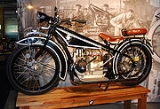
The BMW R32 was the first motorcycle produced by BMW under the BMW name. An aircraft engine manufacturer during World War I, BMW was forced to diversify after the Treaty of Versailles banned the German air force and German aircraft manufacture...

, in 1923.

Motorcycle history


Pre-1921


BMW
BMW
Bayerische Motoren Werke AG is a German automobile, motorcycle and engine manufacturing company founded in 1916. It also owns and produces the Mini marque, and is the parent company of Rolls-Royce Motor Cars. BMW produces motorcycles under BMW Motorrad and Husqvarna brands...

 began in 1916 as a reorganization of Rapp Motorenwerke
Rapp Motorenwerke
Rapp Motorenwerke GmbH was one of the first aircraft engine manufacturers in Germany at the turn of the 20th Century and underwent numerous mergers and changes before becoming BMW AG.-Early engines:...

, an aircraft
Aircraft
An aircraft is a vehicle that is able to fly by gaining support from the air, or, in general, the atmosphere of a planet. An aircraft counters the force of gravity by using either static lift or by using the dynamic lift of an airfoil, or in a few cases the downward thrust from jet engines.Although...

 engine
Engine
An engine or motor is a machine designed to convert energy into useful mechanical motion. Heat engines, including internal combustion engines and external combustion engines burn a fuel to create heat which is then used to create motion...

 manufacturer that began production before World War I
World War I
World War I , which was predominantly called the World War or the Great War from its occurrence until 1939, and the First World War or World War I thereafter, was a major war centred in Europe that began on 28 July 1914 and lasted until 11 November 1918...

. With the Armistice, the Treaty of Versailles
Treaty of Versailles
The Treaty of Versailles was one of the peace treaties at the end of World War I. It ended the state of war between Germany and the Allied Powers. It was signed on 28 June 1919, exactly five years after the assassination of Archduke Franz Ferdinand. The other Central Powers on the German side of...

 banned the German air force
Luftwaffe
Luftwaffe is a generic German term for an air force. It is also the official name for two of the four historic German air forces, the Wehrmacht air arm founded in 1935 and disbanded in 1946; and the current Bundeswehr air arm founded in 1956....

 and the manufacture of aircraft in Germany, so the company turned to making air brakes, industrial engines, agricultural machinery, toolboxes and office furniture and then to motorcycles and cars.

1921–1945


In 1921, BMW began manufacture of its M2B15
BMW M2B15
The BMW M2B15 was a portable industrial engine manufactured by BMW from 1919 to 1922. It was used by several German motorcycle manufacturers to power their motorcycles....

 flat-twin engine. Designed by Max Friz
Max Friz
Max Friz was a German mechanical engineer specializing in engine design. He was the key contributor of engine design and innovation that led to the founding of Bayerische Motoren Werke AG in 1917.-Early life:...

 for use as a portable industrial engine, the M2B15 was largely used by motorcycle manufacturers, notably Victoria
Victoria (motorcycle)
Victoria was a bicycle manufacturer in Nürnberg, Germany that made motorcycles from about 1901 until 1966. It should not be confused with a lesser-known, unrelated Victoria Motorcycle Company in Glasgow, Scotland that made motorcycles between 1902 and 1928....

 of Nuremberg
Nuremberg
Nuremberg[p] is a city in the German state of Bavaria, in the administrative region of Middle Franconia. Situated on the Pegnitz river and the Rhine–Main–Danube Canal, it is located about north of Munich and is Franconia's largest city. The population is 505,664...

, and Bayerische Flugzeugwerke in their Helios motorcycle. Friz was also working on car
Automobile
An automobile, autocar, motor car or car is a wheeled motor vehicle used for transporting passengers, which also carries its own engine or motor...

 engines.

BMW merged with Bayerische Flugzeugwerke in 1922, inheriting from them the Helios motorcycle and a small two-stroke motorized bicycle
Motorized bicycle
A motorized bicycle, motorbike, cyclemotor, or vélomoteur is a bicycle with an attached motor and transmission used either to power the vehicle unassisted, or to assist with pedaling. Since it always retains both pedals and a discrete connected drive for rider-powered propulsion, the motorized...

 called the Flink. In 1923, BMW's first "across the frame" version of the boxer engine was designed by Friz. The R32
BMW R32
The BMW R32 was the first motorcycle produced by BMW under the BMW name. An aircraft engine manufacturer during World War I, BMW was forced to diversify after the Treaty of Versailles banned the German air force and German aircraft manufacture...

 had a 486 cc engine with 8.5 hp and a top speed of 95 kilometre per hour. The engine and gearbox
Transmission (mechanics)
A machine consists of a power source and a power transmission system, which provides controlled application of the power. Merriam-Webster defines transmission as: an assembly of parts including the speed-changing gears and the propeller shaft by which the power is transmitted from an engine to a...

 formed a bolt-up single unit
Unit construction
Unit construction is a term used to describe the design of larger motorcycles where the engine and gearbox components share a single casing. The term is sometimes applied to the design of automobile engines and was often loosely applied to motorcycles with rather different internal layouts such as...

. At a time when many motorcycle manufacturers used total-loss oiling systems, the new BMW engine featured a recirculating wet sump
Wet sump
A wet sump is a lubricating oil management design for four-stroke piston internal combustion engines which uses a built-in reservoir for oil, as opposed to an external or secondary reservoir used in a dry sump design....

 oiling system with a drip feed to roller bearings. This system was used by BMW until 1969, when they adopted the "high-pressure oil" system based on shell bearings and tight clearances, still in use today.

The R32 became the foundation for all future boxer-powered BMW motorcycles. BMW oriented the boxer engine with the cylinder heads projecting out on each side for cooling as did the earlier British ABC
ABC motorcycles
ABC motorcycles was a British motorcycle manufacturer established in 1914 by Ronald Charteris in London. Several British motorcycle firms started up with the name "ABC", including Sopwith. The All British Engine Company Ltd...

. Other motorcycle manufacturers, including Douglas (motorcycles)
Douglas (motorcycles)
Douglas was a British motorcycle manufacturer from 1907–1957 based in Kingswood, Bristol, owned by the Douglas family, and especially known for its horizontally opposed twin cylinder engined bikes and as manufacturers of speedway machines...

 and Harley-Davidson
Harley-Davidson
Harley-Davidson , often abbreviated H-D or Harley, is an American motorcycle manufacturer. Founded in Milwaukee, Wisconsin, during the first decade of the 20th century, it was one of two major American motorcycle manufacturers to survive the Great Depression...

, aligned the cylinders with the frame, one cylinder facing towards the front wheel and the other towards the back wheel.

The R32 also incorporated shaft drive. BMW continued to use shaft drive in all of its motorcycles until the introduction of the F650
BMW F650 single
The BMW F650 is a family of single-cylinder motorcycles that was produced by BMW Motorrad beginning in 1993. Models include the F650ST Strada, F650 Funduro, F650GS, F650GS Dakar and latterly the G650GS...

 in 1994, which featured chain drive.

In 1937, Ernst Henne
Ernst Jakob Henne
Ernst Jakob Henne was a distinguished German motorcycle racer and racecar driver.Henne was born in the village of Weiler, near Wangen im Allgäu. His father was a saddlemaker. In 1919 Henne was apprenticed to a become a motor vehicle mechanic. He started racing in 1923 in Mühldorf, and in 1925 he...

 rode a supercharged
Supercharger
A supercharger is an air compressor used for forced induction of an internal combustion engine.The greater mass flow-rate provides more oxygen to support combustion than would be available in a naturally aspirated engine, which allows more fuel to be burned and more work to be done per cycle,...

 500 cc overhead camshaft
Overhead camshaft
Overhead cam valvetrain configurations place the engine camshaft within the cylinder heads, above the combustion chambers, and drive the valves or lifters in a more direct manner compared to overhead valves and pushrods...

 BMW 173.88 mph (77.7 m/s), setting a world record that stood for 14 years.

During World War II
World War II
World War II, or the Second World War , was a global conflict lasting from 1939 to 1945, involving most of the world's nations—including all of the great powers—eventually forming two opposing military alliances: the Allies and the Axis...

 the Wehrmacht
Wehrmacht
The Wehrmacht – from , to defend and , the might/power) were the unified armed forces of Nazi Germany from 1935 to 1945. It consisted of the Heer , the Kriegsmarine and the Luftwaffe .-Origin and use of the term:...

 needed as many vehicles as it could get of all types and many other German companies were asked to build motorcycles. The BMW R75
BMW R75
The BMW R75 is a World War II-era motorcycle and sidecar combination produced by the German company BMW.In the 1930s BMW were producing a number of popular and highly effective motorcycles...

, a copy of a Zündapp
Zündapp
Zündapp was a major German motorcycle manufacturer. The company was founded in 1917 in Nuremberg by Fritz Neumeyer, together with the Friedrich Krupp AG and the machine tool manufacturer Thiel under the name "Zünder- und Apparatebau G.m.b.H." as a producer of detonators...

 KS750, performed particularly well in the harsh operating environment of the North African Campaign
North African campaign
During the Second World War, the North African Campaign took place in North Africa from 10 June 1940 to 13 May 1943. It included campaigns fought in the Libyan and Egyptian deserts and in Morocco and Algeria and Tunisia .The campaign was fought between the Allies and Axis powers, many of whom had...

. Motorcycles of every style had performed acceptably well in Europe, but in the desert the protruding cylinders of the flat-twin engine performed better than configurations which overheated in the sun, and shaft drives performed better than chain-drives which were damaged by desert grit.

So successful were the BMWs as war-machines that the U.S. Army asked Harley-Davidson, Indian
Indian 841
The Indian 841 was a motorcycle designed by the Indian Manufacturing Co. for desert warfare. It pioneered the drivetrain configuration later popularized by Moto Guzzi, having a longitudinally mounted air-cooled 90-degree V-twin with shaft drive to the rear wheel.-History:During World War II, the...

 and Delco
Delco Electronics
Delco Electronics Corporation was the automotive electronics design and manufacturing subsidiary of General Motors based in Kokomo, Indiana.The name Delco came from the Dayton Engineering Laboratories Co., founded in Dayton, Ohio by Charles Kettering and Edward A...

 to produce a motorcycle similar to the side-valve
Flathead engine
A flathead engine is an internal combustion engine with valves placed in the engine block beside the piston, instead of in the cylinder head, as in an overhead valve engine...

 BMW R71. Harley copied the BMW engine and transmission — simply converting metric measurements to inches — and produced the shaft-drive 750 cc 1942 Harley-Davidson XA
Harley-Davidson XA
The Harley-Davidson XA was a flat-twin shaft drive motorcycle made by Harley-Davidson for the US Army during World War II....

.

1945–1955


The end of World War II
World War II
World War II, or the Second World War , was a global conflict lasting from 1939 to 1945, involving most of the world's nations—including all of the great powers—eventually forming two opposing military alliances: the Allies and the Axis...

 found BMW in ruins. Its plant outside of Munich was destroyed by Allied bombing. The Eisenach
Eisenach
Eisenach is a city in Thuringia, Germany. It is situated between the northern foothills of the Thuringian Forest and the Hainich National Park. Its population in 2006 was 43,626.-History:...

 facility while badly damaged was not totally destroyed and tooling and machinery was safely stored nearby. The facility was not dismantled by the Soviets as reparations and sent back to the Soviet Union where it was reassembled in Irbit
Irbit
Irbit is a town in Sverdlovsk Oblast, Russia, located from Yekaterinburg by train or by car on the right bank of the Nitsa River. It is crossed by long distance railway Yekaterinburg–Tavda–Ustye-Akha and by road traffic routes, directed to Kamyshlov, Artyomovsk, Turinsk, and Tyumen. Total area...

 to make IMZ-Ural
IMZ-Ural
IMZ-Ural is a Russian maker of heavy sidecar motorcycles. Recently the company has developed a solo motorcycle with no sidecar.In 1940, the Soviet Union acquired the design and production techniques for BMW R 71 motorcycles and sidecars. The first M-72 model was finished in 1941...

 motorcycles as is commonly alleged. The IMZ plant was supplied to the Soviets by BMW under license prior to the commencement of the Great Patriotic War
Eastern Front (World War II)
The Eastern Front of World War II was a theatre of World War II between the European Axis powers and co-belligerent Finland against the Soviet Union, Poland, and some other Allies which encompassed Northern, Southern and Eastern Europe from 22 June 1941 to 9 May 1945...

. After the war the terms of Germany's surrender forbade BMW from manufacturing motorcycles. Most of BMW's brightest engineers were taken to the US and the Soviet Union to continue their work on jet engines which BMW produced during the war.

When the ban on the production of motorcycles was lifted in Allied controlled Western Germany, BMW had to start from scratch. There were no plans, blueprints, or schematic drawings because they were all in Eisenach. Company engineers had to use surviving pre-war motorcycles to copy the bikes. The first post-war BMW motorcycle in Western Germany, a 250 cc R24, was produced in 1948. The R24 was based on the pre-war R23, and was the only postwar West German BMW with no rear suspension. In 1949, BMW produced 9,200 units and by 1950 production surpassed 17,000 units.

BMW boxer twins manufactured from 1950 to 1956 included the 500 cc models R51/2 and 24 hp R51/3, the 600 cc models 26 hp R67, 28 hp R67/2, and R67/3, and the sporting 35 hp 600 cc model R68. All these models came with plunger rear suspensions
Suspension (motorcycle)
A motorcycle's suspension serves a dual purpose: contributing to the vehicle's handling and braking, and providing safety and comfort by keeping the vehicle's passengers comfortably isolated from road noise, bumps and vibrations....

, telescopic front forks, and chromed, exposed drive shafts. Except for the R68, all these twins came with "bell-bottom" front fenders and front stands.

The situation was very different in Soviet-controlled Eastern Germany where BMW's sole motorcycle plant in Eisenach was producing R35 and a handful of R75 motorcycles for reparations. This resulted in one BMW motorcycle plant existing in Eisenach between 1945 and 1948 and two motorcycle companies existing between 1948 and 1952. One was a BMW in Munich in Western Germany (later the German Federal Republic) and the other in Soviet controlled Eisenach, Eastern Germany (later the German Democratic Republic), both using the BMW name. Eventually in 1952. after the Soviets ceded control of the plant to the East German Government, and following a trademark lawsuit, this plant was renamed EMW (Eisenacher Motoren Werke
Eisenacher Motorenwerk
Eisenacher Motorenwerk was an East German manufacturer of automobiles and motorcycles based in Eisenach. EMW also entered Formula One as a constructor in 1953, but participated in only one race, the 1953 German Grand Prix....

). Instead of BMW's blue-and-white roundel, EMW used a very similar red-and-white roundel as its logo. No motorcycles made in East Germany after World War II were manufactured under the authority of BMW in Munich as there was no need for an occupying power to gain such authority. After the collapse of the Iron Curtain
Iron Curtain
The concept of the Iron Curtain symbolized the ideological fighting and physical boundary dividing Europe into two separate areas from the end of World War II in 1945 until the end of the Cold War in 1989...

 many EMW models have made their way to the USA. It is possible to find find restored R35 motorcycles today parts of which are EMW and parts of which are BMW as many parts are interchangeable, making authentic identification quite difficult because all BMW R35 motorcycles were produced in Eisenach until 1952, when they became EMW.

1955–1969


As the 1950s progressed, motorcycle sales plummeted. In 1957, three of BMW's major German competitors went out of business. In 1954, BMW produced 30,000 motorcycles. By 1957, that number was less than 5,500. However, by the late 1950s, BMW exported 85% of its boxer twin powered motorcycles to the United States. At that time, Butler & Smith, Inc. was the exclusive U.S. importer of BMW.

In 1955, BMW began introducing a new range of motorcycles with Earles forks and enclosed drive shafts. These were the 26 hp 500 cc R50, the 30 hp 600 cc R60, and the 35 hp sporting 600 cc R69.

On June 8, 1959, John Penton rode a BMW R69 from New York to Los Angeles in 53 hours and 11 minutes, slashing over 24 hours from the previous record of 77 hours and 53 minutes set by Earl Robinson on a 45 cubic inch (740 cc) Harley-Davidson
Harley-Davidson
Harley-Davidson , often abbreviated H-D or Harley, is an American motorcycle manufacturer. Founded in Milwaukee, Wisconsin, during the first decade of the 20th century, it was one of two major American motorcycle manufacturers to survive the Great Depression...

.

Although U.S. sales of BMW motorcycles were strong, BMW was in financial trouble. Through the combination of selling off its aircraft engine division and obtaining financing with the help of Herbert Quandt
Herbert Quandt
Herbert Werner Quandt , was a German industrialist who is regarded as having saved BMW when it was at the point of bankruptcy and made huge profit in doing so.- Early life :...

, BMW was able to survive. The turnaround was thanks in part to the increasing success of BMW's automotive division. Since the beginnings of its motorcycle manufacturing, BMW periodically introduced single-cylinder models. In 1967, BMW offered the last of these, the R27
BMW R27
The 247 cc BMW R27, introduced in 1960, was the last shaft-driven, single-cylinder motorcycle manufactured by BMW.-History:After World War II, the Potsdam Agreement of the USSR, USA, and the UK, prohibited BMW Aktiengesellschaft from building motorcycles...

. Most of BMW's offerings were still designed to be used with sidecars. By this time sidecars were no longer a consideration of most riders; people were interested in sportier motorcycles.

The 26 hp R50/2
BMW R60/2
The R60 and R60/2 are 600 cc boxer-twin that were manufactured from 1956 to 1969 in Munich, Germany, by BMW.-Production history:Some 20,133 of these 600 cc shaft-drive, opposed twin R60 , R60/2 , and R60US were built...

, 30 hp R60/2
BMW R60/2
The R60 and R60/2 are 600 cc boxer-twin that were manufactured from 1956 to 1969 in Munich, Germany, by BMW.-Production history:Some 20,133 of these 600 cc shaft-drive, opposed twin R60 , R60/2 , and R60US were built...

, and 42 hp R69S
BMW R69S
The R69S, R69US, and R69 are motorcycles, fitted with 594 cc boxer twin engines, that were manufactured by BMW in Munich, Germany.-Production history:...

 marked the end of sidecar-capable BMWs. Of this era, the R69S remains the most desirable example of the dubbed "/2" ("slash-two") series because of significantly greater engine power than other models, among other features unique to this design.

For the 1968 and 1969 model years only, BMW exported into the United States three "US" models. These were the R50US, the R60US
BMW R60/2
The R60 and R60/2 are 600 cc boxer-twin that were manufactured from 1956 to 1969 in Munich, Germany, by BMW.-Production history:Some 20,133 of these 600 cc shaft-drive, opposed twin R60 , R60/2 , and R60US were built...

, and the R69US
BMW R69S
The R69S, R69US, and R69 are motorcycles, fitted with 594 cc boxer twin engines, that were manufactured by BMW in Munich, Germany.-Production history:...

. On these motorcycles, there were no sidecar lugs attached to the frame and the front forks were telescopic forks
Motorcycle fork
A motorcycle fork connects a motorcycle's front wheel and axle to its frame, typically via a pair of triple clamps. It typically incorporates the front suspension and front brake, and allows the bike to be steered via handlebars attached to the top clamp....

, which were later used worldwide on the slash-5 series of 1970 through 1973. Earles-fork models were sold simultaneously in the United States as buyers had their choice of front suspensions.

1970–1982


In 1970, BMW introduced an entirely revamped product line of 500 cc, 600 cc and 750 cc displacement models, the R50/5, R60/5 and R75/5 respectively and came with the "US" telescopic forks noted above. The engines were a complete redesign. The roller and ball-bearings in the bottom end had been replaced by shell-type journal bearings
Plain bearing
A plain bearing, also known as a plane bearing or a friction bearing is the simplest type of bearing, comprising just a bearing surface and no rolling elements. Therefore the journal slides over the bearing surface. The simplest example of a plain bearing is a shaft rotating in a hole...

 similar to those used in modern car engines. The camshaft, which had been at the top of the engine, was placed under the crankshaft, giving better ground clearance under the cylinders while retaining the low centre of gravity
Center of mass
In physics, the center of mass or barycenter of a system is the average location of all of its mass. In the case of a rigid body, the position of the center of mass is fixed in relation to the body...

 of the flat-twin layout. The new engine had an electric starter, although the traditional gearbox-mounted kick start
Kick start
Kick start refers to a method of starting an internal combustion engine by pushing a ratcheting lever with one's foot. Kick start mechanisms were almost universally a part of motorcycle engines before the mid-1970s, and were phased out of production over the next twenty years or so as electric...

er was retained. The styling of the first models included chrome-plated side panels and a restyled tank, these have been called "toaster" models because of the tank's resemblance to a kitchen toaster.

The /5 series was given a longer rear swingarm, resulting in a longer wheelbase. This improved the handling and allowed a larger battery to be installed. These were called the long wheelbase, LWB, 1973½ versions.

The /5 models were short-lived, however, being replaced by another new product line in 1974. In that year the 500 cc model was deleted from the lineup and an even bigger 900 cc model was introduced, along with improvements to the electrical system and frame geometry. These models were the R60/6, R75/6 and the R90/6. In 1973 a supersport model, the BMW R90S
BMW R90S
The BMW R90S is a sport motorcycle that was produced by BMW between 1973 and 1976. The first United States AMA Superbike Championship was won in 1976 by British rider Reg Pridmore on a R90S.-Technical overview:...

, was introduced. In 1975, the kick starter was finally eliminated. In addition to "/" or "slash" models, other Airhead models such as the G/S (later, GS) and ST also have dedicated followings within BMW circles, while others favor certain earlier models like /5 "toasters." Each has its merits which owners will freely debate with enthusiasm.
In 1977, the product line moved on to the "/7" models. The R80/7 was added to the line. The R90 (898 cc) models, "/6" and R90S models were replaced by updated versions with a new 1,000 cc; engine, the R100/7, the R100S and the new super sport model the R100RS with a full fairing
Motorcycle fairing
A motorcycle fairing is a shell placed over the frame of some motorcycles, especially racing motorcycles and sport bikes, with the primary purpose to reduce air drag. The secondary functions are the protection of the rider from airborne hazards and wind-induced hypothermia and of the engine...

. This sleek model, designed through wind-tunnel testing, produced 70 hp (51 kW) and had a top speed of 200 km/h (124 mph). The R100RS had a shorter rear end ratio to overcome the higher wind resistance of the full fairing. Many period motorcycle tests in Germany (Das Motorrad) indicated it was actually slightly slower than the R100S with only 65 hp. In 1978, the R100RT was introduced into the lineup for the 1979 model year, as the first "full-dress" tourer, designed to compete in this market with the forthcoming Honda Gold Wing.

In 1979, the R60 was replaced with the 650 cc R65
BMW R65
The BMW R65 was a light touring motorcycle introduced by BMW in 1978 to add a mid-size motorcycle to its product line. The original R65 was made up until 1984 with a smaller frame than larger R series motorcycles, but in 1985 the R65’s engine was put into the new R80 frame which featured a single...

, an entry-level motorcycle with 48 hp that had its very own frame design. Due to its smaller size and better geometrics, front and rear 18 inches (457.2 mm) wheels and a very light flywheel, was an incredibly well-handling bike that could easily keep up and even run away from its larger brothers when in proper hands on sinuous roads. BMW added a variant in 1982: the R65LS
BMW R65
The BMW R65 was a light touring motorcycle introduced by BMW in 1978 to add a mid-size motorcycle to its product line. The original R65 was made up until 1984 with a smaller frame than larger R series motorcycles, but in 1985 the R65’s engine was put into the new R80 frame which featured a single...

, a "sportier" model with a one-fourth fairing, double front disc brakes, stiffer suspension and different carburettors that added 5 hp. A short stroke version of the R65, the 450 cc R45 appeared in some markets.

1983–2003


In early 1983, BMW introduced a 1,000 cc, in-line four-cylinder, water-cooled engine to the European market, the K100. The K series comes with a simplified and distinctive rear suspension, a single-sided swingarm. (In 1985 the traditionally powered boxer R80RT touring bike received this monolever rear suspension system and in 1987 the R100RT received it).

In 1985, BMW introduced a 750 cc three-cylinder version, this one smoothed with another first, a counterbalance
Balance shaft
In piston engine engineering, a balance shaft is an eccentric weighted shaft which offsets vibrations in engine designs that are not inherently balanced...

 shaft.

In 1986, BMW introduced an electrically adjustable windshield on the K100LT.

In 1988, BMW introduced ABS
Anti-lock braking system
An anti-lock braking system is a safety system that allows the wheels on a motor vehicle to continue interacting tractively with the road surface as directed by driver steering inputs while braking, preventing the wheels from locking up and therefore avoiding skidding.An ABS generally offers...

 on its motorcycles. ABS became standard on all BMW K models. In 1993 ABS was first introduced on BMW's boxer line on the R1100RS. It has since become available as an option on the rest of BMW's motorcycle range.

In 1989, BMW introduced its version of a full-fairing sport bike, the K1. It was based upon the K100 engine, but now with four valves per cylinder. Output was near 100 hp.

In 1995, BMW ceased production of airhead
Airhead (motorcycle)
Airheads are the traditional BMW motorcycles with a flat-twin air-cooled engine that were built from 1923 to 1995...

 2-valve engines and moved its boxer engined line completely over to the 4-valve oilhead
Oilhead
An oilhead is the name used for BMW motorcycle engines that advertise the use of oil cooling to transfer some of the heat from the engine to the atmosphere....

 system first introduced in 1993.

During this period, BMW introduced a number of motorcycles including:
  • R Series (airheads) - R65GS, R80GS, R100GS,
  • R Series (oilheads) - R850R/GS/C, R1100R/RS/RT/GS
    BMW R1100GS
    The BMW R1100GS is a dual-sport motorcycle that was manufactured from 1993 to 1999 by BMW Motorrad in Berlin, Germany.The bike has a 1,085 cc flat-twin engine, first seen in the R1100RS which was launched the year before in 1992,...

    /S, R1150R/RS/RT/GS/S, R1200C
  • F Series - F650 Funduro, F650ST Strada, F650GS, F650GS Dakar
    BMW F650 single
    The BMW F650 is a family of single-cylinder motorcycles that was produced by BMW Motorrad beginning in 1993. Models include the F650ST Strada, F650 Funduro, F650GS, F650GS Dakar and latterly the G650GS...

    , F650CS Scarver
    BMW F650CS
    The F650CS was a standard motorcycle made by BMW Motorrad from 2001 to 2005. CS stood for city/street, as it was aimed at urban commuters and it was also known as the Scarver, a portmanteau of street and carver. The CS was the third generation in the F650 single series, after the 1993–2001 F650,...

  • K Series - K1
    BMW K1
    The BMW K1 is a motorcycle that was designed by BMW as a high-speed sports-tourer, designed to change the motorcycle media and buying public's mind of BMW as only a manufacturer of flat-twin tourers....

    , K100
    BMW K100
    The BMW K100 is a family of four-cylinder 987 cc motorcycles that were manufactured by BMW from 1983 to 1992.-Background:As the 1970s came to an end, BMW faced three problems from developing its flat-twin boxer engine further:...

    , K100RS
    BMW K100
    The BMW K100 is a family of four-cylinder 987 cc motorcycles that were manufactured by BMW from 1983 to 1992.-Background:As the 1970s came to an end, BMW faced three problems from developing its flat-twin boxer engine further:...

    , K100RT
    BMW K100
    The BMW K100 is a family of four-cylinder 987 cc motorcycles that were manufactured by BMW from 1983 to 1992.-Background:As the 1970s came to an end, BMW faced three problems from developing its flat-twin boxer engine further:...

    , K75
    BMW K75
    The BMW K75 was a standard motorcycle produced by BMW Motorrad from 1985 to 1995. At the time of its introduction, the K75 was BMW's cheapest motorcycle...

    , K75C
    BMW K75
    The BMW K75 was a standard motorcycle produced by BMW Motorrad from 1985 to 1995. At the time of its introduction, the K75 was BMW's cheapest motorcycle...

    , K75S
    BMW K75
    The BMW K75 was a standard motorcycle produced by BMW Motorrad from 1985 to 1995. At the time of its introduction, the K75 was BMW's cheapest motorcycle...

    , K75RT
    BMW K75
    The BMW K75 was a standard motorcycle produced by BMW Motorrad from 1985 to 1995. At the time of its introduction, the K75 was BMW's cheapest motorcycle...

    , K1100RS, K1100LT, K1200RS, K1200LT, K1200GT.
  • C1
    BMW C1
    The BMW C1 is an enclosed scooter manufactured by Bertone for BMW.-Models and options:Two models were manufactured. The '125' model has a 124 cc capacity four valve, four-stroke, water-cooled, fuel injected engine producing . The '200' model has a 176 cc engine producing...

     enclosed scooter
    Scooter (motorcycle)
    A scooter is a motorcycle with step-through frame and a platform for the operator's feet. Elements of scooter design have been present in some of the earliest motorcycles, and motorcycles identifiable as scooters have been made from 1914 or earlier...


The R1200C, produced from 1997 to 2004, was BMW Motorcycles only entry into the Cruiser
Cruiser (motorcycle)
Cruiser is the term for motorcycles that mimic the design style of American machines from the 1930s to the early 1960s, including those made by Harley-Davidson, Indian, Excelsior and Henderson. The market for models evocative of the early cruisers has grown to embrace 60 percent of the U.S...

 market. At the other end of the model lineup, the C1, produced from 2000 to 2002, was an enclosed scooter, the only scooter to be offered for sale by BMW.

K series


On 25 September 2004, BMW globally launched a radically redesigned K Series motorcycle, the K1200S, containing an all new in-line four-cylinder, liquid-cooled engine featuring 123 kW. The K1200S was primarily designed as a Super Sport motorcycle, albeit larger and heavier than the closest Japanese competitors. Shortly after the launch of the K1200S, problems were discovered with the new power plant leading to a recall until the beginning of 2005, when corrective changes were put in place.

In the years after the launch of K1200S, BMW has also launched the K1200R naked roadster, and the K1200GT
BMW K1200GT
The BMW K1200GT is a sport-touring motorcycle made by BMW. The second generation K1200GT, introduced in 2006, uses essentially the same inline-4 engine as the BMW K1200S sportbike, which held the world speed record in 2005 for its class at 173.57 mph ,and the K1200R...

 sport tourer, which started to appear in dealer showrooms in spring (March–June) 2006. All three new K-series motorcycles are based on the new in-line four-cylinder engine, with slightly varying degrees of power. In 2007, BMW added the K1200R Sport, a semi-faired sport touring version of the K1200R.

In October 2008, BMW launched three new 1,300 cc K-series models: the K1300R
BMW K1300R
The BMW K1300R is a naked motorcycle launched at the end of 2008 to replace the K1200R as BMW's flagship urban motorcycle. The K1300R produces a claimed @ 9,250 rpm from its 1,293 cc Inline-four engine with torque of @ 8,250 rpm...

, K1300S and K1300GT.
The K1300 models feature an increase in engine capacity of 136 cc, an increase in power to 175 hp, newly styled fairings and a new exhaust system.

In 2011, BMW launched two six-cylinder, 1,600 cc, K1600GT and K1600GTL
BMW K1600
The BMW K1600GTL and K1600GT are motorcycles announced by BMW Motorrad in July 2010,and unveiled at the Intermot motorcycle show in Cologne in October 2010.The bikes went on sale in March 2011....

 motorcycles, the former intended as a sport-tourer and the latter as a luxury touring
Touring motorcycle
A touring motorcycle is a type of motorcycle designed for touring. Although any motorcycle can be used to tour with, manufacturers have brought specific models designed to address the particular needs of these riders...

 model. The engine produces 160 hp and 129 lb.ft. They also offer adaptive headlights, traction control, ABS, tire pressure monitors, and a variety of sound systems.

R series


In 2004, bikes with the opposed-twin-cylinder "boxer" engine were also revamped. The new boxer displacement is 1170 cc. The engine is more powerful, and all of the motorcycles that use it are lighter than their predecessors.

The first motorcycle to be launched with this updated engine was the R1200GS
BMW R1200GS
The BMW R1200GS and R1200GS Adventure are motorcycles manufactured in Berlin, Germany by BMW Motorrad, part of the BMW group. It is one of the BMW GS family of dual sport motorcycles. Both motorcycles feature a 1,170 cc, 2-cylinder boxer engine with 4-valves per cylinder...

 dual-purpose motorcycle. The R1200RT
BMW r1200rt
The BMW R1200RT is a touring motorcycle that was introduced in 2005 by BMW Motorrad to replace the R1150RT model. It features a flat-twin engine with a six-speed gearbox and shaft drive.-Previous RT models, 1970s to 2004:...

 tourer and R1200ST sports tourer followed shortly behind. BMW then introduced the 175 kg (385.8 lb), 105 kW HP2 Enduro, and the 223 kg (491.6 lb), 100 hp R1200GS Adventure, each specifically targeting the off-road and adventure-touring motorcycle segment, respectively. In 2007, the HP2 Enduro was joined by the road-biased HP2 Megamoto fitted with smaller alloy wheels and street tyres.

In 2006, BMW launched the R1200R
BMW R1200R
The BMW R1200R is a naked motorcycle that was introduced in 2006 by BMW Motorrad. It replaces the R1150R, compared with which it has a weight saving and 28% increase in power.-External links:* * * * *...

 and the R1200S, which is rated at 90 kW @ 8,250 rpm.

F series


BMW has also paid attention to the F Series in 2006. It lowered the price on the existing F650GS and F650GS Dakar
BMW F650 single
The BMW F650 is a family of single-cylinder motorcycles that was produced by BMW Motorrad beginning in 1993. Models include the F650ST Strada, F650 Funduro, F650GS, F650GS Dakar and latterly the G650GS...

, and eliminated the F650CS
BMW F650CS
The F650CS was a standard motorcycle made by BMW Motorrad from 2001 to 2005. CS stood for city/street, as it was aimed at urban commuters and it was also known as the Scarver, a portmanteau of street and carver. The CS was the third generation in the F650 single series, after the 1993–2001 F650,...

 to make room in the lineup for the all-new F800 Series. The new motorcycles are powered by a parallel twin engine, built by Rotax
Rotax
BRP-Powertrain GmbH & Co KG , commonly known simply as Rotax, is an Austrian engine manufacturer. It develops and produces four-stroke and advanced two-stroke engines for Bombardier Recreational Products products as well as for motorcycles, karts,...

. They feature either a belt drive system, similar to the belt drive found on the now defunct F650CS, or chain drive. Initially, BMW launched two models of the new F800 Series, the F800S
BMW F800S
The F800S was a sport bike made by BMW Motorrad from 2006 to 2010. Along with the F800S, other bikes in the F-bike range are the dual-sport F800GS, the sport touring F800ST, and the naked F800R....

 sport bike and the F800ST sport tourer; these were followed by F650GS and F800GS
BMW GS parallel-twin
The BMW F800GS and F650GS are members of the GS family of dual-sport motorcycles manufactured in Berlin, Germany by BMW Motorrad. Both bikes were launched in 2008, and use the same 798 cc parallel-twin engine with chain drive, but with different power outputs and equipment levels...

 dual-purpose motorcycles, both of which use the 798 cc engine despite the different names.

G series


In October 2006, BMW announced the G series of offroad style motorcycles co-developed with Aprilia
Aprilia
Aprilia is an Italian motorcycle company, one of the seven marques owned by Piaggio, the world's fourth largest motorcycle manufacturer.Aprilia started as a scooter manufacturer, but has more recently come to be known for its race-winning sportbikes...

. These are equipped with an uprated single-cylinder water-cooled 652 cc fuel-injected engine producing 53 hp, similar to the one fitted to the single-cylinder F650GS
BMW F650 single
The BMW F650 is a family of single-cylinder motorcycles that was produced by BMW Motorrad beginning in 1993. Models include the F650ST Strada, F650 Funduro, F650GS, F650GS Dakar and latterly the G650GS...

, and are equipped with chain drive. There are three models in the series, all produced for BMW by Aprilia in their North Italian Scorzè
Scorzè
-Scorzè:Scorzè is a big town and comune in the province of Venice, in the Italian region of Veneto, located about 15 km southwest of Treviso and about 20 km northwest of Venice.The country is bordered by Zero Branco, Trebaseleghe and Noale....

 Plant, each focused on a slightly different market:
  • G650 Xchallenge hard enduro featuring 21 inch front and 18 inch rear spoked wheels
  • G650 Xcountry scrambler / adventure sports featuring 19 inch front and 17 inch rear spoked wheels
  • G650 Xmoto street moto / supermoto featuring 17 inch cast alloy wheels

In some markets the single-cylinder F650GS has been rebranded as the G650GS.

HP2 Series


First was the 175 kg (385.8 lb), 105 hp HP2 Enduro, followed by the road-biased HP2 Megamoto fitted with smaller alloy wheels and street tyres in 2007.

In April 2007, BMW announced its return to competitive road racing, entering a factory team with a "Sport Boxer" version of the R1200S to four 24-hour endurance races. In 2008 they released this as the HP2 Sport.

S1000RR


The S1000RR is a sport bike
Sport bike
A sport bike, also written as sportbike, is a motorcycle optimized for speed, acceleration, braking, and cornering on paved roads, typically at the expense of comfort and fuel economy in comparison to less specialized motorcycles...

 launched to compete in the 2009 Superbike World Championship
Superbike World Championship
Superbike World Championship is the worldwide Superbike racing Championship. The championship was founded in . The Superbike World Championship season consists of a series of rounds held on permanent racing facilities...

.
It is powered by a 999 cc inline-four engine producing 193 bhp.

Husqvarna acquisition


In July 2007, it was announced that BMW had signed a contract to acquire Husqvarna Motorcycles
Husqvarna Motorcycles
Husqvarna Motorcycles, a subsidiary of BMW, is a company manufacturing motocross, enduro and supermoto motorcycles. The company began producing motorcycles in 1903 at Huskvarna, Sweden, as a branch of the Husqvarna armament firm which had supplied the Swedish army with rifles since 1689.-History:As...

, including its production facilities and staff, from Italian manufacturer MV Agusta
MV Agusta
MV Agusta is a motorcycle manufacturer founded in 1945 near Milan in Cascina Costa, Italy. The company began as an offshoot of the Agusta aviation company formed by Count Giovanni Agusta in 1923. The Count died in 1927, leaving the company in the hands of his wife and sons, Domenico, Vincenzo,...

.

Engine types


There are currently four lines of BMW motorcycles:
  • F & G series singles
  • F series twins
  • R series
  • K series


The series differ primarily in the class of engine that each uses.

F and G series singles


The F Series of single-cylinder BMW motorcycles was first launched in 1994, as the F650
BMW F650 single
The BMW F650 is a family of single-cylinder motorcycles that was produced by BMW Motorrad beginning in 1993. Models include the F650ST Strada, F650 Funduro, F650GS, F650GS Dakar and latterly the G650GS...

, and was built by Aprilia
Aprilia
Aprilia is an Italian motorcycle company, one of the seven marques owned by Piaggio, the world's fourth largest motorcycle manufacturer.Aprilia started as a scooter manufacturer, but has more recently come to be known for its race-winning sportbikes...

 around a carbureted 650 cc four-stroke, four-valve, single piston engine, and chain drive. The mission for the F 650 was to provide an entry level BMW motorcycle. In 2000, the F650 was redesigned, now with fuel injection, and labeled the F650GS
BMW F650 single
The BMW F650 is a family of single-cylinder motorcycles that was produced by BMW Motorrad beginning in 1993. Models include the F650ST Strada, F650 Funduro, F650GS, F650GS Dakar and latterly the G650GS...

. An off-road focused F650 Dakar model was also launched that year. 2002 saw the addition of the F650CS
BMW F650CS
The F650CS was a standard motorcycle made by BMW Motorrad from 2001 to 2005. CS stood for city/street, as it was aimed at urban commuters and it was also known as the Scarver, a portmanteau of street and carver. The CS was the third generation in the F650 single series, after the 1993–2001 F650,...

 'Scarver' motorcycle to the line up. The Scarver was different from the F650GS variants in that it utilized a belt drive
Belt (mechanical)
A belt is a loop of flexible material used to link two or more rotating shafts mechanically. Belts may be used as a source of motion, to transmit power efficiently, or to track relative movement. Belts are looped over pulleys. In a two pulley system, the belt can either drive the pulleys in the...

 system opposed to a chain, had a much lower seat height, and was intended for on-road use. All F650 motorcycles produced from 2000 to 2007 used a 652 cc engine built in Austria by Rotax
Rotax
BRP-Powertrain GmbH & Co KG , commonly known simply as Rotax, is an Austrian engine manufacturer. It develops and produces four-stroke and advanced two-stroke engines for Bombardier Recreational Products products as well as for motorcycles, karts,...

 and were built by BMW in Berlin.

In late 2006, the G series of offroad biased bikes motorcycles was launched using the same 652 cc engine fitted to the F650GS, although that engine is no longer manufactured by Rotax. The latest version of the 652cc single engine fitted in the new G650GS is now produced in Berlin after 2 years production in Loncin, China.

In November 2007, the G450X sport enduro
Enduro
Enduro is a form of motorcycle sport run on courses that are predominantly off-road. Enduro consists of many different obstacles and challenges...

 motorcycle was launched using a 450 cc single-cylinder engine. The G450X contained several technological improvements over the Japanese off road racing motorcycles but the most unique and significant was the use of a single pivot point for the drive sprocket
Sprocket
A sprocket or sprocket-wheel is a profiled wheel with teeth, cogs, or even sprockets that mesh with a chain, track or other perforated or indented material. The name 'sprocket' applies generally to any wheel upon which are radial projections that engage a chain passing over it...

 and the swing arm. This unusual configuration allowed for a very tense drive chain
Chain drive
Chain drive is a way of transmitting mechanical power from one place to another. It is often used to convey power to the wheels of a vehicle, particularly bicycles and motorcycles...

 with no slop and eliminated acceleration squat. The former benefit saves on chain and sprocket wear and the later allows for a more consistent drive geometry and fully available rear suspension travel during heavy acceleration.

F series twins


In mid 2006, The F Series added two new motorcycles to the lineup, the F800S
BMW F800S
The F800S was a sport bike made by BMW Motorrad from 2006 to 2010. Along with the F800S, other bikes in the F-bike range are the dual-sport F800GS, the sport touring F800ST, and the naked F800R....

 sports bike and F800ST sports tourer, both which use an 798 cc parallel-twin engine built by Rotax
Rotax
BRP-Powertrain GmbH & Co KG , commonly known simply as Rotax, is an Austrian engine manufacturer. It develops and produces four-stroke and advanced two-stroke engines for Bombardier Recreational Products products as well as for motorcycles, karts,...

. Both motorcycles also feature a belt drive
Gilmer belt
Gilmer belt is a trade name for a type of belt used for transferring power between axles in a machine. The belt itself has ribs on the inner side to engage special pulleys mounted to the axles....

 system similar to what was in use on the F650S. In 2007 the single-cylinder F650GS was replaced with the twin-cylinder F800GS and F650GS
BMW GS parallel-twin
The BMW F800GS and F650GS are members of the GS family of dual-sport motorcycles manufactured in Berlin, Germany by BMW Motorrad. Both bikes were launched in 2008, and use the same 798 cc parallel-twin engine with chain drive, but with different power outputs and equipment levels...

 models. The latter uses a de-tuned version of the 798 cc engine fitted to the F800GS, marking a departure from BMW's naming convention.

R series


The R series are built around a horizontally opposed flat-twin
Flat-twin
A flat-twin is a two cylinder internal combustion engine with the cylinders arranged on opposite sides of the crankshaft. It is part of the class of flat engines, sub-type "boxer", and shares most characteristics of those engines.-Motorcycle use:...

 boxer engine. As the engine is mounted with a longitudinal crankshaft, the cylinder heads protrude well beyond the sides of the frame, making the R series motorcycles visually distinctive. Originally, R series bikes had air-cooled heads ("air heads
Airhead (motorcycle)
Airheads are the traditional BMW motorcycles with a flat-twin air-cooled engine that were built from 1923 to 1995...

"), but are now produced only with oil-cooled heads ("oilhead
Oilhead
An oilhead is the name used for BMW motorcycle engines that advertise the use of oil cooling to transfer some of the heat from the engine to the atmosphere....

s" and "hexheads").

Photo of Four different BMW "heads": How do you tell the different BMW valve covers ("heads") since 1970 apart? The "airhead" cover on a 1973 R75/5 is upper left. The first "oilhead" cover, introduced in model year 1993 in Europe and 1994 in the US, is upper right. The "oilhead" cover on an R1150RT, with two spark plug
Spark plug
A spark plug is an electrical device that fits into the cylinder head of some internal combustion engines and ignites compressed fuels such as aerosol, gasoline, ethanol, and liquefied petroleum gas by means of an electric spark.Spark plugs have an insulated central electrode which is connected by...

s per cylinder, is lower left. The latest "hexhead" cover, with an optional valve cover protector, on an R1200RT, is lower right.

Photo of Pre-1970 valve cover: A common valve cover from 1952 to 1969 on models R50, R60, R50/2, R60/2
BMW R60/2
The R60 and R60/2 are 600 cc boxer-twin that were manufactured from 1956 to 1969 in Munich, Germany, by BMW.-Production history:Some 20,133 of these 600 cc shaft-drive, opposed twin R60 , R60/2 , and R60US were built...

, R51/3, R67, R67/2, R67/3 had six fins. The R50S, R68, R69, and R69S
BMW R69S
The R69S, R69US, and R69 are motorcycles, fitted with 594 cc boxer twin engines, that were manufactured by BMW in Munich, Germany.-Production history:...

 of this period had two-fin valve covers.

K series


The K series BMW's have water-cooled engines of three (K75
BMW K75
The BMW K75 was a standard motorcycle produced by BMW Motorrad from 1985 to 1995. At the time of its introduction, the K75 was BMW's cheapest motorcycle...

), or four (K100, K1100, K1200, K1300), or six (K1600) cylinders. Until 2005, although currently in use on the K1200LT, the engine was longitudinally mounted
Longitudinal engine
In automotive engineering, a longitudinal engine is an internal combustion engine in which the crankshaft is oriented along the long axis of the vehicle, front to back....

, laid out on its left side with the cylinder heads on the left and the crankshaft on the right. It is called the "Flying Brick" because of the appearance of this layout. Sales did not meet BMW's expectations, and production ceased with the 1993 model. In 2004, BMW introduced a new four-cylinder water-cooled engine that transverses the chasis and is tilted forward 55 degrees. The BMW K75, three-cylinder, models were produced from 1985 to 1996.
The first K-series production bike was the K100
BMW K100
The BMW K100 is a family of four-cylinder 987 cc motorcycles that were manufactured by BMW from 1983 to 1992.-Background:As the 1970s came to an end, BMW faced three problems from developing its flat-twin boxer engine further:...

, which was introduced in the 1983. In 1988 BMW introduced the K1 which had the Bosch Motronic fuel injection system.

From 1985 to 1996, the K75 740 cc three-cylinder engine was produced.

In 1991 BMW increased the displacement of the K100 from 987 cc to 1,097 cc and the model designation became the K1100. The K1100LT was the first with the new engine displacement. In 1998 BMW increased the size again to 1,170 cc. This upgraded flat four engine appeared in the K1200RS. This engine is still in production for the K1200LT.

The later K1200 engine is a 1,157 cc transverse
Transverse engine
A transverse engine is an engine mounted in a vehicle so that the engine's crankshaft axis is perpendicular to the long axis of the vehicle. Many modern front wheel drive vehicles use this engine mounting configuration...

 inline-four, announced in 2003 and first seen in the 2005 K1200S. The new engine generates 123 kW an is tilted forwards 55 degrees. It is 43 cm (17 in) wide, giving the bikes a very low center of mass without reducing maximum lean angles.

In October 2008, BMW announced the new K1300GT, K1300S and K1300R models, all of which feature a larger capacity 1293 cc engine producing up to 175 hp. The new engine produces maximum power output 1,000 RPM lower than the previous engine, produces more torque due in part butterfly flap fitted in the exhaust.

In 2011, BMW launched the K1600
BMW K1600
The BMW K1600GTL and K1600GT are motorcycles announced by BMW Motorrad in July 2010,and unveiled at the Intermot motorcycle show in Cologne in October 2010.The bikes went on sale in March 2011....

 range—the K1600GT and K1600GTL—featuring a new 1649 cc straight-six engine, which is mounted transversely
Transverse engine
A transverse engine is an engine mounted in a vehicle so that the engine's crankshaft axis is perpendicular to the long axis of the vehicle. Many modern front wheel drive vehicles use this engine mounting configuration...

 across the chassis. The engine is angled forward by 50°.
The engine was originally used on the Concept 6, a concept bike
Concept car
A concept vehicle or show vehicle is a car made to showcase new styling and or new technology. They are often shown at motor shows to gauge customer reaction to new and radical designs which may or may not have a chance of being produced....

 that was shown at the 2009 EICMA Milan Motor Show
EICMA
EICMA , or the Milan Motorcycle Show is an annual trade show in Milan, Italy featuring motorcycles. The 2008 show drew over half a million visitors. The show is frequently used by manufacturers to debut new models....

.
BMW claims that the engine at 560 mm (22 in) wide, just 67 mm (2.6 in) wider than the K1300 engine, is the narrowest six-cylinder engine ever produced. Cylinder bore is 72 mm (2.8 in) and the distance between cylinder centres 77 mm (3 in).
The camshaft
Camshaft
A camshaft is a shaft to which a cam is fastened or of which a cam forms an integral part.-History:An early cam was built into Hellenistic water-driven automata from the 3rd century BC. The camshaft was later described in Iraq by Al-Jazari in 1206. He employed it as part of his automata,...

 is hollow, with cam lobes pressed on, which saves around 2 lb (0.90718474 kg).
The engine has electronic throttle control
Electronic throttle control
Electronic throttle control is an automobile technology which severs the mechanical link between the accelerator pedal and the throttle. Most automobiles already use a throttle position sensor to provide input to traction control, antilock brakes, fuel injection, and other systems, but use a...

 and multiple drive modes which can be set according to road conditions.

Model designation


BMW motorcycles are named according to a three-part code made up of the engine type, approximate engine volume, and styling information (e.g., sport, sport touring, luxury touring, etc.). The three parts are separated by blanks.

Engine type
  • R - boxer engine, horizontally opposed flat twin-cylinder
  • K - in-line 3- or 4-cylinder water-cooled engine
  • F & G - single or twin vertical cylinder water-cooled engine


Engine displacement in cc
  • Current models: 1300, 1200, 900, 800, 650 and 450. Previous models included 850, 1100, and 1150.
  • Older model BMWs divide the approximate engine displacement by ten for the model number. For example, K75 = approx 750 cc.


Styling suffix designations:
  • C - Cruiser
    Cruiser (motorcycle)
    Cruiser is the term for motorcycles that mimic the design style of American machines from the 1930s to the early 1960s, including those made by Harley-Davidson, Indian, Excelsior and Henderson. The market for models evocative of the early cruisers has grown to embrace 60 percent of the U.S...

  • CS - Classic Sport
  • G/S - Gelände/Strasse Off-road/Street
  • GS - Gelände Sport Off-road Sport (Enduro)
  • GT - Gran Turismo
    Grand tourer
    A grand tourer is a high-performance luxury automobile designed for long-distance driving. The most common format is a two-door coupé with either a two-seat or a 2+2 arrangement....

     or Grand Touring
  • LT - Luxus Tourer (Luxury Tourer)
  • R - Road or Roadster - typically naked
  • RS - Reise Sport (Travel Sport)
  • RT - Reise Tourer (Travel Tourer)
  • S - Sport
    Sport bike
    A sport bike, also written as sportbike, is a motorcycle optimized for speed, acceleration, braking, and cornering on paved roads, typically at the expense of comfort and fuel economy in comparison to less specialized motorcycles...

  • ST - Strasse (Street) or Sport Tourer
  • T - Touring


Additionally, a bike may have the following modifiers in its name:
  • A - ABS
  • L - luxury
  • P - police
    Police motorcycle
    A police motorcycle is a motorcycle used by various police forces and departments. They may be custom designed to meet the requirements unique of a particular use. A police motorcycle is often called a "motor" by police officers in the United States...

  • C - custom
  • PD - Paris Dakar


Examples: K1200S, R1200RT, F650GS, R1150RSL, K1200LT, K1200LT-C, R1200RT-P, R1200RSA.

Prior to the introduction of the K100 series and the R1100 series motorcycles, the letter prefix was always the same, and the numbers were either based on displacement, as mentioned above, or were just model numbers.

Single-sided rear suspension


The first BMW monolever suspensions appeared in 1980 on the then-new R80G/S range. It had a single universal joint immediately behind the engine/gear-box unit. This system was later included on updated versions of the K & R Series.

Paralever


Paralever is a further advance in BMW's single-sided rear suspension technology (photo right). It decouples torque reaction as the suspension compresses and extends, avoiding the tendency to squat under braking and reducing tyre chatter on the road surface. It was introduced in 1988 R80GS and R100GS motorcycles.
In 2005, along with the introduction of the "hexhead", BMW inverted the Paralever and moved the torque arm from the bottom to the top of the drive shaft housing (photo right). This reduces underhang of components and tends to increase ground clearance in right lean.

It is believed that the term Paralever was developed due to the appearance of a parallelogram shape between the four items making up the rear suspension (rear drive, drive shaft, transmission, and lower or upper brace). Other motorcycle manufacturers have patented versions of this system, including Arturo Magni for MV Agusta
MV Agusta
MV Agusta is a motorcycle manufacturer founded in 1945 near Milan in Cascina Costa, Italy. The company began as an offshoot of the Agusta aviation company formed by Count Giovanni Agusta in 1923. The Count died in 1927, leaving the company in the hands of his wife and sons, Domenico, Vincenzo,...

 and Moto Guzzi
Moto Guzzi
Moto Guzzi is an Italian motorcycle manufacturer. It is one of seven brands owned by Piaggio.Established in 1921 in Mandello del Lario, Italy, the company is noted for its central historic role in Italy's motorcycling manufacture, its prominence worldwide in motorcycle racing, and a series of...

's Compact Reactive Shaft Drive.

Telescopic front fork


In 1935, BMW fitted a hydraulically damped telescopic fork to its motorcycles. BMW still uses telescopic forks today on its F-series, G-series and HP motorcycles. The R-series and K-series use the Telelever and the Duolever front suspensions.

Earles front fork


Englishman Ernest Earles designed a unique triangulated fork that resists the side-forces introduced by sidecars (unlike telescopic forks).
BMW fitted the Earles fork to all its models for 14 years from 1955. In the event, this was the year that use of sidecar
Sidecar
A sidecar is a one-wheeled device attached to the side of a motorcycle, scooter, or bicycle, producing a three-wheeled vehicle.-History:A sidecar appeared in a cartoon by George Moore in the January 7, 1903, issue of the British newspaper Motor Cycling. Three weeks later, a provisional patent was...

s peaked and quickly fell off in most European markets (e.g. the UK) but the Earles fork system was well liked by solo riders too. It causes the front end of the motorcycle to rise under braking — the reverse of the action of a telescopic fork. The mechanical strength of this design sometimes proved to be a weakness to the rest of the motorcycle, since it transfers impact pressure to the frame where damage is more difficult and expensive to correct.

Telelever front fork


The Telelever system was developed by Saxon-Motodd in Britain in the early 1980s.
The Telelever is a unique front fork, where the shock absorber is located between and behind the two primary tubes attached to a telelever arm.

This system both lowers unsprung weight as well as decouples wheel placement function of the forks from the shock absorption function - eliminating brake dive and providing superior traction during hard-braking situations. This system improves comfort and stability considerably while providing excellent and sporty handling.

In the photo to the left you can see the Telelever suspension unit. The two fork tubes provide no damping or suspension. The front of the light gray "A-arm
Control arm
thumb|right|300px|Double Wishbone SuspensionIn automotive suspension, an automobile's control arm or wishbone is a nearly flat and roughly triangular suspension member , that pivots in two places. The broad end of the triangle attaches at the frame and pivots on a bushing...

" can be seen reaching forward from the side of the engine to the (hidden) cross brace between the fork tubes.

Duolever


In 2004, BMW announced the K1200S, incorporating a new front suspension based upon a design by Norman Hossack. BMW recognised this fact but paid Hossack no royalties. BMW named its new front suspension the Duolever. As of 2009, the Duolever is on the K1300S, K1300R and K1300GT.

The official BMW Motorrad explanation of the duolever is:
The Duolever front wheel suspension is kinematically regarded as a square joint, in which two trailing links made of forged steel are attached via rolling bearings to the frame. These trailing links, which visually resemble a conventional fork, guide the extremely torsionally rigid wheel carrier made of aluminium permanent mold casting. A central strut, which adjusts the suspension and damping, is linked to the lower of the two trailing links, and rests against the frame.


A trapezoidal shear joint mounted to the control head and the wheel carrier is coupled with the handlebar. This shear joint transmits the steering movements. Thus, the Duolever design in contrast to the telefork does not need sliding and fixed tubes. At the same time, it decouples the steering as well as the damping more consistently than the proven telelever.


The advantage of this front wheel suspension on the motorcycle market at present is its torsional rigidity. The BMW Motorrad Duolever front wheel suspension is not influenced by negative forces in the same manner as a conventional telefork whose fixed and take-off tubes twist laterally as well as longitudinally during jounce/rebound and steering. Its two trailing links absorb the forces resulting from the jounce/rebound and keep the wheel carrier stable. Thus, any torsioning is excluded and the front wheel suspension is very precise. The steering commands of the rider are converted directly and the feedback from the front wheel is transparent in all driving conditions.


A kinematical anti-dive effect is additionally achieved, just as for the Telelever, due to the arrangement of the trailing link bearings. While a conventional telefork during strong braking manoeuvres jounces heavily or locks, the Duolever still has sufficient spring travel remaining in this situation and therefore the rider can still brake into the corner extremely late yet directionally stable.


The obstacle-avoidance manoeuvre of the front wheel when riding over uneven surfaces can be converted with the Duolever similar to the behaviour of a telefork. In connection with the low unsprung masses and the small breakaway forces of the system, this results in more sensitive and comfortable response characteristics.

Restoration


Admirers of vintage BMW motorcycles are growing rapidly in number. As time marches on, that which BMW enthusiasts consider "vintage" is amended. Pre-war BMWs are the most coveted, as demonstrated during the Gooding & Company auction in California in October 2006, when a 1925 BMW R32 sold for $77,000.

Plunger-frame models from the 1950s are the next most coveted, and then "Slash-2" variants from 1955 to 1969. In recent years, the "Slash-5" models from the 1970 to the 1973 model years have begun to join that exclusive club. Prices for historic BMW models have been rising quickly, fed in part by motorcycle auctions such as the massive Mid-America Auction held each January in Las Vegas, Nevada
Las Vegas, Nevada
Las Vegas is the most populous city in the U.S. state of Nevada and is also the county seat of Clark County, Nevada. Las Vegas is an internationally renowned major resort city for gambling, shopping, and fine dining. The city bills itself as The Entertainment Capital of the World, and is famous...

.

Opinions as to the treatment of vintage motorcycle varies according to their condition and their owners' tastes. First preference tends to be for preserving the original machine if it is in reasonably good condition. Second preference is to do limited restoration, maintaining as much of the original fabric as possible. Third, when dealing with a machine in poor condition, is so-called frame-up restoration. In the latter case, the motorcycle is completely disassembled and each individual part is refurbished, and then the motorcycle is reassembled hewing as much as possible to the original design, but sometimes using modern replacement parts, such as stainless steel, or plating parts that were originally not plated. At the extreme end of restoration is the "concours" restoration in which only original parts are used and work is done with an obsession for originality in every minor detail. Unlike many other motorcycle brands, parts for vintage BMWs, though expensive, are obtainable from sources in Germany and the United States.

There are several professional BMW motorcycle restorers at work in North America and Europe. Two American membership organizations, Vintage BMW Motorcycle Owners and the BMW Veteran Motorcycle Club of America are dedicated to the preservation of vintage BMW motorcycles.

External links