


Australian Army Cadets

Encyclopedia
The Australian Army Cadets (AAC) is a youth organisation that is involved with progressive training of youths in military and adventurous activities. The programme has more than 19,000 Army Cadets between the ages of 12½ and 19 based in 236 units around Australia
. The motto is "Courage, Initiative and Teamwork".
The cadet programme has strong links to the Australian Army
and is a part of the Australian Defence Force Cadets
. However, its members are not members of the Australian Defence Force
by virtue only of their membership of the Australian Army Cadets. While cadets are encouraged to consider enlisting in the military, it is not required that they do so.
Activities of the Army Cadets include navigation and orienteering, ceremonial drill, radio communication skills, basic bush skills, equipment maintenance, participation in cadet bands, and shooting the Australian Defence Force Service Rifle, the F88 Austeyr with one-on-one Army supervision.
and other youth exploration groups as its main focus is that of learning and using military and leadership skills. The organisation boasts a nationwide reach with Cadet units in every state and territory in Australia.
Youths who have reached the age of 12 years and 6 months are eligible to apply for enrolment into the AAC. Once enrolled, they may remain as a cadet until the day before they attain the age of twenty years. A cadet in the AAC is not considered to be a member of the Australian Defence Force, nor are cadets allowed to be a member of the Defence Force or, other than in approved exceptional circumstances, any other cadet service during their time as a cadet.
Research studies have shown that cadets have performed better than non-cadets in Australian Defence Force Training, and 25.4% of the Australian Defence Force has been in the Australian Defence Force Cadets. From 2001-05, cadets have made up 10% of applications and 11% of total Australian Defence Force enlistments.
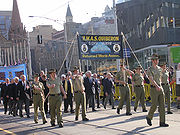 The King's School
and Newington College
vie for the honour of having the oldest Cadet Corps in Australia. An embryonic corps was founded by Newington College when a drill master was appointed to staff in 1865. Two years later, a sergeant-major was appointed and muskets and carbines were purchased and an armoury and gunpowder store were opened at Newington College. The first official unit was established in Australia on 29 March 1866 at St Mark's Collegiate School by Reverend Macarthur. In June 1868, The King's School had closed and did not reopen until January 1869, when it was amalgamated with the St Mark's unit, the unit was re-named The King's School Cadets Corps. In 1869, the Newington College Cadet Corps was formally incorporated by the Governor of New South Wales (Somerset Lowry-Corry, 4th Earl Belmore
) and that unit is now believed to be the oldest continually running corps in Australia. With the establishment of many cadet units and corps at numerous boys schools throughout the Commonwealth, His Majesty King Edward VII established the Commonwealth Cadet Corps in Australia on 16 July 1906.
In 1910, the universal training scheme was introduced, under the scheme all medically fit males 14–18 years of age had to serve in cadets. Boys who did not comply were charged and dealt with by the courts. Training cadets were divided into two groups. Senior cadets aged between 16–18 years of age were attached to Militia Units (now known as Army Reserve Units), called Regimental Detachments, while students aged between 14–16 years of age remained as school cadets. Officers came from teaching staff and selected cadets were made "Cadet Lieutenants". In 1939, the outbreak of World War II
caused the Regimental Detachments to be disbanded as staff were needed to train soldiers for overseas service. Some School Based Units closed down while some struggled on. By the end of World War II, Regimental Detachments had been re-raised. Between 1949–1975, School Based Units were attached to Citizen Military Forces units. The CMF is the precursor of the modern day Australian Army Reserve
. Regimental Units continued to exist. By 1951, The Commonwealth Cadet Corps was renamed the Australian Cadet Corps (ACC) and on 2 June 1953, The Duke of Edinburgh
became the Colonel-in-Chief
of the ACC, as a part of the coronation of his wife, Queen Elizabeth II. The Duke of Edinburgh presented his banner as a gift to the Corps on 2 May 1970 at Victoria Barracks
, Sydney. At this time, there were 46,000 cadets in Australia.
In 1975, the ACC was disbanded by the Whitlam Labor government and was re-raised by the Fraser Liberal government on 1 October 1976. After the ACC was re-raised all Regimental Cadet Units were shut down and School Based Units were encouraged to become Regional Cadet Units (Community Based). By 1981, the ACC had 20,650 cadets. The Hawke Government in 1983 also encouraged cadet units to become Regional Cadet Units. Units that stayed School Based received less army support, but by 1998, all cadet units received full support. During 1993, the Australian Cadet Corps was renamed the Australian Army Cadet Corps. Many cadet units were now re-equipped with DPCU uniforms replacing the older green uniforms. In 2001, the Australian Army Cadet Corps was renamed the Australian Army Cadets as part of major reforms brought about with the Topley review and during 2004, the title of Regional Cadet Unit (RCU) was dropped in favour of Army Cadet Unit (ACU). Governor-General
Michael Jeffery
presented a replacement banner on behalf of the Duke to commemorate the centenary of the cadets on 24 September 2005, with the old Duke of Edinburgh Banner laid up at the Soldiers Chapel at Kapooka during the 2006 Chief of Army Cadet Team Challenge.
The AAC celebrated its centenary since the establishment of the Commonwealth Cadet Corps on 16 July 2006, as opposed to the centenaries of individual units, with the Victorian Brigade holding a large parade to mark the event.
The Duke of Edinburgh's Banner may only be carried by a Cadet Under Officer, referred to on-parade as 'Banner Ensign'. When on parade, the Banner must be escorted by two cadets holding maximum rank of Cadet Warrant Officer Class One and preferably minimum rank of Cadet Sergeant, with this extending to Cadet Corporal, should circumstances dictate.
On 24 September 2005, the Governor-General, His Excellency Major General Michael Jeffery
, AC, CVO, MC, presented a replacement banner to the AAC on the behalf of the Duke of Edinburgh. The Governor-General was received on-parade by some 250 cadets from units across the nation, representing the 16,000 members of the Australian Army Cadets as a whole. This Parade took place at Victoria Barracks, Sydney. The original Banner is laid up at the Soldiers Chapel, Kapooka.
Cadet Policy Branch (previously known as Directorate Defence Force Cadets), whilst not being part of the official command structure provide services in policy development, tri-service activity and other projects. Cadet Policy Branch was disbanded in 2009.
School Based Cadet Units are essentially the same as Community Based Units with a few minor differences, the school is the principle Unit Sponsor and the unit is closed to the general public. When the Whitlam Government discontinued funding to the cadet organisations most government school cadet units were unable to operate due to lack of funds and equipment. Army cadets forces were kept alive mainly by various private school cadet units. These schools were able to use surplus bursaries to effectively fund the units. After the Whitlam Government was dismissed from office some staff and former cadets were able to establish cadet units with the support of the local community or Army unit (using their facilities to conduct training) - hence the terms 'community based unit' or Regional Cadet Unit (RCU), the title of RCU was dropped in 2004 in favour of ACU, or Army Cadet Unit. Some smaller school based units allow non-members of that school to become members, in some school units membership in for a certain period of time is compulsory.
However, some cadet units that are based in schools can be ACUs. Examples include Baulkham Hills High School Army Cadet Unit, James Ruse Agricultural High School Army Cadet Unit, and Sydney Boys High School Army Cadet Unit. These units are based at a school, and only allow membership from that school. However, these units are not funded by the school, instead by the cadets and the Government.
(OC), usually of the rank Major or Captain. Some units are big enough to be commanded by a Lieutenant Colonel, appointed as the Commanding Officer
(CO). Newly appointed OOCs who are to command a cadet unit are often given a trial period. During this time rather than being referred to as a CO or OC they are termed an Administrative Commander (Admin Comd). On successful completion of the agreed trial or probationary period and completion of the OOC Command Course their appointment is changed to CO or OC as the case warrants.
Other appointments that may be held by OOC/IOCs are Quartermaster
, Adjutant
, Administration Officer, Training Officer, Operations Officer, as well as various other appointments that exist at Battalion, Regional and National Headquarters.
and Stand at Ease, to Forms on the March. Cadets also learn weapon drill, including Weapons Drill with Lee Enfield .303 Rifle, L1A1 SLRs and F88 Austeyrs and Colour Drill .303 and SLR drill is being phased out and is only taught at unit level, since the 1996 Firearms act. WO2's and WO1's, who hold the position of Company Sergeant Major or Regimental Sergeant Major, perform Cane and Pace Stick drill respectively. In the case of a Cadet Under Officer, Sword Drill is performed. Many units may also have a Drum Corps, Pipes and Drums or a Band. Drum/Pipe and Band Majors carry a Mace. Drill is taught as per the Land Warfare Procedures - General [LWP-G 7-7-5] Drill manual, 2005 and the Australian Army Ceremonial Manual, 1999, Volumes 1 & 2.
as appropriate to the Army, this includes; Section Formations, Camouflage and Concealment, Field Signals, Moving by day and night. Cadets are also taught basic bushcraft
.
To be qualified to obtain the rank of Cadet Lance Corporal or Cadet Corporal, a cadet must be deemed competent on the AAC Junior Leaders' Course (JLC, previously known as the Junior Non-commissioned Officers Course, JNCO Course). To be qualified for the rank of Cadet Sergeant a cadet must then pass the AAC Senior Leaders' Course Module 1 (SLC Mod 1). This was previously known Senior Non-Commissioned Officer's Course (SNCO Course), and is often today shortened to SLC. For any further promotion, a cadet must complete AAC Senior Leaders' Course - Module 2 (SLC Mod 2), which is also known as the Cadet Under Officers' and Cadet Warrant Officers' Course (CUO/CDTWO Course). To obtain a promotion above the of CDTWO2 and higher, a cadet must be over the age of 16, however, in the past, this has not been strictly adhered to.
Senior cadets (Usually above the rank of CDTSGT) can apply to be Assistant Directing Staff (ADS) on Promotion Courses who instruct groups of cadets on courses, depending on their rank, with NCO's below the rank of CDTSGT occasionally assisting as General Duties Staff (GDS).
The content of these courses is outlined by National Headquarters (HQ AAC) in the AAC's Training Management Packages (TMP), with a common list of instruction and assessment applicable to each course. The courses are held in state as follows:
Levels of training for annual camps across Australia differ, but usually consists of three levels (Tiers):
In addition, many School Based Units run their own AFX, as they have the numbers to allow them to do so. By state their AFX's are:
Patent leather parade boots have been removed from Block Scale as of 18/03/2011.
As of 18 March 2011, Polyester Uniforms have been removed from issue, and may only be worn by the following personnel:
Other Items of Equipment are:
Note 1- Other units (Usually school units) may seek approval to wear different shoulder titles.
The regulations for Orders of Dress are stated in the AAC Policy Manual 2004, which is combined with the Army Standing Orders of Dress (ASOD) 2004 edition.
Note 1: "Dux" is also often referred to as "Student Of Merit"
Other Awards are
Obsolete awards are:
(NCAC) is the link between cadets and HQ, and consistes of the NCUO, RCUOs, NATCDTRSM and REGCDTRSMs. The NCAC has the power to influence changes to cadet policy and is the voice of cadets at HQ. The NCAC is chaired by the National CUO; Madeline Paech as of November 2010 cadets of all ranks and status are effectively involved in the ongoing management of the AAC.
Australia
Australia , officially the Commonwealth of Australia, is a country in the Southern Hemisphere comprising the mainland of the Australian continent, the island of Tasmania, and numerous smaller islands in the Indian and Pacific Oceans. It is the world's sixth-largest country by total area...
. The motto is "Courage, Initiative and Teamwork".
The cadet programme has strong links to the Australian Army
Australian Army
The Australian Army is Australia's military land force. It is part of the Australian Defence Force along with the Royal Australian Navy and the Royal Australian Air Force. While the Chief of Defence commands the Australian Defence Force , the Army is commanded by the Chief of Army...
and is a part of the Australian Defence Force Cadets
Australian Defence Force Cadets
The Australian Defence Force Cadets are a community-based, youth development organisation of approximately 22,000 cadets and 2,200 cadet staff in 464 units and squadrons across Australia. Coordination of the Australian Defence Force Cadets is via the Cadet Policy Branch...
. However, its members are not members of the Australian Defence Force
Australian Defence Force
The Australian Defence Force is the military organisation responsible for the defence of Australia. It consists of the Royal Australian Navy , Australian Army, Royal Australian Air Force and a number of 'tri-service' units...
by virtue only of their membership of the Australian Army Cadets. While cadets are encouraged to consider enlisting in the military, it is not required that they do so.
Activities of the Army Cadets include navigation and orienteering, ceremonial drill, radio communication skills, basic bush skills, equipment maintenance, participation in cadet bands, and shooting the Australian Defence Force Service Rifle, the F88 Austeyr with one-on-one Army supervision.
Background
The AAC is authorised under Section 62 of the Defence Act 1903 with lawful policies provided in the Cadet Forces Regulations 1977. The Australian Army Cadets is a youth organisation that is modelled on the Australian Army. It differs from ScoutsScouts Australia
Scouts Australia is an organisation for children and young adults from 6 to 26 years of age. Scouts Australia is part of the global Scouting movement and has been a national member of the World Organization of the Scout Movement since 1953...
and other youth exploration groups as its main focus is that of learning and using military and leadership skills. The organisation boasts a nationwide reach with Cadet units in every state and territory in Australia.
Youths who have reached the age of 12 years and 6 months are eligible to apply for enrolment into the AAC. Once enrolled, they may remain as a cadet until the day before they attain the age of twenty years. A cadet in the AAC is not considered to be a member of the Australian Defence Force, nor are cadets allowed to be a member of the Defence Force or, other than in approved exceptional circumstances, any other cadet service during their time as a cadet.
Research studies have shown that cadets have performed better than non-cadets in Australian Defence Force Training, and 25.4% of the Australian Defence Force has been in the Australian Defence Force Cadets. From 2001-05, cadets have made up 10% of applications and 11% of total Australian Defence Force enlistments.
History
The King's School, Sydney
The King's School is an independent Anglican, day and boarding school for boys in North Parramatta in the western suburbs of Sydney, Australia. Founded in 1831, it is Australia's oldest school and forms one of the nine "Great Public Schools" of New South Wales. Situated within a site, Gowan Brae,...
and Newington College
Newington College
Newington College is an independent, Uniting Church, day and boarding school for boys, located in Stanmore, an inner-western suburb of Sydney, New South Wales, Australia....
vie for the honour of having the oldest Cadet Corps in Australia. An embryonic corps was founded by Newington College when a drill master was appointed to staff in 1865. Two years later, a sergeant-major was appointed and muskets and carbines were purchased and an armoury and gunpowder store were opened at Newington College. The first official unit was established in Australia on 29 March 1866 at St Mark's Collegiate School by Reverend Macarthur. In June 1868, The King's School had closed and did not reopen until January 1869, when it was amalgamated with the St Mark's unit, the unit was re-named The King's School Cadets Corps. In 1869, the Newington College Cadet Corps was formally incorporated by the Governor of New South Wales (Somerset Lowry-Corry, 4th Earl Belmore
Somerset Lowry-Corry, 4th Earl Belmore
Somerset Richard Lowry-Corry, 4th Earl Belmore GCMG, PC , styled as Viscount Corry from 1841 to 1845, was an Irish nobleman and Conservative politician.-Background and education:...
) and that unit is now believed to be the oldest continually running corps in Australia. With the establishment of many cadet units and corps at numerous boys schools throughout the Commonwealth, His Majesty King Edward VII established the Commonwealth Cadet Corps in Australia on 16 July 1906.
In 1910, the universal training scheme was introduced, under the scheme all medically fit males 14–18 years of age had to serve in cadets. Boys who did not comply were charged and dealt with by the courts. Training cadets were divided into two groups. Senior cadets aged between 16–18 years of age were attached to Militia Units (now known as Army Reserve Units), called Regimental Detachments, while students aged between 14–16 years of age remained as school cadets. Officers came from teaching staff and selected cadets were made "Cadet Lieutenants". In 1939, the outbreak of World War II
World War II
World War II, or the Second World War , was a global conflict lasting from 1939 to 1945, involving most of the world's nations—including all of the great powers—eventually forming two opposing military alliances: the Allies and the Axis...
caused the Regimental Detachments to be disbanded as staff were needed to train soldiers for overseas service. Some School Based Units closed down while some struggled on. By the end of World War II, Regimental Detachments had been re-raised. Between 1949–1975, School Based Units were attached to Citizen Military Forces units. The CMF is the precursor of the modern day Australian Army Reserve
Australian Army Reserve
The Australian Army Reserve is a collective name given to the reserve units of the Australian Army. Since the Federation of Australia in 1901, the reserve military force has been known by many names, including the Citizens Forces, the Citizen Military Forces, the Militia and, unofficially, the...
. Regimental Units continued to exist. By 1951, The Commonwealth Cadet Corps was renamed the Australian Cadet Corps (ACC) and on 2 June 1953, The Duke of Edinburgh
Prince Philip, Duke of Edinburgh
Prince Philip, Duke of Edinburgh is the husband of Elizabeth II. He is the United Kingdom's longest-serving consort and the oldest serving spouse of a reigning British monarch....
became the Colonel-in-Chief
Colonel-in-Chief
In the various Commonwealth armies, the Colonel-in-Chief of a regiment is its patron. This position is distinct from that of Colonel of the Regiment. They do not have an operational role. They are however kept informed of all important activities of the regiment, and pay occasional visits to its...
of the ACC, as a part of the coronation of his wife, Queen Elizabeth II. The Duke of Edinburgh presented his banner as a gift to the Corps on 2 May 1970 at Victoria Barracks
Victoria Barracks
There are several Victoria Barracks in the world.*Victoria Barracks, Windsor Castle*Victoria Barracks, Melbourne*Victoria Barracks, Hong Kong*Victoria Barracks, Sydney*Victoria Barracks, Brisbane...
, Sydney. At this time, there were 46,000 cadets in Australia.
In 1975, the ACC was disbanded by the Whitlam Labor government and was re-raised by the Fraser Liberal government on 1 October 1976. After the ACC was re-raised all Regimental Cadet Units were shut down and School Based Units were encouraged to become Regional Cadet Units (Community Based). By 1981, the ACC had 20,650 cadets. The Hawke Government in 1983 also encouraged cadet units to become Regional Cadet Units. Units that stayed School Based received less army support, but by 1998, all cadet units received full support. During 1993, the Australian Cadet Corps was renamed the Australian Army Cadet Corps. Many cadet units were now re-equipped with DPCU uniforms replacing the older green uniforms. In 2001, the Australian Army Cadet Corps was renamed the Australian Army Cadets as part of major reforms brought about with the Topley review and during 2004, the title of Regional Cadet Unit (RCU) was dropped in favour of Army Cadet Unit (ACU). Governor-General
Governor-General of Australia
The Governor-General of the Commonwealth of Australia is the representative in Australia at federal/national level of the Australian monarch . He or she exercises the supreme executive power of the Commonwealth...
Michael Jeffery
Michael Jeffery
Major General Philip Michael Jeffery AC, CVO, MC was the 24th Governor-General of Australia , the first Australian career soldier to be appointed governor-general...
presented a replacement banner on behalf of the Duke to commemorate the centenary of the cadets on 24 September 2005, with the old Duke of Edinburgh Banner laid up at the Soldiers Chapel at Kapooka during the 2006 Chief of Army Cadet Team Challenge.
The AAC celebrated its centenary since the establishment of the Commonwealth Cadet Corps on 16 July 2006, as opposed to the centenaries of individual units, with the Victorian Brigade holding a large parade to mark the event.
Aims
The aim of military training within the AAC is:- to develop an interest in the Army and its traditions;
- to encourage cadets to continue military or community service;
- to give cadets a foundation of military knowledge and discipline;
- to develop the qualities of leadership, self-discipline, self-reliance and initiative; and
- to provide training that may contribute to Army common induction training.
The Duke of Edinburgh's Banner
The Duke of Edinburgh's Banner is the standard of the Australian Army Cadets, it was presented to the, then, Australian Cadet Corps by Prince Phillip, Duke of Edinburgh on 2 May 1970. This banner has been carried on many significant parades since.The Duke of Edinburgh's Banner may only be carried by a Cadet Under Officer, referred to on-parade as 'Banner Ensign'. When on parade, the Banner must be escorted by two cadets holding maximum rank of Cadet Warrant Officer Class One and preferably minimum rank of Cadet Sergeant, with this extending to Cadet Corporal, should circumstances dictate.
On 24 September 2005, the Governor-General, His Excellency Major General Michael Jeffery
Michael Jeffery
Major General Philip Michael Jeffery AC, CVO, MC was the 24th Governor-General of Australia , the first Australian career soldier to be appointed governor-general...
, AC, CVO, MC, presented a replacement banner to the AAC on the behalf of the Duke of Edinburgh. The Governor-General was received on-parade by some 250 cadets from units across the nation, representing the 16,000 members of the Australian Army Cadets as a whole. This Parade took place at Victoria Barracks, Sydney. The original Banner is laid up at the Soldiers Chapel, Kapooka.
Structure
- Headquarters of the Australian Army.
- Headquarters Australian Army Cadets (HQAAC).
- Regional Headquarters (Brigades or Battalions, depending on number of cadets).
- HQ NSW AAC BDE (includes 224 ACU Canberra, the only unit in the ACT and 230 ACU on Norfolk Island)
- HQ VIC AAC BDE
- HQ NQLD AAC BDE
- HQ SQLD AAC BDE
- HQ TAS AAC BN
- HQ NT AAC BN
- HQ WA AAC BDE
- HQ SA AAC BDE
- Brigades are then broken up into Battalions, for example, in Victoria the battalions are 31 AC Bn (Schools), 32 AC Bn (Western), 33 AC Bn (Northern) and 34 AC Bn (Eastern). This type of numbering system is followed in the other states.
- Cadet Units are usually based on a company structure (the larger units are based on a battalion structure), and are under the control of both the Battalion and Brigade HQs.
Cadet Policy Branch (previously known as Directorate Defence Force Cadets), whilst not being part of the official command structure provide services in policy development, tri-service activity and other projects. Cadet Policy Branch was disbanded in 2009.
School Based Cadet Units
School Based Cadet Units are essentially the same as Community Based Units with a few minor differences, the school is the principle Unit Sponsor and the unit is closed to the general public. When the Whitlam Government discontinued funding to the cadet organisations most government school cadet units were unable to operate due to lack of funds and equipment. Army cadets forces were kept alive mainly by various private school cadet units. These schools were able to use surplus bursaries to effectively fund the units. After the Whitlam Government was dismissed from office some staff and former cadets were able to establish cadet units with the support of the local community or Army unit (using their facilities to conduct training) - hence the terms 'community based unit' or Regional Cadet Unit (RCU), the title of RCU was dropped in 2004 in favour of ACU, or Army Cadet Unit. Some smaller school based units allow non-members of that school to become members, in some school units membership in for a certain period of time is compulsory.
However, some cadet units that are based in schools can be ACUs. Examples include Baulkham Hills High School Army Cadet Unit, James Ruse Agricultural High School Army Cadet Unit, and Sydney Boys High School Army Cadet Unit. These units are based at a school, and only allow membership from that school. However, these units are not funded by the school, instead by the cadets and the Government.
Cadets Rank System
(Note: To distinguish themselves from the Australian Army, cadet ranks have the prefix 'CDT' added to them, whilst OOC/IOC ranks end with 'AAC')- Cadet Recruit (CDTREC) - Cadets begin their experience where they are allocated to a section which consists of their Section Commander, a Section Second-in-Command and up to eight fellow recruits/cadets.
- Cadet (CDT) - At completion of recruit training, cadets may take on other roles such as logistics after completion of their first year or stay in a section, sometimes appointed as Section Second-in-Command.
- Cadet Lance CorporalLance CorporalLance corporal is a military rank, used by many armed forces worldwide, and also by some police forces and other uniformed organizations. It is below the rank of corporal, and is typically the lowest non-commissioned officer, usually equivalent to the NATO Rank Grade OR-3.- Etymology :The presumed...
(CDTLCPL) - Most commonly a Section Second-in-Command, a variety of other appointments exist e.g. logistics. - Cadet CorporalCorporalCorporal is a rank in use in some form by most militaries and by some police forces or other uniformed organizations. It is usually equivalent to NATO Rank Code OR-4....
(CDTCPL) - Most commonly a Section Commander, again a diverse variety of appointments exists. - Cadet SergeantSergeantSergeant is a rank used in some form by most militaries, police forces, and other uniformed organizations around the world. Its origins are the Latin serviens, "one who serves", through the French term Sergent....
(CDTSGT) - Usually a Platoon SergeantPlatoon SergeantIn many militaries, a platoon sergeant is the senior enlisted member of a platoon, who advises and supports the platoon's commanding officer in leading the unit.-Singapore:...
; other positions, such as Training Sergeant, exist. - Cadet Staff SergeantStaff SergeantStaff sergeant is a rank of non-commissioned officer used in several countries.The origin of the name is that they were part of the staff of a British army regiment and paid at that level rather than as a member of a battalion or company.-Australia:...
(CDTSSGT) - Positions can vary. Most commonly a Company Quartermaster SergeantCompany Quartermaster SergeantCompany quartermaster sergeant is a military rank or appointment.-Canada:A Company Quartermaster Sergeant in the Canadian Forces is the non-commissioned officer in a company who is in charge of supplies. The CQMS also serves as deputy to the Company Sergeant Major and is the second most senior NCO...
(CQMS). Other positions in special cases include the Company Sergeant MajorCompany Sergeant MajorA company sergeant major is the senior non-commissioned soldier of a company in the armies of many Commonwealth countries, responsible for standards and discipline. In combat, his prime responsibility is the supply of ammunition to the company...
(CSM) and Platoon Commanders. This rank is no longer attainable in the AAC, however persons who hold the rank will continue to hold it until they are either promoted, or leave the AAC. - Cadet Warrant Officer Class Two (CDTWO2) - Position is generally the Company Sergeant Major. Other existing appointments include the Operations Warrant Officer and the Training Warrant Officer, as well as Regimental Quartermaster Sergeants in large Units.
- Cadet Warrant Officer Class One (CDTWO1) - Position exists in the AAC for Cadet Regimental Sergeant Majors. CDTRSMs are appointed in each battalion, brigade and in the case of School Based Units, an RSM may be appointed with the CDTWO1 rank where their establishment is large enough. Brigade or Regional RSMs may apply and possibly receive the position of National Cadet Regimental Sergeant Major, bearing an insignia similar to the Regimental Sergeant Major of the Army (RSM-A) , the difference being a blue wreath encircling the insignia so as to provide a distinction from that of RSM-A. A cadet with the rank of CDTWO1 may also hold the position of RQ or Regimental Quartermaster for the corps.
- Cadet Under Officer (CUO) - Cadet Under Officer is the cadet equivalent of a junior officer although they do not receive a commission and are subordinate to all adult staff. The insignia is similar to that of a large hollow diamond shape, referred to as a 'lozenge of chevronelles'. The lozenge of chevronelles outline consists of 27½ chevrons. Headquarters positions exist at battalion, brigade and national level, with each battalion and brigade having a Battalion/Regional Cadet Under Officer. The rank insignia for a Regional Cadet Under Officer is a lozenge of chevronelles with a blue center. At National Headquarters level, the CUO is appointed as a National Cadet Under Officer. They bear a lozenge of chevronelles with a red centre. In November 2010, CUO Madeline Paech was appointed as the National Cadet Under Officer (NCUO).
Instructor of Cadets (IOC) Rank
- Unit Assistant - UA (no rank embellishment, although they are referred to by their respective honorific i.e. Mr, Mrs)
- Lance Corporal (AAC) - LCPL(AAC)
- Corporal (AAC) - CPL(AAC)
- Sergeant (AAC) - SGT(AAC)
- Staff Sergeant (AAC) - SSGT(AAC)-No longer attainable, but still held by some IOC's
- Warrant Officer Class Two (AAC) - WO2(AAC)
- Warrant Officer Class One (AAC) - WO1(AAC)
Officer of Cadets (OOC) Rank
- Second LieutenantSecond LieutenantSecond lieutenant is a junior commissioned officer military rank in many armed forces.- United Kingdom and Commonwealth :The rank second lieutenant was introduced throughout the British Army in 1871 to replace the rank of ensign , although it had long been used in the Royal Artillery, Royal...
(AAC) - 2LT(AAC) - LieutenantLieutenantA lieutenant is a junior commissioned officer in many nations' armed forces. Typically, the rank of lieutenant in naval usage, while still a junior officer rank, is senior to the army rank...
(AAC) - LT(AAC) - Captain (AAC) - CAPT(AAC)
- MajorMajorMajor is a rank of commissioned officer, with corresponding ranks existing in almost every military in the world.When used unhyphenated, in conjunction with no other indicator of rank, the term refers to the rank just senior to that of an Army captain and just below the rank of lieutenant colonel. ...
(AAC) - MAJ(AAC) - Lieutenant ColonelLieutenant colonelLieutenant colonel is a rank of commissioned officer in the armies and most marine forces and some air forces of the world, typically ranking above a major and below a colonel. The rank of lieutenant colonel is often shortened to simply "colonel" in conversation and in unofficial correspondence...
(AAC) - LTCOL(AAC) - ColonelColonelColonel , abbreviated Col or COL, is a military rank of a senior commissioned officer. It or a corresponding rank exists in most armies and in many air forces; the naval equivalent rank is generally "Captain". It is also used in some police forces and other paramilitary rank structures...
(AAC) - COL(AAC)
Officer of Cadet Appointments
Army Cadet Units are under command of an Officer CommandingOfficer Commanding
The Officer Commanding is the commander of a sub-unit or minor unit , principally used in the United Kingdom and Commonwealth. In other countries, the term Commanding Officer is applied to commanders of minor as well as major units.Normally an Officer Commanding is a company, squadron or battery...
(OC), usually of the rank Major or Captain. Some units are big enough to be commanded by a Lieutenant Colonel, appointed as the Commanding Officer
Commanding officer
The commanding officer is the officer in command of a military unit. Typically, the commanding officer has ultimate authority over the unit, and is usually given wide latitude to run the unit as he sees fit, within the bounds of military law...
(CO). Newly appointed OOCs who are to command a cadet unit are often given a trial period. During this time rather than being referred to as a CO or OC they are termed an Administrative Commander (Admin Comd). On successful completion of the agreed trial or probationary period and completion of the OOC Command Course their appointment is changed to CO or OC as the case warrants.
Other appointments that may be held by OOC/IOCs are Quartermaster
Quartermaster
Quartermaster refers to two different military occupations depending on if the assigned unit is land based or naval.In land armies, especially US units, it is a term referring to either an individual soldier or a unit who specializes in distributing supplies and provisions to troops. The senior...
, Adjutant
Adjutant
Adjutant is a military rank or appointment. In some armies, including most English-speaking ones, it is an officer who assists a more senior officer, while in other armies, especially Francophone ones, it is an NCO , normally corresponding roughly to a Staff Sergeant or Warrant Officer.An Adjutant...
, Administration Officer, Training Officer, Operations Officer, as well as various other appointments that exist at Battalion, Regional and National Headquarters.
Drill
Drill training encompasses all Army drill movements from AttentionAt attention
The position of At attention, or Standing at attention is a military posture which involves the following general postures:* Standing upright with an assertive and correct posture: famously "chin up, chest out, shoulders back, stomach in"....
and Stand at Ease, to Forms on the March. Cadets also learn weapon drill, including Weapons Drill with Lee Enfield .303 Rifle, L1A1 SLRs and F88 Austeyrs and Colour Drill .303 and SLR drill is being phased out and is only taught at unit level, since the 1996 Firearms act. WO2's and WO1's, who hold the position of Company Sergeant Major or Regimental Sergeant Major, perform Cane and Pace Stick drill respectively. In the case of a Cadet Under Officer, Sword Drill is performed. Many units may also have a Drum Corps, Pipes and Drums or a Band. Drum/Pipe and Band Majors carry a Mace. Drill is taught as per the Land Warfare Procedures - General [LWP-G 7-7-5] Drill manual, 2005 and the Australian Army Ceremonial Manual, 1999, Volumes 1 & 2.
Fieldcraft
Cadets are taught all aspects of fieldcraftFieldcraft
Fieldcraft is a term used especially in American, Canadian and British military circles to describe the basic military skills required to operate stealthily and the methods used to do so, which can differ during day or night and due to weather or terrain...
as appropriate to the Army, this includes; Section Formations, Camouflage and Concealment, Field Signals, Moving by day and night. Cadets are also taught basic bushcraft
Bushcraft
Bushcraft is a long-term extension of survival skills. A popular term for wilderness skills in Canada, The UK, Australia, New Zealand and South Africa, the term was popularised in the southern hemisphere by Les Hiddins in Australia as well as in the northern hemisphere by Mors Kochanski and...
.
First Aid
Cadets complete a comprehensive course on first aid. They are taught how to treat injuries such as fractures, bites and stings. They are taught how to call in a CASEVAC for emergency situations.Navigation
Cadets are taught navigational skills in line with the Australian Army's navigation training for all ranks. There is an emphasis on military equipment and maps. Consequently cadets are taught to use the standard issue service prismatic compass along with the lightweight compass, protractor and standard issue service topographical survey maps. Advanced training incorporates orienteering and rogaining. Cadets are also taught the use of a GPS as an aid to navigation, but are trained to not rely on it, as GPS has been shown to be unreliable.Radio Telecommunications (Ratel)
Cadets are taught Radio Telecommunications skills in accordance with the Australian Army's Ratel training. Cadets are taught the use of communications equipment such as the AN/PRC-77 set (a low band VHF set), or simple UHF Handheld radios, and the proper processes that apply to communications in the Army. Cadets are also taught the maintenance of their radio equipment. As of late, the RAVEN series of radios are becoming more common for use in cadets.Aviation
Cadets are able to do Aviation training such as; Powered Flying, Groundcrew, Air Traffic Control, Engineering and Gliding. Cadets also do three theory subjects; Aviation, Aircraft recognition and Air power. Training is officially conducted through 161 ACU (Aviation) however other ACUs have conducted AVN activities in the past.Leadership
See the section regarding Promotion CoursesMarksmanship
Cadets are able to qualify for marksman on the .22 Long Rifle and the F88 Austeyr. In the past, cadets have attended International Competitions. A cadet biathlon has been held at Whiskey Flat in the Victorian Alps since 2006.Promotion Courses
Whilst policy requires a cadet to complete a promotion course to attain the rank of CDTCPL, this policy is often interpreted flexibly, with some cadets being promoted up to and including the rank of CDTSSGT without having done the course, as promotions below CDTWO2 are decided at the individual unit OC's discretion. Promotion above CDTSSGT needs to be approved by the Regional Headquarters. Promotions courses are run by each Region for their own cadets and are generally planned by the Regional Headquarters. Permission may also be extended to Battalion Headquarters (in large regions) and individual ACU's (usually school based) to run courses, as needed, independently to that of the Regional run courses, where a Battalion/Unit will supply staff to run the course.To be qualified to obtain the rank of Cadet Lance Corporal or Cadet Corporal, a cadet must be deemed competent on the AAC Junior Leaders' Course (JLC, previously known as the Junior Non-commissioned Officers Course, JNCO Course). To be qualified for the rank of Cadet Sergeant a cadet must then pass the AAC Senior Leaders' Course Module 1 (SLC Mod 1). This was previously known Senior Non-Commissioned Officer's Course (SNCO Course), and is often today shortened to SLC. For any further promotion, a cadet must complete AAC Senior Leaders' Course - Module 2 (SLC Mod 2), which is also known as the Cadet Under Officers' and Cadet Warrant Officers' Course (CUO/CDTWO Course). To obtain a promotion above the of CDTWO2 and higher, a cadet must be over the age of 16, however, in the past, this has not been strictly adhered to.
Senior cadets (Usually above the rank of CDTSGT) can apply to be Assistant Directing Staff (ADS) on Promotion Courses who instruct groups of cadets on courses, depending on their rank, with NCO's below the rank of CDTSGT occasionally assisting as General Duties Staff (GDS).
The content of these courses is outlined by National Headquarters (HQ AAC) in the AAC's Training Management Packages (TMP), with a common list of instruction and assessment applicable to each course. The courses are held in state as follows:
- In New South Wales, Promotion Courses have been held in such locations as Holsworthy BarracksHolsworthy BarracksHolsworthy Barracks is located in the outer south-western Sydney suburb of Holsworthy. It is part of the Holsworthy military reserve, which has been a training area and artillery range for the Australian Army since World War I. Following World War II it became a major base for the permanent...
, south of Sydney, HMAS AlbatrossHMAS Albatross (air station)HMAS Albatross, also known as Naval Air Station Nowra , is an airfield operated by the Royal Australian Navy , in support of the RAN's aviation branch, the Fleet Air Arm...
, in Nowra, HMAS HarmanHMAS HarmanHMAS Harman is a Royal Australian Navy communications and logistics facility. The main base is located in the Australian capital of Canberra, and is geographically recognised as the suburb of Harman...
in Canberra, and Centre Ridge at the Singleton Army Training Area. In April 2006, the SLC Mod 2 course was held for the first time at the Royal Military College, DuntroonRoyal Military College, DuntroonThe Royal Military College, Duntroon is the Australian Army's officer training establishment. It was founded at Duntroon, in the Australian Capital Territory, in 1911 and is situated on picturesque grounds at the foot of Mount Pleasant near Lake Burley Griffin, close to the Department of Defence...
in Canberra. Recent promotions courses have been run at Singleton Army Training Area.
- In North Queensland, all promotions courses are combined into a single eight-day session held in December at Abergowrie College, near InghamIngham-People:* Albert Ingham, Mathematician* Alice Ingham, Roman Catholic nun and missionary.* Barrie Ingham, British actor* Benjamin Ingham, 18th Century Yorkshire Evangelist* Bernard Ingham, British journalist and former press secretary to Margaret Thatcher...
. However, they are now being held at Lavarack BarracksLavarack BarracksLavarack Barracks is a major Australian Army base located in Townsville, Queensland. Lavarack Barracks is currently home to the Army's 3rd Brigade and 11th Brigade. Elements of the 3rd Brigade based at the Barracks include the Combat Signals Regiment, 3rd Combat Services Support Battalion and the...
Townsville.
- In South Queensland, promotion courses are held at Gallipoli Barracks, EnoggeraEnoggeraEnoggera may refer to:*Enoggera, Queensland, a suburb of Brisbane, in Queensland, Australia*Enoggera Barracks an Australian Army base in the suburb...
in Brisbane.
- In South Australia, promotion courses are held at Hampstead BarracksHampstead BarracksHampstead Barracks is an Australian Army base in the Adelaide suburb of Greenacres, located about to the north of the Adelaide central business district. Situated on the corner of Hampstead and Muller Roads, it is only a small suburban base, sitting on less than 24 acres of land...
in AdelaideAdelaideAdelaide is the capital city of South Australia and the fifth-largest city in Australia. Adelaide has an estimated population of more than 1.2 million...
.
- In Victoria, the promotion courses are usually held at the old National Service Lines in PuckapunyalPuckapunyalPuckapunyal is an Australian Army training facility and base 10 km west of Seymour, in central Victoria, south-eastern Australia.-Description:Puckapunyal is a small restricted-access town inhabited mainly by about 280...
. However, between 2004 and 2006, asbestos removal was taking place at that site. Instead, they have been held at other locations, such as RAAF WilliamsRAAF WilliamsRAAF Williams comprises the two bases of Point Cook and Laverton. Both establishments previously existed as separate RAAF Bases until 1999 when they were amalgamated to form RAAF Williams...
(Laverton and Point Cook sites) and Simpson BarracksSimpson BarracksSimpson Barracks is an Australian Army facility in the suburb of Macleod in Melbourne, Victoria, Australia.Simpson Barracks is home to the DFSS , Financial Services Unit, Defence Force School of Music, Land Warfare Centre and the headquarters of 4th Brigade...
. From 2006 to 2009 CUO/WO and SLC were held annually at the end of the year, as opposed to twice yearly before then. Since 2009 CUO/WOs and SLC have been held during mid-year holidays, instead of end of year. JLC is held bi-annually in the July and December school holidays. A second course was developed to run alongside the Victorian JLC in December at Puckapunyal; named the Cadet Leadership Development Course (CLDC) which was designed to train cadets who may have missed out on attending the so that they will be at the required skill level for the next set of courses. CLDC was renamed Cadet Development Course(CDC)in 2010. The course has continued to be conducted in VIC AAC BDE.
- In Western Australia, the promotion courses are held at Leeuwin Barracks and Bindoon Training Area.
- In Tasmania, the promotions courses are held at the Tasmanian Police Academy or Anglesea Barracks.
- In the Northern Territory, the promotion courses are held at Larrakeyah BarracksLarrakeyah BarracksLarrakeyah Barracks incorporating HMAS Coonawarra is the main base for the Australian Defence Force in the Northern Territory of Australia, and occupies the headland west of the suburb of Larrakeyah in the capital, Darwin...
. However, the Northern Territory only has the resources to run Junior and Senior Leaders' courses. Cadets are typically sent to Western Australia to complete their CUO or WO courses. These courses are held at Leeuwin Barracks and Bindoon Training Area.
Other Activities
Other activities that cadets often participate in are:- Adventure Training Award (ATA)
- Chief of Army Cadet Team Challenge (CACTC)
- Local ceremonial parades (e.g.: ANZAC day, Remembrance Day)
- Army Cadet Exchange (ACE)
Annual Field Exercise
The AAC conducts an Annual Field Exercise (AFX) once every year at regional level for a duration of 1 to 2 weeks.Levels of training for annual camps across Australia differ, but usually consists of three levels (Tiers):
- Tier 1 (Recruit/IET)
- Tier 2 (Proficiency)
- Tier 3 (Advanced)
In addition, many School Based Units run their own AFX, as they have the numbers to allow them to do so. By state their AFX's are:
- In New South Wales, AFX is held at Singleton Army Barracks. Most School Based Units have separate AFXs to the Community Based Units, however, Baulkham Hills High School Cadet Unit and James Ruse Agricultural High School Cadet Unit attend AFX as part of 22BN and are a part of 22BN, not SBUs. Recent 22BN AFXs have included senior rank cadets of St Aloysius Cadet Unit and Knox Grammar Cadet Unit along with Vietnam Veterans Association of Australia (VAS) to aid in the exercise.
- In North Queensland Tier 1, Tier 2, Tier 3 and Tier 4 are all held in an 8 day block at the Harvey Range Training Area, at Camp McAliney.
- In South Queensland Tier 1 and Tier 2 are held in week 1 and Tier 3 in week 2.
- In Victoria, AFX is known as Exercise EMU and is held at Puckapunyal Military Area. School Based Units typically do their AFX one week before the Community Based Units.
- In Western Australia the AFX is held over the September October School holidays for 1 week at Bindoon Army base just outside of Perth.
- In the Northern Territory the AFX is held in the last week of June for 1 week at Kangaroo Flats Training Area in rural Darwin.
- In Tasmania the AFX is held during the September school holidays, lasting for one week. The AFX is held at Stony head or Buckland, each year the location is the opposite to the previous (i.e. 2009, Buckland. 2010, Stony Head).
Uniforms
Upon joining the AAC cadets are issued with;- Disruptive Pattern Combat Uniforms (DPCU)
- DP Bush Hat
- DP Shirt
- DP Trousers
- Jumper Khaki
- Ceremonial Parade Belt, Black
- ADFC General Purpose Boots
- Field Equipment
- Webbing (Load Carrying Equipment)
- Field Pack
- Knife Fork Spoon (KFS) set
- Canteen Cup
- Pan Set Messing
- Hexamine Stove
- Water Bottle x2
- Field Shelter (Hutchie)
- Hat Khaki Fur Felt (Hat KFF/'Slouch Hat')
Patent leather parade boots have been removed from Block Scale as of 18/03/2011.
As of 18 March 2011, Polyester Uniforms have been removed from issue, and may only be worn by the following personnel:
-
- All ACS of the rank of MAJ(AAC) and above
- Cadet unit Officer Commanding (Not administrative Commanders or Detachment Commanders)
- Pipers and Drummers in approved AAC bands
- Other Musicians of HQ AAC approved bands (For ceremonial activities only)
- Cadets holding the positions of NCUO, NCDTRSM, RCUO or RCDTRSM
- Members of a Joint Service Catafalque party
Other Items of Equipment are:
- Scarlet Sash, Infantry
- Issued to Sergeant, Staff Sergeant and Warrant Officers Class 2.
- Sam Browne Belt
- Issued to Warrant Officers Class 1 and Cadet Under Officers .
Note 1- Other units (Usually school units) may seek approval to wear different shoulder titles.
The regulations for Orders of Dress are stated in the AAC Policy Manual 2004, which is combined with the Army Standing Orders of Dress (ASOD) 2004 edition.
Awards and Commendations
Within the AAC, members (both cadets and staff) are eligible for Commendations for various achievements within the AAC. Commendations are given at Regional Commander AAC (Bronze), Deputy Commander AAC (Silver) and Commander AAC (Gold) level. Commendations are awarded at the discretion of their respective representative, often on the basis of a recommendation; However, some achievements warrant to the immediate presentation of a commendation. These are as follows:- Regional Commander AAC Commendation (Bronze):
- Dux of the Junior Leaders Course (JLC) [Junior Non-Commissioned Officer (JNCO)]
- Member who completes the Chief of Army (CA) or Chief of Defence Force (CDF) Challenge
- Deputy Commander AAC (DCOMD AAC) Commendation (Silver):
- Dux of the Senior Leaders Course (SLC) [Senior Non-Commissioned Officer Module 1 (SNCO Mod 1)]
- Member of the runner up team of the Chief of Army (CA) or Chief of Defence Force (CDF) Challenge
- Commander AAC (COMD AAC) Commendation (Gold):
- Dux of the Cadet Under Officer/Warrant Officer Course (CUO/WOs) [Senior Non-Commissioned Officer Module 2 (SNCO Mod 2)]
- Dux of the Adventure Training Award (ATA) Assessment
- Member of the winning team of the Chief of Army (CA) or Chief of Defence Force (CDF) Challenge
Note 1: "Dux" is also often referred to as "Student Of Merit"
Other Awards are
- Adventure Training Award
- The Duke of Edinburgh's AwardThe Duke of Edinburgh's AwardThe Duke of Edinburgh's Award , is a programme of activities that can be undertaken by anyone aged 14 to 24, regardless of personal ability....
- Pilots Wings (For Powered Flying and Gliding)
Obsolete awards are:
- Parachute Wings
- 2006 Centenary of Cadets badge (only awarded for cadets who participated in the Victorian Cadet Centenary Parade)
National Cadet Advisory Council
The National Cadet Advisory CouncilNational Cadet Advisory Council
The National Cadet Advisory Council is the link between cadets and officers in the Australian Army Cadets, system. The NCAC, as it is commonly known, endeavours in improve cadets and the standard of cadets any way it can. The NCAC generally meets once a year, with regional CAC's meeting at least...
(NCAC) is the link between cadets and HQ, and consistes of the NCUO, RCUOs, NATCDTRSM and REGCDTRSMs. The NCAC has the power to influence changes to cadet policy and is the voice of cadets at HQ. The NCAC is chaired by the National CUO; Madeline Paech as of November 2010 cadets of all ranks and status are effectively involved in the ongoing management of the AAC.
See also
- List of Australian Army Cadet units
- Australian Air Force CadetsAustralian Air Force CadetsThe Australian Air Force Cadets , known as the Air Training Corps until 2001, is a Federal Government funded youth organisation. The parent force of the AAFC is the Royal Australian Air Force...
- Australian Navy CadetsAustralian Navy CadetsThe Australian Navy Cadets is a voluntary youth organisation sponsored by the Royal Australian Navy. Together with the Australian Air Force Cadets and Australian Army Cadets, it forms the Australian Defence Force Cadets. It hosts over 91 units.-History:...
- Australian Defence Force CadetsAustralian Defence Force CadetsThe Australian Defence Force Cadets are a community-based, youth development organisation of approximately 22,000 cadets and 2,200 cadet staff in 464 units and squadrons across Australia. Coordination of the Australian Defence Force Cadets is via the Cadet Policy Branch...