


Attitude change

Encyclopedia
Attitudes
are the evaluations and associated beliefs and behaviors towards some object. They are not stable, and because of the communication and behavior of other people, are subject to change by social influences, as well as an individual's motivation to maintain cognitive consistency when cognitive dissonance
occurs--when two attitudes or when attitude and behavior conflict. Attitudes and attitude objects are functions of affective and cognitive components. It has been suggested that the inter-structural composition of an associative network can be altered by the activation of a single node. Thus, by activating an affective or emotion node, attitude change may be possible, though affective and cognitive components tend to be intertwined.
 Compliance
refers to a change in behavior based on consequences, such as an individual’s hopes to gain rewards or avoid punishment from another group or person. The individual does not necessarily experience changes in beliefs or evaluation towards an attitude object, but rather is influenced by the social outcomes of adopting a change in behavior.
The individual is also often aware that he or she is being urged to respond in a certain way.
Compliance was demonstrated through a series of laboratory experiments known as the Asch experiments
. Experiments led by Solomon Asch
of Swarthmore College
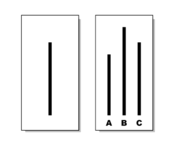
asked groups of students to participate in a "vision test". In reality, all but one of the participants were confederates of the experimenter, and the study was really about how the remaining student would react to the confederates' behavior. Participants were asked to pick, out of three line options, the line that is the same length as a sample and were asked to give the answer out loud. Unbeknown to the participants, Asch had placed a number of confederates to deliberately give the wrong answer before the participant. The results showed that 75% of participants succumbed to the majority's influence and gave the answer the confederates picked. Variations in the experiments showed that compliance rates increased as the number of confederates increased, which plateaus at around 15 confederates. Also, minority opposition, such as if even one confederate gave the correct answer, the likelihood of compliance drops. The basis for compliance is founded on the fundamental idea that people want to be accurate and right.
refers to the change in beliefs and affect when one finds the content of the attitude to be intrinsically rewarding, and thus leading to actual change in beliefs or evaluation towards an attitude object. The new attitude or behavior is consistent with the individual’s value system, and tends to be merged with the individual’s existing values and beliefs. Therefore, behavior adopted through internalization are due to the content of the attitude object.
The Expectancy-value theory
is based on internalization of atittude change. This model describes the states that the behavior towards some object is a function of an individual’s intent, which is a function of one’s overall attitude towards the action.
plays a major role in persuasion
, social influence
, and attitude change. Much of attitude research has emphasised the importance of affective or emotion components. Emotion works hand-in-hand with the cognitive process, or the way we think, about an issue or situation. Emotional appeals are commonly found in advertising, health campaigns and political messages. Recent examples include no-smoking health campaigns (see tobacco advertising
) and political campaign advertising emphasizing the fear of terrorism.
Important factors that influence the impact emotion appeals include self efficacy, attitude accessibility, issue involvement, and message/source features. Attitudes that are central to one's being and highly resistant to change while others that are less fixed may change with new experiences or information. A new attitude (e.g. to time-keeping or absenteeism or quality) may challenge existing beliefs or norms so creating a feeling of psychological discomfort known as cognitive dissonance. It is difficult to measure attitude change since attitudes may only be inferred and there might be significant divergence between those publicly declared and privately held.Self efficacy is a perception of one’s own human agency; in other words, it is the perception of our own ability to deal with a situation. It is an important variable in emotion appeal messages because it dictates a person’s ability to deal with both the emotion and the situation. For example, if a person is not self-efficacious about their ability to impact the global environment, they are not likely to change their attitude or behaviour about global warming.
Affective forecasting
, otherwise known as intuition or the prediction of emotion, also impacts attitude change. Research suggests that predicting emotions is an important component of decision making, in addition to the cognitive processes. How we feel about an outcome may override purely cognitive rationales.
In terms of research methodology
, the challenge for researchers is measuring emotion and subsequent impacts on attitude. Since we cannot see into the brain, various models and measurement tools have been constructed to obtain emotion and attitude information. Measures may include the use of physiological cues like facial expressions, vocal changes, and other body rate measures. For instance, fear is associated with raised eyebrows, increased heart rate and increase body tension. Other methods include concept or network mapping, and using primes or word cues.
and the heuristic-systematic model of information processing
.
describes two depths in the processing of attitude change, which includes systematic processing and heuristic processing. In this model information is either processed in a high-involvement and high-effort systematic way, or information is processed through shortcuts known as heuristics. For example, emotions are affect-based heuristics, in which feelings and gut-feeling reactions are often used as shortcuts.
According to the Heuristic-Systematic Model of Information Processing, people are motivated to use systematic processing when they want to achieve a "desired level of confidence" in their judgments There are factors that have been found to increase the use of systematic processing, which these factors are associated with either decreasing an individual's actual confidence or increasing an individual's perceived confidence. These factors may include framing of persuasive messages in an unexpected manner; self-relevancy of the message.
Systematic processing has been shown to be beneficial in social influence settings. Systematic reasoning has been shown to be successful in producing more valid solutions during group discussions and greater solution accuracy. Shestowsky's (1998)research in dyad discussions revealed that the individual in the dyad who had high motivation and high need in cognition had the greater impact on group decisions.
For example, people are more likely to grant favors if reasons were provided. For example, a study shows that when people asked, “Excuse me, I have five pages to xerox. May I use the copier?” held a positive response of 60% whereas, “Excuse me, I have five pages to xerox. I am in a rush. May I use the copier?” held a 95% success rate.
Heuristic processing examples include social proof
, reciprocity
, authority
, and liking.
is similar in concept to and share many ideas with other dual processing models, such as the Heuristic-Systematic Model of Information Processing
. In the Elaboration Likelihood Model
, cognitive processing is the central route and affective/emotion processing is often associated with the peripheral route. The central route pertains to an elaborate cognitive processing of information while the peripheral route relies on cues or feelings. The ELM suggests that true attitude change only happens through the central processing route that incorporates both cognitive and affective components as opposed to the more heuristics-based peripheral route. This suggests that motivation through emotion alone will not result in an attitude change.
, a theory originally developed by Festinger (1957)], is the idea that people experience a sense of guilt or uneasiness when two linked cognitions are inconsistent, such as when there are two conflicting attitudes about a topic, or inconsistencies between one's attitude and behavior on a certain topic. The basic idea of the Cognitive Dissonance Theory relating to attitude change, is that people are motivated to reduce dissonance which can be achieved through changing their attitudes, beliefs,or behaviors (action). Cooper & Fazio's (1984) have also added that cognitive dissonance does not arise from any simple cognitive inconsistency, but rather results from freely chosen behavior that may bring about negative consequences. These negative consequences may be threats to the consistency, stability, predictability, competence, moral goodness of the self-concept, or violation of general self-integrity (see Self-Affirmation Theory
).
Research has suggested multiple routes that cognitive dissonance can be reduced. Self-affirmation
has been shown to reduce dissonance, however it is not always the mode of choice when trying to reduce dissonance. When multiple routes are available, it has been found that people prefer to reduce dissonance by directly altering their attitudes and behaviors rather than through self-affirmation. People who have high levels of self-esteem, who are postulated to possess abilities to reduce dissonance by focusing on positive aspects of the self, have also been found to prefer modifying cognitions, such as attitudes and beliefs, over self-affirmation. A simple example of cognitive dissonance resulting in attitude change would be when a heavy smoker learns that his sister died young from lunch cancer due to heavy smoking as well, this individual experiences conflicting cognitions: the desire to smoke, and the knowledge that smoking could lead to death and a desire not to die. In order to reduce dissonance, this smoker could change his behavior--stop smoking, change his attitude about smoking--smoking is harmful, or retain his original attitude about smoking and modify his new cognition to be consistent with the first one--"I also work out so smoking won't be harmful to me". Thus, attitude change is achieved when individuals experience feelings of uneasiness or guilt due to cognitive dissonance, and actively reduce the dissonance through changing their attitude, beliefs, or behavior relating in order to achieve consistency with the inconsistent cognitions.
Attitude (psychology)
An attitude is a hypothetical construct that represents an individual's degree of like or dislike for something. Attitudes are generally positive or negative views of a person, place, thing, or event— this is often referred to as the attitude object...
are the evaluations and associated beliefs and behaviors towards some object. They are not stable, and because of the communication and behavior of other people, are subject to change by social influences, as well as an individual's motivation to maintain cognitive consistency when cognitive dissonance
Cognitive dissonance
Cognitive dissonance is a discomfort caused by holding conflicting ideas simultaneously. The theory of cognitive dissonance proposes that people have a motivational drive to reduce dissonance. They do this by changing their attitudes, beliefs, and actions. Dissonance is also reduced by justifying,...
occurs--when two attitudes or when attitude and behavior conflict. Attitudes and attitude objects are functions of affective and cognitive components. It has been suggested that the inter-structural composition of an associative network can be altered by the activation of a single node. Thus, by activating an affective or emotion node, attitude change may be possible, though affective and cognitive components tend to be intertwined.
Bases for attitude change
There are three bases for attitude change, which includes compliance, identification, and internalization. These three processes represent the different levels of attitude change.Compliance
Compliance (psychology)
Compliance refers to a response — specifically, a submission — made in reaction to a request. The request may be explicit or implicit . The target may or may not recognize that he or she is being urged to act in a particular way.Social psychology is centered on the idea of social influence...
refers to a change in behavior based on consequences, such as an individual’s hopes to gain rewards or avoid punishment from another group or person. The individual does not necessarily experience changes in beliefs or evaluation towards an attitude object, but rather is influenced by the social outcomes of adopting a change in behavior.
The individual is also often aware that he or she is being urged to respond in a certain way.
Compliance was demonstrated through a series of laboratory experiments known as the Asch experiments
Asch conformity experiments
The Asch conformity experiments were a series of studies published in the 1950s that demonstrated the power of conformity in groups. These are also known as the Asch Paradigm.-Introduction:...
. Experiments led by Solomon Asch
Solomon Asch
Solomon Eliot Asch , also known as Shlaym, was an American Gestalt psychologist and pioneer in social psychology.-Early life and education:...
of Swarthmore College
Swarthmore College
Swarthmore College is a private, independent, liberal arts college in the United States with an enrollment of about 1,500 students. The college is located in the borough of Swarthmore, Pennsylvania, 11 miles southwest of Philadelphia....
asked groups of students to participate in a "vision test". In reality, all but one of the participants were confederates of the experimenter, and the study was really about how the remaining student would react to the confederates' behavior. Participants were asked to pick, out of three line options, the line that is the same length as a sample and were asked to give the answer out loud. Unbeknown to the participants, Asch had placed a number of confederates to deliberately give the wrong answer before the participant. The results showed that 75% of participants succumbed to the majority's influence and gave the answer the confederates picked. Variations in the experiments showed that compliance rates increased as the number of confederates increased, which plateaus at around 15 confederates. Also, minority opposition, such as if even one confederate gave the correct answer, the likelihood of compliance drops. The basis for compliance is founded on the fundamental idea that people want to be accurate and right.
Identification
Identification explains one’s change of beliefs and affect in order to be similar to someone who one admires or likes. In this case, the individual adopts the new attitude, not due to the specific content of the attitude object, but more so because it is associated with the desired relationship. Often, children’s attitudes on race, or their political party affiliations are adopted from their parents’ attitudes and beliefs.Internalization
InternalizationInternalization
Internalization has different definitions depending on the field that the term is used in. Internalization is the opposite of externalization.- General :...
refers to the change in beliefs and affect when one finds the content of the attitude to be intrinsically rewarding, and thus leading to actual change in beliefs or evaluation towards an attitude object. The new attitude or behavior is consistent with the individual’s value system, and tends to be merged with the individual’s existing values and beliefs. Therefore, behavior adopted through internalization are due to the content of the attitude object.
The Expectancy-value theory
Expectancy-value theory
Expectancy-value theory was originally created in order to explain and predict individual's attitudes toward objects and actions. Originally the work of psychologist Martin Fishbein, the theory states that attitudes are developed and modified based on assessments about beliefs and values...
is based on internalization of atittude change. This model describes the states that the behavior towards some object is a function of an individual’s intent, which is a function of one’s overall attitude towards the action.
Emotion-based attitude change
EmotionEmotion
Emotion is a complex psychophysiological experience of an individual's state of mind as interacting with biochemical and environmental influences. In humans, emotion fundamentally involves "physiological arousal, expressive behaviors, and conscious experience." Emotion is associated with mood,...
plays a major role in persuasion
Persuasion
Persuasion is a form of social influence. It is the process of guiding or bringing oneself or another toward the adoption of an idea, attitude, or action by rational and symbolic means.- Methods :...
, social influence
Social influence
Social influence occurs when an individual's thoughts, feelings or actions are affected by other people. Social influence takes many forms and can be seen in conformity, socialization, peer pressure, obedience, leadership, persuasion, sales, and marketing...
, and attitude change. Much of attitude research has emphasised the importance of affective or emotion components. Emotion works hand-in-hand with the cognitive process, or the way we think, about an issue or situation. Emotional appeals are commonly found in advertising, health campaigns and political messages. Recent examples include no-smoking health campaigns (see tobacco advertising
Tobacco advertising
Tobacco advertising is the advertising of tobacco products or use by the tobacco industry through a variety of media including sponsorship, particularly of sporting events. It is now one of the most highly regulated forms of marketing...
) and political campaign advertising emphasizing the fear of terrorism.
Important factors that influence the impact emotion appeals include self efficacy, attitude accessibility, issue involvement, and message/source features. Attitudes that are central to one's being and highly resistant to change while others that are less fixed may change with new experiences or information. A new attitude (e.g. to time-keeping or absenteeism or quality) may challenge existing beliefs or norms so creating a feeling of psychological discomfort known as cognitive dissonance. It is difficult to measure attitude change since attitudes may only be inferred and there might be significant divergence between those publicly declared and privately held.Self efficacy is a perception of one’s own human agency; in other words, it is the perception of our own ability to deal with a situation. It is an important variable in emotion appeal messages because it dictates a person’s ability to deal with both the emotion and the situation. For example, if a person is not self-efficacious about their ability to impact the global environment, they are not likely to change their attitude or behaviour about global warming.
Affective forecasting
Affective forecasting
Affective forecasting is the forecasting of one's affect in the future. This kind of prediction is affected by various kinds of cognitive biases, or systematic errors of thought also known as "empathy gap" and "impact bias"....
, otherwise known as intuition or the prediction of emotion, also impacts attitude change. Research suggests that predicting emotions is an important component of decision making, in addition to the cognitive processes. How we feel about an outcome may override purely cognitive rationales.
In terms of research methodology
Methodology
Methodology is generally a guideline for solving a problem, with specificcomponents such as phases, tasks, methods, techniques and tools . It can be defined also as follows:...
, the challenge for researchers is measuring emotion and subsequent impacts on attitude. Since we cannot see into the brain, various models and measurement tools have been constructed to obtain emotion and attitude information. Measures may include the use of physiological cues like facial expressions, vocal changes, and other body rate measures. For instance, fear is associated with raised eyebrows, increased heart rate and increase body tension. Other methods include concept or network mapping, and using primes or word cues.
Dual models: Depth of Processing in Attitude Change
Many dual process models are used to explain the affective (emotional) and cognitive processing and interpretations of messages, as well as the different depths of attitude change. These include the elaboration likelihood modelElaboration likelihood model
The elaboration likelihood model of persuasion is a model of how attitudes are formed and changed that was developed by R. E. Petty and J. T. Cacioppo in the early 1980s . Central to this model is the "elaboration continuum", which ranges from low elaboration to high elaboration...
and the heuristic-systematic model of information processing
Heuristic-systematic model of information processing
Heuristic-Systematic Model of Information Processing, or HSM, is a widely recognized communication model by Shelly Chaiken that attempts to explain how people receive and process persuasive messages. The model states that individuals can process messages in one of two ways: heuristically or...
.
Heuristic-Systematic Model of Information Processing
The Heuristic-Systematic Model of Information ProcessingHeuristic-systematic model of information processing
Heuristic-Systematic Model of Information Processing, or HSM, is a widely recognized communication model by Shelly Chaiken that attempts to explain how people receive and process persuasive messages. The model states that individuals can process messages in one of two ways: heuristically or...
describes two depths in the processing of attitude change, which includes systematic processing and heuristic processing. In this model information is either processed in a high-involvement and high-effort systematic way, or information is processed through shortcuts known as heuristics. For example, emotions are affect-based heuristics, in which feelings and gut-feeling reactions are often used as shortcuts.
Systematic processing
Systematic processing occurs when individuals are motivated and have high cognition to process a message. Individuals using systematic processing are motivated to pay attention and have the cognitive ability to think deeply about a message; they are persuaded by the content of the message, such as the strength or logic of the argument. Motivation can be determined by many factors, such as how personally relevant the topic is, and cognitive ability can be determined by how knowledgeable an individual is on the message topic, or whether or not there is a distraction in the room. Individuals who receive a message through systematic processing usually lead to internalization, and thus resulting in longer and more stable attitude change.According to the Heuristic-Systematic Model of Information Processing, people are motivated to use systematic processing when they want to achieve a "desired level of confidence" in their judgments There are factors that have been found to increase the use of systematic processing, which these factors are associated with either decreasing an individual's actual confidence or increasing an individual's perceived confidence. These factors may include framing of persuasive messages in an unexpected manner; self-relevancy of the message.
Systematic processing has been shown to be beneficial in social influence settings. Systematic reasoning has been shown to be successful in producing more valid solutions during group discussions and greater solution accuracy. Shestowsky's (1998)research in dyad discussions revealed that the individual in the dyad who had high motivation and high need in cognition had the greater impact on group decisions.
Heuristic processing
Heuristic processing occurs when individuals have low motivation and/or low cognitive ability to process a message. Instead of focusing on the argument of the message, recipients using heuristic processing focus on more readily accessible information and other non-content cues, such as the authority or attractiveness of the speaker. Individuals who process a message through heuristic processing does not result in internalization, and thus any attitude change resulting from the persuasive message is temporary and unstable.For example, people are more likely to grant favors if reasons were provided. For example, a study shows that when people asked, “Excuse me, I have five pages to xerox. May I use the copier?” held a positive response of 60% whereas, “Excuse me, I have five pages to xerox. I am in a rush. May I use the copier?” held a 95% success rate.
Heuristic processing examples include social proof
Social proof
Social proof, also known as informational social influence, is a psychological phenomenon where people assume the actions of others reflect correct behavior for a given situation...
, reciprocity
Norm of reciprocity
The norm of reciprocity is the social expectation that people will respond to each other in kind—returning benefits for benefits, and responding with either indifference or hostility to harms. The social norm of reciprocity often takes different forms in different areas of social life, or in...
, authority
Authority
The word Authority is derived mainly from the Latin word auctoritas, meaning invention, advice, opinion, influence, or command. In English, the word 'authority' can be used to mean power given by the state or by academic knowledge of an area .-Authority in Philosophy:In...
, and liking.
- Social proofSocial proofSocial proof, also known as informational social influence, is a psychological phenomenon where people assume the actions of others reflect correct behavior for a given situation...
is by the means where we utilize other people’s behaviors in order to form own beliefs. Our attitudes change towards in following the majority’s response when a situation is uncertain or ambiguous to us, when the source is an expert, or when the source is similar to us. In a study conducted by Sherif, he discovered the power of crowds when he worked with experimenters who looked up in the middle of New York City. As the number of the precipitating group increased, the percentage of pass-byers who looked up as well increased. - Reciprocity is to return a favor someone has done. People are more likely to return a favor if he or she has a positive attitude towards the opposing party. Reciprocities also develop interdependence and societal bonds.
- AuthorityAuthorityThe word Authority is derived mainly from the Latin word auctoritas, meaning invention, advice, opinion, influence, or command. In English, the word 'authority' can be used to mean power given by the state or by academic knowledge of an area .-Authority in Philosophy:In...
plays a role in attitude change in situations where there are superior-inferior relationships. We are more likely to become obedient to authorities due to factors such as the authority’s expertese and potential rewards we may receive. A famous study that constitutes the difference in attitude change is the Milgram experimentMilgram experimentThe Milgram experiment on obedience to authority figures was a series of notable social psychology experiments conducted by Yale University psychologist Stanley Milgram, which measured the willingness of study participants to obey an authority figure who instructed them to perform acts that...
, where people changed their attitudes to “shocking their partner” more so when they followed authorities whereas the subjects themselves would have not done so otherwise. - Liking has shown that if one likes an opposite party, the individual is more inclined to carry out a favor. The attitude changes are based on whether an individual likes an idea or person, and if he or she does not like the opposite party, he/she may not carry out the favor or do so out of obligation. Liking can influence one's opinions through factors such as physical attractiveness, similarities, compliments, and contact and cooperation.
Elaboration Likelihood Model
The Elaboration Likelihood ModelElaboration likelihood model
The elaboration likelihood model of persuasion is a model of how attitudes are formed and changed that was developed by R. E. Petty and J. T. Cacioppo in the early 1980s . Central to this model is the "elaboration continuum", which ranges from low elaboration to high elaboration...
is similar in concept to and share many ideas with other dual processing models, such as the Heuristic-Systematic Model of Information Processing
Heuristic-systematic model of information processing
Heuristic-Systematic Model of Information Processing, or HSM, is a widely recognized communication model by Shelly Chaiken that attempts to explain how people receive and process persuasive messages. The model states that individuals can process messages in one of two ways: heuristically or...
. In the Elaboration Likelihood Model
Elaboration likelihood model
The elaboration likelihood model of persuasion is a model of how attitudes are formed and changed that was developed by R. E. Petty and J. T. Cacioppo in the early 1980s . Central to this model is the "elaboration continuum", which ranges from low elaboration to high elaboration...
, cognitive processing is the central route and affective/emotion processing is often associated with the peripheral route. The central route pertains to an elaborate cognitive processing of information while the peripheral route relies on cues or feelings. The ELM suggests that true attitude change only happens through the central processing route that incorporates both cognitive and affective components as opposed to the more heuristics-based peripheral route. This suggests that motivation through emotion alone will not result in an attitude change.
Cognitive Dissonance Theory and Attitude Change
Cognitive dissonanceCognitive dissonance
Cognitive dissonance is a discomfort caused by holding conflicting ideas simultaneously. The theory of cognitive dissonance proposes that people have a motivational drive to reduce dissonance. They do this by changing their attitudes, beliefs, and actions. Dissonance is also reduced by justifying,...
, a theory originally developed by Festinger (1957)], is the idea that people experience a sense of guilt or uneasiness when two linked cognitions are inconsistent, such as when there are two conflicting attitudes about a topic, or inconsistencies between one's attitude and behavior on a certain topic. The basic idea of the Cognitive Dissonance Theory relating to attitude change, is that people are motivated to reduce dissonance which can be achieved through changing their attitudes, beliefs,or behaviors (action). Cooper & Fazio's (1984) have also added that cognitive dissonance does not arise from any simple cognitive inconsistency, but rather results from freely chosen behavior that may bring about negative consequences. These negative consequences may be threats to the consistency, stability, predictability, competence, moral goodness of the self-concept, or violation of general self-integrity (see Self-Affirmation Theory
Self-affirmation
The theory of self-affirmation is a psychological theory that was first proposed by Claude Steele with the premise that people are motivated to maintain the integrity of the self. The ultimate goal of the self is to protect an image of its self-integrity, morality and adequacy...
).
Research has suggested multiple routes that cognitive dissonance can be reduced. Self-affirmation
Self-affirmation
The theory of self-affirmation is a psychological theory that was first proposed by Claude Steele with the premise that people are motivated to maintain the integrity of the self. The ultimate goal of the self is to protect an image of its self-integrity, morality and adequacy...
has been shown to reduce dissonance, however it is not always the mode of choice when trying to reduce dissonance. When multiple routes are available, it has been found that people prefer to reduce dissonance by directly altering their attitudes and behaviors rather than through self-affirmation. People who have high levels of self-esteem, who are postulated to possess abilities to reduce dissonance by focusing on positive aspects of the self, have also been found to prefer modifying cognitions, such as attitudes and beliefs, over self-affirmation. A simple example of cognitive dissonance resulting in attitude change would be when a heavy smoker learns that his sister died young from lunch cancer due to heavy smoking as well, this individual experiences conflicting cognitions: the desire to smoke, and the knowledge that smoking could lead to death and a desire not to die. In order to reduce dissonance, this smoker could change his behavior--stop smoking, change his attitude about smoking--smoking is harmful, or retain his original attitude about smoking and modify his new cognition to be consistent with the first one--"I also work out so smoking won't be harmful to me". Thus, attitude change is achieved when individuals experience feelings of uneasiness or guilt due to cognitive dissonance, and actively reduce the dissonance through changing their attitude, beliefs, or behavior relating in order to achieve consistency with the inconsistent cognitions.