

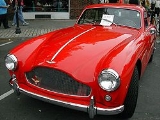
Aston Martin DB Mark III

Encyclopedia
- See also Aston Martin DB3Aston Martin DB3The Aston Martin DB3 and later DB3S were racing cars built in the 1950s. Although they used some DB2 parts, they were quite different, being designed especially for racing...
for the racing car often confused with the Mark III
The DB Mark III (normally simply called Mark III, even at the time of its introduction) is a sports car
Sports car
A sports car is a small, usually two seat, two door automobile designed for high speed driving and maneuverability....
sold by Aston Martin
Aston Martin
Aston Martin Lagonda Limited is a British manufacturer of luxury sports cars, based in Gaydon, Warwickshire. The company name is derived from the name of one of the company's founders, Lionel Martin, and from the Aston Hill speed hillclimb near Aston Clinton in Buckinghamshire...
from 1957 through 1959. It was an evolution of the DB2/4 Mark II
Aston Martin DB2/4
The DB2/4 is a grand tourer sold by Aston Martin from 1953 through 1957. It was based on the DB2 it replaced, available as a Drophead coupe and 2+2 hatchback well ahead of the times. Other changes included a wraparound windscreen, larger bumpers, and repositioned headlights...
model it replaced, using an evolution of that car's W.O. Bentley-designed Lagonda
Lagonda Straight-6 engine
The Lagonda Straight-6 is a famous automobile engine used by Aston Martin and Lagonda marques in the 1950s. Designed by Walter Owen Bentley of Bentley Motors Limited, it vaulted Aston Martin to fame as a maker of desirable sports and racing cars.-History:...
2.9 L (2922 cc/178 in³) straight-6
Straight-6
The straight-six engine or inline-six engine is a six-cylinder internal combustion engine with all six cylinders mounted in a straight line along the crankcase...
engine, redesigned by Tadek Marek
Tadek Marek
Tadeusz "Tadek" Marek was a Polish automobile engineer, known for his Aston Martin engines.Marek was from Krakow.He raced and won with a Chevrolet Master sedan in the XII Rally Poland before moving to Great Britain...
.
Overview
Changes included a grille like that on the DB3SAston Martin DB3S
The Aston Martin DB3S was a sports racing car built by Aston Martin as a replacement for the heavy and uncompetitive Aston Martin DB3. In total 31 cars were made, with 11 works cars and 20 cars being sold for customer use. The DB3S was introduced in 1953 and it proved somewhat more successful than...
, a new instrument panel, and available Girling disc brake
Disc brake
The disc brake or disk brake is a device for slowing or stopping the rotation of a wheel while it is in motion.A brake disc is usually made of cast iron, but may in some cases be made of composites such as reinforced carbon–carbon or ceramic matrix composites. This is connected to the wheel and/or...
s. The hydraulically operated clutch was new as well, and an optional Laycock-de Normanville overdrive
Overdrive (mechanics)
Overdrive is a term used to describe a mechanism that allows an automobile to cruise at sustained speed with reduced engine RPM, leading to better fuel economy, lower noise and lower wear...
that was attached to the STD 4 speed gearbox after the 1st 100 cars or even an automatic transmission
Automatic transmission
An automatic transmission is one type of motor vehicle transmission that can automatically change gear ratios as the vehicle moves, freeing the driver from having to shift gears manually...
were available. Worm-and-sector steering and a live axle
Live axle
A live axle, sometimes called a solid axle, is a type of beam axle suspension system that uses the driveshafts that transmit power to the wheels to connect the wheels laterally so that they move together as a unit....
rear end were carry overs. At the rear, the DB2/4 Mark II's tailfins (after the 1st few early cars) were altered to use the rear lights from the Humber
Humber (car)
Humber is a dormant British automobile marque which could date its beginnings to Thomas Humber's bicycle company founded in 1868. Following their involvement in Humber through Hillman in 1928 the Rootes brothers acquired a controlling interest and joined the Humber board in 1932 making Humber part...
Hawk.
The standard DBA engine model with twin SU carburettors produced 162 hp (121 kW), though an optional dual-exhaust system (a claimed 16 b.h.p. increase) raised this to a reputed 178 hp (133 kW). Thus equipped, the car could reach 60 mph (97 km/h) in 9.3 seconds and hit 120 mph (193 km/h). An optional high-output DBB engine with three twin-choke Weber 35 DCO 3 carburettors, special long duration camshaft
Camshaft
A camshaft is a shaft to which a cam is fastened or of which a cam forms an integral part.-History:An early cam was built into Hellenistic water-driven automata from the 3rd century BC. The camshaft was later described in Iraq by Al-Jazari in 1206. He employed it as part of his automata,...
s, high compression 8.6:1 pistons and the dual-exhaust system boasted 195 hp (145 kW), though this was rarer ( 10 cars thus equipped) than the mid-level DBD option with triple SU 1.75" carbs and 180 hp (134 kW) also with the dual exhaust system, fitted to 47 cars.
One car was fitted with the special DBC competition engine with a reputed 214 b.h.p., this was fitted with racing camshafts, special connecting rods, very high compression pistons (possibly 9.5:1) & three twin-choke Weber 45 DCO 3 carburettors.
 |
 |
Girling disc brakes were fitted as standard to the front wheels of all MkIII Astons after the first 100 had been made. Many cars were upgraded later.
Only five automatic cars were made from a total of 551.
A 1959 review by Road & Track
Road & Track
Road & Track is an American automotive enthusiast magazine. It is owned by Hearst Magazines, and is published monthly. The editorial offices are located in Newport Beach, California.-History:...
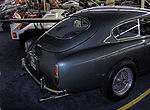
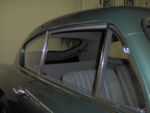
magazine praised the car for everything but its $7,450 price. "A car for connoisseurs," they called it. "The Aston has many virtues and few faults." Among the faults was too-heavy steering effort, high door sills, and a stiff ride. Interestingly, R&T failed to comment at all on the car's innovative hatchback
Hatchback
A Hatchback is a car body style incorporating a shared passenger and cargo volume, with rearmost accessibility via a rear third or fifth door, typically a top-hinged liftgate—and features such as fold-down rear seats to enable flexibility within the shared passenger/cargo volume. As a two-box...
body style, complete with fold-down rear seats, although this had been first introduced in the 2/4 MkI in 1953.
Coupés
Two Coupe variants of the Mark III were also produced. A Drophead Coupé convertibleConvertible
A convertible is a type of automobile in which the roof can retract and fold away having windows which wind-down inside the doors, converting it from an enclosed to an open-air vehicle...
, while not common, still outnumbered the Fixed Head Coupé – 84 of the former were produced, while just five of the latter were built. All five Fixed Head Coupés feature the mid-spec DBD engine, however. Both featured conventional hinged boot lids rather than the innovative hatch back.
James Bond
James BondJames Bond
James Bond, code name 007, is a fictional character created in 1953 by writer Ian Fleming, who featured him in twelve novels and two short story collections. There have been a six other authors who wrote authorised Bond novels or novelizations after Fleming's death in 1964: Kingsley Amis,...
drives an Aston Martin DB Mark III in the novel version of Goldfinger, though it is referred to as a "DB III" in the book – indeed, the chapter in which he drives to his famous golf-course encounter with the villain is entitled 'Thoughts in a DB III'. It is the only Bond car in the Ian Fleming
Ian Fleming
Ian Lancaster Fleming was a British author, journalist and Naval Intelligence Officer.Fleming is best known for creating the fictional British spy James Bond and for a series of twelve novels and nine short stories about the character, one of the biggest-selling series of fictional books of...
novels to have gadgets installed. For the film adaptation
Goldfinger (film)
Goldfinger is the third spy film in the James Bond series and the third to star Sean Connery as the fictional MI6 agent James Bond. Released in 1964, it is based on the novel of the same name by Ian Fleming. The film also stars Honor Blackman as Bond girl Pussy Galore and Gert Fröbe as the title...
five years later, the car was updated to the Aston Martin DB5
Aston Martin DB5
The Aston Martin DB5 is a luxury grand tourer that was made by Aston Martin. Released in 1963, it was an evolution of the final series of DB4. The DB series was named honouring David Brown ....
model and the array of gadgetry was much expanded. It was to become one of the most iconic of classic cars as a result.
Production
- DB Mark III: 551
- Hatchback: 462
- Drophead Coupé: 84
- DBA: 68
- DBB: 2
- DBD: 14
- Fixed Head Coupé: 5