

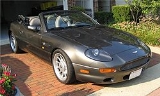
Aston Martin DB7

Encyclopedia
The Aston Martin DB7 is a grand tourer
which was produced by Aston Martin
from September 1994 to December 2004. The grand tourer
was available either as a coupé
or a convertible
. The prototype was complete by November 1992, and debuted at the Geneva Motor Show in March, 1993, the car was styled by Ian Callum
and Keith Helfet. The six-cylinder
DB7 was positioned as an "entry-level" model below the hand-built V8
Virage
introduced a few years earlier. This model was the highest production Aston Martin vehicle ever, with more than 7,000 built before it was replaced by the DB9
.
, owner of Aston Martin since 1988. The DB7's platform is an evolution of the Jaguar XJS
's, though with many changes. The styling started life as the still-born Jaguar F type (XJ41 – coupe / XJ42 – convertible) designed by Keith Helfet. Ford cancelled this car and the general design was grafted onto an XJS platform. The styling received modest changes by Ian Callum so that it looked like an Aston Martin. The first generation Jaguar XK-8 also uses an evolution of the XJ-S/DB7 platform and the cars share a family resemblance, though the Aston Martin was significantly more expensive and exclusive.
The DB7 was engineered in Kidlington, Oxfordshire, by Tom Walkinshaw Racing
on behalf of Aston Martin. The engines continued to be built in Kidlington
during the production run of the vehicle.
With production of the Virage (soon rechristened "V8" following Vantage styling revisions) continuing at Newport Pagnell
, a new factory was acquired at Bloxham, Oxfordshire
that had previously been used to produce the Jaguar XJ220
, where every DB7 would be built throughout its production run. The DB7 and its relatives were the only Aston Martins produced in Bloxham and the only ones with a steel unit construction inherited from Jaguar (Aston Martin had traditionally used aluminium for the bodies of their cars, and models introduced after the DB7 use aluminium for the chassis as well as for many major body parts).
The convertible Volante version was unveiled at the North American International Auto Show
in Detroit in 1996. Both versions have a supercharged
straight-6
engine
that produced 335 bhp and 361 lbft of torque. In the United States, the Coupé sold for $140,000, and the Volante for $150,000. Works Service provided a special Driving Dynamics package, which greatly enhanced performance and handling for drivers who wanted more than the standard configuration.
engine produced 420 bhp and 400 ft.lbf of torque
. It has a compression ratio
of 10.3:1. It was available with either a TREMEC T-56 six speed manual or a ZF 5HP30
five speed automatic gearbox. Aston Martin claimed it had a top speed of either 186 mi/h with the manual gearbox or 165 mi/h with the automatic gearbox, and would accelerate from 0–60 mph (97 km/h) in 4.9 seconds. It is 4,692 mm long, 1830 mm (72 in) wide, 1243 mm (48.9 in) high, with a weight of 1800 kg (3,968.3 lb).
After the launch of the Vantage, sales of the supercharged straight-6 engine DB7 had reduced considerably and so production was ended by mid-1999.
s made by Brembo
. When being tested by Jeremy Clarkson
on Top Gear in 2003, he demonstrated the car's ability to pull away in fourth gear and continue until it hit the rev limiter at a speedometer indicated 135 mi/h.
Grand tourer
A grand tourer is a high-performance luxury automobile designed for long-distance driving. The most common format is a two-door coupé with either a two-seat or a 2+2 arrangement....
which was produced by Aston Martin
Aston Martin
Aston Martin Lagonda Limited is a British manufacturer of luxury sports cars, based in Gaydon, Warwickshire. The company name is derived from the name of one of the company's founders, Lionel Martin, and from the Aston Hill speed hillclimb near Aston Clinton in Buckinghamshire...
from September 1994 to December 2004. The grand tourer
Grand tourer
A grand tourer is a high-performance luxury automobile designed for long-distance driving. The most common format is a two-door coupé with either a two-seat or a 2+2 arrangement....
was available either as a coupé
Coupé
A coupé or coupe is a closed car body style , the precise definition of which varies from manufacturer to manufacturer, and over time...
or a convertible
Convertible
A convertible is a type of automobile in which the roof can retract and fold away having windows which wind-down inside the doors, converting it from an enclosed to an open-air vehicle...
. The prototype was complete by November 1992, and debuted at the Geneva Motor Show in March, 1993, the car was styled by Ian Callum
Ian Callum
Ian Callum is a British car designer who currently serves as Design Director for Jaguar and is older brother to fellow car designer Moray Callum. He is married, has two sons and currently resides in Oxfordshire, England.-Early years:...
and Keith Helfet. The six-cylinder
Straight-6
The straight-six engine or inline-six engine is a six-cylinder internal combustion engine with all six cylinders mounted in a straight line along the crankcase...
DB7 was positioned as an "entry-level" model below the hand-built V8
V8 engine
A V8 engine is a V engine with eight cylinders mounted on the crankcase in two banks of four cylinders, in most cases set at a right angle to each other but sometimes at a narrower angle, with all eight pistons driving a common crankshaft....
Virage
Aston Martin Virage
The Virage was Aston Martin's replacement for the decades-old V8 models. Introduced at the Birmingham Motor Show in 1988, it was joined by the high-performance Vantage in 1993, and the name of the standard car was changed to V8 in 1996....
introduced a few years earlier. This model was the highest production Aston Martin vehicle ever, with more than 7,000 built before it was replaced by the DB9
Aston Martin DB9
-DB9 Volante:The Aston Martin DB9 Volante is the convertible version of the DB9 coupe. It is built by hand in limited numbers and has enhanced styling. It is powered by the same 6.0 litre, DOHC 48 valve V12 as the DB9 and is completed with 470 bhp and a top speed of 186 mph...
.
Overview
The DB7, known internally as the NPX project, was made mostly with resources from Jaguar and had the financial backing of the Ford Motor CompanyFord Motor Company
Ford Motor Company is an American multinational automaker based in Dearborn, Michigan, a suburb of Detroit. The automaker was founded by Henry Ford and incorporated on June 16, 1903. In addition to the Ford and Lincoln brands, Ford also owns a small stake in Mazda in Japan and Aston Martin in the UK...
, owner of Aston Martin since 1988. The DB7's platform is an evolution of the Jaguar XJS
Jaguar XJS
The Jaguar XJ-S is a luxury grand tourer produced by the British manufacturer Jaguar from 1975 to 1996. The XJ-S replaced the E-Type in September 1975, and was based on the XJ saloon. It had been developed as the XK-F, though it was very different in character from its predecessor...
's, though with many changes. The styling started life as the still-born Jaguar F type (XJ41 – coupe / XJ42 – convertible) designed by Keith Helfet. Ford cancelled this car and the general design was grafted onto an XJS platform. The styling received modest changes by Ian Callum so that it looked like an Aston Martin. The first generation Jaguar XK-8 also uses an evolution of the XJ-S/DB7 platform and the cars share a family resemblance, though the Aston Martin was significantly more expensive and exclusive.
The DB7 was engineered in Kidlington, Oxfordshire, by Tom Walkinshaw Racing
Tom Walkinshaw Racing
Tom Walkinshaw Racing , was an auto racing team and engineering firm founded in 1976 by touring car racer Tom Walkinshaw.-History:TWR started by modifying BMW 3.0 CSLs, but soon was contracted to head Mazda's works program in the British Touring Car Championship. The TWR developed RX-7, with Win...
on behalf of Aston Martin. The engines continued to be built in Kidlington
Kidlington
Kidlington is a large village and civil parish between the River Cherwell and the Oxford Canal, north of Oxford and southwest of Bicester.-History:...
during the production run of the vehicle.
With production of the Virage (soon rechristened "V8" following Vantage styling revisions) continuing at Newport Pagnell
Newport Pagnell
Newport Pagnell is a town in the Borough of Milton Keynes , England. It is separated by the M1 motorway from Milton Keynes itself, though part of the same urban area...
, a new factory was acquired at Bloxham, Oxfordshire
Bloxham
Bloxham is a village and civil parish in northern Oxfordshire on the edge of the Cotswolds, southwest of Banbury.-Early settlement:Under Roman rule between the 1st and 5th centuries there were several farms and a burial site in the Bloxham area....
that had previously been used to produce the Jaguar XJ220
Jaguar XJ220
The Jaguar XJ220 is a mid-engined supercar produced by Jaguar in collaboration with Tom Walkinshaw Racing as Jaguar Sport between 1992 and 1994. It held the record for the highest top speed of a production car , until the arrival of the McLaren F1 in 1994...
, where every DB7 would be built throughout its production run. The DB7 and its relatives were the only Aston Martins produced in Bloxham and the only ones with a steel unit construction inherited from Jaguar (Aston Martin had traditionally used aluminium for the bodies of their cars, and models introduced after the DB7 use aluminium for the chassis as well as for many major body parts).
The convertible Volante version was unveiled at the North American International Auto Show
North American International Auto Show
The North American International Auto Show is an annual auto show held in Detroit, Michigan at Cobo Center, usually in January. It is among the largest auto shows in North America.-History:...
in Detroit in 1996. Both versions have a supercharged
Supercharger
A supercharger is an air compressor used for forced induction of an internal combustion engine.The greater mass flow-rate provides more oxygen to support combustion than would be available in a naturally aspirated engine, which allows more fuel to be burned and more work to be done per cycle,...
straight-6
Straight-6
The straight-six engine or inline-six engine is a six-cylinder internal combustion engine with all six cylinders mounted in a straight line along the crankcase...
engine
Internal combustion engine
The internal combustion engine is an engine in which the combustion of a fuel occurs with an oxidizer in a combustion chamber. In an internal combustion engine, the expansion of the high-temperature and high -pressure gases produced by combustion apply direct force to some component of the engine...
that produced 335 bhp and 361 lbft of torque. In the United States, the Coupé sold for $140,000, and the Volante for $150,000. Works Service provided a special Driving Dynamics package, which greatly enhanced performance and handling for drivers who wanted more than the standard configuration.
V12 Vantage
In 1999, the more powerful DB7 V12 Vantage was introduced at the Geneva Motor Show. Its 6.0 litre, 48-valve, V12V12 engine
A V12 engine is a V engine with 12 cylinders mounted on the crankcase in two banks of six cylinders, usually but not always at a 60° angle to each other, with all 12 pistons driving a common crankshaft....
engine produced 420 bhp and 400 ft.lbf of torque
Torque
Torque, moment or moment of force , is the tendency of a force to rotate an object about an axis, fulcrum, or pivot. Just as a force is a push or a pull, a torque can be thought of as a twist....
. It has a compression ratio
Compression ratio
The 'compression ratio' of an internal-combustion engine or external combustion engine is a value that represents the ratio of the volume of its combustion chamber from its largest capacity to its smallest capacity...
of 10.3:1. It was available with either a TREMEC T-56 six speed manual or a ZF 5HP30
ZF 5HP30 transmission
The ZF 5HP30 is a five-speed automatic transmission for passenger cars from ZF Friedrichshafen AG. Introduced in 1992, it was produced through 2003, and has been used in a variety of cars from Aston Martin, Bentley, BMW, and Rolls Royce.-Applications:...
five speed automatic gearbox. Aston Martin claimed it had a top speed of either 186 mi/h with the manual gearbox or 165 mi/h with the automatic gearbox, and would accelerate from 0–60 mph (97 km/h) in 4.9 seconds. It is 4,692 mm long, 1830 mm (72 in) wide, 1243 mm (48.9 in) high, with a weight of 1800 kg (3,968.3 lb).
After the launch of the Vantage, sales of the supercharged straight-6 engine DB7 had reduced considerably and so production was ended by mid-1999.
V12 GT and GTA
In 2002, a new variant was launched, named V12 GT or V12 GTA when equipped with an automatic transmission. It was essentially an improved version of the Vantage, its V12 engine producing 435 bhp and 410 ft.lbf of torque. Aesthetically, compared to the Vantage it has a mesh front grille, vents in the bonnet (hood), a boot (trunk) spoiler, an aluminium gear lever, optional carbon fibre trim and new wheels. It also has 355 mm (14 in) front and 330 mm (13 in) rear vented disc brakeDisc brake
The disc brake or disk brake is a device for slowing or stopping the rotation of a wheel while it is in motion.A brake disc is usually made of cast iron, but may in some cases be made of composites such as reinforced carbon–carbon or ceramic matrix composites. This is connected to the wheel and/or...
s made by Brembo
Brembo
Brembo S.p.A. is a manufacturer of automotive brake systems, especially for high-performance cars and motorcycles. It was established in Bergamo, Italy in 1961. Soon after the company was formed, it specialised in disc brakes, which were exclusively imported from the United Kingdom at the time...
. When being tested by Jeremy Clarkson
Jeremy Clarkson
Jeremy Charles Robert Clarkson is an English broadcaster, journalist and writer who specialises in motoring. He is best known for his role on the BBC TV show Top Gear along with co-presenters Richard Hammond and James May...
on Top Gear in 2003, he demonstrated the car's ability to pull away in fourth gear and continue until it hit the rev limiter at a speedometer indicated 135 mi/h.
Special editions
A number of special-edition DB7 cars were built:- DB7 I6
- 1998 Alfred Dunhill Edition – 150 "platinum metallic" cars with a built-in humidorHumidorA humidor is any kind of box or room with constant humidity, and ideal temperature, used to store cigars, cigarettes, or pipe tobacco. For private use, small wooden or acrylic glass humidor boxes for a few dozen cigars are used, while cigar shops may have walk-in humidors, sometimes consisting of a...
- 1998 Neiman-Marcus Edition – 10 special black cars for the 1998 Neiman MarcusNeiman MarcusNeiman Marcus, formerly Neiman-Marcus, is a luxury specialty retail department store operated by the Neiman Marcus Group in the United States. The company is headquartered in the One Marcus Square building in Downtown Dallas, Texas, and competes with other department stores such as Saks Fifth...
Christmas catalogue - 1999 Stratstone Edition – 19 special black cars, 9 coupes and 10 Volantes
- 1998 Beverly Hills Edition – 6 "Midnight Blue", 2 coupes and 4 Volantes
- 1998 Alfred Dunhill Edition – 150 "platinum metallic" cars with a built-in humidor
- DB7 V12 Vantage
- 2003 Jubilee Limited Edition – 24 "jubilee blue" cars were made for Europe and 26 were made for North America to celebrate the Golden JubileeGolden JubileeA Golden Jubilee is a celebration held to mark a 50th anniversary.- In Thailand :King Bhumibol Adulyadej, the world's longest-reigning monarch, celebrated his Golden Jubilee on 9 June 1996.- In the Commonwealth Realms :...
of Queen Elizabeth IIElizabeth II of the United KingdomElizabeth II is the constitutional monarch of 16 sovereign states known as the Commonwealth realms: the United Kingdom, Canada, Australia, New Zealand, Jamaica, Barbados, the Bahamas, Grenada, Papua New Guinea, the Solomon Islands, Tuvalu, Saint Lucia, Saint Vincent and the Grenadines, Belize,... - 2002 Keswick Limited Edition – A small number of "nero daytona black" models
- 2003 Anniversary Edition – 33 (of an announced 100) "slate blue" cars to celebrate the end of DB7 Vantage production
- 2003 Jubilee Limited Edition – 24 "jubilee blue" cars were made for Europe and 26 were made for North America to celebrate the Golden Jubilee
Special models
Two special edition variants were made late in the DB7's production run:- DB7 Vantage ZagatoAston Martin DB7 ZagatoThe Aston Martin DB7 Vantage Zagato is a limited-edition grand tourer made by Aston Martin/Zagato. Introduced at the Paris Motor Show in October, 2002, the Zagato was immediately sold out...
- DB AR1Aston Martin DB AR1The Aston Martin DB AR1 is a limited-edition grand tourer that was made by Aston Martin and Zagato for the United States market in 2003. The AR1 name stands for American Roadster 1...
External links
- Aston Martin DB7 i6 and V12 AstonMartins.com
- Original DB7 Vantage Sales Brochure Aston.co.uk